If I’ve said it once, I’ve said it 100 times: truth without charity is not truth.

Those who follow me on Twitter know that I get my fair share of inappropriate comments and “hate mail.” On a regular basis, I am called names, sent graphic messages, have my priesthood questioned, and witness my family, friends, or brothers attacked. It is discouraging to say the least.

Especially when you consider that 99% of it comes from fellow Christians, the majority from fellow Catholics.

To be honest, these sorts of comments rarely have a personal effect on me. I understand what I’m dealing with online, that there is plenty of anger and mental illness in our world, and so I can usually ignore it fairly easily. I have learned to utilize the “block” and “mute” features of social media quiet liberally…

But that doesn’t mean that I remain entirely unaffected by the constant stream of hatred. While not hurtful personally, I am often distraught by the effect that people’s words can have on others; I look at the comments towards me, said by Christians, as undermining the wonderful work of evangelization happening in our Church. Why would anyone join a Church where its people talk to each other in this way? It saddens me to see that Christians on the internet act no differently from the rest of the world, that they may, in fact, act worse because of their supposed righteous anger.

This is not good. And it needs to stop.

What I have presented here is an open letter to all Christians. I hope that you may share it with anyone you know who acts rudely or violently online, that it may be a wake-up call to all of us: the world is watching. What do they see when Christians speak to one another? What do they think of Christianity?

I tell you, people will rarely remember what you say to them, but they will never forget how you made them feel. If we are to be evangelizers of Jesus Christ, it doesn’t just matter what we say. How we say it is equally important.

Peace and good to you all.

Click here to listen

Click to listen

Have you ever had a friend that you were so close with that you could just say one word and they would laugh? With a common experience, you two could understand each other and find something funny that no one else understood.

Entertainment can be the same way. While some entertainment makes reference to other works of art to speak to its viewer, sometimes, if a work is large enough, it may make reference to itself. Only those who have seen the other episodes, read the other books, or seen the other movies will get what’s going on, making the work a bit of an inside joke between the writers and the consumer.

That’s what Br. Tito and I set out to discuss this week on Everyday Liminality. Looking at three popular works (30 Rock, the Marvel universe, and Arrested Development) we investigated how this is done, what benefits/drawbacks it offers, and how it speaks to our lives.

For previous episodes, click here, and check us out every Tuesday this fall!


The following is my homily for the 23rd Sunday in Ordinary Time, Year C. The readings can be found here.

They say that you should always read the fine print before you sign anything. I… have not always been the best at doing this. Throughout my life, I have often acted impulsively and signed up for something without knowing what I was getting myself involved with.

When I was in second grade, I saw the boy scouts in their uniforms and thought it was so cool. The idea of hiking and camping seemed awesome, and so I signed up, made my parents buy the uniform and everything I needed… until I realized that we wouldn’t be going on an adventure in the rocky mountains every week and that there were many things about being a boy scout I found boring. I quit after three weeks.

When I was a freshman in college I signed up for this sort of “outside the box” series of classes that sounded incredible. It was team taught by the best faculty in the school, used interdisciplinary methods, and was supposed to be this amazing learning experience. Turns out, they were also known as the hardest courses at the school… and you had to take all three to get credit for any of them, so there was no quitting without losing everything. Should have read that pamphlet all the way through…

And then there was that time that I met the Franciscans and was so moved by their lives that I signed up to be a priest only to find out after the fact that they take a vow of chastity and can’t get married. You should have seen my face when I realized that one!  Okay, the last one is a joke, but you get my point. So many times in my life I got involved with things before I knew what I was getting myself into, and as a result, never really committed to what I was doing. Easy in, easy out.

For many people in the world, the Church is the same way. 

I look at all of the kids that have gone through religious education over the years. Their parents signed them up for the classes, they coasted through for a couple of years, and then got a nice party at the end with a pretty communion dress. Without much knowledge of what they were doing, without a strong commitment to what they were signing up for, they became Catholic Christians, they began receiving the sacraments, without knowing much of Christ or his mission.

This was certainly the case for me. I went to class, knew I was a Catholic, but come confirmation, it was basically my graduation. I went to Mass because it was a “good thing to do,” I guess, but I didn’t want to get involved, didn’t want to go to any more classes, didn’t really want to do anything. I considered myself a Christian, but my life wasn’t really any different from any of my other friends. I acted just like others, wanted the same things as them. I was very much a Christian in name, but not in commitment.

Unfortunately, this is the case for many people. I think of friends and family who say that they’re Catholic, consider themselves Christians… but never actually pray, never actually go to Church, change nothing about their lives. They’ve gone through the motions and received the sacraments, they bear the indelible mark of Christ on their souls that they received in baptism, they might even receive Christ in the Eucharist from time to time, but they’re not actually disciples of Christ. They are Christians in name, but not in commitment.

Maybe, to some extent, you’re the same way. You’re here, and that’s awesome. There is obviously something inside you that got you here, you want to be here for this hour, and I applaud you for that.  But what about the other 167 hours of the week? Do you have a relationship with Christ that shapes and defines all that you do?
If you do, awesome! Let it grow. If not… and I know this sounds harsh… but are you really a Christian?

The reason I ask is not because I’m here to judge you, not because I’m here to separate the real Christians from the fake ones. No, I ask simply because I know that Jesus doesn’t want lackluster commitments. He doesn’t want easy signups, partial followers, people who accidentally find themselves involved with something because they forgot to read the fine print. Through a number of parables and sayings in our Gospel today, Jesus reminds his followers that being a Christian is not a part time job. Being a disciple means giving everything to God, making Jesus the most important person in our lives, for whom we’d be willing to do anything. Life for a disciple is not easy… and he wants to make sure that anyone who follows him, everyone who signs up knows ahead of time. Like the king calculating his troops, the builder planning the house, Jesus wants his disciples to take this commitment seriously. Are you sure you know what you’re signing up for? If you follow me, read the fine print: You better be ready to bear your own cross.

This does not simply mean that things will be difficult for us. We use the phrase so much that I think it’s lost its meaning—bearing our cross is nothing more than an inconvenient situation. We get sick? Cross to bear. Have to deal with difficult people? Cross to bear. Have to share Netflix account with my sister and she’s always using it? The worst cross to bear!

No… Following Jesus, bearing our cross, means radically changing our lives. It means aligning our values, our thoughts, our actions, our politics, what we do with our free time, how we spend out money—everything about us—with Jesus Christ. It means, in a world where slavery is the norm, being like Paul writing to Philemon, challenging his friend to act more justly: now that you are a Christian, he says, you cannot treat men as slaves, receive this man as your own brother. It means realizing that the world will not accept us when we side with Jesus, that we will face persecution and hatred because of his name. Like Paul, we may even find ourselves in prison.

No, following Jesus is not an easy task. It is not for the faint of heart. And so Jesus wants to let people know: this is what you’re signing up for, this is what you’re getting yourself involved with. Are you really sure you want to follow?

Here at mass we are given Christ’s very self, the Way, the Truth, and the Life in physical form. We are given all that we could ever want, and MORE. What Jesus is offering us today is something that no one else in the world can offer. But in receiving it, in coming to this table, we do not simply receive something, we make a covenant with the Lord, we sign our names in his blood, accepting all that comes along with it.

You’ve read the fine print, you know what that entails. And so I leave you with this question: Do you just want to be called a Christian, or do you actually want to be one?

Throughout history, there have been moments that radically changed the way the world operated. The fall of Rome. Columbus landing in the “new world.” The French Revolution. How could the world be the same ever again?

I believe that we are living in such a moment in our Church: looking back 2000 years from now, historians will see the Second Vatican Council as one of the two or three most significant events in Church history, radically redefining life in the Church.

Why, do you ask? Because it was at that moment that the Church truly adopted a global mindset.

But the Church has always been global, you say. We’ve always been the “universal” Church, present around the world in many cultures in just the first few centuries. I think it’s hard for people to understand what I’m getting at here. I think this because I have had ten hours to read comments since this video was released, and I can see it clearly. Many people argue that there is no need for change, that the Church has always been global, that the Church does not need other cultures because it is above culture.

These opinions are very naive, if not borderline racist. The idea that the Church does not have a culture is just absurd.

It is true that the Church existed in many countries, but it is incorrect to assume that this made us a global Church. More accurately, we were a Roman Church inserted into other countries. The culture, worldview, theology, and of course, language, were all of a particular people. To be a Catholic in Asia, Africa, or Latin America prior to 1965 meant not only accepting Jesus Christ as your savior and the pope as the leader of the Church, but also accepting Latin as your language and Europeans as your law givers. Like so many things, the dominant culture was blind to the fact that it was even a culture because it failed to acknowledge that any others even existed or had anything worthy to offer. Everyone just assumed that the way Rome did things was normal.

As more and more bishops and cardinals from non-European countries have taken up leadership and raised their voices, the more we’ve seen how particular our Church existed for many years, and how important it is to have better global representation.

I truly believe that we are in one of the most prosperous times in the history of our Church. It is an exciting time to live. And that might sound strange to you given the issues we face. But that’s precisely my point: which issues? Closing churches, lack of faith, problems with secularism, scandals, low vocations? These are issues that Europe and North America are facing, not Asia, Africa, and South America. Too often our worldview gets too small and we think that we we experience is what everyone experiences. It is only with added voices and better representation that we get the whole picture.

If you find the Church’s outlook to be bleak, it might be time to broaden your view. The Church is changing, and I can’t wait to see how it grows.

The following is my homily for the 22nd Sunday in Ordinary Time, Year C. The readings can be found here.

A number of years ago there was a cop drama on TV that my mom and I used to watch. Unlike Law and Order or CSI, this show didn’t focus on police officers and prosecutors using the law to catch “bad guys,” but rather on a mysterious vigilante that helped people with impossible situations. When the law had failed them, he would fix their problem by “creative” means. Unfortunately, there was a catch. In order to accept his services, people either had to pay him a million dollars or owe him an undetermined favor in the future. Talk about a quid pro quo! People were happy to have their problems disappear, but invariably lived in fear of what they might owe the vigilante.

While this is a fairly extreme case (and hardly the type of show designed for a 3rd grader!), I think we can probably relate to the concept of such exchanges fairly easily. We live in a fairly transactional society. A few years ago, a friend of mine wanted a small wedding with just some close friends and family. This was not possible. Her mother stepped in and said, “Oh no, you have to invite your cousin Johnny, he invited you to his wedding” and “We need another invite for my friend Paula. She used to babysit you and she’s been so good to the family.” Her “small” wedding had over 200 guests.

Maybe you’ve been on the other side of this. You really put yourself out there, help someone move or wake up at 2 in the morning to bail someone out of jail. You know… And so the next time you’re moving, the next time you’re in jail at 2 in the morning… you expect them to help you. I was there when you needed me, now you owe me!

Even at Christmas, what do we do? We ask our friends and family members if they want to “exchange gifts.” I’ll give you something if you give me something. 

My suspicion is that most of our interactions work this way. It doesn’t mean that we’re not generous, but it does mean we live largely with a transactional mentality. We like fairness, and so we feel guilty when someone gives us something and feel cheated when someone doesn’t give us something back.

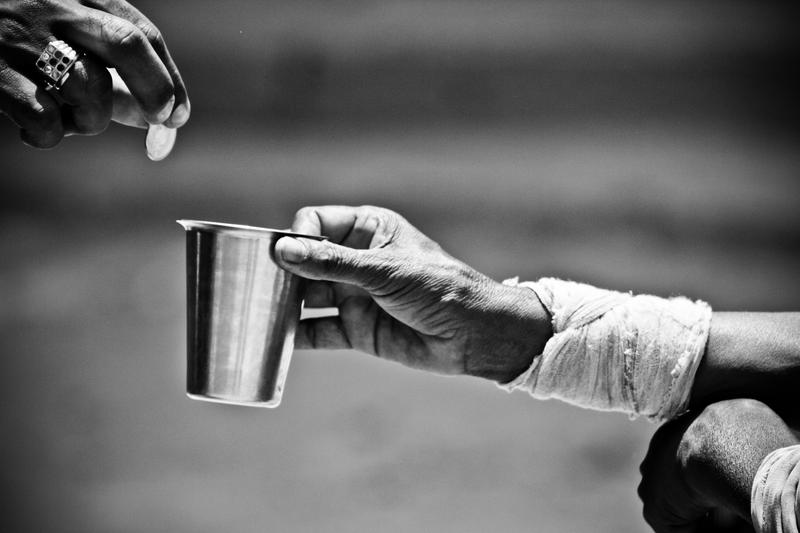
This is quite different from what Jesus tells us today. What does he say in our Gospel? “When you hold a banquet, do not invite your friends, brothers, wealthy neighbors.” Why? Because they may be able to invite you back. They may be able to repay you. And if they can repay you, you might be tempted to do it simply to get repaid. “Instead, invite the poor, crippled, lame, and the blind”—invite those who have absolutely nothing, who never get invited to parties, who are ridiculed by others—because they will never be able to repay you, because your act of hosting people in this situation will truly be a gift.

What Jesus is getting at here is the selflessness of love. A true gift is something that is freely given, without any promptings or reservations, no strings attached, completely for the sake of showing love. As an act of love, it is an end in itself. It doesn’t need anything in return. How can it? Gifts are given simply because we have something we want to share. I imagine the idea of exchanging gifts at Christmas would seem like an oxymoron to Jesus! How do you exchange something that is freely given out of one’s generosity? No, a true gift does not need anything in return.

The reason that I believe Jesus tells us this parable is to show how God loves us. God created us, gave up his life, animates us with the Spirit. He gives us the sacraments, chiefly the Eucharist. He does this, not as an exchange, not a transaction, but as a free gift. We have done nothing to earn any of this, we can do nothing to pay God back. In God’s court, we are the poor, crippled, lame, blind. We’re useless—we sin, we have no idea what we’re doing in life, have nothing to offer in return, and certainly don’t belong.

But he invites us anyway. He invites us, not because of who we are, but because of who God is. It is an act of love because it is something that we cannot earn.

The opposite is true as well. As an act of love, a true gift, is something that we cannot lose. No sin, no disobedience, no wrong decision could ever force God to stop loving us, could make God take back what he offers, because his gift is not dependent on who we are or what we do. Sure, we may turn away ourselves, we may refuse to accept it, ut God gives us these gifts to us not because of who we are, but because of who God is. Even if we turn away, even if we remove ourselves from God’s grace, God will continue to follow us, continue to invite us, continue to prepare a place in his home.

How amazing is this? Take a moment, and just let that sink in. In a world so dependent on performance… in a world where everything is an exchange—you do this for me, I’ll do that for you—our God loves us… no matter what. Maybe that makes you feel uncomfortable. Maybe you don’t know how to respond. Nothing is free in life, right? There must be a catch! How can I get such an amazing gift and not do something in return? Surely… there have to be strings attached!

Truly, there is only one thing we can do: Be thankful. Accept the gifts that he has offered us with a thankful heart. Enter completely into this liturgy, singing with full voice, listening attentively to the prayers, praying like your life depends on it. We gather together at this table, not just to receive, but to give thanks. That is what eucharist means—thanksgiving. Be thankful for what God does in your life, be thankful for the person sitting to your right and to your left, be thankful that you live in a country with freedom of religion and press and protest. Be thankful, recognizing that it need not be this way. We do not deserve any of this, but receive it as gift.

And then, with a heart overflowing with grace and thanksgiving, pass it on: Do the same for others.

Give gifts that cannot be repaid. Love those who cannot return the favor. Act selflessly, giving to others not because of who they are, not because of who you are, but because of how God has already loved you. Invite the poor, crippled, lame, and the blind to your house, to this house; eat a meal with those who are outcasts of society, those who cannot repay you because they can’t even take care of themselves.

When we look at this from the perspective of the world, it seems crazy. My guess is there are more people who would be willing to owe an enormous favor to a mysterious vigilante after he fixes our problem than there are who think that inviting the poor into their homes is a good idea. As ridiculous as that crime show was, it at least made sense to the world: you give me something, so I give you something.

But that’s not the way God works. It’s not the way of our faith. God gives without counting the cost. We are filled with abundance for doing absolutely nothing.

What can we do but do the same for others?