Through stories, letters, historical accounts, laws, proverbs, and liturgical texts, the Bible contains truths about God, our humanity, the world, and how we are to be in relationship with each. It is a wealth of wisdom and knowledge, capturing what God’s people have said about God for thousands of years, and so naturally is something that we as Christians should study seriously.

But the Bible is not simply a source of truth and knowledge, a book of facts for one to amass and master. Sacred Scripture is a living document, a mystery, a source of spiritual nourishment that can only be entered into, never fully grasped. As much as it is useful to study the Bible in an academic way so as to understand the context and the meaning that the human writer intended, one’s knowledge of the Bible is only truly useful to a Christian to the extent that it helps one enter more deeply into what the divine writer, God, had in mind. Scripture is something to be studied, yes, but it is more fundamentally something that should be prayed.

By no means an exhaustive list, I want to share two ways that I have found to do just that.

Ignatian Reading One of the most common ways to pray with Scripture, credited to St. Ignatius of Loyola and the Jesuits, is to use one’s imagination to enter into the text. After reading a passage two or three times, the reader is encouraged to close one’s eyes and to reconstruct the whole scene as if s/he was there as a witness. What did the scene look like? Was it bright or dark? Who was there? Were there any distinct smells or sounds? What did the situation physically feel like? By using one’s imagination, the scene becomes more than words on a page but a real life situation. Often the reader is encouraged then to take on the role of one of the characters in the story, maybe a minor role, to see the text from a new and focused perspective. What did the character feel when this happened? 

In using one’s imagination in this way, the reader is focused less on coming up with an intellectual summation of the text (the passage means ____) and more on experiencing the passage as it was actually experienced. The brilliance of this method is that one does not simply walk away with a concrete directive or definitive interpretation, but with a first-hand emotional and sensory encounter. Unlike interpretations, encounters are personal, intimate, and new every time. And so is Scripture.

Incarnational Reading The second method is a bit less popular, and as such, I’m not sure if it even has a name. After reading the passage two or three times, the reader is encouraged to draw on the lived experience of the reading in today’s world. How have I experienced this passage in my own life? Where have I seen this character before? When has this situation happened to me? Unlike the Ignatian method that helps the reader go back to the world of the text, this method of reading Scripture brings Scripture forward to the life of the reader. It is not a means of entering into the Word, per se, but a means of noticing the Word alive and true all around.

A comparison might be the best way of explaining the difference. If we were to read the passage, say, of the Rich Man and Lazarus (Lk 16:19-31), the Ignatian method would provide a powerful sensory experience: the sight of the poor man lying on the road, the smell of the dogs all around him, the feeling of hunger, the texture of his sores, and so on, would allow the reader to feel as if s/he were in 1st century Palestine with Lazarus himself. Reading the same story with the Incarnational method, however, might provide the reader with a new sense of clarity and divine vision: thinking about the poverty of Lazarus might remind the reader of a homeless person s/he passed earlier that day or a time when s/he acted like the Rich man in his indignation towards the poor. In doing so, the text comes alive just as in the Ignatian method, but alive in the sense that the Word is realized to be a lived experience in today’s world, not just 2000 years ago. Oh… Jesus loves that poor homeless man on the street and it is a grave sin for me to walk past him with no concern. The story is about me

The brilliance of this method is that it moves the experience of Scripture and God’s Word (Jesus) away from “something that happened” toward “something that is happening.” God’s word is alive. The events recounted in Scripture are not meant to be read as a history book, finished and complete, never to be repeated again; they are snapshots in time of who and what God is in eternity. Reading in this way moves God–and religion in general–away from rules, facts, rituals, and morals to be remembered and towards a personalintimate experience of God today, right now.

***

Naturally, both methods offer incredibly valuable insights and promote a prayerful reading of Scripture. They encourage active participation, and transform the text into a personal encounter with our God. Personally, as a Franciscan, I am much more inclined to favor the latter example as it is straight out of our spirituality, but I recognize the benefit of the Ignatian method and think that they can work in tandem for a deeper experience of prayer. Of course, these are just two ways of prayerfully studying Scripture, and if neither of them work for you, maybe there is another method that would work better! The important this is not the specific method we use, but that we engage the Word of God in our lives in a way that it guides and transforms us into disciples of Christ.

On December 8 of last year, Pope Francis officially opened the doors to the “Year of Mercy,” a focused effort to remind us of the mercy God shows us each and every day, and a call to show that mercy to others in our world. His document announcing the year and it’s purpose (found here) is a wonderful source of inspiration and something that could easily serve as a guide to our year’s prayer life.

And how could it not? Mercy is an essential aspect of our life as Christians, right up there with love, justice, sacrifice, and faith in terms of our most used words. Christianity, by its very nature, is a religion of mercy. The good news of Jesus Christ is that God has come to be like us, has shown us love, and offers us a new path despite our sins and failings. Rather than give us what we deserve, God gives us what we do not deserve: forgiveness and eternal salvation to those who follow.

For this reason, I recently sat down with Fr. Patrick Tuttle, OFM, Franciscan Friar and pastor of St. Anthony’s Catholic Church in Greenville, SC. Not only has Fr. Patrick personally shown me great mercy over the years, he was the first friar that I met when I was in college and has been a tremendous influence in my life, inspiring me to be a better Christian, to take leadership in the Church, and to eventually join the Franciscans. As a spiritual mentor, fellow Franciscan brother, and close friend, I wanted to get his take on what this year could mean for me training for the priesthood and for all of us Christians. We came up with three things worth sharing: Forgiveness, Joy, and Confession.

For those on email, click here for the video.


There are few speeches more memorable than Martin Luther King’s “I Have a Dream” speech. There are few moments more memorable the 1963 March on Washington in which more than 200,000 people gathered in support of civil rights for all people. Today, on Martin Luther King, Jr. Day, we remember and celebrate a pioneer, an American hero, and a prophet to our world.

I do not use this final characterization lightly. While the word “prophet” and “being prophetic” get thrown around today to designate anyone who is counter-cultural or revolutionary, I mean to call Dr. King a prophet with all of the weight it used to bear, a prophet in the Old Testament sense of the word.

Dr. King saw the world with God’s eyes Being “prophetic,” in the Old Testament sense, is not a matter of predicting the future as much as it is seeing the present with the clarity of God’s vision. Prophets see the world not as human beings do, blinded by sinfulness and focused only on the “what is,” they see the world as God does, taking in the whole picture to know “what should be.” The prophet’s eyes are sensitive to injustice, maltreatment, division because s/he knows that these are not of the Kingdom.

Dr. King did not just see a world that was, he saw a world that could and should be. Like a prophet of God, there was a severe disconnect from what he saw—institutional racism—and the world that God had created. While his contemporaries in the clergy were blind to issues of the day, some even calling his words and actions, “unwise and untimely,” Dr. King saw that God desired something more. God desired justice.

Courage to speak truth to power But prophets are not just those who know that the world is far the Kingdom of God, they are the ones who have the courage to proclaim God’s Kingdom to those causing division and those who do not want to hear. Think of what it must have been like to be Isaiah, Jeremiah, or Amos. They lived in a world ruled by the sword without any rights of free speech. They did not speak with the backing of a political party or non-profit… they spoke with only the support of God’s Word.

Dr. King certainly did not speak alone, but given the climate of race relations in the country in his life, and given the places where he spoke, his situation was not all that different. Birmingham was not exactly a place where African-Americans were treated fairly under the law; Montgomery was not exactly a place where African-Americans possessed political control; Memphis (the place where he was eventually assassinated), was not exactly a place where African-Americans were respected for their opinions. Dr. King did not hide from the issues, speaking about them from afar only to those for whom he would receive support. He went to the frontline of the issue and spoke truth to power as someone without power at all.

His medium was the message Simply challenging the status quo or calling for revolution does not make one a prophet, though. What separates the Old Testament prophets from those fighting for a cause is that they embodied God’s message in their lives; their lives were a messages in themselves. In preaching peace, they did not set fire to the homes of the soldiers. In preaching economic justice, they did not steal from the rich or hoard undue wealth to themselves. Guided by prayer and upright lives, they spoke with their words and their deeds to reveal God’s word to the nations.

And so it was with Dr. King. Having faced oppression, hatred, and injustice, no one would have batted an eye if he had advocated retaliation and retribution for sins committed against African-Americans. “Take to the streets! Throw the white man out of this city as they have thrown us out of their restaurants!” But he didn’t. Not even once. His message was of peace and justice and his medium was of peaceful protest. No matter how much violence he and his people endured, he never returned even a single violent word for he knew that peace was the answer and that actions were just as important as words.

We are all called to be prophets In Second Vatican council document Lumen Gentium, the Dogmatic Constitution of the Church (which is the highest authoritative body in the Catholic Church), the Church reminds its people that all baptized people are, “in their own way made sharers in the priestly, prophetical, and kingly functions of Christ and they carry out for their own part the mission of the whole Christian people in the Church and in the world” (LG 31). It is not the responsibility of the priests and bishops alone to carry out the work of Christ in the world, it is first and foremost the work of all baptized Christians. We are in this together by virtue of our one baptism in Christ and our oneness in God.

So what does that mean for us on this day of celebrating one of God’s prophets? Are we called to start a movement that will change the course of human history for the sake of building up the Kingdom of God, like Dr. King? Well… yes… some of us are. And there is hardly a shortage of issues right in front of us today. Thousands of unborn children are denied their dignity and discarded every year. Refugees from all around the world are seeking asylum but only find hatred and closed doors. Many of our gay and lesbian brothers and sisters live in fear of job termination, violent words and actions, or even state-sanctioned executions because of their sexual orientation. The richest one percent of the world controls nearly 40% of the world’s wealth, more than the bottom 95% combined. These are not signs of God’s Kingdom, they are grave injustices of our own. As baptized Christians, it is our right and duty, like Dr. King, to be a prophet for a more justice and holy world.

Obviously, though, not all of us have been called or gifted in the way that Dr. King was, and so it’s a bit unfair to expect everyone to champion an enormous issue like he did. But that doesn’t free us from being prophetic in our own world, albeit on a much smaller scale. The way that we act, treat others, use out time and even spend our money can be prophetic. In our daily lives and interactions, do we build up the Kingdom of God or do we tear it down? Do we act as a mouthpiece for God or do we silence the Word in our midst? Simple things like putting away our phones and giving someone our full attention is prophetic in our world; stopping someone from sharing gossip and changing the subject to something more constructive is prophetic in our world; being conscious of the products we buy, the companies we support, and the amount of money we spend so as to better benefit the poor is tremendously prophetic in our world.

When I look back on the life and work of Dr. Martin Luther King, Jr., a man that overcame injustice and oppression, spoke with courage and conviction, and eventually died for the cause that God had inspired in him, I am inspired to follow in his footsteps. I may never give a resounding speech or lead a march of hundreds of thousands, but I know that I am called just as he was to be a prophet in this world. It’s because of this that my prayer each day is not that I may accomplish great and wonderful things, but as my spiritual director taught me, “to be granted the eyes and ears of faith to see and hear the world as God does.” If we can do this, we will be like Dr. King in our own world, and what a world that would be.

One of the perennial questions for people of faith is that of evil and suffering. If God is all good and all powerful, why is there evil and suffering in the world? For many, it is the most challenging question to faith, the thing that most powerfully drives people away from God. When many see the massive destruction of a natural disaster, the horrors of an event like the Holocaust, or the tragic deaths of children, they’re left wondering what the point of it all is.

The fact of the matter is, despite the great wealth of wisdom we have in our Church, we have many more “okay” and “sufficient” answers than we do “excellent” ones. For centuries, we as a Church has grappled with the discomfort of incomplete responses. For much of my life, then, this has been a prominent point of reflection for me, a question that I have had to wrestle with constantly as I grow in faith. What’s the point of it all?

In 2011, shortly after joining the friars and starting my blog, I offered what I found to be the best approach to the question in a three-part blog post. It was a stab in the dark, an attempt to wrap my hand around a mystery that cannot be mastered, and obviously it was incomplete. Looking back, I see great wisdom in what I wrote, but also some problematic holes that need to be nuanced.

Today, I offer another reflection, this time in video form. Like the blog posts from more than four years ago, I am pleased with the words I have found and believe that there is wisdom worth sharing: God is not responsible for all of our suffering. While our first response is to always look to God as being responsible for everything that happens, it is much more appropriate that we look to ourselves as the culprits. In our narrow perspective, misdirected desires, and poor choices, there is enough fault in ourselves to free God of our finger pointing.

It is a reflection that has been very helpful in my own life.

And yet, just as in 2011, I fully admit that my reflection is not the end of the conversation: I present to you a video with problematic holes and incomplete thoughts. Just because we are responsible for much of our pain and suffering does not completely free God from all responsibility. Are there times when God does intentionally cause suffering, either to get our attention or for God’s own satisfaction? How do we reconcile the story of Job with a loving and all-powerful God? Why would God create a zero-sum game of a world, one in which its creatures were constantly in conflict with one another and suffering was inevitable?

It is a reflection that requires more thinking and more nuanced answers.

There’s so much more that I want to say, but I think that’s the beauty of mystery. We can never capture it all and there is always more to know. The question I seek to answer today is something that should challenge us as Christians for the rest of our lives. It is my hope that this video will not be seen as an a definitive answer to the question, but a stimulus for further reflection and discernment.


After a two-week long hiatus, I’m back on the blog and ready to start the new year. I had a fantastic ten-day vacation (once again traveling nearly 1200 miles!), spending four days with my family, visiting three friar communities, and opening the new year with ten friends from college. It was good to go home, but after it all, it’s also great to be back.

Or, at least it was… for the hour that I made it back to D.C. on Sunday. After my final leg of the 1200 mile vacation extravaganza, I was back in the car for a three-and-a-half hour drive to New Jersey with the friars. Another vacation? Not exactly…

12491797_10153930733136424_4081137593281048207_oEach January, all of the friars in formation (minus the novices in Wisconsin) attend a workshop together on a Franciscan topic related to our life and ministry. These are no “cupcake” topics either. In years past, we’ve had presentations about the Franciscan theology of the Trinity, the relationship between the Franciscan Order and Islam, and the contemplative dimension of leadership (given by a former Vice President of a Fortune 500 company). This year was no different: we were privileged to welcome Fr. Michael Blastic, OFM, one of the foremost Franciscan scholars in the English-speaking world, to discuss the connection between St. Francis, the Second Vatican council, and Pope Francis. As one would expect, the content was fantastic and our discussions were lively and fruitful.

And alone, it would have been great; a quality workshop for our intellectual formation. But intersession is not just a workshop. As Franciscans, our formation is not just intellectual, it’s prayerful, emotional, and absolutely social.

Outside of the designated times for lecture and discussion each day, when we weren’t praying or at meals, we spent our time together truly enjoying each other’s company. Away from school and ministry in the comfortable confines of a retreat center, without stress or distraction, we were free to simply be ourselves, together. It was time to catch up with the guys out on their internship year (final year of formation before solemn profession) and to mix a little more with those in different levels of formation. All told, it may not sound like much, but is always a blessed time of the year filled with laughter, relaxation,  and brotherly love, a time to share our lives with the other men going through the process together.

And alone, it would have been an inspiring and rejuvenating week. But there was more.

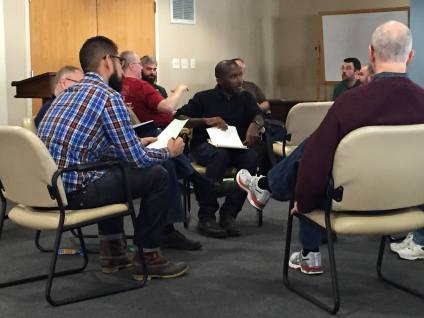
12493410_10153930734676424_7948693549053161023_oNot only did the friars from SPUFY (Solemnly Professed Under Five Years… we love acronyms in religious life) meet at the same time and place as us, offering a unique opportunity for recreation each night, on Wednesday we welcomed 50 of the 70 friars in our province under the age of 55 for an unprecedented meeting about the future of the Franciscans as we enter a period of restructuring and revitalization. For 24 hours, we discussed our vision for the Franciscans in the country, shared our hopes and fears, and debated on the best way to make that happen. Although I can’t share the specifics of what we discussed, there are few things that stuck out to me:

  1. The numbers are so much more significant when they have faces. So often in the Church we talk about declining numbers, lack of vocations, and a very bleak future. In our province, we talk about how few guys we will have in the future to run our ministries. And it’s all true… based on the expectations of the 1950s. But standing before me this week were fifty men who have devoted their lives to radically living the Gospel. And that’s not even all of them. To think that we have seventy men in the peak of their lives, in our province alone, that are committed to the same life as I am, is incredibly encouraging (not to mention the 240 other men who happen to be 56 or older, many of whom run the province). Too often you see a religious community with 2-3 new members, men or women, under the age of 55, surrounded by 100 others on the verge of retirement. Not the Franciscans. Not Holy Name Province. There is a strong future ahead of us.
  2. I love these guys. Not only are there enough men to create a viable community for years to come, there are enough quality men to sustain me for the rest of my life. For many, I’m sure it was nothing more than another tedious meeting (and parts of it was…); for me, it was a strong re-affirmation of my vocation. These men make me laugh. They do incredible work. They love each other. They inspire me. Whether we all want to admit it or not, there are really only two questions that we ever want to answer: Who am i? and Who’s going to love me? Being with a group like this, even for a day, reminds me how blessed I am that I can answer both of these questions with joy and confidence.
  3. We don’t have to get along to be brothers. While the love of Jesus and his Church certainly bound the men in the room, very little else did. In the fifty guys present, it was hard to miss how diverse we are at times when it comes to country of origin, culture, political leaning, vision for the Church, definition of friar life, ideal lifestyle, and personality. It was hard to miss how we don’t get along sometimes. It was hard to miss how, dare I say, certain guys actually don’t like each other. Gasp! Sounds kind of like… I don’t know… every other situation in the world! While some would point to conflict and division as signs of weakness, I see it as one of the strongest points of witness that we have to offer the world. Here we are, men with personalities, egos, issues, etc., and yet we’re willing to come together for something greater rather than giving up on the people and things that annoy us. Do we do it perfectly? Absolutely not. But what I saw in this gathering was enough to brag about: we have at least fifty men that are willing to at least try to follow Jesus in his mission, accepting each other, not because we want to but because Jesus did it first.

In total, it was a rejuvenating, inspiring week with my “young” peers. Together with the guys in formation, those recently professed and navigating their first assignments, and those men who are coming into their prime of their friar lives, I saw that there is a lot to look forward to as a province, and a lot of inspiration for my own personal road ahead. I do not know what the restructuring and revitalization of our Order in the US will look like in five years, but I’m excited to be a part of it.

***

As a final note, I’m in the process of working on two new videos and planning a few more after the semester gets started, so check back soon!

(Cover photo by Christian Seno, OFM. Body photos by Basil Valente, OFM.)