Upon turning 70 years old last week, one of our friars took the opportunity at mass to share some words of wisdom and a beautiful prayer about what the experience of getting “old” is like. Using the words of Pierre Teilhard de Chardin, he said something to effect of, “as the body begins to break and weaken, filling up with holes, one finds room for God they never had before.” It was from the heart, insightful, and highly appropriate.

Or so I thought.

After concluding mass, a parishioner approached him, agitated at what he had said. “You’re not old! I’m 78 and I still do so much. Do you think I’m old?!” While the friar was simply using the word as an objective category, “someone who is closer to death than baptism,” as he said, the parishioner took the word to have an offensive undertone: something that is “old” is less-capable, out-of-date, and undesirable.

It’s a situation that I have been in many times in my life as a friar. Being the “youngest” friar in the province, I learned very quickly that what I considered “young” and “old” was often not what others did, and that using such words was to be done with extreme caution, if ever at all. Despite being a senior citizen, 65 was not “old” to a 70-year-old. Despite being the average age of death, 75 was not “old” to an 80-year-old, and so on. Depending on who I’m talking to, someone who is 40, 50, even 60 can be considered “young,” and you don’t dare call them otherwise.

You can guess what that frame of reference does to someone in my position. At 27-years-old, having entered at 22, I am the youngest professed friar in our province… and can never forget it. “Oh my God you’re so young!” is a phrase I hear from parishioners and friars alike on a regular basis. For five years, it has been my “minority status,” the underrepresented category in our Order and Church that defines me, making me the unofficial spokesperson, expert, and representative for all things youthful. Because the friars are aging in this country, I am and probably will be “young” in this line of work far longer than if I were to do anything else.

Which is fine. Hooray. Outside of the occasional question of my maturity, being “young” is a great thing. It’s the reason that 78-year-olds still think of themselves that way and refuse to use the word “old.” It’s the reason that Bob Dylan and Alphaville sung songs about it, why we have so much nostalgia for our youth, why it takes some people a decade to move on after college. Being “young” is what we want and being “old” is terrible. Right?

What I want to suggest in this post, and why I have the words “young” and “old” in quotes throughout this whole post, is that these words are generic terms that do not adequately reflect the human experience nor do they point us to what is really important.

As someone who has been branded with the title of “young” over the past five years, I can’t help but recognize the irony of the fact that I have come to recognize my own age and mortality in that same time period. At 22, when I became the “youngest in the province,” I played my last ever competitive baseball game. I reached an age in which the best of something was behind me. At 24, being the “youngest novice in the country,” I tore my shoulder and was told that I would have to begin exercising in a different way. I became physically unable to do something I once could. At 27, as parishioners can’t believe that I’m old enough to be a friar, I notice that the small cut on my face from shaving has become a permanent scar, the stray and occasional grey hair has become a dozen fixed features of my scalp, and my one eye sags a little bit when I smile. My body is shifting from growth to decline. Despite being so “young,” I can’t help but feel “old” compared to how I used to be.

Am I “old” then? Aren’t I still “young”? The obvious answer is that these terms are meant to be relative and only make sense in comparison to something else: I am old compared to the students at Immaculata Elementary School but quite young compared to my formators and provincial leadership. But I don’t think that is what offends people at church or drives people to want to be “forever young.” No, the problem is that we associate being “young” with life, vibrancy, and potential whereas we associate being “old” with weakness, decay, and the past. Despite the fact that youth comes with its tremendous detriments (immaturity, doubt, lack of experience) and that increased age comes with its tremendous benefits (wisdom, confidence, identity), we somehow only remember the things we used to do but now can’t, rather than all of the things we couldn’t do but now can.

Why such pessimism? I can’t speak for everyone, but I have a theory for most: we fear our own death more than we think. With everything that changes, diminishes, gets weaker, or disappears, we are reminded that there will come a day when we are a shadow of the person we once were; with everything that we lose, we are reminded that there will come a day when we lose it all. The little things we lose—the color of our hair, the quickness of our mind, the strength in our step—do not bother us in themselves. Who cares about a few grey hairs? It’s what they represent that gets us. Loss. Diminishment. Irrelevancy. Death.

That’s the problem with the categories we use: no matter the age, we all experience death and loss. It’s not a binary system in which one goes from “young” to “old” overnight, from a period of growth to decline as if we’re two different people. No matter the age, we are all confronted with the fact that the past is gone, that what we once knew and loved will not last forever. All things must come to an end.

So to speak.

While all of us have an innate fear of the unknown, difficulty handling loss, and uneasiness about death, we as Christians know at our very core that death is not the end, that loss is not the final note. It is precisely from death that we receive new life; it is from our pain, loss, and weakness that we find relief, gain more than we had, and know that Christ is strong in us. In an ultimate sense, we know that we our death from this world will be made new with the resurrection and we will rise with Christ on the last day.

But it’s more than that and sooner than that. With every loss that we experience throughout our years, there is the sadness of saying goodbye to something we loved, but also room to welcome something new to love. Leaving college was sad… but starting a career is exciting. Not being able to play baseball anymore was devastating… but taking up a new hobby of golf is invigorating. Saying goodbye to the people we love is tragic… but finding the time and need to love others in their place is a life-giving opportunity. With every loss comes new life. It is in that understanding that I understand very clearly what my Franciscan brother meant to share at mass last week: sometimes, in the weak moments when all we seem to know are the holes of what used to be, we find that we have more room for God’s work than we ever had before. I tell you, that is a lesson to learn, no matter the age.

The following is a reflection on this week’s readings, the 24th Sunday of Ordinary Time, year C.

Have you ever stolen something, lied to your parents, called someone a hurtful name, done something hurtful to yourself, or anything else you regretted enough to had to go to confession?

If so, have you ever been smote by God’s wrath, hit by a lightning bolt from heaven, or dropped dead immediately after doing something wrong? Probably not.

Or, after having done something wrong, something you regretted, did you later have an experience of God, a powerful prayer, a feeling of relief, or anything that made you know that God was still with you, that he had not abandoned you? My guess is that the latter experience is a bit more common…

You see, on the one hand, our God is a God of justice. He set a way that his people were to live and told them that if they follow it they’ll be rewarded and if they don’t they’ll be punished. Justice: people get what they deserve. Look at how he reacted to the Israelites in our first reading today: seeing that they built an idol out of gold to worship, his first reaction is to send down his wrath of fire to destroy them. Harsh? Maybe. But he gave them rules to follow, told them that death was the penalty for sin, and they couldn’t even handle the FIRST commandment. Justice meant paying them what they were due, and they were due punishment.

But God didn’t end up doing that, did He? While our God is a God of justice, He is also a God of mercy. Even though He was very clear of the rules, and even though they immediately broken a really big one, God chose to show mercy to His people and give them more than they deserved: a second chance, new life, safety from death.

It’s the same story with St. Paul in our second reading. While we all know Paul as the great missionary that built up the Church after Jesus, sometimes we forget that he was a great sinner prior to his vision of Jesus. In our second reading today he even says himself, “I was once a blasphemer and a persecutor and arrogant, but I have been mercifully treated.” Even though he tore down the church, imprisoned and killed Christians, and denounced Jesus, God did not give him the punishment he was due, He gave him mercy… He gave him forgiveness; God was able to transform something terrible into something great.

Why? Because God loves those who love Him and are perfect, right? God loves those who help themselves, right? Quite the opposite, actually. Time and time again we hear that God loves the outcast… the sinner… the weak… the lowly. The very reason that Jesus tells the parables in our Gospel today is because the Pharisees were complaining about who He was eating with: “This man welcomes tax collectors and sinners and eats with them!” He was eating with the lowest, most detestable people in society. But why? Because no one outside of God’s mercy, there is no length that God won’t go to bring them back.

Jesus asks them, “Who among you, losing one sheep, wouldn’t leave the 99 behind to find the one?” The correct answer is everyone! The idea of leaving behind 99 sheep to find just one is ridiculous! But that’s what God does for all of us. He’s like the woman who completely overturned the whole house to find just one coin and threw a major party over it. He’s like the father who didn’t care that his son disrespected him, took half of his wealth, defaced himself, and then came crawling back for help. No one is outside of God’s mercy… no matter who they are… no matter what they’ve done.

God doesn’t treat us fairly, He doesn’t give us what we’re due… he gives us so much more than we deserve. Even tax collectors. Even sinners. Even people who lie and cheat and say mean things to their parents, who don’t feel connected at mass, or don’t even think they need God. Even them, you, and me. Even… Even terrorists.

On this the 15th anniversary of the September 11th attacks on our country, we will be inundated with a simple, two-word message: Never forget… Never forget… Never forget. It’s a powerful message, a catchy message, an important message. But what does it mean? What exactly is it that we never want to forget as long as we live?

For some, it is an opportunity to focus on justice. What we should never forget is the horror of the day: the deaths of so many people and the hatred of the people that did it to us. This was an objectively evil act, and we need to take it upon ourselves to give them what they’re due: punishment. Never forget what they did.

When we go down this road, fueled by hate and anger and fear, we have a tendency to take horrible, sinful acts and give them back even worse. More than 300,000 middle-Easterners dead, torture, regular acts of distrust, name-calling, and violence against completely innocent Muslim citizens of this country. If all we remember is the terrible acts of the day, if all we remember is the sadness and anger we felt when it happened, that is likely all we are going to be able to give back in return.

Is that the Christian response?

In light of our readings today, I want to suggest an alternative, that the thing we should “Never Forget” is not the evil of that day… but rather the mercy of God who continues to be with us all… even the sinners. The God who turns evil into good and never tires of chasing after us…even the terrorists. The God who doesn’t give us what we deserve, because he gives us so much more. Instead of remembering the deaths of so many, let’s never forget the lives that God touched, the saints and sinners in those buildings for whom God waited on patiently their whole lives. Instead of remembering the destruction and turmoil, let’s never forget the heroic acts of first responders risking their lives for others, how the whole city, an entire nation united together, moving beyond our differences to be one. Instead of remembering the terrible things that others have done and how they need justice, let’s never forget that we are all sinners and yet all of us have been treated mercifully by God.

When people hurt us, they betray our trust, inflict pain… our first reaction is almost always to get even; we want justice. And there’s room for that: a world in which no one is accountable for there actions and sin is okay is not a world that our God wants. But we never need reminding of this; our instinct to fix this comes naturally. What we do need from time to time, though, what we must never forget, is that God has treated with his mercy, and wants us to do the same for others. Never forget.

For those receiving this post by email, click here for the short video reflection related to this post.

Having just arrived in Durham and being around a lot of new people, I’ve been going through the usual suspects of questions quite a bit: “How did you know you wanted to be a Franciscan?” “How old are you?” “How much longer do you have left?” and my *favorite* one, “Are you going to be a priest or a brother?” Regular readers of the blog will know this question (and my feeling towards it), and will understand why I generally choose to be difficult with people by saying, “Yes,” or “Well, we’re all brothers…”

When it comes right down to it, I don’t ever blame people for not knowing the subtleties of being a Franciscan or that certain phrasings of the question are highly offensive (e.g. “Are you going to remain a brother or go on to be a priest?”). The question reflects a culture in the Church that is very common, and at the core, it’s not a bad question to ask: Knowing that not all Franciscans are priests, they want to know if I will be.

But that doesn’t mean that it’s not a teaching moment either. Whether acknowledged or not, there is often an underlying assumption in people that one is better than another, that one is a “higher calling” or more important life, and so there is an unconscious hope for “priest.” Given the shortage of priests in our country, I completely understand why someone might be disposed that way. But at the same time, it is an attitude that undermines our understanding of what it means to be Franciscan. We are not two groups in one, the priests on one side and the lay brothers on the other. We are one brotherhood. Some of us live out our baptismal call to discipleship behind an altar and some behind a desk, but our place in the brotherhood is no different.

It may seem like old news to the faithful readers, but a topic worth emphasizing every so often. I hope you enjoy the newest Ask Brother Casey segment as I explain once again the difference and share my own reason for choosing the path of priesthood.

Priest or Brother?

Five years ago Saturday, as a newly received postulant, I attended the solemn vow ceremony of two of our brothers. Having just entered a few days earlier and being at the very beginning of my six-year journey of formation, I was deeply moved by that experience:

“It’s hard to imagine that six years ago, these two men were in my position, postulants, young and new to the order, attending some other friars’ solemn profession. It’s kind of cool that one of the first things we do is attend this ceremony because it gives us a glimpse of the ‘finish line,’ so to speak.”

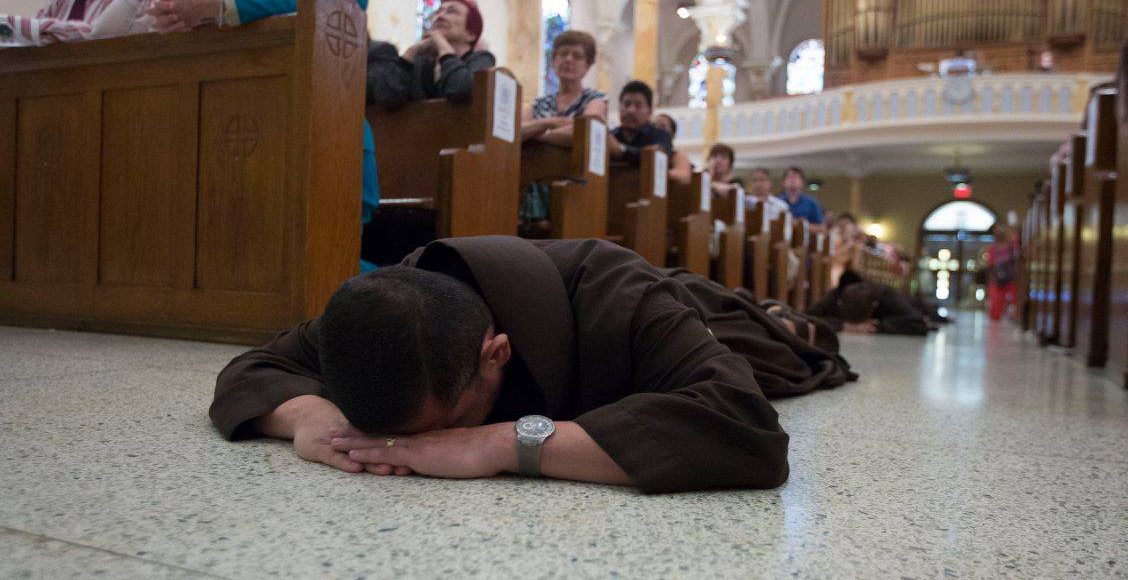
From day one (or four) I was looking to the future at what would one day come: myself in their place, lying on the floor during the litany of the saints preparing to permanently vow my life to God in the way of St. Francis of Assisi. At that time, being as new and far off as one could be, the experience was powerful yet safe, a distant vision that was little more real than a dream.

This Saturday, I found myself sitting in the exact same pew for the exact same ceremony… with a very different reaction. What I was witnessing was not some far off goal, a “finish line” from the view of someone on lap one, it was an imminent reality just before me, the finish line from the perspective of someone who has run the race and knows that they are almost there. The men before me were not just “some friars” years ahead acting as a generic example for my future; having lived with each of them for two years, they were my classmates, my housemates, and my friends. I knew what they were going through and I knew what had gotten them to where there were, but maybe most significantly to me, I knew that I was next.

It was at the moment, sitting in the very pew that had given me the image of running a race to the finish, that I was struck with a new image: I’m now on deck. All at once it became real to me that there is no one in front of me. With no one on and no one out, I better get my helmet and bat because I’m going to be hitting next. Just as I had watched them last year go out on internship year, be evaluated and voted on, sign formal documents with more weight than any documents they had ever signed in their lives, and finish their discernment with a final one-month long retreat, I knew that all of that was upon me now.

How did this make me feel? Exactly like being on deck in baseball, actually: a little nervous, but wanting nothing more than to be at the plate. When you’re sixth in the order, you know that you’re going to get up eventually but there’s no pressing need to be ready. When you’re on deck, things are very real. Nerve-racking, but also so very exciting. No one wants to be sixth in the lineup, they want to be hitting. I knew a year before I even entered that this life was for me and have not doubted that feeling for a minute, and I can’t wait to make that decision official, with family, friends, and friars present. For five years it has been a far-off goal. Now, I’m ready to hit.

14125553_422398677930516_4374013541427741310_o

Congratulations to George, John, and Egdardo

Welcome, Again

Last year, I started my video experiment. I bought a camera, filmed a road trip, and thought it was a pretty cool medium. When I realized that what I was doing was no longer a cool hobby but rather the next step in my communications ministry, I threw together a welcome video to set the tone for the channel. It was fun and a little corny, but it got the job done. I was happy with what I had made on such short notice and with almost no video background, and it worked.

After a year, things have changed. That quirky little video we filmed outside of the Church one day wasn’t cutting it for me anymore. The cheesy jokes about Jedi and Medieval Festivals weren’t doing it for me anymore. I wanted something that better reflected where I was now, a year later, and what I hoped to accomplish in the future. I didn’t want a welcome video, I wanted a trailer.

And so, with time on my hands before things get crazy at the parish, that’s what I did.

What is a Habit? (Trailer)