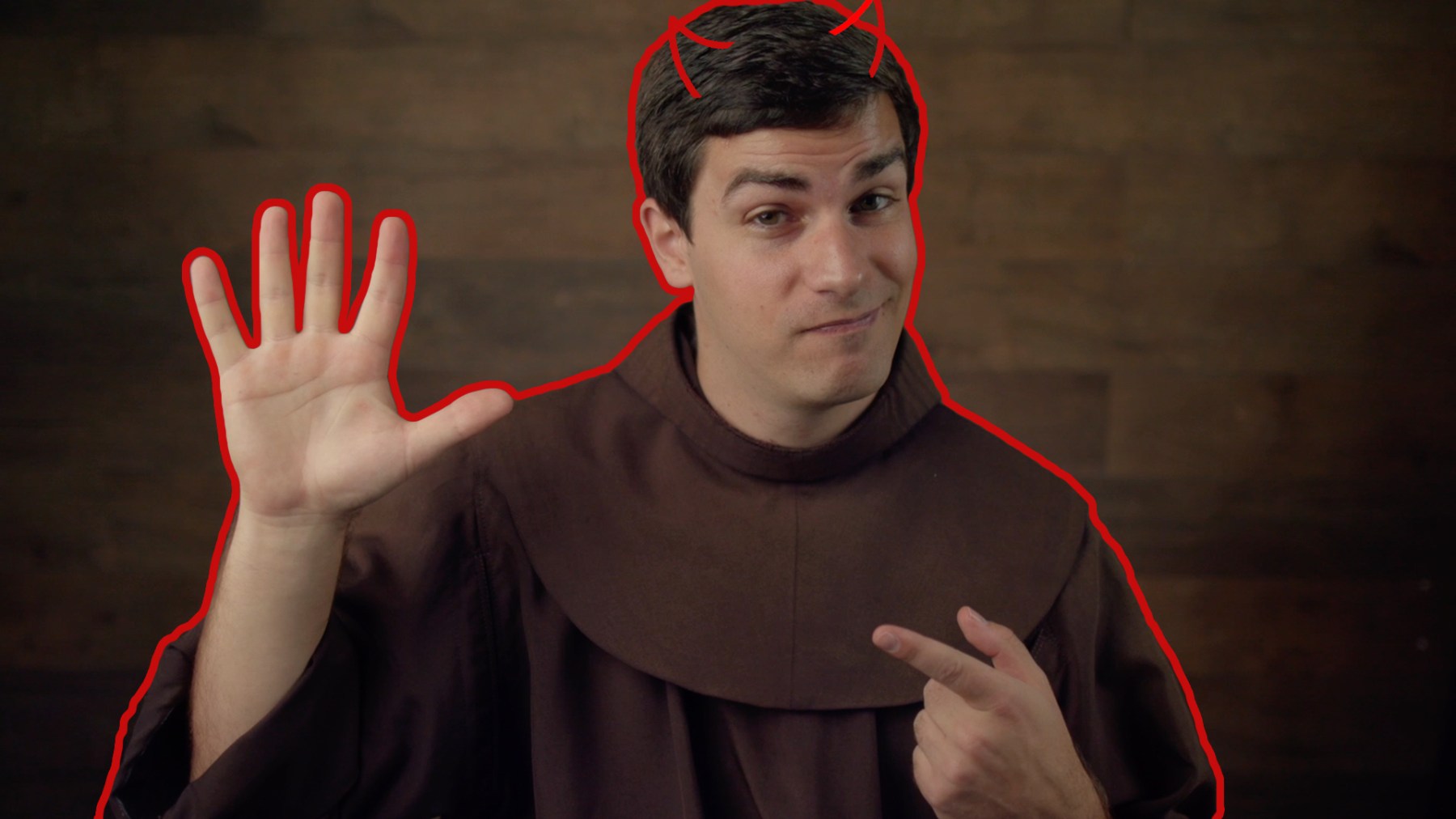
What is the utmost goal of every Christian? Or, at least, what should it be? As far as I can tell, the clear answer is “holiness.” We seek to be like the one who came to be like us. As much as we think of ourselves as people who “do” things, who accomplish things, who work and work and work, the reality of the Christian mission is that it’s not so much about a “what” as it is a “who.” We do what Jesus did because we want to be like him. Our life goal is to become saints, those who live with him in heaven forever.

So, how do we get there?

For the past 2000 years, there has been no shortage of treatises and guides. From the lives of the saints to apostolic exhortations written by popes, I could sit here and list hundreds of perspectives on the matter. Many people want to help you become more holy, and I encourage you to read as many of them as you can.

In this video, I’ve decided to take a slightly different approach. Rather than attack the issue head on, offering tips that will help us become holier and closer to Jesus, I’ve decided to present five ways that each of us can become a bit more evil. (Probably not what you were expecting! One commenter wrote that I’ve been in quarantine for too long, and I don’t disagree!)

The idea is simple: sometimes, it’s helpful to look at the opposite of what you want to see how you might be subtly undermining your goals. In this satirical take, I offer five things that are the furthest goals from a Christian life—things that are horrid and absurd and downright unconscionable—to make clear what we must avoid. Even as people seeking holiness, there is a part of us that is still susceptible to evil. We must be on our guard, quick to turn away from it when we find it.

Is there anything wrong with being rich? This is America. And in America, we reward hard work and ingenuity. You can be anything and anyone you want, right, as long as you work for it. If you work hard enough and have enough skill, you deserve everything you get. Millionaire? Billionaire? Richest person in the world? This is the sign that you have worked hard, and everything you earn is rightfully yours. No one can take it away from you.

Okay. But what if that person is a Christian?

The question of what we do with our money is arguably the most important issue found in the entire Bible (in the Old Testament, second only to the issue of idolatry.) More than an insistence on peace, more than politics, far more than sexual ethics, Jesus spends most of his earthly ministry caring for the poor and preaching about wealth. He tells his disciples how they are to approach it, preaches against the rich, and raises up the poor. Truly, if there is one thing that Jesus cares about more than anything else, it’s what we do with our money.

Understandably, then, the Catholic Church has a few things to say on the topic. Drawing from the social encyclicals, papal pronouncements, and ecumenical council documents, this week’s Catholicism In Focus offers a brief overview of the Church’s stance on but one economic topic: private property.

Can a Christian be rich? In general, the Church has no problem. But it definitely depends on what one does with their riches.

“All I want to do is lie around, watch t.v., and eat. That’s the life!” There have definitely been times in my life that I’ve thought this. Especially now that the weather is getting nice in Georgia, it would seem that I’ve gotten exactly what most people always dream of.

Except, as many of you are likely figuring out, lying around, watching tv, and eating gets old after a while. At some point, there’s something that just starts to itch inside you.

By the looks of things, we’re probably in this for a while longer, and so it’s about time that we began to set a few things in place for a more sustainable life. In this video, I offer 5 things that we can and should do to stay safe, sane, and spiritually nourished in this time of isolation.

This weekend was likely unsettling for many people: a Sunday without Eucharist. As a response to the novel coronavirus pandemic, bishops have closed churches for public gatherings.

And it has many people confused, angry, and alone.

In this video, I want to suggest two things: 1) this is the right decision, and b) our connection with God can still flourish.

Most of you are probably well aware of this, but there are Christians in the world that hate Catholics. They don’t just disagree with our teachings, they do not think that we are Christians, and believe that we are nothing liars and deceivers.

Oh, and they’ve got the “scriptural evidence to back it up.” Because, you know, we don’t read the Bible and have no idea what’s in it.

One of the most common attacks we hear comes in regards to most famous title for a Christian leader: “father.” According to them, it is against the teaching of Jesus. Quoting Matthew 23, they point out that Jesus said “call no one father,” evidence that Catholics don’t care about Jesus’ teaching.

Of course, the Bible is absolutely central to our faith as Catholics. We would never disobey Jesus is such a blatant way. There must be more to the story than what appears on face value!

Hence, this week’s episode of Catholicism in Focus. Enjoy!