In the United States, it is rare to find a church that is more than 100 years old. Unlike Italy that has churches more than a thousand years old on every corner (when the “New Church” in Rome is from the 16th century…), you are hard-pressed to find a Catholic Church in most areas older than 75 years old. In my case especially, having lived in the “new south” for many years in which the number of Catholics is growing and new churches are actually being built all around us, finding a church from the 1980s, let alone the 1880s, is not all that common.
You can imagine my reaction, then, to walking into a church built in 1884 this week. Talk about ancient by our standards! And yet, nothing about it seemed all that old. With the revitalization of church buildings after the Second Vatican council, this one was a beautiful blend of old traditions and new faith, adorned with statues and grand art while also being open and bright, facilitating participation and active engagement. Quite to my surprise, I actually found the church to be quite nice.
A quick update, by the numbers (as of 6/22):
Days on mission: 21
Miles traveled: 6586
Homilies preached: 22
Talks given: 12
Videos produced: 8
Miles run: 47.96 (14 runs)
Books read: 1.75
Episodes of The West Wing watched: 42 (I was on vacation for 5 days…)
I’m currently in Cincinnati, OH, where I’ll be preaching at St. Monica-St. George Parish (student center) tonight and tomorrow. Be sure to check YouTube tomorrow for a new video that I’m actually walking out the door to film!
Well long-time blog readers, you know what time it is. Three years in a row as summer has approached, I’ve made a big announcement about my summer plans. The first summer, I drove cross country with my classmate, then went on my first international trip for a mission trip. The year after that, I led a tour of the southern half of our province for two friars who had never been to the south, followed by a two-month trip to Mexico to learn Spanish. Last summer, I joined two other friars on a massive road trip filming a (failed) documentary, and then spent a month in Italy for my solemn vow retreat.
Noticing a pattern? While I won’t need my passport this summer, it’s going to be my most ambitious one yet!
Starting the first week of June, I will be spending my entire summer traveling the country on a preaching mission. For three months (11 out of 13 weeks, actually) I will be spending a week at a different Franciscan parish in the country, preaching at all of the masses and offering a two-day mission during the week on the themes of discernment and discipleship.
You might have heard me talk about these themes before. Yes, well, they’re kind of central to my book Called: What Happens After Saying Yes to God, and so there will be opportunities to talk about the book, answer questions, purchase a copy, and have yours signed.
As of now, all but the final stop (New York) have been confirmed, and so if you live near a Franciscan parish in that city, you can almost guarantee that it will be yours that I’m stopping at. Since Cincinnati has multiple parishes, I’ll clarify by saying that I’ll be at St. Monica-St. George, and it is likely that the New York stop will be a brief one-day event rather than a full mission.
A few weeks ago at daily mass the first reading came from the book of the prophet Zechariah. As I prayed with the reading, one line jumped out at me:
In those days ten people from nations of every language will take hold, yes, will take hold of the cloak of every Jew and say, “Let us go with you, for we have heard that God is with you.”
I was overcome by the image of it. These people, numbered greatly from all the world, looked at the Jews and were so moved by the presence of God that they followed where they were going. The Jews did not have to give a tremendous speech, perform incredible miracles, or win an argument. Presumably, they were just living their normal lives.
That was the inspiration for my newest video, a reflective piece on our ability to be like those Jews. How many people look at who we are and where we’re going as Christians and say, “I want to go there to”?
There is often a question in reading the Bible about the “literal” meaning of the text. Stemming from controversies with fundamentalist readers, we find ourselves wondering…
Did God create the world in 6 days less than 6000 years ago?
Was there really an ark that held all every single creature in it?
How accurate are the numbers when they claim tribes and armies in the tens of thousands?
How could Jonah survive in the belly of a giant fish (and what fish in the world is large enough to swallow a man) for three days?
Who was Cain’s wife?
…and so on. Reading many of these things “literally,” by which I mean at face value without any recognition of rhetorical device, leads us to some bizarre and difficult interpretations.
In addition to this video, I would like to offer to additional bits of information: 1) an explanation of why it’s difficult to use the word “literal” (and why it’s in quotes), and 2) scriptural examples of what I speak about in this video.
So first, the word “literal.” Since the 19th century and the rise fundamentalism in Christianity, we have had Christians claiming to read the Bible “literally,” but the fact of the matter is that we have always used this term… only it meant something different. For Catholics, we may become confused by this term in our own writings because the Church still refers to the “literal meaning of the text.” When we say this, we do not mean the reading of the text stripped of rhetorical device but simply “what the human author meant.”
For instance, numbers are often very symbolic in the Bible. In the book of Revelation, we read that there are 144,000 in the kingdom of heaven. Fundamentalist Christians reading literally would say that there are exactly 144,000—not 143,999, not 144,001. They take it without any symbolic understanding, without any regard to what the author meant, just what it says. For Catholics (and many other mainline Christians), we say we read this literally to mean that it refers to the 12 tribes of Israel, times 12 (a number of completeness in the Bible), times 1000 (a number often used to show a great, incalculable multitude, much like we would say, “There were like a million people there.”) What the author meant to say in this symbolic statement, the literal meaning of the statement, was that the kingdom of heaven with consist of people from every nation in such great number that it is impossible to count. The author did not mean that there is a counter at the gate ready to close the door at 144,001.
We use the same word “literal,” but in different ways. Yes, confusing. (But we said it first…)
Second, a few examples of how the Historical-Critical method helps us to understand the text beyond the face-value meaning.
Why not start from the beginning. The very beginning. In Genesis 1, God speaks and things are created. Out of nothing, things come to be. Man and women he creates them. In Genesis 2, God is very human-like, planting a garden, forming man out of clay, breathing life into him. To read this literally, we need some major mental gymnastics. How can God create man and women at the same time simply by speaking and then go and create man first out of clay? How does God speak the world into creation and then go plant it himself later? The more we read, the more we realize that the two chapters represent two different stories written hundreds of years apart. What the authors represent, and why the editor(s) decided thousands of years ago to include both stories, is not because they thought it was scientific fact without contradiction, but because both stories poetically capture truths about God. On the one hand, God is powerful, distant, all-knowing, and beyond creation. On the other hand, God is gentle, near, intimate, and relational. Both sets of statement are true but impossible to convey in one story.
That… and how can we know what happened before we were even created? Really. These passages are not to be taken “literally” because they weren’t meant that way. (For more on this topic, St. Augustine wrote a great explanation in the 5th century.)
Take, then, the passage from Exodus: “But if injury ensues, you shall give life for life, eye for eye, tooth for tooth, hand for hand, foot for foot, burn for burn, wound for wound, stripe for stripe.” At face value, it may seem like God is willing revenge or that attacking the guilty is the right thing to do. Sort of. Until you get into the culture of the day and realize that there was no police force, court system, or prison, and that most cases were handled by people taking the law into their own hands. Someone steals your cow? Well, you go and kill his whole family. Not the greatest… Within that context, a law that says that the penalty is to be the same as the injury is not to be read as giving license to revenge, but rather putting a limit on retribution. You can only do this much, and then move on.
How about Abraham being told to go sacrifice his son Isaac and then being stopped just in the nick of time by an angel. At face value, it may seem very strange God. Why would he ask this terrible thing of Abraham? Did God change his mind at the very end? It just seems bizarre. Until you read some of the writings of the other cultures and religions of the time and realize that human sacrifice to the Gods was not uncommon. Within that context, the story means something different. Abraham, just getting to know this new God, “the LORD,” obeys his order because he accepts that this is what the gods want. But then, after he shows his loyalty, God steps in and emphatically stops him, showing that He, the true God, does not require human sacrifice. The story reveals that this God is different, that he will not stand or accept those sorts of sacrifices. You can almost picture the ancient reader hearing this story. “Yup, sounds normal. This god wants a sacrifice. Yup, Abraham obeys. Wait! What?? He said no to the sacrifice?” When it stands in such a contradiction to what the reader would otherwise hear in his/her time, the passage bears a lot of meaning. Within our own context, that meaning might be difficult to see reading it just “literally.”
Finally, an attempt at redeeming our good friend St. Paul. In Ephesians 5, he famously tells women to be subordinate to their husbands and for husbands to love their wives. Not exactly the sort of family structure most of us want to hear. And yet, many throughout history (including the Catholic Church) and even up to today, read this passage out of context and at face value: women, in every place and every time, you are at the mercy of whatever your husband says. Be subordinate. But we don’t read things out of context. We read this text as it would have been heard in the 1st century, male-dominated culture that it was first heard. “Women be subordinate to your husbands” was as normal and uninteresting as, “Make sure you stay hydrated.” Duh, they would have said. But the second part, “Husbands should love their wives as their own bodies. He who loves his wife loves himself,” now that‘s where we get somewhere. This passage is not elevating men over women but raising women to the importance of men. In a culture in which the women were property, in which they were totally at the mercy of whatever the man wanted to do, this passage must have been controversial and ahead of its time: “Men, you cannot treat your women as less than yourself, you should treat them as your treat your very selves.” Out of context, we might focus on the first part. But that’s not the purpose of the passage. The purpose of the passage is to remind men that women are equal to them and deserve their love.
I hope this clarification and these examples help, and I hope that this video can offer greater tools in understanding and reading the Bible. If you have any questions about specific passages, be sure to go to my Facebook page and ask me in the comments or personal message!
Hey blog post readers! I didn’t forget about you today! I’m just a little late… and trying something new.
For six years now I’ve written a blog post almost every week, sometimes multiple per week. It has been a great opportunity for me to share my experience as a friar, reflect on theological and social topics, to include others on my journey, and to connect with young men and women discerning a vocation.
What started as the occasional, small weekly reflection has blossomed into a full-time ministry of evangelization and catechesis, pushing me to explore new ways of spreading the word. Through Facebook, Twitter, YouTube, and Instagram, and now more recently, booking speaking opportunities like retreats and vocation talks.
For that reason… I’m not done thinking and growing. As the world changes, so too does the way I (we) share the message. What are people watching? Where do people look for entertainment? How do people learn best?
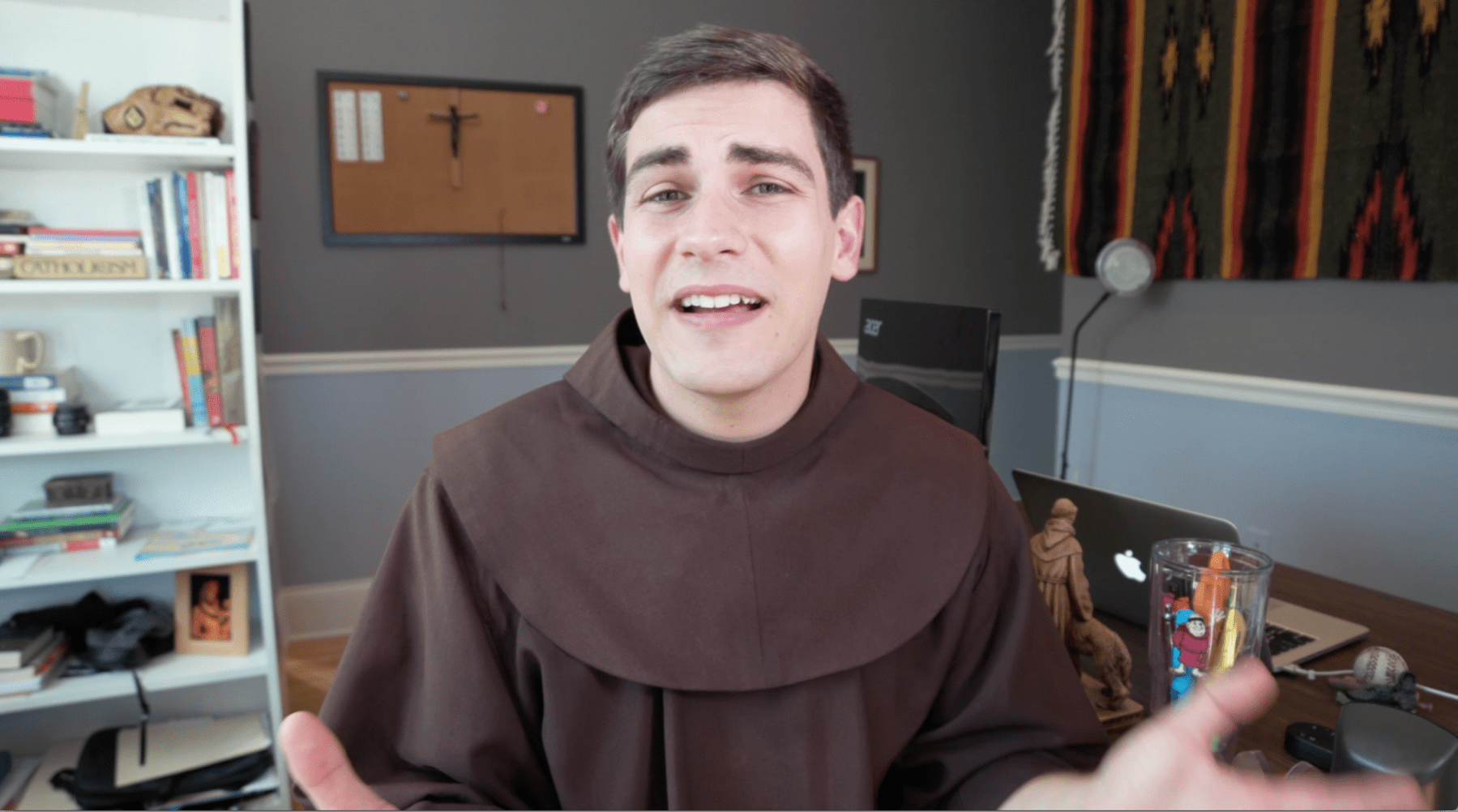
With that in mind, I have decided to try something a little new, presenting my weekly reflections in a new form: Vlogging. A medium that has far out-reached blogging in recent years, I think it’s worth a try.
All videos and news will still be posted here, so if you’re an email subscriber you’ll still get notified of new content, but the content itself might be a little different. Click here to watch, and let me know what you think!


 Starting the first week of June, I will be spending my entire summer traveling the country on a preaching mission. For three months (11 out of 13 weeks, actually) I will be spending a week at a different Franciscan parish in the country, preaching at all of the masses and offering a two-day mission during the week on the themes of discernment and discipleship.

 Breaking In The Habit