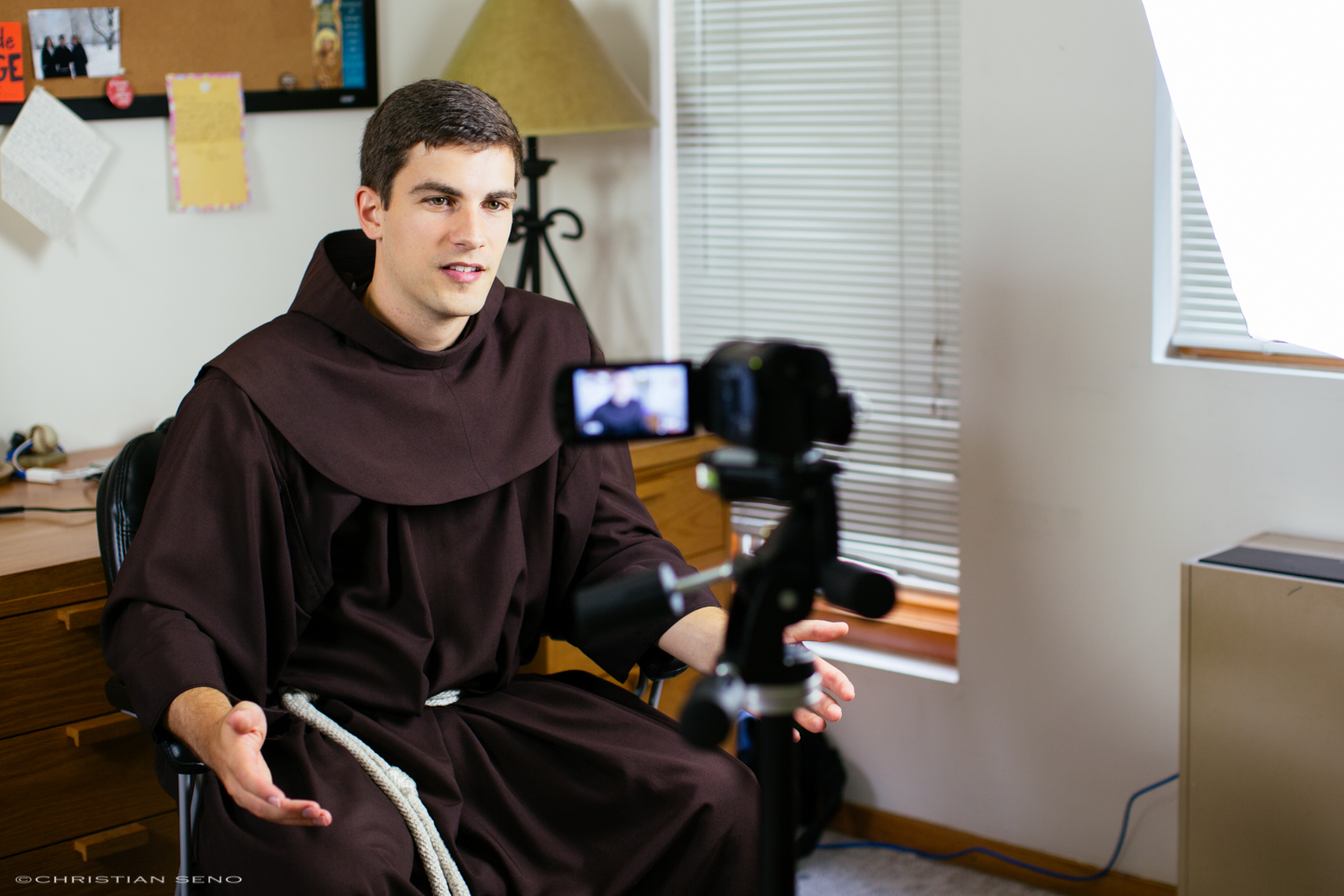
As many of you have seen, the Top Ten Friar Questions video I posted during the summer had quite the response. It turns out that there are many more questions out there to be answered about being a friar! From discernment and prayer, lifestyle and entertainment, church and culture, the questions keep coming in.

At first, I thought the best thing to do would be another “Top Ten” video, something like “Ten More Friar Questions.” As I thought about it more, though, I wanted something a bit more intentional and much more sustainable. Instead of quickly answering ten questions at one time, what about answering one question at a time in depth? And so “Ask Br. Casey” was born. Below you will find the newest YouTube video and also the first in a new segment. Each week I will select one question from those asked here on the blog or on the video itself, and answer it in a new video. Questions can be about Franciscan life, the Church, culture, or personal questions for me, Br. Casey, about my everyday life. What do you want to know?

Since I will be heading back to school shortly, I thought that I would start by answering a very commonly asked question: How much longer do I have to go to school before I can become a priest?

For those on email, you can view the video by clicking here.


Discernment, Formation, and the Church in the Modern World

If you think that title is long, wait until you see the video! But before I get to that, I have great news! Our brother in Syria, Fr. Dhiya Azziz, OFM was released unharmed by his kidnappers! Praise be to God! Thank you all so much for your thoughts and prayers throughout this past week. 

And with news like that, where do I go from here? Well I can assure you that I can’t beat it. And since you’re going to be disappointed anyway… let’s talk about this video that I have for you. You see, it started off with the best intentions. I planned to film a two part series: one on my discernment process, the other on the formation process of becoming a friar. I worked out the script, had lots of pictures, filmed it three times… and realized it was incredibly boring and useless. What I also realized was that, in between takes, the conversations Rob and I were having were really lively and really interesting. So we filmed that.

And here’s the thing. I think it’s the best video yet. The conversation was candid and lively, the questions were honest and off-the-cuff, and the answers surprised even me. When we went back to see what we had, we couldn’t find a place to cut or edit… and so we didn’t. What I have before you is a forty minute video. That’s right. 4-0. But do you know what? That’s shorter than one episode of Law and Order, and certainly shorter than a football game, so I don’t feel bad at all! Enjoy it at your own leisure, either all at once or in little bites, or don’t enjoy it at all! That’s up to you! All I’ll say is that I am really pleased at how it came out: for the first time, I really think you get to see a bit of my personality and passion for this life come out in a way that blog posts and scripted video reflections can’t capture. For that alone, I stand by it and hope you will to.

For those on email, you can click here to view.

Also, if you’re interested in more about my vocation story, you can click here to read a shortened version, or here to see other related posts. There are also quite a few about the formation process, which can be found here.


Top Ten Friar Questions

The video series rolls on. And does it ever. I want to thank everyone for your amazing support over the past week. I’ve received a lot of encouraging messages and really appreciate how much people have shared the new video series with others on social media. Comments are nice, but seeing that people like it enough to share is so affirming. (To give you an idea, a normal day is about 80 hits and the most in a day in 308. Four straight days now it’s been over 200, and yesterday reached a new high of 555 hits! As of 10:00am this morning, there have already been 70 hits.)

With that said, hopefully you’ll enjoy this one just as much. Because I’m still experimenting and trying to find the character of the channel, you’ll notice that it is a very different style than the Patience video and the Welcome but just as Franciscan: Top ten questions I get asked as a Franciscan friar.

Also, special thanks to Rob Goraieb, OFS (a parishioner and Secular Franciscan at the parish) for his many hours of planning, filming, critiquing, editing and making me laugh! You’ll catch him at the end of the video in our “bonus segment.”

A Christian Lens on “Cloud Atlas”

“Our lives are not our own. From womb to tomb, we are bound to others. Past and present. And by each crime and every kindness, we birth our future.”

No one is an island. Our actions now have an effect on others well beyond our own time and place.

No one is an island. Our actions now have an effect on others well beyond our own time and place.

Last weekend, a few of the student friars watched what I found to be one of the most interesting and thought-provoking movies I had ever seen: Cloud Atlas. Besides being an ascetically imaginative movie with incredible scenery, special effects, and makeup, the directing of the story was truly fascinating. Unlike most movies that have a protagonist, a conflict, and a resolution, and present events in the order in which they happened, this movie interlaces six different stories, each based in different places and spanning multiple centuries, and progresses thematically, not linearly. Added to the peculiarity of the plot was that the small cast of 13 actors played a total of 65 characters, some even playing a different character in each time period, often transitioning age, race, and gender. One minute Tom Hanks is a greedy doctor stealing from his patients on a Pacific trading ship in the 19th century, the next he’s a physicist working at a San Francisco power plant, the next he’s a shepherd in a primitive society years after an alleged fallout in society; he is at one moment the protagonist, the next an extra in another character’s story.

Like any great piece of art, the medium is the message in Cloud Atlas, and the message is as complicated, and profound, as its medium: humans are inescapably linked to one another, in person and across human history, and the decisions made before us have a profound effect on our ability to act. What the movie displays so powerfully is that no one is an island and no one’s actions affect only them. Everything we do affects people around us. Even the most subtle gestures or the most minor of insults can have lasting impacts on who we are and what we choose to do. And it doesn’t stop with us. Having affected someone with our decisions, this other person will inevitably do the same, passing on what they have felt from us to another person. Everything we do to another, whether it be love or hate, heroism or cowardice, charity or greed, inclusivity or racism, can and will be passed on to the next. What one does in one time period, for better or for worse, can be passed on to other times, crossing many generations, geographies and even cultures. In the movie, generations of people continued to make the same mistake, acting towards another as someone had acted to them, inadvertently passing on the decisions of those that had come before them.

An example of the character complexity

An example of the character complexity

While not intending to make a Christian statement, what Cloud Atlas does is present the clearest example of the power of sin to limit our freedom I have ever seen. This was a major topic of discussion with my spiritual director during novitiate. For him, Family of Origin was the answer to almost everything. For any issue I brought up in myself, he worked with me trace it to its origin, the place where I learned to think or act in a certain way. Did I get it from one of my parents, a close friend? And where did they get it from? Their parents? How far back does it go? For him, and other Family of Origin proponents, our values, desires, goals, fears, strengths and weaknesses do not pop out of thin air and they are not systematically chosen by us. No one has the freedom to choose their personality or their fears, but they do have an origin, and left unattended, they will be passed on to others.

All of this may sound rather simple to some, and if you’ve gotten this far, you might be wondering why I’ve used up 635 words to say that we’re influenced by our parents. As a religious blog, does this have anything to do with Christianity? Yes. The point I’m working to make, the most thought-provoking part of this movie and my time with my spiritual director can be summed up in one line he said during one of our sessions: “So now that you’ve discovered a defect in yourself that is likely to have been passed down to you through many generations, wouldn’t it be something if this defect stopped with you, if you could resolve it in yourself so as to not pass it on to anyone else? Do you think you could bring redemption to your whole family?” Wow. What a thought. Like the characters in the movie, I realized that I was intimately connected with those who had come before me; like the heroic characters in the movie, I realized that I had the ability to bring resolution to potentially hundreds of years of a particular character defect or action by not passing it on myself. In the movie, one racism is passed down for hundreds of years unquestioned until one character chooses to act differently. Done. It will not be passed on to the next generation in that family. What if I could do the same with the fears, insecurities, and inordinate desires I had acquired form others, family or not?

This is where Christ comes into the picture and I depart from the movie. While the movie presents reincarnation as the ultimate principle guiding human souls and potentially offering resolution to sinfulness, we as Christians know that Jesus Christ is the only one capable of breaking our cycle of sin in an absolute sense. Whereas we will inevitably pass down some form of alienation due to sin, alienation from God and from ourselves, Jesus was and in the resolution to all sin. Faced with everything that we face, experiencing all that humanity experiences, Jesus acted in perfect obedience and returned nothing but love for all the hate he received. He did not perpetuate the sins of our fathers (and mothers); he transformed them into love. Rather than acting as the world does, returning violence for violence, he freely accepted his death, allowing God to transform death into life with the resurrection. In him, and through his grace, we are given not only the example of how to live, to transform the errs of those before us into love, we are given the strength and ability to do so perfectly. When we act as Christ did and bring resolution to a complex world of sin, it is in fact Christ working in us, bringing resolution and redemption to hundreds of years of alienation and defect, transforming opportunities for sin into opportunities for love and grace. While Cloud Atlas does not take the message of redemption to this extent, it does an incredible job of showing the effect our actions can have not only on ourselves, but all of history.

***

If you’re thinking about running out right now and getting this movie for the next family night, I do offer a strong disclaimer. This movie is rated R for a reason, and I would not recommend it for all audiences. The overall message is a powerful one, but often the way that message is depicted is through less than admirable actions.

Not Wed to the Idea

There is nothing appealing about this experience. And yet, in every marriage, there is an opportunity to bring people closer to God.

There is nothing appealing about this experience. And yet, in every marriage, there is an opportunity to bring people closer to God.

When I was discerning my call to the priesthood, you might remember that one of the things that drew me to the possibility of being ordained was the sacrament of reconciliation. I find it to be a very powerful experience and the thought of welcoming people back to the church was very appealing.

What I didn’t mention in my posts concerning discernment, however, was one of my major deterrents: the sacrament of marriage. My thought during postulancy, a thought that I continue to hold to some extent today, is that presiding at weddings is the worst part of being a priest. Don’t get me wrong, witnessing the love of two people is a wonderful thing and I’m happy to be a part of it. But I want to be a part of it in a sacramental way. The thought of being a “rent-a-priest” in some elaborate fairy tale that has nothing to do with Christ’s love for the Church or the ceremony being the obligatory hoop to jump through before the couple can have a reception and honeymoon is less than inspiring.

And yet, there is now a part of me that is excited about the prospect of presiding at weddings. What has changed? My education. The more I learn about the sacrament, the wedding rite, and married life, the more I see an opportunity to offer people a powerful and life-changing experience of God in their lives that is often lacking or misunderstood.

Preparation

One thing our Church is witnessing these days is that a lot people are very poorly prepared for the whole process. A little preparation goes a long way in forming healthy, lasting marriages. How do we communicate with one another? How do we resolve conflict? What role does God play in our marriage? What is the theology of the Church regarding our bodies and sex? These questions, especially the last one, are not always discussed in a meaningful way before couples get married and I think that is a great detriment to their love.

The major issue, I think, is helping people to build a marriage with God as their foundation. My professor put it pretty well yesterday: love for one another does not sustain the marriage bond, the marriage bond in God sustains the love. This is both critically important and really encouraging. Marriage is a sacrament in the Catholic Church, an experience of God in a visible, tangible way meaning that the act of marriage is both the experience of God’s grace and the source of grace to be able to accept it. Romantic love is a major part of marriage, but it is not what will sustain the couple in tough times and on bad days, those times when he tracks mud into the kitchen for the thousandth time or she snores all night long.

Breaking down “traditions” and false-signs

And so if this is the case, and God is the centerpiece of the marriage, we want to have the opportunity to say so in a liturgical way. How do we do this? Being that it is a sacrament, what is the “visible sign” that confers the invisible grace? It’s not the rings. It’s not the priest’s blessing. It’s not the priest “pronouncing” anything or anyone. Believe it or not, the liturgical act is nothing other than the consent of the couple. In a truly beautiful and powerful act of love, the couple administer the sacrament to each other in the words, “I take you (name) to be my husband/wife.” This is the centerpiece of the whole ceremony, the sacramental experience.

One of the difficulties about this, then, is breaking down “traditional” or misunderstood marriage practices that distract or distort this experience. For instance, how should the bride process into the church? “Traditionally” she comes in with her father with the groom waiting at the altar to receive her. Why? Because traditionally women were property that needed to be handed from one male authority to another! Is that what we want to say? Absolutely not! In contrast, the Catholic liturgical rite calls for the couple to process in together behind the priest (and even accompanied by both sets of parents) because they are the administers of the sacrament, even if celebrated in the context of marriage. This is fantastic symbolism! And yet not “traditional” as some would expect.

The same goes for “traditions” about the bride and groom not seeing each other before the ceremony (put in place during a time of arranged marriages so the groom could be fooled into marrying the wrong person), the bride wearing white (not a sign of purity but a convention for the bride to look like royalty after Queen Victoria did it), the wedding party wearing the same outfit (superstition to confuse demons… seriously), entering to “Here Comes the Bride” (a song from the opera Lohengrin, which is not exactly appropriate… It’s the equivalent of walking down the isle to something on the radio), and the priest “pronouncing them man and wife” (which is bad theology because they pronounce each other).

Marriage as an act of the community

Lastly and most importantly, marriage and the ceremony that initiates it should not be an insular experience that focuses on the couple in themselves, but rather the couple as now a new identity in relationship with God and neighbor. Karl Rahner, S.J. had this to say about it:

“Marriage is not the act in which two individuals come together to form a ‘we,’ a relationship in which they set themselves apart from the ‘all’ and close themselves against this. Rather it is the act in which a ‘we’ is constituted which opens itself lovingly precisely to all.”

In the Catholic Church, marriage is an act of the community for the community. It is public and it is inviting. It is an experience of grace with one another for the sake of sharing that grace with the world. What does this mean, practically? St. John Chrysostom advices couples to invite the poor to their gatherings and to have modest receptions centered in Christ. While I may struggle to convince couples not to have an open bar at the wedding, it is not uncommon for couples to choose a simpler ceremony or even add a charity or food shelter to their registry rather than spend thousands of dollars on the event. As a Franciscan, I can’t think of a greater first act of marriage than to have a couple choose modesty over excess or the poor over opulence.

But it gets better. As a way to liturgically express the theology that a couple’s love for each other is both supported by the community and helps build up said community, the Church actually encourages couples to get married on Sunday within the context of a normal Sunday mass. How awesome is that? Rather than “a princess’ special day” the wedding is clearly and explicitly more about the community than the couple, more about looking outwards than hiding inwards. Sure, it’s difficult to have a bridal party of ten and a guest list of 500, but the entire community gets the opportunity to take part in supporting the marriage and experiencing the fruit of its love.

***

Overall, I still think that weddings (and marriage in general) will be the most frustrating part of being a priest. For every couple that I can open up to Catholic ideal there will be plenty others that will jump through hoops rather than fully prepare, insist on writing their own marriage rite than following the Church’s, and mothers that will know more about weddings that I do. Such is life. But unlike how I felt a few months ago, I know that that is not all of life. Weddings are an extraordinary time for counsel, guidance, and even evangelization given the amount of non-Catholics that we be a part of the process. For many, they may be the only time they ever step foot inside of a church, and the experience they have may define what they think of the Church for the rest of their lives. I hope and pray that these experiences will be as grace filled as they are intended by God and that we as Church, and me as future minister, will be able to best express the love of Christ found for them here. Now that is something I could get wed to!