Hey blog post readers! I didn’t forget about you today! I’m just a little late… and trying something new.
For six years now I’ve written a blog post almost every week, sometimes multiple per week. It has been a great opportunity for me to share my experience as a friar, reflect on theological and social topics, to include others on my journey, and to connect with young men and women discerning a vocation.
What started as the occasional, small weekly reflection has blossomed into a full-time ministry of evangelization and catechesis, pushing me to explore new ways of spreading the word. Through Facebook, Twitter, YouTube, and Instagram, and now more recently, booking speaking opportunities like retreats and vocation talks.
For that reason… I’m not done thinking and growing. As the world changes, so too does the way I (we) share the message. What are people watching? Where do people look for entertainment? How do people learn best?
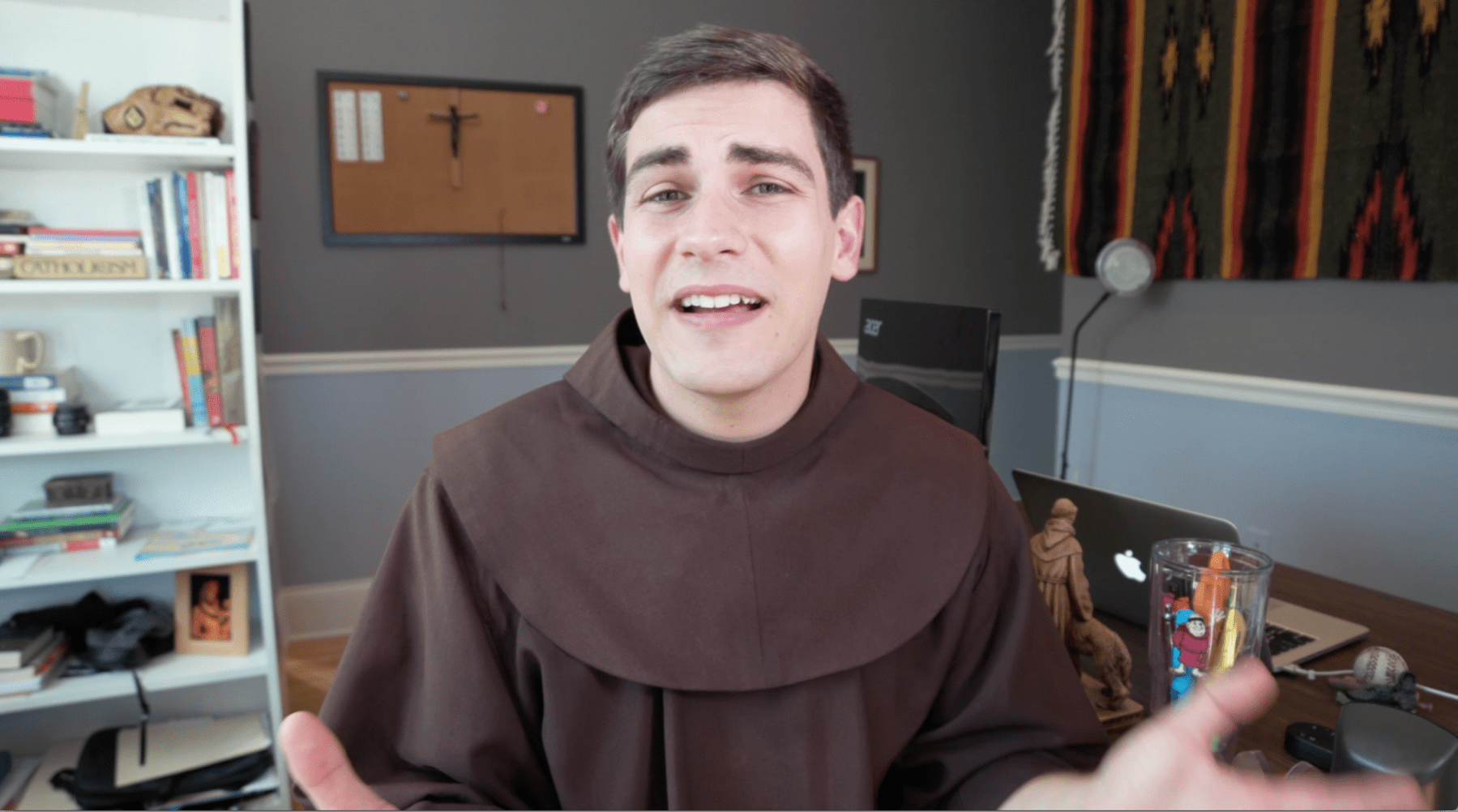
With that in mind, I have decided to try something a little new, presenting my weekly reflections in a new form: Vlogging. A medium that has far out-reached blogging in recent years, I think it’s worth a try.
All videos and news will still be posted here, so if you’re an email subscriber you’ll still get notified of new content, but the content itself might be a little different. Click here to watch, and let me know what you think!
Every second Monday of October, residents of the United States celebrate “Columbus Day,” a commemoration of Christopher Columbus’ arrival in the Americas in 1492. For many who live in this country, it marks the beginning of our history, the start of European settling in the Western Hemisphere.
For many others, however, the date and commemoration are not things to celebrate. Besides the fact that the Americas were “discovered” thousands of years earlier by the people who had called it home when Columbus arrived, his arrival marked not the beginning of our history but the end of theirs. In the decades that followed, many native nations were assimilated, thrown into slavery, or wiped out, witness to horrible atrocities that would continue into the 20th century. Today, 1492 represents a terrible memory—both for the remaining native people and for European-descended Christians who lament our first ancestors’ actions—of the evil that is possible when greed leads us.
Like all of history, though, it’s a mixed bag that leaves us sitting uncomfortably in the middle without a correct answer. Was Columbus a “bad” guy? I’m not willing to say that outright. As easy as it is to see the actions of a particular historical figure and judge them from the perspective of our current moral lens, doing so is not prudent or fair. While the actions of a historical figure may not be permissible today, we must always remember that we are where we are and know what we know precisely because of the lived experience—and major failures—of those who have gone before us. To impose our value system on a historical situation that was acting under completely different historical situations and values—essentially holding two people to the same rules even though they’re playing a different game—is not a beneficial way to look at history. While I do think that many of the acts committed against the native peoples were objectively against the will of God, we must remember, as in all cases, that our social context, systems of injustice, societal expectations, and limited worldview restrict our ability to freely choose the good.
For that reason, I spend this Columbus Day—or Indigenous People’s Day—or First Nations Day—or the Second Monday of October… day—not focusing on the evil committed by someone of history and accepted as normal by the people of his day; someone acting the way that most acted in their day is not worth commemorating, good or bad. Instead, I spend this day focused on a man who stood against what was normal and accepted in his day, a man who risked his life and reputation to stand for something that was unpopular and unheard of. That man? Dominican Friar Bartolomé de Las Casas, the “Protector of the Indians.”
For email subscribers, click here to watch this week’s video.
It seems like a rule of nature that conflict is inevitable. While the last two decades has been witness to extremely polarized thinking in both ecclesiastical and political debates, the fact of the matter is that people have always been in conflict. We disagree with one another. We get angry. We fight. Such is life. On this side of the Kingdom, I’m just not sure we can avoid it.
But oh do we try.
When I meet someone who has opinions diametrically different from mine, my first impulse is to try to change their mind. I may not open with that, and really, I may not even pursue it in action, but that desire is there. While small differences in opinion are not only good, they’re necessary, there is something deep inside of me that is unsettled when someone claims something I find absolutely ludicrous. I must fix them.
Maybe you know this feeling. If so, then maybe you know what usually happens in these cases: nothing. In my whole life, in all the people I have met and in all of the conversations about politics, religion, philosophy, or the like, I’m not sure if I have ever changed the opinion of someone who started off diametrically opposed to me. Never. Instead, what almost always happens is that at least one of us gets frustrated at our inability to fix the other person and we leave the conversation worse off than when we started: same opinions held but a worse relationship between us.
What do we do now?
More times than not, we just let it go. Rather than carrying the burden of the frustration with us well after the conversation is done, we try to forget the argument and move on with our lives. And on the surface, this seems like our best option: adding resentment to an altogether meaningless conversation is not good for one’s mental or emotional health, and benefits neither you nor your opponent. Letting the conversation go is probably the best thing we can do.
Rather unfortunately, though, we often let go of much more than that. In my experience, when faced with a difficult person or opinion that we cannot reconcile with the way we view the world, we often let go of the person as well. Rather than having to deal with the frustration that such a perspective is out there, and unwilling to accept that it cannot be reconciled with our world view, we employ a defense mechanism that eliminates the problem: we determine that that person or opinion is fundamentally wrong, therefore not of any worth to our lives.
It’s a nice tactic, actually. Able to put someone in a box—no, they put themselves in a box away from reason, not us!—our commitment to them and their ideas disappears. Those people are so messed up, we say. That one is crazy, we think. Why waste time thinking about or engaging people who are so far from right thinking?
And yet, as nice and comforting it is to us, as neat and tidy as it makes our relationships, when we do this, we forget something rather fundamental to our lives: As Christians, we do not have the luxury of writing people off.
As much as we want to solve problems by cutting people out of our lives and forever ignoring them, we do not have the luxury: we are called to forgiveness.
As much as we want to put people down for being “so messed up,” we do not have the luxury. We are called to love even our enemies.
As much as we want to attack others, play the victim, or try to get people our our side against them, we do not have the luxury. We are called to be meek peacemakers.
As much as the world may find certain behaviors and ways of dealing with conflict acceptable, we do not have the luxury. We are called to another world.
As much as we want to hide from issues and people, avoiding conflict and saying that “it’s not my problem,” we do not have the luxury. We are called to imitate God’s justice and mercy in our world, building up the kingdom of God, not just for ourselves, but for all.
There is no doubt in my mind that conflict has existed as long as life has existed and that it will continue long after I am gone. I have no utopian dreams of creating a world in which everyone holds hands and gets along, all thinking and speaking with one voice. This side of the Kingdom, conflict is a reality at the center of our lives. As Christians, that should not free us from being who we say we are—Christians. No, Jesus himself came and lived in a volatile world with conflict all around him. In fact, it is mainly through conflict that we know what we know about him and how we are to live. As easy as it is to buy into the values of the world—to act like the leaders of camps we see around us, to improve our cause by putting down our enemy, to determine for ourselves who is worth engaging and who is not—we need to remember one thing: if we want to call ourselves followers of Christ, we do not have the luxury of letting go of any part of the body of Christ.
Quotes. They’re a powerful literary and rhetorical device that bring meaning to what we’re saying, strengthen our argument, and legitimize our ideas, showing that someone of significance had the same feeling about something that we have.
Or they’re completely made up.
As comedian John Oliver presented on his late night HBO show two years ago, we live in a world where the spread of information reaches further than our ability (or desire) to fact check. While presenting a number of ridiculous and obviously fake quotes from Abraham Lincoln, Marie Curie, Alexander Hamilton, and even himself, he points out, “If you have the right font and the right photo any quote can seem real.”
No doubt, we have all witnessed this phenomenon on social media, and while we probably don’t want to admit it, we have probably perpetuated it. I mean, who among us hasn’t quoted Ghandi saying “Be the change you wish to see in the world” or seen a quote from Albert Einstein and said, “Wow, I like that”? Chances are, all of us have fallen prey to at least one of these 50 common misquotations or, more to theme of these blog, a misquote of the Bible or a popular saint.
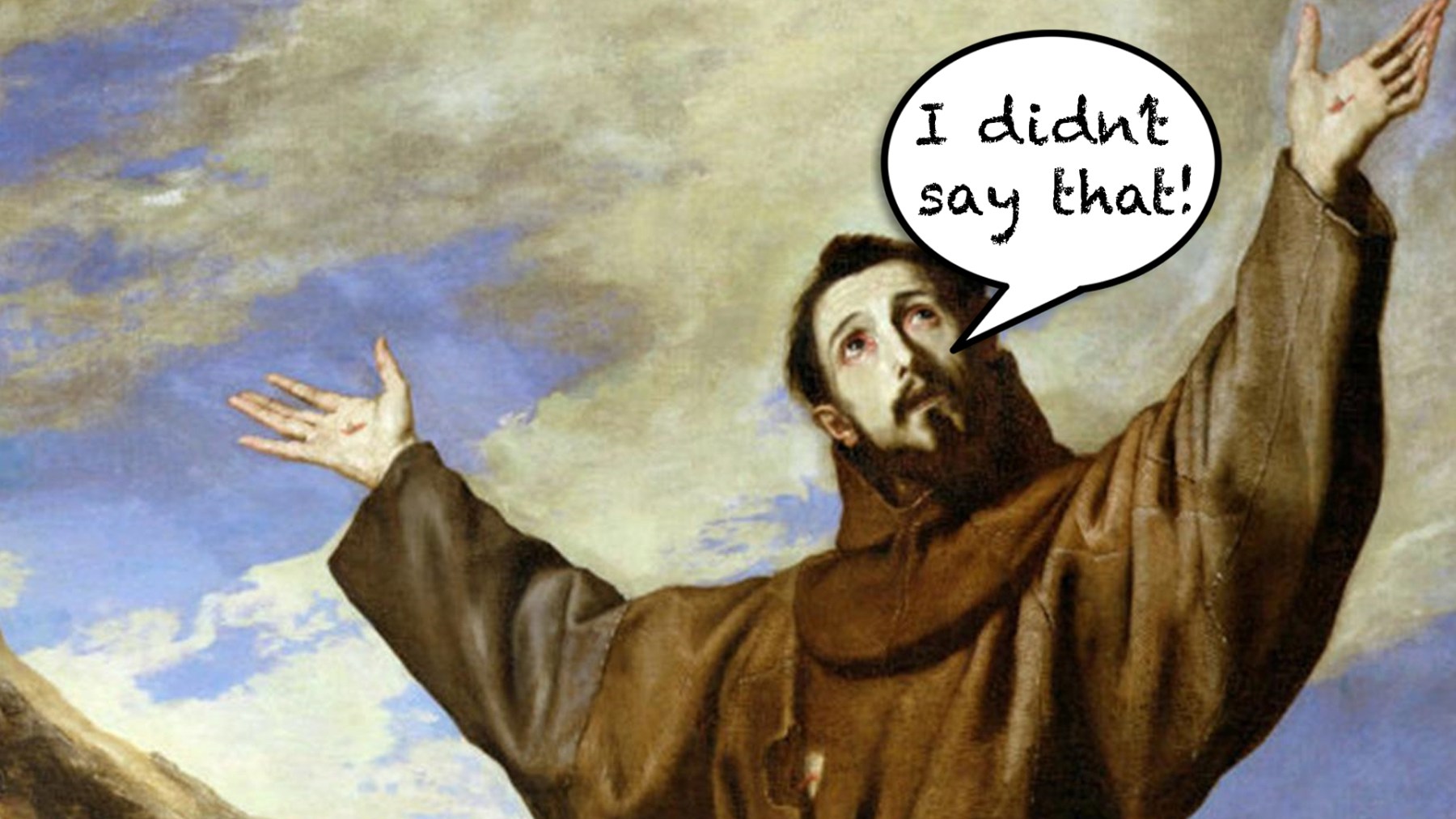
Which brings us to the beloved saint, Francis of Assisi. Arguably the most popular saint behind the blessed Mother, what St. Francis lacks in popularity behind Mary the Mother of God is more than made up for in misappropriated quotes. Sure, you can find pictures every once in a while of Mary holding the rosary (praying through herself…?) and there is no shortage of claimed apparitions, but no one matches the breadth of famously-quoted-but-never-actually-spoken lines as St. Francis. Do a quick Google search of “St. Francis quotes” and you will find tons of beautiful words attributed to the saint, many of which you have undoubtedly heard before. Many of them are great lines that touch our hearts and captures our imagination. And most of them have nothing to do with St. Francis! In researching this topic, I went to a popular quote website to see what he is credited with saying. Of the top 20, he might have said three of them (although none of them were exact quotations), but he most definitely did not say the first 16 listed.
That would not get you a good grade on an essay. Just saying.
But it raises an interesting question: what do we do with all of these quotes attributed to St. Francis? Outside of an academic setting where accuracy is paramount, I’m a bit torn. A part of me, sharing in John Oliver’s frustration, seeks for a purity of history, sticking as close to the facts as we are able and citing sources to support our claims. The spread of incorrect information is no small issue. And yet, there’s another part of me that sees the merit in even misattributed quotes. While not historically factual, there is nonetheless something true about some of them. Maybe St. Francis did not say these exact words, but he lived by their meaning, and, had he lived in the 21st century with us, might have said it just like that. In these historically inaccurate and misattributed lines we find an insight to the saint that we love and a way to carry on his legacy in a new world.
Or not. Some are just ridiculous and insulting and really frustrating and should never be said or shared or thought ever again. *Regains composure*
So, which quotes of Francis are authentic, and what do we do with the not-so-historically-accurate ones? That is the topic of this week’s Catholicism in Focus. In honor of the Feast of St. Francis this Wednesday, I look into some of his most popularly shared quotes on social media and give my take of their significance in our lives today.
As a final note, I have left here at the bottom some of my favorite quotes of St. Francis that actually have a source. Now, we can question the historical accuracy of the document (a much larger discussion for another time), but we are probably much closer to the real Francis when we quote sources from the 1220s rather than the 1990s… (All quotes from Francis of Assisi: Early Documents, New City Press, volume 1.)
“For what a person is before God, that he is and no more.” (Admonition XIX)
“A person sins who wishes to receive more from his neighbor than he wishes to give of himself to the Lord God.” (Admonition XVII)
“Nothing should displease a servant of God except sin.” (Admonition XI)
“Nothing belongs to you; you can boast of none of these things.” (Admonition V)
“Most high, glorious God, enlighten the darkness of my heart and give me true faith, certain hope, and perfect charity, sense and knowledge, Lord, that I may carry out your hold and true command.” (Prayer before the Crucifix)
“We must never desire to be above others, but, instead, we must be servants and subject to every human creature for God’s sake.” (Later Admonition and Exhortation to the Brothers and Sisters of Penance)
“When the day of death does come, everything they think they have shall be taken from them. The wiser and more powerful they may have been in this world, the greater will be the punishment they will endure in hell.” (A Letter to the Rulers of the Peoples)
“It is a great misery and miserable weakness that when you have Him present in this way, you are concerned with anything else in the whole world!” (A Letter to the Entire Order)
“The Lord gave me, Brother Francis, thus to begin doing penance in this way: for when I was in sin, it seemed to bitter for me to see lepers. And the Lord Himself led me among them and I showed mercy to them. And when I left them, what had seemed bitter to me was turned into sweetness of soul and body. And afterwords I delayed a little and left the world.” (The Testament)
“Hail, O Lady, Holy Queen, Mary, holy Mother of God, who are the Virgin made Church, chosen by the most Holy Father in heaven whom he consecrated with His most holy beloved Son and with the Holy Spirit the Paraclete, in whom there was and is all fullness of grace and every good. Hail His Palace! Hail His Tabernacle! Hail His Dwelling! Hail His Robe! Hail His Servant! Hail His Mother! And hail all You holy virtues which are poured into the hearts of the faithful through the grace and enlightenment of the Holy Spirit, that from being unbelievers, you may make them faithful to God.” (A Salutation of the Blessed Virgin Mary)
If you’ve followed anything I’ve written or said in the past six years, you know that fraternity is a pretty important part of being a Franciscan and one of the main reasons why I chose this life. While our public lives may look the same as diocesan priests or dedicated lay volunteers, there is just something different about our internal lives that makes this whole thing meaningful to me.
At least, ideally there is.
The problem, sometimes, is that we conflate “living together” with “fraternity.” While the former is pretty essential to developing the latter, it does not guarantee it. Sometimes, even when a Franciscan house has all the right elements—communal prayer, meals, recreation, shared work—it is not truly a fraternity. Sometimes, it is just a group of guys that share a common domicile and peacefully interact with one another on a daily basis. In other words, sometimes we’re just roommates to one another. In such cases, the life of the fraternity is left up to the personalities of the inhabitants: if they get along it’s “good fraternity” and they enjoy each others’ company, and if they don’t get along it’s “bad fraternity,” and they live largely anonymous lives under the same roof.
I didn’t join this life for a roommate. I don’t think I’ll survive in this life if it’s completely dependent on personalities.
No, for me, fraternity means much more than casual encounters. Fraternity, at its best, is the act of giving one’s life to another to create something more than oneself; of being vulnerable and interdependent with a group of people, in making sacrifices on behalf of the group, to become a part of someone else’s life and to let them be a part of yours. It’s not enough to be in the same place at the same time doing the same thing. At its best, fraternity requires a genuine desire to know and support one another as a brother, someone whom we care about and want to walk with.
I can’t tell you, though, how many guys I have lived with over the past six years and had no idea what they were going through or who they really were. Or who didn’t know me. Especially when living in a big house with busy people, it can be almost impossible to get to know everyone in a meaningful way. We go about our lives, praying the scripted Liturgy of the Hours and exchanging small-talk at dinner, without ever knowing what is going on in someone’s life.
And really, that’s not a knock on any person or house, that’s just the reality of the situation: dinner is not the usually the best time to share about one’s struggles in prayer or relationships, and most of our communal prayers are pre-written without room for additions. Unless a problem (or joy) is extraordinary, it’s probably going to be kept private or shared only on a personal basis, never reaching the life of the fraternity as a whole. In many cases, I have seen a group of men yearning for an opportunity to be more intimate with one another without an outlet to do so. The large group becomes very formal and business life, stuck in small-talk and superficiality, with intimacy and friendship reserved for later in the one-on-one encounters with those personalities that best fit us. In essence, there really isn’t a fraternity but a house of potential friendships.
For me, as forced or artificial as it sounds, I think you just have to schedule time for fraternity. We schedule time for food, prayer, work, meetings, and so on. Why don’t we schedule time to simply be one another?
One of my favorite examples of this, something that many in our house this year have begun to do, is faith sharing. Each Thursday night after dinner, a group of us meets in the living room for Lectio Divina and community time. Over the course of an hour, we listen to and silently reflect on the Gospel for the upcoming Sunday, share with one another what the reading means in our lives, and conclude by checking in with one another, offering to the group what’s going on in our lives and what we might need prayers for.
It is truly one of the best parts of my week.
Built around a basic structure, the act itself is not what’s important and we’re flexible each week to do something different. What makes the time meaningful is that we have decided to be with one another, for something, and come knowing that it is a space to share our lives with one another. Sometimes, the conversation is light and relaxing. Other times, guys share deep personal struggles and fears. Either way, I leave better knowing my brothers (and they knowing me), having taken the time to build a relationship.
Naturally, there are any number of ways to do this in a fraternity and the need for intentionality is not limited to a group of religious. Families need this. Spouses need this. Friends need this. Churches need this. As connected as we may feel in one sense through social media, we are a tragically disconnected world today, many people going through life feeling alone and yearning for greater intimacy. You don’t need to be in a religious community to find intimacy and joining a religious community will not guarantee it. What you truly need—what I truly need—is to simply find the time with the people that matter to me so that we can share our lives with one another.



 Breaking In The Habit