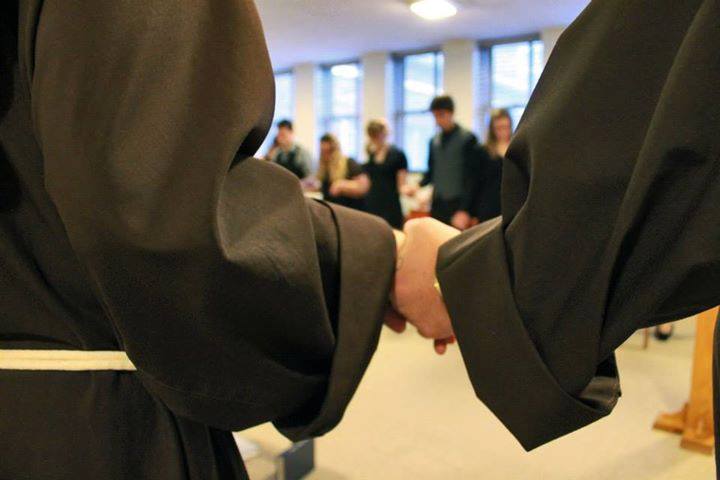
Last week I made a video explaining how the many groups of Franciscans developed over the centuries, splitting and reforming into the many Orders we know today. But I think there is an even more interesting question: what was so attractive about the early movement that it grew as quickly as it did and remains vibrant in the Church today? It’s in answering that question that we see why Franciscans are needed as much as ever in our world today.

A renewed sense of prayer

When we think of the medieval world, many of us think that everyone was Christian, that it was not until the modern world that “secular society” began to exist. The fact of the matter is that there has always been a divide between the religious and secular, and Christians have had various degrees of religious commitment since the time of Jesus. In Francis’ time, corruption (both at the hands of the Church and civil society), disenfranchisement, and apathy all around. Few people received the Eucharist, and because many people were either illiterate or ignored, they rarely had profound encounters with God in the Church.

With Francis and the Franciscans, the Church was called to a renewed sense of prayer and spirituality. Their “incarnational spirituality” showed people that God was in their midst, comprehendible and accessible to them wherever they were. And do you know what? They used entertainment to get their message across. The Franciscans were popular preachers. They did not preach precise doctrines or theological treatises, they preached the Gospel in the language of their hearers. They preached with joy, with life, and most of all, with creativity. Their spirituality caused people to change their lives, but their style of preaching made people want to listen to them in the first place.

Today, the world looks quite different, but the issues remain the same: many people are disconnected, alienated, even cynical towards faith. But notice how I don’t say that it is “secular society” or “new atheism” that’s the problem. While more and more people are claiming “no preference” on religion, there is still a strong spiritual yearning, even among youth. The real problem, as I see it, is that the established religions have failed to speak the language of new generations and engage them in a way that makes prayer meaningful. Too often, when faced with difficult questions, they’re handed answers of morality and philosophy when all they’re looking for is compassion, inspiration, and joy.

How do we respond? With engaging preaching that comes from a solid life in prayer. For Francis, the world was his cloister: he could at once be grounded in prayer while also attuned to the needs of the people around him, a witness to something greater.

Brought together in equality

The 13th century saw the beginnings of a new economic system: the feudal economy was fading away and the market economy was coming to prominence. On the one hand, it brought wealth to people who would have otherwise been ignored because of their lack of nobility; on the other hand it broke the bonds of responsibility for the poor and subjected some to even more humiliating poverty. It was a time of major class division, growing disparity between rich and poor, and no recourse to bridge the gap.

And then there were the Franciscans. Here was this bunch of men that brought together rich and poor at one table. Clergy, professors, princes, homeless, porters, lepers. Together in one family, they were all equal. Where else in the 13th century could you experience such radical emphasis on human dignity? Where could you step outside of the expectations and systems of society to live as the Apostles did? No where.

Today, we see the divide between the rich and poor growing rapidly in recent years. In the past 40 years, the United States has seen some of the worst of this: the top 1% own 10% more of the total wealth today than they did in 1979, have seen a 275% increase of income compared to 40% for the rest, and in 2011, despite being the most affluent country in the world, half of the United States lived in poverty or was designated low-income. Among the rest of the world, the United States is in the 30th percentile (70% of countries are better) with the trend getting worse.

How do we respond? By being minors for the sake of the poor. Because we do not believe that we are above anyone else or deserve respect because of who we are, we find ourselves among the poorest and most forgotten of society.

A Fraternity bigger than oneself

I can’t say exactly what it was about the time of Francis, but there appeared to be a deep yearning for brotherhood. Francis and his brothers were by no mean revolutionary when it came to the idea of forming a brotherhood: the middle ages saw a tremendous flux of new communities and orders all throughout the Church. The answer might be a simple one: people have a natural drive to be together, and seeing other people with similar ambitions is attractive.

Today, we live in a highly individualized culture. In a very positive way, the turn to the self has allowed more people to develop a personal relationship with Jesus in a way that previous generations simply did not even think about, not to mention the heightened sense of the personal dignity and health of self. These are great things. That said, much of our culture has taken this to the extreme, isolating and individualizing everything in such a way that we live fragmented, selfish lives. Everything is about “me, me, me.” The rise of new forms of communication have connected people in ways never before seen, but it has not been accompanied with the maturity and responsibility required to maintain personal relationship at the same time. Despite being so connected, so much of the world feels so alone.

How do we respond? With an example of “us, us, us.” Being a fraternity in mission categorically changes the way we do mission, and really, the mission itself. We don’t just work together, together we work for the sake of one another; we don’t just live together, we have lives together.

Building bridges, not walls

Finally, there could be no discussion about the Franciscans without a mention of peacefulness. One of the most foundational experiences in Francis’ own conversion was witnessing the horrors of war. In this time, there were battles between cities, wars between nations, and a little thing called the crusades. Groups like the “Knights Templar” and “Militia of the Faith of Jesus Christ” (seriously…) even sprang up as religious brotherhoods of soldiers, seeing it their duty to engage in violence for the sake of the kingdom.

The Franciscans could not be any more different. Francis always came in peace and told his brothers to always begin preaching with the words, “peace be with you.” They were forbidden to carry arms and could not even use violence to defend their own property or lives. As if this was not revolutionary enough, Francis even went to the front lines of the crusades and attempted to make peace. Crossing enemy lines, he walked right into the camp of the Muslims and spoke with the Sultan. Did he tell the Sultan that Islam was wrong? No. Did he try to convert the Sultan? Nope. He simply showed the love he had for God and spoke with him as a brother. Even in his words, Francis acted as a man of peace before all.

Today, violence is all around us. It is on battlefields, in our streets, on our televisions, in our politics, and in our homes. It’s as if we have forgotten how to dialog, how to disagree with one another while maintaining respect. In recent months, our political debates have been a prime example of this. But it’s more than that. Washington is not broken as much as Washington reflects the way we engage one another in our daily lives: name-calling, judging, excluding “those” people, looking down on those with which we disagree, and failing to show each other the respect we deserve.

How do we respond? By being peacemakers like St. Francis. Rather than seeing everyone as potential enemies, why not see everyone as Francis did, fellow children of God? Instead of starting conflicts or running from them, why not run towards them with a desire to reconcile? We need peacemakers who are willing to build bridges, not walls.

800 years ago, the Franciscans grew like wildfire because they were exactly what the world needed and people wanted to be a part of the movement. Today, I think that is still the case. What we stand for is exactly what the world is longer for.

But ideals and mission statements don’t change the world. Throughout history, it’s been the men and women who have heard the call and lived these values that has made the real difference. Nothing else will do.

So, what does the world need today. It needs men and women who live prayerful lives, lives that spring forth in creative in relatable ways; it needs men and women who are able to check their ambition and privilege at the door to be equals with anyone else who walks in; it needs men and women who are capable of struggling with others, overcoming their shortcomings, and making it work with others; it needs men and women who want to live for others, who want to build the kingdom of God even in the most difficult of places.

The funny thing about it all is that these people are already out there in the world, living and doing these very things. Maybe it’s even you. Maybe what the world needs most right now is not some politician to fix our problems or God to perform some incredible miracle, but you, as you are, living the 800 year old charism of St. Francis of Assisi.


Today’s Gospel reading at mass was the story of the rich man and Lazarus (Luke 16:19-31). What I offer to you is the reflection that I gave to my brothers in formation this evening.

“I didn’t do anything.”

That’s what I said to the principal when I was called into her office in 4th grade. (I’m not entirely sure if my parents actually know about this story… so… surprise!) You see, there was a kid in my class that no one really liked. He was loud and immature, often dressed inappropriately and had bad hygiene, and was known for acting out,  bullying others, and saying inappropriate things to the girls. He was a bully that no one liked… a very bad combination.

One day, things boiled over. At morning recess, he apparently touched one of the girls in our class and said something to her, and my friends didn’t like that. Enough was enough. They planned to teach him a lesson. At lunch recess, they were going to corner him and “beat him up” as they said. When lunch came, we all went out to recess, and three of the guys in my class started pushing him, calling him names. I think one of them even kicked him.

The kid didn’t sustain any major injuries, just a scraped knee and a scratch on his eye,  but it was a big deal in the school. The three students who had orchestrated the whole thing were called into the principal’s office, but so was I and a few other students. “I didn’t do anything,” I said. “It was ____ and _____ and _____. They were the ones who beat him up. I did not even touch him.”

In my mind, I was innocent. My principal didn’t think so. As she saw it, I knew something bad was going to happen, but I didn’t stop it. Why didn’t I say something? Why didn’t I intervene? Why didn’t I help him? Even though he was weird, even though he might have even brought it on himself, even though I may have suffered a bit myself for defending him, no one deserves to be treated that way. I had the power to do something, but didn’t do anything.

In our Gospel passage today, the rich man finds himself in a similar situation. No doubt shocked to find himself in a place of torment while Lazarus is in the place of honor, you can almost hear him say, “But I didn’t do anything. I didn’t make him poor. I didn’t steal from him. I didn’t make him unclean.” And maybe he didn’t. But just like me in the fourth grade, the rich man knew Lazarus. He knew that he was suffering. I mean, cmon, he was lying at his door! He probably needed to step over him to go out! Even though Lazarus was not the most desirable person in town, even though he was probably unclean and the rich man may have suffered for helping him, no one deserves to be treated that way. The rich man had the power to do something, but didn’t do anything.

I think that is what’s so powerful for us to remember today: Not doing anything is not amoral. Doing nothing does not free us from guilt; in life, there is no “pass”; we can’t just opt out of acting… even doing nothing is something. It’s why in the confiteor, the act of contrition we say at mass, we pray for God to forgive the sins of “What I have done, and what I have failed to do.” Sometimes, what we don’t do can have a tremendous effect on others, and can absolutely be sinful.

It doesn’t take much to see so in our world. When we look at the world’s problems, global epidemics of poverty, climate change, human trafficking, and so on, it’s easy for us to say, “Well I didn’t do that.” And maybe we didn’t (I think we are complicit in much more than we realize, but that’s for another post). But what we often don’t realize is that we are in a position of privilege. If you are able to read this post, it’s likely that you find yourself among the wealthiest 25% in the world. Wealth. Education. Civil liberties. Social status. Even just the knowledge that there are problems in the world that need fixing and the time to think about them is a privilege. In so many situations, we are the rich man facing Lazarus each day.

But it happens much closer to home. What about our friends and families. Here in this house as brothers. We often know what our brothers are going through. We know that they need help at times. Sometimes, it can be very easy, especially if it’s a brother that we don’t particularly like or even annoys us, to write them off and say, “He brought it on themselves” or “He’s not my responsibility,” or “I didn’t do anything.” And likely we didn’t. But that’s not what’s important here: there is a situation in which we are able to do something to build up the kingdom of God.

Because, in the end, whether it’s our brother, Lazarus, or that poor boy in my 4th grade class, it is not up to us to determine who is worthy and who is not. It is not us that grants dignity, and so it is not up to us to decide who we should care for and who we shouldn’t. We may face a lot of people in need in our life, a lot of which are very difficult to be around—you might even think about some people in this room. Who knows. One day, though, we will have to answer to Jesus for what we did and what we did not do. On that day, will we be able to say that we did something for our brothers and sisters in need, or will we be left with nothing to say except, “I didn’t do anything”?

“Which type of Franciscan are you?”

While strangers on the street may ask me if I’m in a renaissance fair or am impersonating a Jedi, this is the most common question I get asked by fellow Catholics and other religious. They know that I’m a religious, can tell that I’m probably a Franciscan, but which one?

Benedict Groeschel’s group? No. The friars on EWTN? Nope. Capuchin? Not today. The friars at Stuebenville University? Different friars.

As the conversation continues, we usually end up in one of two places: “Why are there so many types of Franciscans?” or even better, “Which one is the real/original one?” My response? “It’s complicated.”

And it is. Our history is fragmented and diverse. It’s needlessly complicated and unlike all other religious orders. There are three branches of Franciscans, and within each branch there are many different types, either breaking off from previous groups or starting as another order and then be assimilated into the Franciscans years later. There are hundreds, and new ones even created today.

Many have asked me to explain the difference between the groups and I have always resisted. While each group is definitely different and I could probably make some generalizations about many of them, there are also exceptions to each generalization and overlaps to difference. Because the groups developed organically over time, its hard to make clear distinctions between them; we’re all Franciscan… just a slightly different thread of the same cord.

That doesn’t mean there’s nothing to share, though. In this second installment of Catholicism in Focus, I look at the historical development of the three branches of the Franciscan Order to try to make as much sense of it as I can. It’s not complete, and it’s by no means perfect, but maybe it will help put some things into perspective.

For those reading this through email, click here to watch the video.

There are few shows that I enjoy (and quote) more than Scrubs. Just ask my friends. More sentences have been started with, “It’s like that episode of Scrubs…” than any other phrase. There isn’t a life situation that I can’t relate back to one episode or another.

This week, though, the association went the other way around: while watching an episode, I was struck by something I had learned last year in my marriage and family class.

The episode is entitled, “My Sex Buddy,” and I’m sure you can guess what it was about. While going through a rough patch in each of their lives, two of the main characters find themselves in bed with one another to ease the pain. The next morning when they wake up, they’re both terribly embarrassed. Besides the fact that the same thing had happened in the previous season, starting a relationship that barely lasted an episode, they just know they’ve made a terrible mistake when they look at one another… Until one of them decides that it wasn’t a mistake at all. “I guess we could be sex buddies,” she says. And so the episode goes. Vowing to sever emotion from sex, the two seek each other out whenever they’re stressed, excited or just bored. Sex is a game, an adventure, an event to pass the time. There’s no need to get bogged down in emotions or commitments. “It’s just sex,” she says. This, her male counterpart thinks, is “what every man wants to hear.”

But despite the warnings of another lead character against the arrangement, the situation ends poorly. One of the characters finds himself unable to separate his emotions from the sexual encounters and is left hurt by the rejection of the other; the other character, continuing her normal trend established in previous episodes, seems unaffected by the situation but struggles to find happiness in her relationships. Both characters, until the final season of the show, exhibit incredible difficulty committing in a relationship.

While just a typical television sitcom, what these characters go through is exactly what scientific evidence has suggested in recent years and what was a topic of discussion in our Marriage and Family class. You see, besides obvious increased risk of unwanted pregnancy, STIs, and feelings of shame and lower self-esteem (more likely among women than men), casual sex can drastically mess with one’s brain chemistry. Aside from producing dopamine, a chemical in the brain that produces pleasure in the similar way that intense exercise and synthetic drugs do, sex also exposes the brain to oxytocin, a hormone intrinsically related to social distance between people. Increasing one’s disposition to trust, become attracted to another, and willingly raise children (oxytocin is produced in women while breastfeeding), oxytocin is a medical explanation of love and commitment.

What do we make of this? Some in today’s world look to this as a way to argue for greater promiscuity and experimentation, as it will inevitably lead to creating lasting bonds. Test out sexual encounters with many people until the bond is created, they say. Unfortunately, this is incorrect. While there have been noted potential benefits of sexual encounters in general, ranging from higher confidence to better test scores, casual sexual encounters actually hurt one’s ability to create lasting bonds. Even though we are biologically disposed to create bonds and sex helps facilitate that, research is showing now that repeated casual encounters that attempt to sever emotional attachment from sexual activity, tied with continued cycles of sexual encounters that eventually lead to break up and loss, trains the brain to suppress the effects of bonding. In other words, “hookups” actively fight against our natural tendencies to be together until people are biologically disposed not to bond; hookups challenge one’s ability to commit.

So what, you say? Anonymous sex is exciting, mysterious! It makes me feel alive! And for many people researched, it is. At first. But as one severs the emotional attachment from the encounter, two very big problems have begun to occur in many people: 1) the lack of communication or relationship has led to an entirely physical focus, actually diminishing the pleasurability of the act over time because emotion is such a powerful part of the experience, producing 2) a desire or need for increased number of encounters to achieve the same experience, essentially creating an addiction to the release of dopamine rather than a fulfilling, healthy experience. Together with the ease of access of internet pornography, the American Association for Marriage and Family Therapy estimates that 12 million people in the United States experience some level of addiction, while incalculable number experience greater difficult achieving intimacy in their relationships. This is not just a problem, this is an epidemic.

So, why does the celibate man choose to discuss such a topic so close to Valentine’s Day? Might he be a bit jealous or repressed, simply wanting an opportunity to seem morally superior and in control?

I assure you that this is not the case and that I am by no means morally superior to any of you. This is not a condemnation of anyone or an exaltation of myself. We all have our sins and vices, past and present, and we should never forget that.

In all honesty, I’m not entirely sure why I write this today. Maybe it’s because the issue is so prevalent in our lives and I don’t find enough intelligent conversations. Maybe it’s because I see so much pain in people and want them to have a fuller experience. Maybe its just because I found the science interesting and wanted to share it. Who knows.

What I do know, though, is that sex is everywhere in our culture. It’s the topic of our conversations, jokes, entertainment, and advertisements. Everywhere we look we are bombarded with messages of sex. Whether we’re willing to admit it or not, I imagine many of us like that too. Sexual desire is a strong desire in humans, and that’s nothing to be ashamed of. Too often the Church is branded as anti-sex or prudish; the very notion that a friar is writing this may seem odd or scandalous to many. The fact of the matter is that the Church loves sex, sees it as a wonderful gift from God, and wants people to enjoy it to its fullest. Sex can be an act of prayer, an experience of the transcendent God. What else can one do to produce life? It’s a mystery, a wonder in our eyes.

Or, at least it can be.

And maybe that’s the problem. Maybe that’s why I chose to write today: the wonderful gift that God has given us is too often tread upon, neglected, or misused. The fact that our culture gives sex so much prominence and attention isn’t what bothers me, it’s that it strips it of so much of what makes it so wonderful. It isolates one aspect of the experience and manipulates it for the greatest gain, leading so many to believe that “hooking up” is the height of excitement and pleasure. But it’s not. The Church is not prudish or repressed when it calls people to commitment, relationship, and life, it is simply calling everyone to realize that there’s so much more to sex than simply hooking up.

It’s like that episode of Scrubs.

Each year, Catholics give something up for lent. For forty days, we struggle through our penance, going without something we really love. Everyone does it. It’s just a part of our faith as Catholics. But why? What is the reason for this devotion? In this latest video, I look at this popular Catholic practice against the backdrop of the early Church and suggest that our focus during lent be on something a little different this year.

This video is also the first segment in a new series entitled, “Catholicism In Focus.” Throughout the series, I’ll take a deeper look at the things we say and do in our faith all the time, but maybe don’t think much about. Things like, Why the Church loves science, and always has; why we now profess that there actually may be salvation outside of the Church; and why Catholics weddings are so different from Protestant ones.