The last couple days have been… shall we say… grim. Besides the official election of a controversial and volatile president sparking protests and further tearing our social cohesion at the seams, an ambassador was assassinated in cold blood and on live television in Turkey, twelve people were killed at a Christmas celebration in Germany as a crazed truck intentionally drove into the crowd, and the evacuation efforts in Aleppo continue to reveal to the world just how terrible the Syrian situation is. Before that, the State Congress of North Carolina (led by a lame-duck governor) held a secret, surprise session effectively changing the rules of the state before the new electors take office, the CIA and FBI agreed (a rare, unsettling feat in itself) that Russia hacked the US with the intention of swaying the election, and the Vatican’s newly-issued statement about homosexual clergy served only to reignite angry debates in the Church. Oh, and there was of course the 10,000 children of the world under the age of five who died from preventable causes, the 28,000 people in the US who were physically abused, and the 4,600 US residents who were diagnosed with some form of cancer, all of which happen every day.

Yeah, it was a grim day.

If you’re an idealist like me, someone who takes our collective “created in the image of God” seriously and thinks that we’re but one human family, days like these can be extremely troubling. How can there be so much wrong in the world? When days like these happen—when the reign of God seems further away than the day before—I find myself pulled three different ways.

Look away 

Especially this time of year, it can be really easy for me to disengage from the problems of the world. At a time when we’re supposed to be merry and celebrate “peace on earth,” the existence of cruelty, sadness, and downright evil can overwhelm me and ruin the atmosphere of the season. Other times, I’ll admit, I’m just too exhausted to care about anything else—my heart simply can’t handle more bad news. I know that there are bad things in the world, but I can’t do anything about it but weep, and so all I can think to do is look away. Turn off the news. Sign out of Facebook. Don’t read the newspaper. Just pretend it doesn’t exist.

Give up

At the same time, there is a part of me that can’t look away… but also can’t do anything about it. I’m a silent, helpless spectator watching a car crash. At these times, there is a strong temptation to resort to cynicism. The world is messed up. Nothing is ever going to change. What can I really do? Whether it’s enormous, systemic problems like global poverty, or minuscule, petty problems like the unrelenting bad habit of a roommate, my frustration and dissatisfaction can get the best of me and I can be left in a state of emotional and spiritual paralysis, unable to work or hope or live for something better. The only thing left to do is give up trying.

Trust

But there is a third voice that calls to me. Beyond the initial defense mechanisms of denial and learned helplessness, deeper than my gut reaction to run from pain, there is a voice that is not guided by fear, but by trust. In the midst of a torn apart world, it calls to me not to look away, but to let my heart be broken by what I see. When it feels like nothing can be done, it calls to me not to flee, but to go down with the sinking ship. Letting myself be truly moved by the horror of the world—to the point of anger or tears—is not time wasted. It is time spent converting my heart to the heart of God. Refusing to give up in the face of imminent failure—potentially losing something in the process—is not futile stupidity. It is an act of solidarity with those who cannot run away, who cannot give up, who cannot stop trying. There are some who are not afforded these privileges. All they can do is trust. Trust that reminds me that there’s more to the story than I can see and more being down that I can know. Trust that reminds me that, even in failure there are opportunities for growth and love and progress. Trust that reminds me that the world has survived much worse in the past, and yet keeps turning. Trust that reminds me that God created all that is, came to be a part of it, and never left us alone to figure it out.

It is from that trust—something, I will admit, is not always present—that I am able to see through days like yesterday into a greater world. I am able to see that it is this world, our broken and imperfect world, that Jesus chose to come into. Despite the chaos and the disappointments, the tragedies and confusions, the messiness and defects, God chose and still chooses to act in this world. It is tempting to turn away and not look, to give up and no longer try. And I get that. I’m chief among those who shut down when things aren’t perfect. But I also know that when we look away or give up, we fail to see God entering in our midst.

Don’t look away.

Don’t give up.

Trust in the God who is with us.

The liturgical year is one of the greatest gems of the Church. Over the course of the year, we ritually live out the events of salvation history, calling to mind what God has done for us and what God will continue to do. For those who fully enter into it, each season offers a chance to experience God in a different way, focusing on a particular experience of our lives with God and how we are to respond to it.

In Advent, of course, our focus is on what is to come: we wait in joyful anticipation for the coming of our Lord Jesus.

But what does that actually mean?

For many, the focus is what immediately follows Advent: Christmas. What we await is the birth of our Lord, the Incarnation of God as a human being. And who can blame us? It’s no doubt the greatest mystery of all of human history. The Creator became the created. Think about that. God, the all-knowing, all-powerful being that holds together all of existence… came to be a meek, poor, vulnerable creature in a volatile time and place in human history. God took on our humanity (or did we take on His? Look for a video the day after Christmas…) No doubt, this is something to celebrate.

At the same time, though, that event took place in history, meaning that it is long past. Nothing, in effect, will be different come December 25. At Christmas, we celebrate a remembrance of that amazing encounter—and rightfully so—but in many ways, it is just that: a remembrance. Christmas is not the day of the year in which Jesus actually comes in a way that He is not already present to us now, and it is not somehow special because it is the exact date that it happened, like a birthday (no one knows when Jesus was actually born. The date was set in the third or fourth century.)

For many, then, Advent is kind of a strange season if they think about it. If what we celebrate on Christmas has already happened, what are we waiting for in Advent?

  • Some pretend to be surprised, holding back the information they already know so that they can be like the people of Israel who heard the Good News and rejoiced. But how could we forget what we already know?
  • Instead, others try to make Christmas out to be something more than it already is, a day in which Jesus is actually born is some way, that his presence to us on that day is somehow unlike it was was on the previous day. But how can (or why would) Jesus be born anew every year and then leave again?
  • Finally, and probably most common of all, some don’t think much about it at all, simply seeing the season of Advent as a cute ritual of lighting candles and holding back our excitement so that Christmas will be that much more joyful. But why would the Church devote four weeks of the liturgical year to something that’s simply cute or enjoyable?

In my latest YouTube reflection, I want to offer a slightly different approach. Advent, although immediately preceding Christmas, is not primarily a waiting or preparation for the celebration of Jesus’ birth, but in fact quite the opposite: because we already possess the Good News of the Incarnation, life, death, and resurrection of Jesus, what we await now is not His first coming, but rather His second. Unlike the people of Israel who longed for a Messiah, we already have one. We cannot forget this fact, it cannot be taken away from us, and it cannot happen again. Thus, we wait and hope in the Advent season, not because we do not know what will happen, but precisely because we do.

For this reason, Advent is indeed a time of waiting and hope as we have always celebrated, but the knowledge of Christmas gives meaning to our hope and forces us to look beyond what we celebrate: to a world when Jesus will sit on His thrown, the Kingdom of Heaven will be established, peace and justice will reign, and the weak will be lifted up. For three weeks now that has been the message of our Old Testament readings at mass. Really, that has been the focus of our waiting. We do not await a child born on December 25, we await a King to bring justice to our world.

That is what this liturgical season is all about. We are called in this time to remember what God has done throughout history, but also to focus our attention on what God will do one day. We are called to prepare ourselves to receive Jesus into our lives, but also to realize that we already have a foretaste of the encounter we await. We are called to hope for a better world, but also to focus our attention on how we already possess the answer to that hope and are capable of laying its foundation with our own works of peace and justice.

Advent is a wonderful season of the liturgical year. In fact, it might be my favorite. It is a time when we most realize that the world we seek is not the world we have. And yet, it is a time when we are reminded that things will change, and that we can do something about it. We cannot bring about the second coming of our Lord, but because we already possess him in our memory and in our breaking of the bread, we can in fact bring Him into our world, even if it is just a foretaste of what’s to come.

So I guess my question is this: What are we waiting for?

For email subscribers, click here for the video.

The book of Revelation tells us that heaven will be comprised of the elect from all nations and races throughout the world, feasting together as one at the banquet of the lamb. It’s an incredible image of unity in God and each other, a time in which our differences can no longer keep us apart. That, I believe, is what we are striving for as we build the Kingdom of God on earth.

Heavy emphasis on the striving.

It might go without saying, but this image of heaven does not come easily. As ideal as diversity is—no doubt a goal for us as Christians—it cannot be overly romanticized. Diverse communities are difficult (and trust me, I know. My novitiate had representatives from six different nations in one house. Even simple issues like grocery shopping became catastrophic at times!) Besides the obvious differences in personality and opinion that even the most homogenous of communities experience, racially and culturally diverse communities find themselves at odds over some of the most essential building blocks of the communities: style of prayer, morality, food, sense of authority, and family systems, to name a few. “Common sense,” as it were, is not exactly common to all, and planning a common worship, common meal, or common project can present very uncommon problems.

That is, if everyone is even able to communicate with one another.

As if cultural differences weren’t enough, language is not uniform in so many of our churches throughout the United States. And unlike in years past when each new immigrant group brought their own priests and formed their own ethnic churches (sometimes resulting in a Polish, German, Irish, and Italian church all on the same street), most of today’s churches work toward integration and assimilation, trying to form one multi-cultural church rather than many small individual communities of faith.

When done well, it’s easy to see why. Imagine going to mass and seeing people from over 100 countries celebrating a mostly-organized mass containing four or more languages, songs from multiple cultures, and unfamiliar liturgical practices that snap you out of the “same old drab.” That was my experience at one of our parishes, and I have to say, it’s incredible. So enlivening! So inspiring! You look around and see every shade of every color, people from all corners of the earth, coming together as one Church for a common purpose with joy. When done well, diverse communities can be a taste of the heavenly banquet: unity, diversity, and cooperation.

This, unfortunately, is not norm though. In far more cases than the one above, a “multi-cultural” parish simply means that there are people from different countries and languages worshiping in the same building; it says nothing about doing so together or at the same time. There’s the English mass and the Spanish/French/Other mass, with no overlap or interaction. While sharing the same name, what could be one, diverse church ends up being two distinct churches that share a building. In some cases, the relationship may not even be perceived as “shared,” as in mutual relationship, but rather “lent,” as in one community owns the church and the other, second-class citizens, simply uses the space when allowed. When not done well, diverse communities can be just another taste of the earthly banquet: division, hierarchy, and competition.

And yet, as I live and work in a parish that falls somewhere in the middle of these two poles, I’m not sure what the goal should be. The “multi-cultural” mass of the first parish is not without its weaknesses. Thought very powerful at times, is it really something that would work if imposed on every parishioner? Sure, it’s beautiful when people come together for common worship, but when you don’t speak any language but your own and are constantly being presented with symbols and customs that mean nothing to you, there is going to be something lacking in one’s experience of the liturgy. On the other hand, if one is never forced outside of their comfort zone, never presented with new or different ways of experiencing and praising God, one is missing out on a whole world of ideas—and people—that build up the Kingdom of God. It’s great to say that “we’re all brothers and sisters,” many pieces of the same Body of Christ, but if we never actually interact with one another when we share the same building, doesn’t that become just nice Hallmark-y language we like to say but not live?

I don’t know. I think in the world of ideals and heavenly realms, it’s easy to come up with answers. But what about today? What about the limitations we face in this world? Maybe “separate but equal” is okay, each of worshipping with those who are like us in a way that we understand. It’s from the heart, is intellectually grasped, and authentic. But maybe it’s not about us and what we understand. Maybe it’s not enough to talk about communion and solidarity, it’s more important to live it, even if we can’t even ask the person next to us their name.

Ultimately, it comes down to one question: How, in a world of limitations, do we begin to strive for what we await, the heavenly banquet in which all are one? Honestly, I don’t know if I have the answer, and I don’t even know if the perfect answer is even out there. What I do know, though, is that it’s an important question to ask and try to answer, even if imperfectly done. If we believe that it is God’s intention to bring us all together in heaven, that for all eternity we will live without differences  or separations, then it makes sense to me that we begin striving, in the best way we can, to make that happen in the here and now. The ideal, like all ideals, is not something we expect to grasp in our lifetime, but it offers us an image and inspiration for the direction we can start walking.

In the Catholic and Orthodox Churches, Mary the Mother of Jesus has a place of prominence among the saints. Throughout the liturgical year of the Western Church, we celebrate her conception, birth, presentation, annunciation, visitation, motherhood, sorrow, immaculate heart, assumption into and queenship in heaven, and her intercessory power through the rosary; we commemorate her many apparitions throughout history in Lourdes, Fatima, Mount Carmel, and Guadalupe. In all, there are more than 17 feasts and memorials, two months of popular devotions, and countless prayers and novenas devoted to Mary throughout the year.

That’s a lot of face time.

For many Protestants, and even a few Catholics like myself, this can be the source of a bit of heartburn. With the amount of time we devote to her and the elaborate statements we say about her, Mary the “Mother of all” becomes less like us—someone who shared in our experience and so offers us a path to follow—and more for us—a being of heavenly origin with special power and authority to act on our behalf. The existence of the “Co-Redemptrix” movement (the controversial, yet unofficial, idea that Mary was essential to the salvific actions of Jesus), the title of Queen (the complimentary title to that of King, the position held by God), and the replacement of female deities in native religions with the image of Mary, only heightens the concern. As a result, many like myself revere Mary and acknowledge her significance, but do not really have the “high mariology” that is so popular in our Church.

For me the issue comes down to something very simple: I already have a mother. I’m glad that Jesus had a mother, and I think anyone who gave birth and raised our Lord and Savior is worthy of respect, but I don’t need her to be everyone’s mother. I need her to be Jesus’ mother.

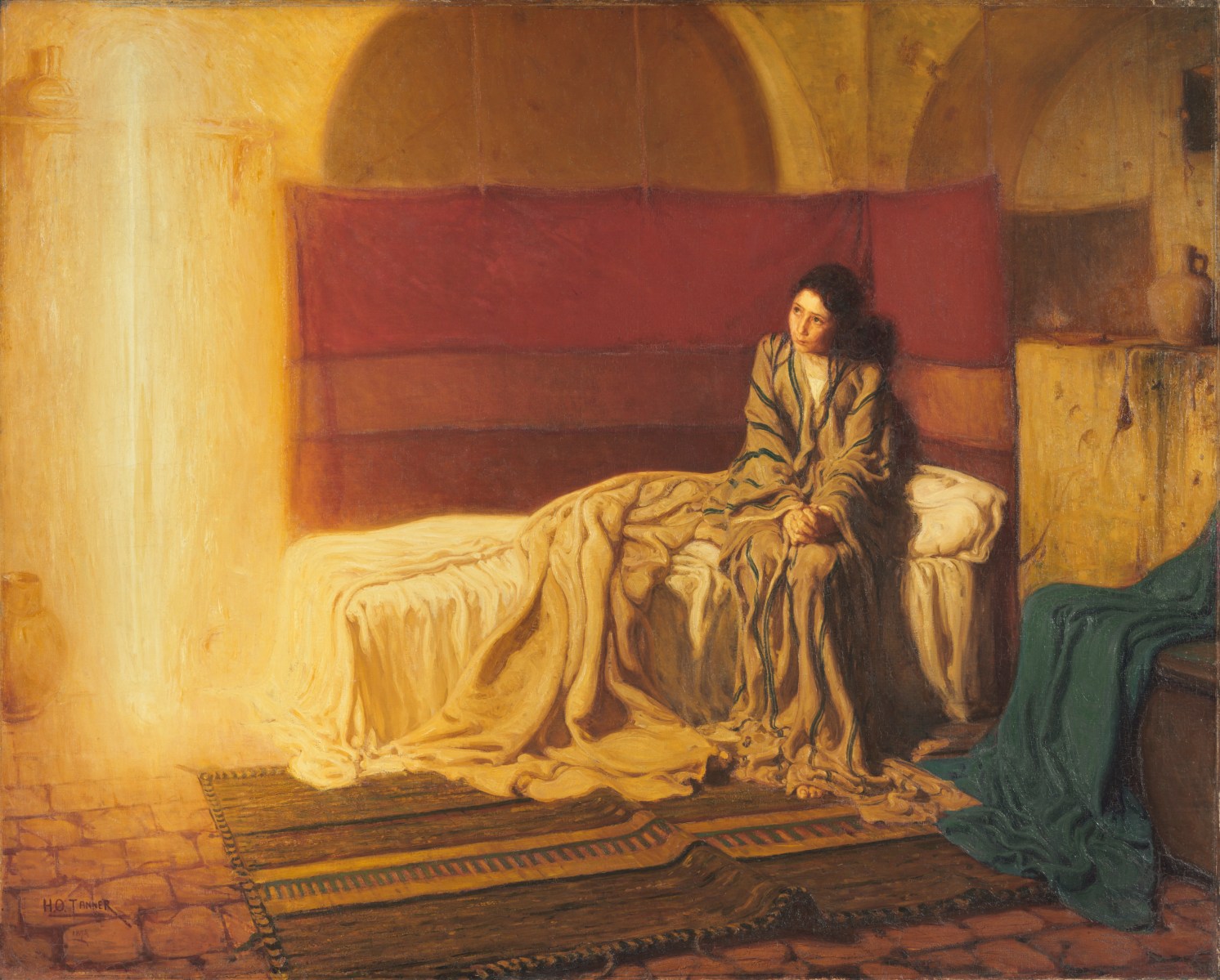
Which is why, I think, my devotion to Mary has grown of the past few years in the season of Advent. Before Mary was seen as the mother of all, before the countless devotions of Mary spread throughout the world, before she was crowned the Queen of heaven, before statues, shrines, effigies, and paintings were constructed in her honor, even before she gave birth to Jesus, the Son of God, Mary was a little girl with a call:

The holy Spirit will come upon you, and the power of the Most High will overshadow you. Therefore the child to be born will be called holy, the Son of God.

There she was, a little girl from a small, insignificant town—a nobody—and through an angel, God was asking her to take part in something beyond her ability or comprehension. “How can this be?”

Like any of us in that situation, Mary was unsure. Like any of us, Mary was afraid. Like any of us, Mary sought wisdom and refuge with family and friends. In remembering her annunciation and visitation, Mary is not the exalted Mother from on high that we so often celebrate today, she was simply a faithful member of a community trying to find her way through the normal difficulties of life. At least in the way she understood herself at the time, she was just someone like everyone else, faced with a big task.

Thus, it is in this season of Advent as we await the coming of our Lord, that a different title for Mary comes alive for me: sister. In these four weeks, Mary is not a queen on her throne to be revered and looked up to, she is a peer to be walked with and inspired by, an equal with gifts and flaws and idiosyncrasies. While the image of “mother” is usually one of reverence or submission, the image of “sister” is a bit more relatable: friendship, rivalry, maybe even conflict. We are reminded in this that her experience is so very much like our own, that what she did in the most significant and literal of way—carrying and making God present in history—we are also supposed to do in our own lives. We are reminded that saying yes to God is not always an easy or safe task, but it can be done. It should be done.

Mary, our sister, shows us so.

That is the Mary that I remember in Advent. That is the Mary that I have a great devotion to. Maybe, like me, the amount of attention the Church gives to her and the elaborate statements it says about her make you feel uncomfortable. That’s okay. Praying the rosary and having a regular devotion to the “Blessed Mother” are great acts of piety, for sure, but they’re not things for everyone’s spirituality. But just because you don’t have that spirituality or are called to those devotions doesn’t mean that Mary can’t be important to you.

We may not need another mother, but we can always use another sister, friend, or inspiration to help us get to who really matters: her son. I can’t think of a better person to have in our lives in Advent.

Five years and some change ago, I made the decision to start a blog. Ugh. I had become one of them. You know, those people that think what they have to say is so interesting and important that people will want to follow them. Those people that think that just because the little button on the blog page says “Publish” means that they’ve actually contributed to some meaningful or respectful cause. Yeah, those people.

I was not thrilled about the idea, and was very self-conscious. When I first thought of the idea as a means to keep friends and family in touch with what I was doing (at their request), I resisted. When I found that it was, in fact, the easiest way to do so, I apprehensively began writing, but was not keen on sharing it too publicly. Maybe if down the road there were people who were interested in the friars and wanted to know what life was like… maybe they could read some of the posts.

As with most things, though, I was immediately stretched beyond my comfort, and have been stretched ever since.

The fact of the matter is social media is a powerful means of connecting with people and spreading information. Even though I was just some random person living in the armpit of the US—by which I mean Wilmington, DE—people wanted to read my posts and ask me questions. Over the next three years, I started to get messages from all over, asking me about being a friar, wanting to know what my personal experience was like, and requesting prayers. I accepted this new endeavor, as it were, as a sort of ministry through social media.

But as in most ministry experiences, just as I was beginning to feel comfort in what I was doing, I felt a push to stretch further. What about really stepping out there? Writing a blog with a few hundred followers is one thing, but its impact is minimal. People don’t read that much. They spend their time watching, and sharing, easy to consume videos on YouTube. What about making videos, the voice inside asked. Ugh. I don’t want to become one of them. YouTubers are even worse than bloggers because they think that they’re so special people not only want to know what they’re thinking, they want to watch them ramble on about nothing. They think that just because they’ve posted a video with their expensive camera that they “make movies.” Yeah, those people.

Once again, I was not thrilled with the idea. But once again, there I was, buying a camera and filming a road trip across the country. Almost immediately, it expanded to regular reflections, and before I knew it, I was completely engrossed in the world of making videos: watching YouTube for tips, taking a film class, and all the while becoming more comfortable with the new ministry.

I share this bit of background as a means of exhortation. Why not do the same? What I have done over the past five years or so is not the work of an expert with loads of education in the field, its simply the result of being honest to who I am and open to where that might lead me. With the amount of time that people spend on social media sites, that’s where we as Church need to be. Why not meet people where they are, replacing what they’re consuming with quality messages? Why not evangelize through social media?

Knowing, of course, that there is not one right way of doing this, I do think that there are some common principles that we should always keep in mind. This most recent video shares seven of them.

For those on email, click here to watch the video.