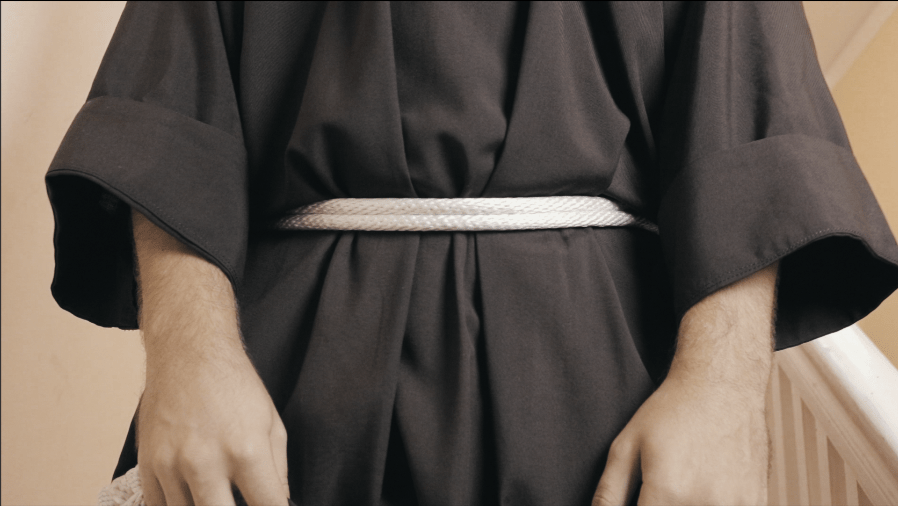
Everyone knows that the Franciscan habit is a powerful symbol. While everyone may not know exactly what it is, it universally speaks to religion, peace, and approachability. That’s not a bad thing to be recognized as when meeting people on the street, especially when someone is looking for prayer or guidance.
What everyone does not necessarily know is that wearing a habit can be a rather difficult task. With long sleeves, loose fabric, and hanging rope, there are innumerable ways to embarrass oneself, break things, and even end up tripping on the floor.
By no means an exhaustive list, my newest video hopes to capture a taste of the things that we face every day in our habits, and the many mistakes that I have made in such a short time. Hope you enjoy!
Email subscribers click here to watch the video! If you’d like to sign up to receive blog posts by email, click here.
Outside of rare circumstances, all priests in the Catholic Church are required to be celibate. You can choose ordination or marriage, but not both. For many, this is a heavy burden to carry, requiring one to either be “heroic” in their denial of the goods of marriage, sacrificing what many want in order to serve the faithful. For many, this burden is simply too much, and is cited as a major reason for the lack of priests in the modern world.
And maybe it is. Maybe some who are married should be allowed to be ordained as well. Being that clerical celibacy is a discipline of the Church and not a doctrine or dogma, it’s conceivable that we could see a change in the future.
But that is a question for someone else. For me, the more interesting question is not whether those who are married should be allowed ordination, but why the practice was instituted in the first place and what benefit has the Church seen in it for centuries. Time and time again people have questioned it, and time and time again the Church has maintained it. Why? What’s so important about it?
After taking a course called Ordained Ministries, and with the help of Msgr. Paul McPartlan, esteemed member of the Catholic University of America faculty, I want to suggest something rarely stated on the matter: celibacy is a gift to the priest and the people of God. That’s right: a gift. While the idea of going one’s entire life without getting married or experiencing the joy of having kids is certainly difficult for some, the idea that celibacy is simply a “means to an end” and that it has no merit in itself lacks vision, imagination, and an understanding of the reason for the practice in the first place.
For subscribers on email, click here to watch the video.
Have you ever stolen something, lied to your parents, called someone a hurtful name, done something hurtful to yourself, or anything else you regretted enough to had to go to confession?
If so, have you ever been smote by God’s wrath, hit by a lightning bolt from heaven, or dropped dead immediately after doing something wrong? Probably not.
Or, after having done something wrong, something you regretted, did you later have an experience of God, a powerful prayer, a feeling of relief, or anything that made you know that God was still with you, that he had not abandoned you? My guess is that the latter experience is a bit more common…
You see, on the one hand, our God is a God of justice. He set a way that his people were to live and told them that if they follow it they’ll be rewarded and if they don’t they’ll be punished. Justice: people get what they deserve. Look at how he reacted to the Israelites in our first reading today: seeing that they built an idol out of gold to worship, his first reaction is to send down his wrath of fire to destroy them. Harsh? Maybe. But he gave them rules to follow, told them that death was the penalty for sin, and they couldn’t even handle the FIRST commandment. Justice meant paying them what they were due, and they were due punishment.
But God didn’t end up doing that, did He? While our God is a God of justice, He is also a God of mercy. Even though He was very clear of the rules, and even though they immediately broken a really big one, God chose to show mercy to His people and give them more than they deserved: a second chance, new life, safety from death.
It’s the same story with St. Paul in our second reading. While we all know Paul as the great missionary that built up the Church after Jesus, sometimes we forget that he was a great sinner prior to his vision of Jesus. In our second reading today he even says himself, “I was once a blasphemer and a persecutor and arrogant, but I have been mercifully treated.” Even though he tore down the church, imprisoned and killed Christians, and denounced Jesus, God did not give him the punishment he was due, He gave him mercy… He gave him forgiveness; God was able to transform something terrible into something great.
Why? Because God loves those who love Him and are perfect, right? God loves those who help themselves, right? Quite the opposite, actually. Time and time again we hear that God loves the outcast… the sinner… the weak… the lowly. The very reason that Jesus tells the parables in our Gospel today is because the Pharisees were complaining about who He was eating with: “This man welcomes tax collectors and sinners and eats with them!” He was eating with the lowest, most detestable people in society. But why? Because no one outside of God’s mercy, there is no length that God won’t go to bring them back.
Jesus asks them, “Who among you, losing one sheep, wouldn’t leave the 99 behind to find the one?” The correct answer is everyone! The idea of leaving behind 99 sheep to find just one is ridiculous! But that’s what God does for all of us. He’s like the woman who completely overturned the whole house to find just one coin and threw a major party over it. He’s like the father who didn’t care that his son disrespected him, took half of his wealth, defaced himself, and then came crawling back for help. No one is outside of God’s mercy… no matter who they are… no matter what they’ve done.
God doesn’t treat us fairly, He doesn’t give us what we’re due… he gives us so much more than we deserve. Even tax collectors. Even sinners. Even people who lie and cheat and say mean things to their parents, who don’t feel connected at mass, or don’t even think they need God. Even them, you, and me. Even… Even terrorists.
On this the 15th anniversary of the September 11th attacks on our country, we will be inundated with a simple, two-word message: Never forget… Never forget… Never forget. It’s a powerful message, a catchy message, an important message. But what does it mean? What exactly is it that we never want to forget as long as we live?
For some, it is an opportunity to focus on justice. What we should never forget is the horror of the day: the deaths of so many people and the hatred of the people that did it to us. This was an objectively evil act, and we need to take it upon ourselves to give them what they’re due: punishment. Never forget what they did.
When we go down this road, fueled by hate and anger and fear, we have a tendency to take horrible, sinful acts and give them back even worse. More than 300,000 middle-Easterners dead, torture, regular acts of distrust, name-calling, and violence against completely innocent Muslim citizens of this country. If all we remember is the terrible acts of the day, if all we remember is the sadness and anger we felt when it happened, that is likely all we are going to be able to give back in return.
Is that the Christian response?
In light of our readings today, I want to suggest an alternative, that the thing we should “Never Forget” is not the evil of that day… but rather the mercy of God who continues to be with us all… even the sinners. The God who turns evil into good and never tires of chasing after us…even the terrorists. The God who doesn’t give us what we deserve, because he gives us so much more. Instead of remembering the deaths of so many, let’s never forget the lives that God touched, the saints and sinners in those buildings for whom God waited on patiently their whole lives. Instead of remembering the destruction and turmoil, let’s never forget the heroic acts of first responders risking their lives for others, how the whole city, an entire nation united together, moving beyond our differences to be one. Instead of remembering the terrible things that others have done and how they need justice, let’s never forget that we are all sinners and yet all of us have been treated mercifully by God.
When people hurt us, they betray our trust, inflict pain… our first reaction is almost always to get even; we want justice. And there’s room for that: a world in which no one is accountable for there actions and sin is okay is not a world that our God wants. But we never need reminding of this; our instinct to fix this comes naturally. What we do need from time to time, though, what we must never forget, is that God has treated with his mercy, and wants us to do the same for others. Never forget.
For those receiving this post by email, click here for the short video reflection related to this post.
Last year, I started my video experiment. I bought a camera, filmed a road trip, and thought it was a pretty cool medium. When I realized that what I was doing was no longer a cool hobby but rather the next step in my communications ministry, I threw together a welcome video to set the tone for the channel. It was fun and a little corny, but it got the job done. I was happy with what I had made on such short notice and with almost no video background, and it worked.
After a year, things have changed. That quirky little video we filmed outside of the Church one day wasn’t cutting it for me anymore. The cheesy jokes about Jedi and Medieval Festivals weren’t doing it for me anymore. I wanted something that better reflected where I was now, a year later, and what I hoped to accomplish in the future. I didn’t want a welcome video, I wanted a trailer.
And so, with time on my hands before things get crazy at the parish, that’s what I did.
For those of you who followed me this summer here on the blog or over on my Facebook page, it should not come at any surprise that my time in Mexico will have a lasting effect on me. How could it not? While I certainly wish I could have spent less time learning Spanish and more time using it with the migrants at La72, I can still say that I left having met some extraordinary people, heard some moving stories, and with a changed perspective that will no doubt effect my life as a Franciscan. Naturally, I couldn’t share everything in one video, but here’s a brief glimpse of what the trip meant to me and how this next year will be unlike any other as a friar.


 Breaking In The Habit