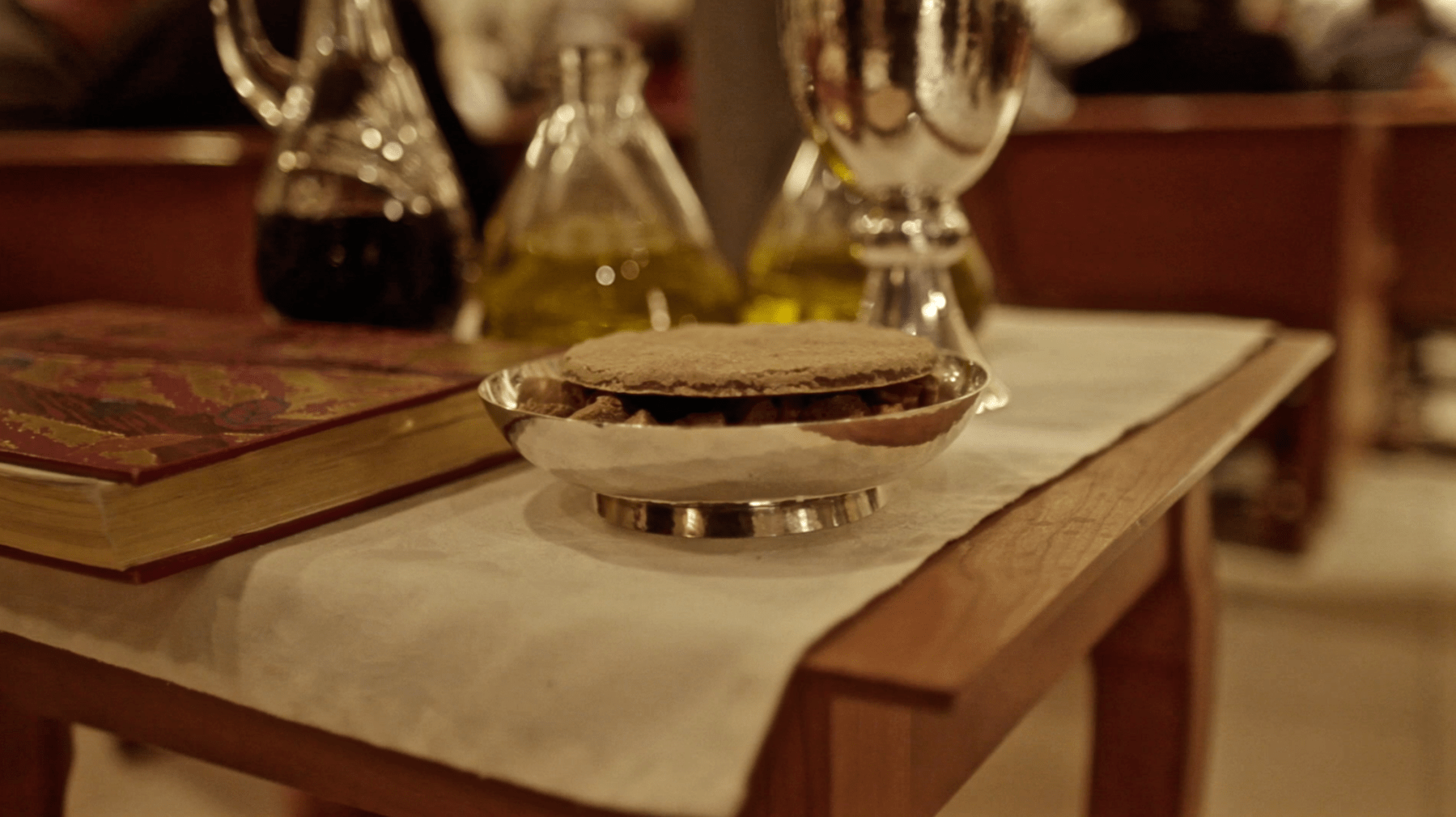
Last week, I went to the greatest show on earth: the Paschal Triduum of the Catholic Church. (If you don’t know what that is, check out my video for this week.)

In reflecting on my experience over the past week, and in defense of the title I chose, I thought I would share a bit about the difference between a “show” and a liturgy, and why I think the Triduum is a wonderful example of this.

Participation

When we go to a show (or watch something on television or computer), we are a passive spectator. Communication goes in only one direction: we sit and information is given to us. While our occasional laughter, cheers, or clapping may effect the experience of the performance if we are in attendence, in reality, we add nothing to what is actually going on; the show goes on just the same whether we are there or watching on television.

A liturgy, on the other hand, depends on our presence. We do not attend as passive spectators waiting to receive entertainment, we attend as active worshippers, coming together to create something new. Not only are their parts of the mass that are rightfully the responsibility of the congregation and inappropriate for a priest to take on himself (e.g. responses such as “and with your spirit”) there is a sense that there is more to the reality of the service than simply what is going happening “on stage.” In our greeting one another, singing in the pews, offering a sign of peace, walking in procession, offering our personal prayers and sacrifices, and so on, we are not simply watching a show, we are making the liturgy (hence its name, from the Greek, which means “the work of the people.”)

And how this is even more true for the Triduum. We are not simply attending a concert or beautiful commemoration of past events put on by actors, we are, together, building an environment where that mystery is made present. Even more than our already active, “Catholic calisthenic” worship services with standing and kneeling and moving all around, we make ourselves a part of the work of the people during the Triduum with special gestures, processions, elaborate songs, and special roles.

Entering a symbolic reality

And yet, it is not as if we are simply attending an improvisation theatre production with major audience participation; a liturgy is not just a play that involves its audience. As theatrical and dramatic as a liturgy is, what we do is not a matter of recreating the past with actors and scenes, attempting to mimic past events with historical accuracy. No, liturgy is the act of entering into a symbolic reality of what those past events represent, offering praise and thanksgiving from our own cultural and historical reality.

What do I mean by this? Well, liturgy is not a passion play in which we take the Bible and make a script out of it, trying to get everything exactly right. Rather, it is an act in which we look at the reality of what happened (e.g. Jesus humbled himself and died on a cross) and create an environment in which the importance of that action makes the most sense to us today. There is no need for costumes; we don’t need to have every detail included or follow the exact order. We do not speak in the language that Jesus did; we do not sing the songs that the disciples did; there is no need to make the gestures exactly as they would have. What is significant is not the historical events as they happened, but making present what we find significant about them. What we do is speak our own language, sing our own songs, and make our own culturally appropriate gestures that capture what the original meant.

How true this is with the liturgy of the Triduum. With old and new coming together, we find an expression of ourselves and our history making the reality of Jesus known. Surely, he did not use a Paschal candle, sing the exultet, wear priestly vestments with specific colors and designs, process as a whole community to wait in the night, and so on. But these images and symbols and gestures make sense to us, evoke some meaning from our own lives, that help us to enter into his historical reality.

And so, was the Paschal Triduum the “Greatest Show on Earth?” Technically, no, because it was not a show at all. It was a liturgy, the act of a community coming together to build a reality that makes another, deeper reality present. It is not like the circus or a performance of Hamilton or even a contest in which the audience participates by voting. And yet, what an amazing job it does of capturing our attention and entering us into a reality far from our own, just as “shows” do. That, for me, is what makes it the best “show” around: it pulls from the technique and quality of those shows we love to watch, while also calling us out of our safe space to be an active part in making it present. Truly, there is nothing better.

On Catholicism in Focus, we tackle some difficult issues of philosophy and theology. Rebelling against a culture that wants soundbites and quick answers, I choose to get the whole truth and nothing but the truth. Why, in our wonderful tradition of intellectual study, would I settle for “almost” correct when it takes just a bit more work to understand the reasoning behind something?

As Catholics have always known that there is nothing wrong with studying the natural world, engaging in philosophy, or dealing with concepts not directly related to the Bible. In fact, if God is the creator and redeemer of all, the more we learn about anything, really, is knowledge in some way about God, if we have the eyes to see. The more we learn about the created world, the more we learn about the one who created it.

At the same time, one might begin to wonder: especially when getting into the complicated depths of philosophy, are we not spending too much of our time on things that don’t really matter? Maybe in the vein of the Protestant Reformers who attacked the Catholic theologians for their useless and self-serving questions, such as “How many angels can dance on the head of a needle?” there are some today who rightly want to know how any of this benefits our faith. (As a side note, that question about angels and needles was completely made up by the Reformers as a way to illegitimatize their work, and was never actually asked by any theologian. Just so you know…)

One’s position or reasons notwithstanding, I think it is a fair objection that needs to be answered from time to time to remind us of what matters. Why do we study this stuff? Why do the details matter so much? As much as we praise those with knowledge, it means very little to faith on its own. One can be very knowledgable and use that knowledge to turn away from faith, become conceited, belittle others, or retreat to ideas at the expense of community. As Christians, knowledge is not our highest goal.

So what is? Well, being disciples and friends of Jesus Christ, of course. As we enter this time of Easter, I think it’s good to take a step back and make that clear. We study, not for our own sake or knowledge, but to grow closer to God.

As we entered the holiest of weeks on Sunday, triumphantly processing into the Church as Jesus marched into Jerusalem, we were reminded where our pilgrimage would ultimately end up: the cross. Hearing the whole story of the Passion proclaimed, it was made clear to us why Jesus entered Jerusalem and what the focus of the entire week would be.

And this presents an interesting theological question for us: knowing of course that Jesus suffered and died on the cross, can God suffer? It is a question that has become very popular over the past 100 years, and one that I explore in this week’s Catholicism In Focus.

I hope that everyone has a good Holy Week and a blessed Easter!

“Why do bad things happen to good people?”

No doubt one of the great mysteries of our human existence, it has puzzled the most brilliant of philosophers and caused grief to even the simplest of men and women. Especially for people who believe in an all-powerful, seemingly all-loving God, the lack of answer for such a question, and the prevalence of evil that good people endure, is a thorn in our side.

But I have a question in return: As Christians, those who follow an innocent man who was betrayed and suffered persecution before laying down his life for others, why would we expect only good things in our life? I’m not sure how you interpret “take up your cross and follow me,” but I can’t imagine that it is going to be an easy road. No, my guess is that a life in Jesus is much more difficult than a life without him.

The fact of the matter is bad things happen to good people because we live in a world that relies on things other than Jesus, and that will inevitably produce pain. Not only do we experience the pain of others’ sins corrupting our world, we experience it in our insistence on being our own strength, in refusing to ask for help when we need it, in failing to change our hearts and learn from our mistakes, and really… in the mere fact that we are mortal. Our own weakness—and our reliance on it—brings pain even to good people.

And for me, this is the great paradox of our faith. While the rest of the world tells us that we can alleviate our pain by seeking more control, growing stronger, and seeking perfection, Christians know that it is quite the opposite: it is only when we embrace our weakness, take on pain, and accept that we cannot solve our problems that we are actually the strongest. It is in those moments of desperation, those moments of pain and suffering, of utter failure, that we find that Christ is most alive in us offering us strength.

When we are weak, God offers strength.

When we sin, God offers forgiveness.

When we are hard of heart, God offers patience.

And when our mortal bodies have reached the end of the road and there is nothing left that we can do for ourselves, God offers us eternal life.

So, why do bad things happen to good people? Why do we suffer, experience pain, and fail even ourselves? I’m not sure. All I know is that even in those moment—especially in those moments—God is present to us more than ever. This lent we are called to embrace our failures and own our brokenness, allowing God to be more than we could ever be on our own.

Thanks for joining me on this journey through Lent. I hope that you enjoyed these reflections and will consider buying my book, Called: What Happens After Saying Yes to God, where you will find many other reflections just like these. 

Last weekend was an adventure. Picture this: 40,000 Catholics from around the country all in one place to share their faith, to hear from the best Catholic speakers around, to share in some of the most extraordinary liturgies imaginable and to buy tons of discounted Catholic merchandise. (Okay, not all of the motives were winners!)

Welcome to the Los Angeles Religious Education Congress, a place that is almost too overwhelming to fully describe! I had the great fortune of making my first appearance this year, and it did not disappoint. With my camera and a bag full of free books to hand out, I walked around the exhibition hall and attended lectures with the intention of sharing my own mission of evangelization and catechesis, while also learning about everyone else’s.

What I found so amazing was the breadth of personalities and spiritualities present. As Catholics, we truly are a big tent, and I met people at LA REC ranging from traditional to progressive, with everything in between, all sharing the same mission: to love and serve Jesus Christ. In a world so divided and focused on what makes us different, it was so encouraging to see so many people come together with only the most important thing on their minds.

At times, I fear that we can get too wrapped up in declaring which type of Catholic we are—as if that matters—and don’t take the time to rejoice in the glory of our diverse Church. For me, that’s what this weekend was about. I hope you enjoy this video as much as I enjoyed attending the Congress!