As I prepare for my eventual presbyteral ordination, one of the things that my province heavily emphasizes is that students practice preaching in front of people and receive appropriate criticism. It only seems natural: if you’re going to take a job doing something technical, you train to make sure you have the skills to complete said job. In my case, that means taking two preaching classes at the Catholic University of America, preaching in-house at the friary once a month, and getting as much experience speaking in front of people in all capacities during our summer internships.

Over the past two years going through this process, I have found out something rather encouraging: I love to preach. Getting in front of people to talk about faith is one of the most energizing, fulfilling things that I have ever done. For ten (or so…) minutes, I have a captive audience with which to share my faith, offer a witness, and encourage to know God in a new way. And even though I am an introvert, I seem to feed off of the energy around me, and have found the larger the congregation the more comfortable I feel.

But of course, the question is not whether like to preach or if feel comfortable talking to people about faith, it’s whether the congregation wants to listen to what I have to say. Am I a good preacher?

Given all that Pope Francis has said about preaching, notably the burden that bad preaching is on the laity, that is the million dollar question. Am I one of the preachers that Pope Francis is talking about, those who bore their congregations and kill their faith?

The first couple of times I preached, I certainly didn’t think so. People came up to me and told me how wonderfully I talked, how I was an incredible preacher, how I was going to make a great priest. You know, the sorts of things that we want to hear because it builds up our egos. I heard enough of it the first couple of times to feel pretty confident: “Wow… a lot of people complimented me. I must be a better preacher than Fr. X.”

And maybe I am. But it didn’t take long for a little perspective. I was at a parish shortly thereafter and I heard what was objectively a horrible homily. It had no strong beginning or end, it meandered through half a dozen topics, and the priest was completely unrelatable. Not a great homily. And do you know what I saw after mass? Everyone shook his hand with a smile, and quite a few people, not just one, said how much they loved his homilies. Whaaaa? Were they smoking something?

Another time, I was talking with someone from one of our parishes about one of our friars. This friar is not exactly known for his homilies, and that is putting it nicely. And do you know what she said? “Fr. X changed my life with a homily once.” Say what now? Are we talking about the same guy, the one who can’t string three words together coherently? Yup. That one. Changed her life.

It is because of these two experiences, early in my preaching, that I learned two invaluable lessons. The first is that some compliments are akin to a child being potty trained: “Ohhhh! Look who made a doo doo! You’re such a big boy!” People mean well, and I’m sure that they were honestly and completely delighted with every word of my homily, but for some it is not what I said that is impressive, but merely the fact that I am a nice young man who’s becoming a priest and people haven’t seen a priest with hair in a long time. What I say may have genuinely delighted them, and that’s great, but that doesn’t mean that it was actually a good homily. Having seen dreadful homilies receive compliments, I know that good preaching is not about hearing some nice words from people as they leave the church, nor is it appropriate to think that just because ten people said something nice that the other five hundred felt the same way. If all we hear are the good responses, or all we seek are compliments, our preaching will never grow and it will never challenge.

The second point, a much more difficult one to accept, is that we are only ever as good as the Holy Spirit allows us to be. While it may be our insights, nice words, and polished delivery, it is ultimately not in our control whether or not the message takes root or not. I’ve seen terrible homilies change lives and incredible ones forgotten. The Spirit can transform even the dullest words into the words of life, and be so disinterested in our waxing eloquent that our words never reach anyone’s soul. This, of course, does not mean that we just get up and say whatever we want without preparation because the Spirit can speak through us. But it does force us as preachers to approach the homily with humility and prayer, to ask God for the words to speak, and to focus on what’s really important. When we’re looking back and grading how successful a homily was, it doesn’t matter how good or bad we looked, felt, or spoke, it only matters how the hearts and lives of our listeners were changed.

And isn’t that what preaching is all about? It’s not about the preacher and how well liked s/he is, it’s about bringing people closer to God and building up the kingdom. Thus, the effect of good preaching is not found in the words that people say about it, it’s found in the vibrancy of faith and life in the community that hears it. Do these words make us feel good, or do they move us to conversion? That’s the question. And so, as I learn this craft and hopefully continue to grow in it, the image of being potty trained works well for me. On the one hand it keeps me humble: I am being complimented for doing something that is not all that impressive. On the other, it keeps me focused on what really matters. Because, really, the sign of someone who is truly potty trained is not the amount of compliments he gets for using the toilet, it’s how dry his pants stay on a regular basis.
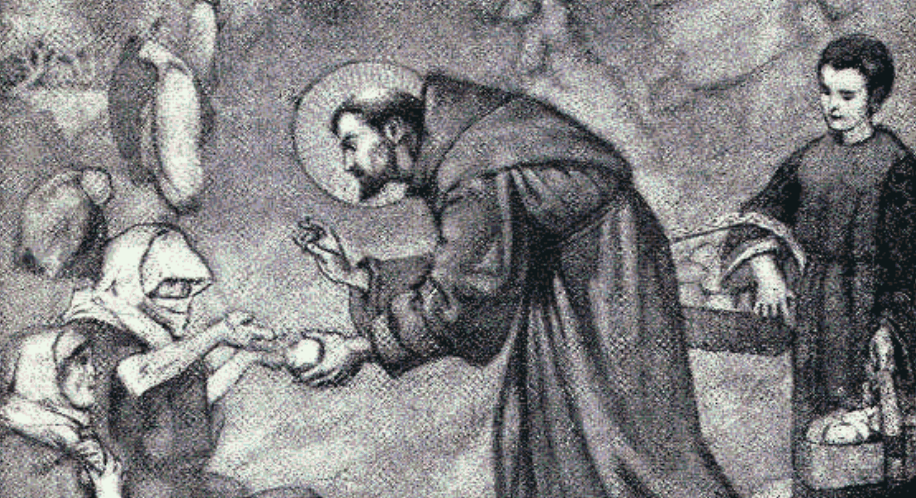


When many people think of St. Francis, there are two things that generally come to mind: preaching to the animals and praying (if you do quick Google image search, these are basically the only things that will come up). After that, many will point out his poverty and will picture a begging Francis with a ripped habit among the lepers.

But what about work? Did Francis spend his entire day in prayer, then beg for food when he was hungry? Is that what we do today? That’s my question for this week on Ask Brother Casey.

One of the first things Francis did, even the Order was formed, was to rebuild fallen churches. Francis worked with his hands. He saw the need for manual labor and a hard day’s work. This is why when the Order was actually formed and he had to write a rule of life, Francis tells the brothers that, while they should not be ashamed to beg, as “our Lord made Himself poor in this world” (ch. 6), work should come first:

“Those brothers to whom the Lord has given the grace of working may work faithfully and devotedly so that, while avoiding idleness, the enemy of the soul, they do not extinguish the Spirit of holy prayer and devotion which all temporal things must attribute” (Rule of St. Francis ch. 5)

And the early friars did work, just as the poor worked. They did not have big trusts of money or salaried positions, they worked as day laborers, earning a living by their efforts in the fields and cities. That was their primary call. When this was not enough or when it seemed fit to give what they had earned to those less fortunate than themselves, they resorted to begging, taking only enough for them to survive.

Today, friars continue this emphasis on work, and are known to engage in any number of careers. While other religious orders have a charism to a particular ministry, say, teaching or missionary work, the friars have never had this; we use the gifts that God has given us to spread the Gospel and care for the poor, whatever those gifts may be. For many of us, that means becoming a parish priest and earning a stipend for our work, but for others, that means any number of things: art, architecture, farming, law, formation, care of the sick and elderly, photography, cooking, cleaning, teaching, writing… there are more than a few ways to live and spread the Gospel!

“Led by the spirit of Saint Francis, the friars, like those who are truly poor, are to consider work and service as a gift of God. For this reason they are to present themselves as little ones of whom no one is afraid, because they seek to serve and not to dominate. Recognizing that work is the ordinary and chief way of providing what is needed, each and every friar should serve and ‘should work faithfully and devotedly,’ fleeing idleness which is ‘the enemy of the soul'” (OFM Constitutions Article 76).

In many ways, then, this is exactly like the rest of the world: we work to make a living, only relying on asking for help when we can’t make ends meet (or more likely, when we are trying to take care of the poor as well). But unlike the rest of the world, we work not to make money or to get rich, but because it is our vocation to do so. All money that we make is shared with the other friars and the poor.

For those on email, you can watch the video here. Be sure to ask your own questions and I might answer it on next week’s segment! Be creative!

You’ve heard this phrase before, I’m sure. For many, it expresses the very strong link people make between the way someone looks and their worth in society. Well-dressed people are important and poorly dressed people are not. For the most part, it is a fairly superficial statement.

But what if the clothes actually did make a person who they were? In discussing the symbolic importance of clothing in my Pentateuch class this week, our professor shared a rather fascinating study published in 2012 called “Enclothed Cognition” (the study itself is not accessible for free, but you can read about it in a New York Times article here.) Basically, researches gave two groups of graduate students the exact same white coats to wear and asked them to complete a series of cognitive tasks. One group was told that the white coat was a doctor’s lab coat, the other was told that it was a painter’s coat. The results? Those who believed they were wearing a lab coat made half as many mistakes as those who believed they were wearing a painter’s coat!

As the article says, researchers have known for years that the way one looks can affect the way people are perceived and treated. What this study indicates, though, is that the clothing one wears can actually affect one’s image of self, and thus, have an effect on one’s psychological processes and productivity.

I have been a long believer of this, even before knowing the science behind it. In high school, our baseball coach allowed us to wear anything we wanted to practice as long as we had long pants and our shirts represented the school. Almost every player chose to wear sweatpants and an untucked t-shirt. I just couldn’t. I wore baseball pants, high socks, belt, and tucked in baseball shirt, the same things I wore for actual games. To most of them, it didn’t matter what one wore, it was how one played that mattered. Which is true. But at least for me, I knew that how I dressed affected how I played. Besides the obvious practical concerns (sweatpants are more cumbersome than baseball pants) there was a psychological disposition that clothing had on me: in my mind, wearing sweatpants was associated with lounging around and being lazy whereas wearing baseball pants was associated with playing baseball, something that was always done as hard as I could, and helped me focus. Clothing was not an inconsequential external, it was a conscious decision that changed the way I thought about myself and likely affected my psychological disposition.

As someone in religious life, this sort of insight is very interesting to me. While I get the feeling that the issue of wearing a religious habit is completely irrelevant to most people, it is a question that has been hotly contested by priests and religious since the Second Vatican council. Should we wear distinct religious garb? Because there are such strong opinions on either side (about which I have written before), the general conclusion for many is simply to say, “It doesn’t matter what you wear anyway, so wear whatever you want.”

I disagreed with this notion when I played baseball, and now, having learned that there is actual research in this area, have to disagree again. What one wears is not some inconsequential external with no meaning. It is an expression of oneself with significant import. What one wears not only affects how one is treated, it affects the way that we understand ourselves and act in the world. As public figures concerned with the spiritual and physical well-being of all people, called to evangelize and shepherd God’s people, how could this not matter?

But that doesn’t mean I’m calling for everyone to wear their habits and collars. Actually, in what might be the biggest surprise for some people, it’s quite the opposite: I think some people should wear their habits much less. Yeah. Didn’t see that coming, did you? Here’s what I mean. For me, the habit is a positive sign. It symbolizes humility, connects me to the larger tradition and church, allows me to connect with the people of God, and overall, makes me feel good as a pastoral minister. I embody what my clothes mean to me. But what about those friars for which the habit represents something negative, a sign of privilege or a way to separate the laity from ministers? For them, wearing the habit and embodying what it means to them is not going to allow them to be the best ministers they can be. Or, worse yet, what about those people for whom the habit is a sign of privilege and a way to separate the laity from ministers, and they like that about it? What it causes them to embody is extremely detrimental to the faith.

So, I guess the question I have comes down to this: if clothes can actually “make the man,” what sort of man is his religious garb making him into? If what someone wears makes him/her a less effective minister or moves them further from God, it might be time for a wardrobe change.

The cover photo is by German artist Herlinde Koelbl in a project titled Kleider Machen Leute (‘Clothes Make The Man’). The subject is Cardinal Müller, the prefect for the Congregation for the Doctrine of the Faith.

A few years ago, I read an article in a Catholic magazine written about a former CEO’s take on the issues facing the Church, particularly declining attendance and public perception. As someone from the business world, his solution, naturally, was to become more business-savvy: If my business were losing as many ‘customers’ as the Church is, I would want to know why: let’s do exit interviews so that we can evaluate the product and fix the problem (my paraphrase)In essence, treat the Church more like a business selling a struggling product.

Naturally, there is an immediate repulsion to this idea among many Catholics. The Church is not just some corporation out for money, willing to change who it is to make a buck. The Church is a divine institution guided by unchanging principles, concerned with building God’s kingdom and saving souls, not monetary gain.

This is true. But as I’ve thought about it over the past four years, I find myself wondering way too often, “Would this fly in the real world? Why do we let it happen in the Church then?” While some churches do some things very well, every church could learn a few things from the business world.

Recruitment, training and evaluation of personnel

A good business doesn’t just come together all-of-the-sudden with the best employees and maintain success over many years by accident. The best businesses are always looking to the future and recruiting new talent. They scout, seek out, and attract new employees every year, going to great lengths to find the right person for the job and convince them to work there. How well do we do this as Church, the business-savvy person asks. Do we nurture talent from our parishes, encourage the right people to get involved, and draw the best outsiders for the job with enticing offers, by which I mean competitive compensation? Are we seeking out the people for the job or are we okay with whoever shows up?

Once a business has found the right person, they need train them to do the job effectively. Even a Harvard grad with a 4.0 GPA will need on-the-job training. Businesses don’t just throw someone out there and expect them to do an incredible job; they make sure the new hire is ready. Why? Because they could lose them a lot of money if they don’t know what they’re doing! The Church may not be as concerned with losing money, but it most certainly can lose parishioners and turn people completely away from the Church with poor liturgical or pastoral skills. That should be reason enough to make sure everyone acting on behalf of the Church is properly trained to do so. Priests attend five or six years of school to be prepared (whether or not they are is another point), but how much training do the music ministers get? The lectors, acolytes, or eucharistic ministers? Are religious educators knowledgable and pedagogically sound about the subject they’re teaching? It’s great to be well-intentioned and want to help the Church, but I don’t think it is outlandish to expect that all ministers be adequately trained in the ideal purpose of their duty and the overall mission of the Church.

Finally, no institution in the “real world” survives without constant evaluation and expectation of improvement. Are you meeting your numbers, getting along with your coworkers, and continuing the mission of the business? If so, great. If not, corrections need to be made by setting goals and obtaining more training. In the business world, if one does more to harm the company than help it, they are let go and replaced. It may sound harsh, but money is at stake here. Do we as Church act with that sort of urgency? Maybe our tolerance and mercy is greater given our work, and it should be, but it just seems odd to me that most priests are not evaluated on their pastoral care or preaching ability, and that there exist so many insufferable or intolerable preachers, lectors, cantors, and musicians with no normative way to address it. If we care about what we’re in the business to do, “save souls,” why wouldn’t we make sure that the best and brightest are out there doing the job well?

This brings up a difficult point for the Church: what do we do with volunteers and employees that are simply inadequate, say, the little old lady that has been playing the piano for thirty years but isn’t very good anymore and kills the life of the mass? In the business world where there is little loyalty, she would be replaced with a younger, more productive piano player. I am not suggesting that we necessarily do the same, but I am suggesting that we balance loyalty and inclusivity with talent and performance, and find ways for people’s talents to best give glory to God. Not everyone has the talent they think they have!

Satisfaction with “business as usual”

In the business world, a company that doesn’t grow dies. It’s just the way business works. There are too many other things that a person could be doing with their money. To be successful, a company can never become satisfied with their current market share, product line, or marketing strategy, to the point of complacency.

As the Church, particularly the Catholic Church, we run a little monopoly, and so this situation doesn’t entirely apply to us, at least not as severely. Because we offer the sacraments, we know that there will always be a core group of followers that will never leave no matter what. And we can play to that least common denominator, approaching our work with either arrogance, “Where else are you going to go?” or apathy, “What we do is good enough.” But is that what we want? Neither of these would fly in the business world… so why do they fly in our churches?

Because of this, our churches can lack professionalism, have little-to-no desire to innovate, and rarely take risks to step outside of the norm. What do I mean by this? Take a look at the average parish website. Some websites are excellent; most are terrible. It may have the mass times and the pastor’s name, but it’s clunky, uninviting, and looks like a 5th grade computer class project with clip art and poorly chosen fonts. In this media age, businesses have incredible websites that make people want to come back and social media campaigns that actively attract new customers. So many churches fail to engage people online, either through a lackluster website or a non-existent social media presence, choosing to remain with the usual, or non-existent, methods of reaching out.

And this sort of attitude can permeate every aspect of parish life. Look at the bulletin on a given Sunday. Are the events creative and engaging or are they boring and routine? One does not need to reinvent the wheel, change Church teaching or the liturgy, or be a multi-million dollar organization to engage people in a new way. I look to things like the Mass Mobs in Buffalo, where a group picks a parish and gets as many people to flood to that church to all worship together, rotating around the city. It makes the “same old thing” exciting and worth joining. I think of one of our parishes that started a program called “St. Anthony University”: students and professionals at the parish offered weekly courses, e.g. Wisdom literature, Church Teaching, Spirituality, etc., and if parishioners fulfilled enough credits in a semester, they earned a “degree” and were treated with a free weekend trip away. I think of the Capuchin Cafe that students at CUA started: powerful prayer, inspiring worship music, and great preaching in the church, followed by food, drinks, and live music in the parish hall (this attracts more than 100 students on a Saturday night!)

And these ideas aren’t even that creative! Think if we sat down and planned things like they do at Apple and Google, pushing the envelope far beyond “business as usual” so that the Church was not only grounded and wise, but also imaginative and relevant?

Pray and evangelize as if our lives depended on it

We as Church have an incredible product. We have 2000 years of faithfulness, a rich tradition of liturgy and prayer, oh, and Jesus. The problem for me is not what we’ve got. The problem, in some cases, is that we don’t take what we got seriously enough. If we approached a business endeavor with as little passion or urgency as so many parishes do in our Church, we would be out of business in a month.

It’s not about whether we should a) hold on to our traditions or b) ditch them to become “cool”; it’s about identifying what it is that we can offer the world, guidance and fellowship on our journey to salvation, and creatively and effectively managing our resources in such a way that more people actually accept it. Good businesses don’t make the customer conform to the product; they get to know their customers so that they can highlight just how their product will satisfy the customer. For us as Church, this doesn’t mean gimmicky tactics or whitewashing our tradition. It means knowing how to effectively and efficiently evangelize the great gift that we have to offer. Imagine what our Church and world would be like if we showed the same passion and sense of urgency as the people who make our computers and cell phones do, if we worked as hard and thought as creatively to make the Church as effective as it could be “selling” our product.

When it comes right down to it, imagine if we put the same amount of resources into making the Church better as we do buying those computers and cell phones. I refuse to accept that money is the problem here, that if we really wanted great musicians, educators, web designers, and pastoral associates, and we really wanted them to be trained as well as they could be, that we couldn’t make that happen somehow. What we lack sometimes in the Church is not money, it’s vision.

I fully acknowledge the fact that this post has been longer and more Jerry-Maguire-manifesto than my other posts, but it’s a message I really stand by and will devote my entire life to carrying out. Truly, I am just warming up. What I hope for in sharing this with you, if you’ve made it this far, is to touch on any dissatisfaction or longing you may have with your church experience that you might be compelled to do something about it. We need more people with passion, drive, creativity and courage, qualities that make someone successful in the business world, to step up and take on leadership in the life of the Church. There is no reason that these qualities shouldn’t be “business as usual” in every one of our churches.

Christianity is a religion of mercy and forgiveness. The great truth that Christianity captures is the fact that, despite our rebelliousness against God, despite the fact that we are owed absolutely nothing, God gives us his grace anyway. We believe that there is no bound to God’s mercy, and at least in theory, there is no sin that God could not forgive. There is nothing that could keep us out of God’s love.

As I continue to grow in faith, working out my own salvation daily and training to help others in theirs, I have found otherwise, at least in practice. While God’s mercy may abound, the Church’s understanding and ability to express it does not, and we are left with one seemingly unforgivable sin.

Which one, you ask? Some point to Mark 3:29, and say that blasphemy against the Holy Spirit will not be forgiven. I’m not entirely sure what that would mean, but am sure that even the worst blasphemies are balanced with one’s faith at the time (“how could they even know what they’re saying?”) and can be forgiven. Others point to truly heinous crimes against humanity, e.g. genocide, or affronts to the most vulnerable, e.g. abortion, as sins that cannot be forgiven. Surely these are terrible sins, but with God’s boundless mercy in mind and the presentation of a truly contrite heart, the Church has a way for truly remorseful sinners who looking for a way back to God to repent and be readmitted into full communion. Sexual abuse must be what I’m getting at, then, right? Still no. Even in the case of priests and religious who have be defrocked and removed from active ministry–serious punishments for a serious sin–God’s mercy still allows that these men and women receive grace, and the Church has a way for them to be readmitted into full communion.

In each of these cases, blaspheming the Holy Spirit, abortion, genocide, and sexual abuse, there is a process by which one can be readmitted to the Eucharistic table and receive the sacraments of the Church. For some divorced and remarried Catholics, though, this process does not exist, and many people find themselves permanently unable to take part in the full life of the Church. For many, remarriage after divorce, at least in practice, is an unforgivable sin.

Maybe some theological background would be helpful hear. In the Catholic Church, marriage is not a simply civil contract between consenting parties, it is covenant before God. Like the covenants of the Bible, marriage is transformative, meaning that the relationship is different in nature than it was before, and indissoluble, meaning that its character is permanently established. Prior to being married, the bond between the couple is based on their will and love for one another; after being married, the bond, now sacramental and covenantal in nature, is based on God’s will and love for the couple. To turn away from this in divorce, or to break this covenant by trying to enter into it again with another person, is obviously problematic.

But the fact of the matter is, regardless of theology, people in the Catholic Church get divorced at the same rate as any other religious affiliation. And while divorce in itself is not sinful and does not remove one from the life of the Church, getting remarried without a declaration of nullity (showing that the sacramental bond never took place because of lack of consent or deceit on behalf of one of the parties) is a serious problem. How can one be in full communion if they break a covenant made before God and try to enter into another one? The Church “welcomes” these people, but does not allow them to fully participate in the life of the Church, i.e. they may not receive Eucharist at mass.

And on the one hand, it makes sense. Marriage is not taken seriously by many, and in many cases, is broken because of “irreconcilable differences” or because the couple doesn’t have the same love it used to. This is seriously upsetting, showing that the couple never quite understood what they were entering into when they made a solemn oath before God. To willfully and even casually jump from one marriage to another does remove one, to some extent, from the body of Christ.

On the other hand, to what extent is this selfish and even sinful act determinative of the rest of someone’s life? You will not find many people in the Church saying that divorce and remarriage is a good thing, but the situation many people face is one without a way out. What solution do we have for people who admit to this sin? Right now, the only solution is an annulment.

But let’s say there is a couple that gets married when they’re 24. They are both well-informed Catholics who know what they are getting involved with and enter into the covenant validly. Five years into marriage, though, they have a low point, let their tempers get the best of them, and say and do things that cannot be reconciled at the time. Without much prayer or consult, they rush into divorce, and choose not to speak again, moving on to other relationships. Looking back on that situation ten years later, one or both of them may see the error of their ways. They may see how selfish they were and how quickly they removed God from their lives. They are truly contrite, and wish that they had not acted thus. But now they are 39, far-removed from one another, and are both in, healthy civil marriages, raising children and teaching them the Catholic faith. What can they do? An annulment is not possible: the marriage was valid and they know it. Getting back together is not possible: they are too far removed, and now have children and lives with other people. They are stuck in a situation without a solution, removed from the body of Christ with no way back in.

This is not an unusual case. This is becoming commonplace in our churches.

When I think about the incredibly high number of people that are in this exact situation, and lament over the droves of people each year that leave the Catholic Church for another Christian denomination, I am reminded of the situation that Jesus faces in each of the Gospels. Weighed down by the heavy burdens of the Pharisaical law, entire groups of people find themselves outside of ritual worship with no way in. The shepherds who witness the Nativity in Luke would not have been allowed in the Temple; the woman suffering from hemorrhages for twelve years in Matthew would have been an outcast in society; the centurion who gives the final and most prophetic pronunciation of Jesus’ identity in Mark was unwelcome in the community; the woman at the well in John, a perfect example for this discussion, was rejected not only by the Jews but her own people. In each of these cases, and really, in almost every single case in the Gospels, Jesus forgives the sins of those unable to enter, reestablishes them within the worshipping community, and tells them to sin no more. He does not criticize the law, nor does he say what they had done wasn’t bad. He simply shows mercy and removes the impediment that keeps them from worshipping him fully with the rest of the faithful.

Isn’t that, ultimately, what we wish of all people? That no one wishing to enter, showing contrite heart and willing spirit, be denied entry into the life of the Church. For blasphemy, genocide, abortion, and sexual abuse, terribly heinous acts that are entirely against God’s will and pull our human family apart, there is no impediment for the Church to grant absolution if the right conditions are met. For divorced and remarried Catholics, the solution is not quite as clear.

So what is it that we do? How do we act as Jesus did, revealing the unbound mercy of God in our world? Some say that we should just stop putting so much emphasis on the whole issue, accept that divorce is natural, and allow it without consequence. Others hold firm to the theology, and, taking the stance of the penitentials of the first millennium of the Church, believe that people should simply understand the gravity of their error and live ascetically for the rest of their lives. For me, neither of these solutions are sufficient because neither capture the redemptive love and transformative grace that Jesus showed in his life.

The great truth of our religion, the “Good News” as it were, is that God humbled Godself, even died upon the cross, to give grace to even the least-deserving. The message of the Gospel is not one of excluding all but the perfect, but rather inclusion of the most imperfect. If we believe that salvation is from our Lord, and that the grace he gives is freely given to unmerited sinners, then we must believe that there is no sin that God cannot overcome. It is with great hope and anticipation, then, that I follow the current Synod on the Family, and pray that we may find a way to serve and welcome those who feel that they are unforgivable… Just like Jesus did.