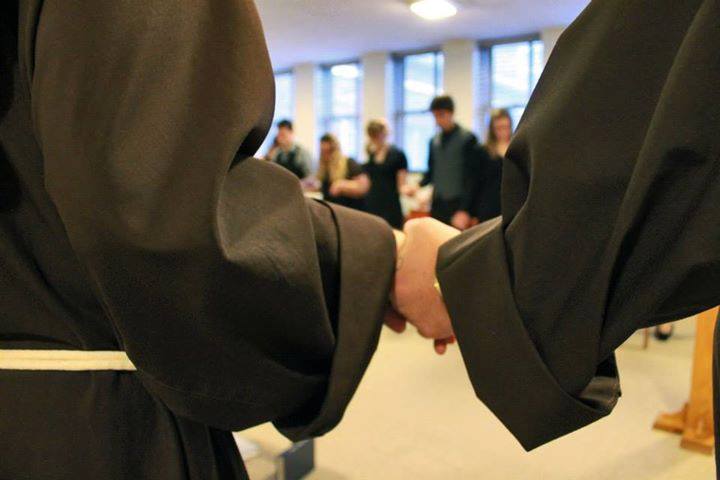
Last week I made a video explaining how the many groups of Franciscans developed over the centuries, splitting and reforming into the many Orders we know today. But I think there is an even more interesting question: what was so attractive about the early movement that it grew as quickly as it did and remains vibrant in the Church today? It’s in answering that question that we see why Franciscans are needed as much as ever in our world today.

A renewed sense of prayer

When we think of the medieval world, many of us think that everyone was Christian, that it was not until the modern world that “secular society” began to exist. The fact of the matter is that there has always been a divide between the religious and secular, and Christians have had various degrees of religious commitment since the time of Jesus. In Francis’ time, corruption (both at the hands of the Church and civil society), disenfranchisement, and apathy all around. Few people received the Eucharist, and because many people were either illiterate or ignored, they rarely had profound encounters with God in the Church.

With Francis and the Franciscans, the Church was called to a renewed sense of prayer and spirituality. Their “incarnational spirituality” showed people that God was in their midst, comprehendible and accessible to them wherever they were. And do you know what? They used entertainment to get their message across. The Franciscans were popular preachers. They did not preach precise doctrines or theological treatises, they preached the Gospel in the language of their hearers. They preached with joy, with life, and most of all, with creativity. Their spirituality caused people to change their lives, but their style of preaching made people want to listen to them in the first place.

Today, the world looks quite different, but the issues remain the same: many people are disconnected, alienated, even cynical towards faith. But notice how I don’t say that it is “secular society” or “new atheism” that’s the problem. While more and more people are claiming “no preference” on religion, there is still a strong spiritual yearning, even among youth. The real problem, as I see it, is that the established religions have failed to speak the language of new generations and engage them in a way that makes prayer meaningful. Too often, when faced with difficult questions, they’re handed answers of morality and philosophy when all they’re looking for is compassion, inspiration, and joy.

How do we respond? With engaging preaching that comes from a solid life in prayer. For Francis, the world was his cloister: he could at once be grounded in prayer while also attuned to the needs of the people around him, a witness to something greater.

Brought together in equality

The 13th century saw the beginnings of a new economic system: the feudal economy was fading away and the market economy was coming to prominence. On the one hand, it brought wealth to people who would have otherwise been ignored because of their lack of nobility; on the other hand it broke the bonds of responsibility for the poor and subjected some to even more humiliating poverty. It was a time of major class division, growing disparity between rich and poor, and no recourse to bridge the gap.

And then there were the Franciscans. Here was this bunch of men that brought together rich and poor at one table. Clergy, professors, princes, homeless, porters, lepers. Together in one family, they were all equal. Where else in the 13th century could you experience such radical emphasis on human dignity? Where could you step outside of the expectations and systems of society to live as the Apostles did? No where.

Today, we see the divide between the rich and poor growing rapidly in recent years. In the past 40 years, the United States has seen some of the worst of this: the top 1% own 10% more of the total wealth today than they did in 1979, have seen a 275% increase of income compared to 40% for the rest, and in 2011, despite being the most affluent country in the world, half of the United States lived in poverty or was designated low-income. Among the rest of the world, the United States is in the 30th percentile (70% of countries are better) with the trend getting worse.

How do we respond? By being minors for the sake of the poor. Because we do not believe that we are above anyone else or deserve respect because of who we are, we find ourselves among the poorest and most forgotten of society.

A Fraternity bigger than oneself

I can’t say exactly what it was about the time of Francis, but there appeared to be a deep yearning for brotherhood. Francis and his brothers were by no mean revolutionary when it came to the idea of forming a brotherhood: the middle ages saw a tremendous flux of new communities and orders all throughout the Church. The answer might be a simple one: people have a natural drive to be together, and seeing other people with similar ambitions is attractive.

Today, we live in a highly individualized culture. In a very positive way, the turn to the self has allowed more people to develop a personal relationship with Jesus in a way that previous generations simply did not even think about, not to mention the heightened sense of the personal dignity and health of self. These are great things. That said, much of our culture has taken this to the extreme, isolating and individualizing everything in such a way that we live fragmented, selfish lives. Everything is about “me, me, me.” The rise of new forms of communication have connected people in ways never before seen, but it has not been accompanied with the maturity and responsibility required to maintain personal relationship at the same time. Despite being so connected, so much of the world feels so alone.

How do we respond? With an example of “us, us, us.” Being a fraternity in mission categorically changes the way we do mission, and really, the mission itself. We don’t just work together, together we work for the sake of one another; we don’t just live together, we have lives together.

Building bridges, not walls

Finally, there could be no discussion about the Franciscans without a mention of peacefulness. One of the most foundational experiences in Francis’ own conversion was witnessing the horrors of war. In this time, there were battles between cities, wars between nations, and a little thing called the crusades. Groups like the “Knights Templar” and “Militia of the Faith of Jesus Christ” (seriously…) even sprang up as religious brotherhoods of soldiers, seeing it their duty to engage in violence for the sake of the kingdom.

The Franciscans could not be any more different. Francis always came in peace and told his brothers to always begin preaching with the words, “peace be with you.” They were forbidden to carry arms and could not even use violence to defend their own property or lives. As if this was not revolutionary enough, Francis even went to the front lines of the crusades and attempted to make peace. Crossing enemy lines, he walked right into the camp of the Muslims and spoke with the Sultan. Did he tell the Sultan that Islam was wrong? No. Did he try to convert the Sultan? Nope. He simply showed the love he had for God and spoke with him as a brother. Even in his words, Francis acted as a man of peace before all.

Today, violence is all around us. It is on battlefields, in our streets, on our televisions, in our politics, and in our homes. It’s as if we have forgotten how to dialog, how to disagree with one another while maintaining respect. In recent months, our political debates have been a prime example of this. But it’s more than that. Washington is not broken as much as Washington reflects the way we engage one another in our daily lives: name-calling, judging, excluding “those” people, looking down on those with which we disagree, and failing to show each other the respect we deserve.

How do we respond? By being peacemakers like St. Francis. Rather than seeing everyone as potential enemies, why not see everyone as Francis did, fellow children of God? Instead of starting conflicts or running from them, why not run towards them with a desire to reconcile? We need peacemakers who are willing to build bridges, not walls.

800 years ago, the Franciscans grew like wildfire because they were exactly what the world needed and people wanted to be a part of the movement. Today, I think that is still the case. What we stand for is exactly what the world is longer for.

But ideals and mission statements don’t change the world. Throughout history, it’s been the men and women who have heard the call and lived these values that has made the real difference. Nothing else will do.

So, what does the world need today. It needs men and women who live prayerful lives, lives that spring forth in creative in relatable ways; it needs men and women who are able to check their ambition and privilege at the door to be equals with anyone else who walks in; it needs men and women who are capable of struggling with others, overcoming their shortcomings, and making it work with others; it needs men and women who want to live for others, who want to build the kingdom of God even in the most difficult of places.

The funny thing about it all is that these people are already out there in the world, living and doing these very things. Maybe it’s even you. Maybe what the world needs most right now is not some politician to fix our problems or God to perform some incredible miracle, but you, as you are, living the 800 year old charism of St. Francis of Assisi.

Each year on New Year’s eve, we celebrate the year that was and anticipate the year that will be. As the ball drops and the clock adds another year at midnight, we sense something significant: it’s a new year. And despite the fact that time is relative and the moment is completely arbitrary… there are feelings of elation, catharsis, inspiration, and regret. The changing of the year offers us a clear break from past and future, and opportunity to move on and live better. With each turning year is a chance for a “fresh start.”

It’s no wonder, then, that it is a time for resolutions. “This year, I’m going to …” People focus on losing weight, working harder, improving relationships, eating better, quitting smoking or drinking, traveling more, or just being a better person. It’s a time of motivation, determination, and achievement of feats one didn’t know possible.

So why do I write about this now on November 28th, a full month ahead of time? Am I that organized and forward thinking? Ha! (Maybe there’s a New Year’s resolution somewhere in there…) No, the reason I write today is because today is actually the final day of the Church calendar. As the sun sets this evening and the evening masses begin, Ordinary Time will end and Advent will begin.

Like the Gregorian Calendar, there is a sense that this is an arbitrary change; since the events we celebrate (Christmas, Easter, etc.) were not recorded by exact date nor do they “happen” again each year, we could have chosen to celebrate them on any day and set any day as the start of the new year. And yet, unlike the Gregorian Calendar, there is great significance to the progression of the year: we begin with anticipation and hope for something better during Advent, experience the joy of the Incarnation, our hope fulfilled, at Christmas, begin our Christian journey in Ordinary Time, call to mind our times of failure in Lent so to prepare ourselves for the fullness of life and salvation during Easter, to finally be sent out to make disciples of the world in Ordinary Time again. In a year, we capture the experience of our salvation, from our humble beginnings to our triumphant salvation.

The beauty of it all, at least to me, is that it is by its nature cyclical. It happens again and again and again and again. The seasons of the year are not things to be completed or perfected so as to move beyond them. So it is with our life as Christians. Our experience of salvation history and the stages of our own Christian growth are not things that can be simply completed like years of high school or the items on a checklist. Just because we have been a Christian for many years does not mean that we have graduated from the anticipation of Jesus’ coming, the excitement of a new faith, the sorrow of a forgotten one, or the call to spread it abound. The seasons and celebrations we commemorate throughout the year, models for salvation history, do not always progress in our lives like a ladder, moving forward to never return; they are like a spiral staircase, always returning to where we once were but with new perspective.

This evening as Advent begins, we will find ourselves at the beginning once again, an opportunity for a “fresh start.” It is a time to return to our roots, to focus on what is most essential to us as Christians and to remember the feelings of hope and anticipation we once knew when we first accepted the faith. It is a time for us to recommit ourselves to the journey of salvation. I say, it’s a time for resolutions. On New Year’s eve, we set resolutions to make our year better than the last one. We focus on our bodies, our money, and our careers. Why not set a resolution to focus on what really matters, to commit ourselves to making this year better for our spiritual lives than the last? Prayer. Donations. Service. Sacrifice. For years we may have been doing these things very well. Maybe we haven’t.

Today, we have an opportunity to start again on our journey. What will you do better this year?

Those of us born between 1982 and 2004 are in a special class of people known as the “Millennial Generation.” We were raised in the dotcom boom and technological age, came of age during the attacks on September 11 and subsequent Iraq War, and now enter our adults years after the Great Recession of 2008. Some point out how these factors have developed the confidence and resilience of our generation, that we are widely tolerant when dealing with social issues, and have become more civically minded, volunteering and getting involved to a greater extent than previous generations. Other have pointed to a less noble set of characteristics, that we are driven by a sense of entitlement, detach ourselves from traditional institutions for the sake of the individual, and are particularly more narcissistic than previous generations (selfies anyone?)

All of this, to the extent that it is true, has had an impact on Millennials’ engagement with the Church. By and large, it has meant the acceptance the secular over ecclesiastical, showing a drastic dip in church attendance compared to the previous generation, while engaging the needs of the world but through volunteerism in a more profound way. Some point to the desire among Millennials to recapture aspects of the tradition lost in previous decades, while it seems clear, even if just anecdotally, that Millennials from both sides of the aisle are more comfortable challenging the practice of the Church for what they see to be a more “authentic” way of life.

For these reasons, among others, Millennials raise issues for the Church that previous generations did not, at least not to the same extent. How does one balance the dominant desire of this generation to assert its individuality and “authenticity” with the tradition and teaching authority of the hierarchical Church? As young religious leaders, how do we navigate the obedience we have to our superiors with the obedience we have to our consciences? To what extent can we learn from the Church, and to what extent do our voices need to be heard to challenge it?

These were the questions I asked Fr. Daniel P. Horan, OFM, Franciscan author and theologian. As a fellow Millennial engaged in the political, social, and theological issues of the Church, he offered balanced responses and encouraging insights into some of the issues facing our generation, and how all of us, no matter our age, can faithfully and authentically engage the Church in today’s world. I had a great time talking with Dan about a whole host of topics, the most relevant of which I share here (unfortunately, the bit about Dan being in a bowling league in high school didn’t make the cut. Sometimes you just have to let something go!)

Please feel free to comment on the conversation, ask any questions that you have, and check out Fr. Dan’s blog, Facebook page, and YouTube channel. For those on email, you can watch this video, as well as others, here on my YouTube channel.

You’ve heard this phrase before, I’m sure. For many, it expresses the very strong link people make between the way someone looks and their worth in society. Well-dressed people are important and poorly dressed people are not. For the most part, it is a fairly superficial statement.

But what if the clothes actually did make a person who they were? In discussing the symbolic importance of clothing in my Pentateuch class this week, our professor shared a rather fascinating study published in 2012 called “Enclothed Cognition” (the study itself is not accessible for free, but you can read about it in a New York Times article here.) Basically, researches gave two groups of graduate students the exact same white coats to wear and asked them to complete a series of cognitive tasks. One group was told that the white coat was a doctor’s lab coat, the other was told that it was a painter’s coat. The results? Those who believed they were wearing a lab coat made half as many mistakes as those who believed they were wearing a painter’s coat!

As the article says, researchers have known for years that the way one looks can affect the way people are perceived and treated. What this study indicates, though, is that the clothing one wears can actually affect one’s image of self, and thus, have an effect on one’s psychological processes and productivity.

I have been a long believer of this, even before knowing the science behind it. In high school, our baseball coach allowed us to wear anything we wanted to practice as long as we had long pants and our shirts represented the school. Almost every player chose to wear sweatpants and an untucked t-shirt. I just couldn’t. I wore baseball pants, high socks, belt, and tucked in baseball shirt, the same things I wore for actual games. To most of them, it didn’t matter what one wore, it was how one played that mattered. Which is true. But at least for me, I knew that how I dressed affected how I played. Besides the obvious practical concerns (sweatpants are more cumbersome than baseball pants) there was a psychological disposition that clothing had on me: in my mind, wearing sweatpants was associated with lounging around and being lazy whereas wearing baseball pants was associated with playing baseball, something that was always done as hard as I could, and helped me focus. Clothing was not an inconsequential external, it was a conscious decision that changed the way I thought about myself and likely affected my psychological disposition.

As someone in religious life, this sort of insight is very interesting to me. While I get the feeling that the issue of wearing a religious habit is completely irrelevant to most people, it is a question that has been hotly contested by priests and religious since the Second Vatican council. Should we wear distinct religious garb? Because there are such strong opinions on either side (about which I have written before), the general conclusion for many is simply to say, “It doesn’t matter what you wear anyway, so wear whatever you want.”

I disagreed with this notion when I played baseball, and now, having learned that there is actual research in this area, have to disagree again. What one wears is not some inconsequential external with no meaning. It is an expression of oneself with significant import. What one wears not only affects how one is treated, it affects the way that we understand ourselves and act in the world. As public figures concerned with the spiritual and physical well-being of all people, called to evangelize and shepherd God’s people, how could this not matter?

But that doesn’t mean I’m calling for everyone to wear their habits and collars. Actually, in what might be the biggest surprise for some people, it’s quite the opposite: I think some people should wear their habits much less. Yeah. Didn’t see that coming, did you? Here’s what I mean. For me, the habit is a positive sign. It symbolizes humility, connects me to the larger tradition and church, allows me to connect with the people of God, and overall, makes me feel good as a pastoral minister. I embody what my clothes mean to me. But what about those friars for which the habit represents something negative, a sign of privilege or a way to separate the laity from ministers? For them, wearing the habit and embodying what it means to them is not going to allow them to be the best ministers they can be. Or, worse yet, what about those people for whom the habit is a sign of privilege and a way to separate the laity from ministers, and they like that about it? What it causes them to embody is extremely detrimental to the faith.

So, I guess the question I have comes down to this: if clothes can actually “make the man,” what sort of man is his religious garb making him into? If what someone wears makes him/her a less effective minister or moves them further from God, it might be time for a wardrobe change.

The cover photo is by German artist Herlinde Koelbl in a project titled Kleider Machen Leute (‘Clothes Make The Man’). The subject is Cardinal Müller, the prefect for the Congregation for the Doctrine of the Faith.

St. Francis is probably the most popular, widely recognized, and most misunderstood saint in the Church’s history. It’s not that people don’t know a lot about him, it’s the opposite: since there have been so many stories written about him over the past 800 years, everyone knows something, but it can be difficult to separate fact from folklore.

As someone who has studied the early sources of his life, it can be frustrating sometimes to see how his name is used or what people are saying about him. Take the “Prayer of St. Francis.” It’s a nice prayer, but those who have read Francis’ actual writings know that it sounds absolutely nothing like him. Dig a little deeper and you’ll find that it was a prayer for peace written during World War I.

Francis preaching to the birds is another example. Did Francis preach to the birds in a literal sense? Maybe. We do have one or two references to it in his early biographies. But what’s interesting is that so many other saints before him were also said to preach to animals, and that, for some, the birds represented the many types of people of the world. And besides that, he did and wrote about many other things; preaching to the birds is something he never mentions, and is really insignificant to all of the other more important things he said and did. And yet, he is the man of the birdbath.

These are just two examples of the manways the image of Francis has been misunderstood throughout the years, and it’s no wonder that he can be found promoting such vastly different causes. Once, for instance, our novitiate class was forced to attend an etiquette because, as the friar hosting it said, “Isn’t this what Francis would have done?” An etiquette workshop. Right.

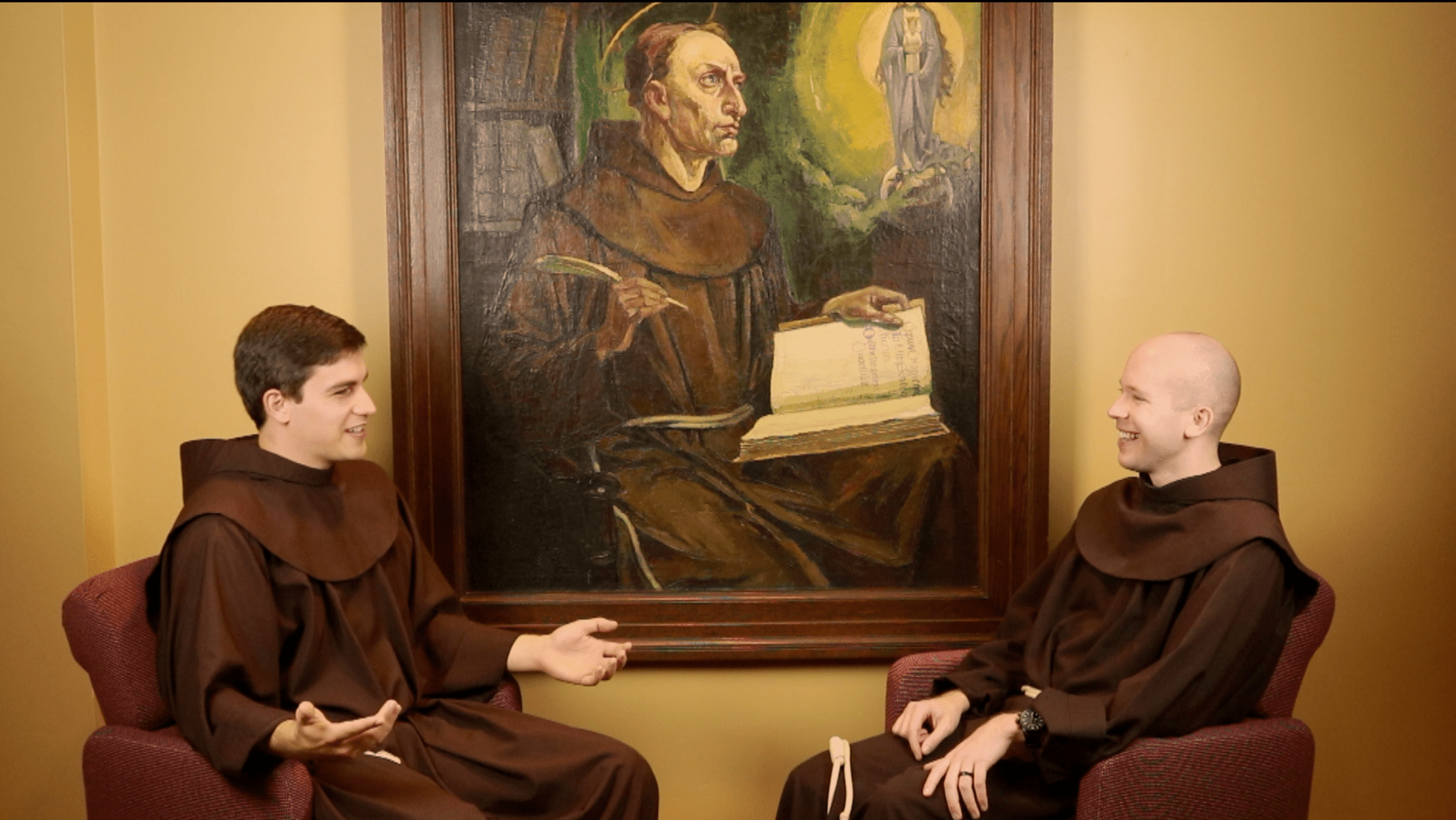
That’s the feeling that Rob Goraieb, OFS had a few weeks ago when we were preparing for the feast of St. Francis, coming up this weekend. How could we deal with this frustration in a positive way? Like the 40 minute video we filmed a few months ago about vocations and church in the modern world, we decided to just sit down and talk about it on camera. What things frustrated us? What aspects of Francis’ life are often overlooked or forgotten? What do we as Franciscans want the world to know about St. Francis?

We sat for about an hour on camera and we hardly scratched the surface of what we wanted to say. In fact, both of us were initially left dissatisfied with what we had done. The fact of the matter, as we realized, is that there is no way to totally encapsulate the inspiration of the life of Francis, and in some ways, we didn’t even want to try. But we did want to share with you what we found most essential to Francis’ life and what it might mean to follow Francis today.

Happy Feast!

For those on email, the link is here.