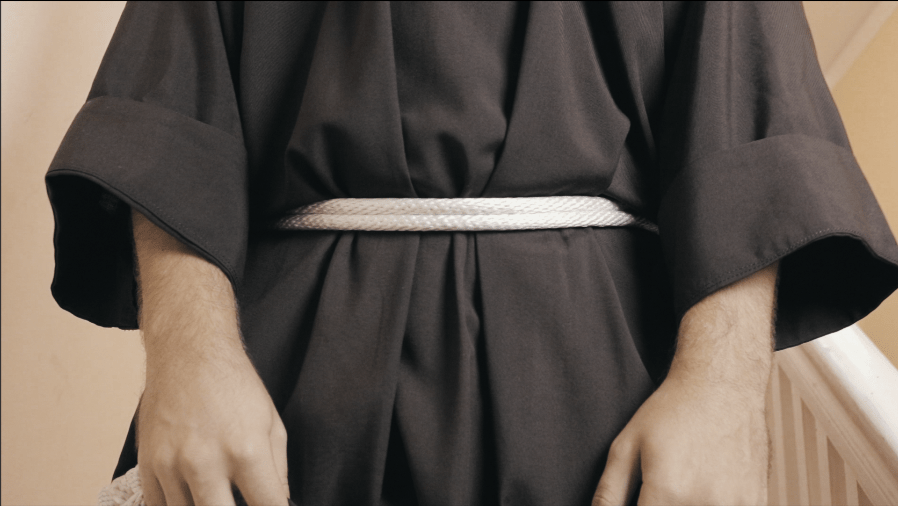
This is the first episode of an ongoing series. For the next episode, click here.

Everyone has that one friend who always has an interesting story. No matter what you’re talking about or who you’re with, that friend always seems to have an experience that is so entertaining and over-the-top that you begin to doubt whether any of it is even real.

In my experience discerning with the friars back in 2010, Br. Fred Dilger, OFM was that friend for me. Living with him and the other friars for two months, I heard more stories about his life than I can possibly share.

There’s the story of him wanting to be an actor after high school. Rather than attending a school for the arts, something that his parents thought would be a waste of money, they decided to encourage his dream by dropping him off in New York City and telling him to see if he could make it. He didn’t, realized it wasn’t for him, and saved at least two years of his life.

Or his first interview at a powerful architecture and interior design firm. When asked where he saw himself in five years, his ambition and drive blurted out, “Your office, higher floor.”

That story only gets better when you find out where he actually was in five years. Having extraordinary talent and business savvy, Br. Fred found himself running his own interior design firm with none other than Elton John, a close personal friend, as his first client. Oh, and he also did design work for John Mellencamp, John Reid, John Bon Jovi… and I’m sure other people not named John.

There was the first time he tried to cook for himself in his Manhattan apartment. Unsuccessful, he thought, because the oven was broken, he found out later that it simply had never been plugged in. This was during his fourth year in that apartment.

But nothing beats his call to religious life. Feeling a little unsettled in his work and wanting some time away, he asked his assistant to book him “a nice room at the monastery” near him, “something overlooking water or something.” Even though his assistant told him that, “They don’t do that sort of thing,” he went anyway. Scandalized by the fact that he would have to share a bathroom with a stranger, he decided to leave quietly, stopping for evening prayer on his way out. Within minutes, he felt a tremendous and undeniable call from God and knew his life needed to change. He called one of his sisters that night to tell her that he was selling his business to join the monastery. And he did.

These are just a few of the stories that make Br. Fred, Fred. And they haven’t stopped since he’s entered the friars now a decade later. Of all places one might have expected him to choose as his first assignment, he chose the poorest one with the most manual labor: St. Francis Inn, a place for people to be served a hot meal restaurant-style 365 days a year. Even in the most ordinary of places, Br. Fred continues to find the extraordinary. While this video, the first of a seven-part series, doesn’t come close to capturing all that makes his life a friar life, it offers a piece of who Br. Fred is and what he brings to this life.

For email subscribers, click here to view this video.

For the past four years, I’ve spent New Year’s Eve renting a house with friends I met freshman year of college. For two, sometimes three nights, we catch up, play games, and just enjoy the company of people we have known for nearly a decade, reminiscing on old times as we make stories worth telling next year. Now nine years removed from the time we all met living in the same freshman dormitory, twelve different people have attended at least one weekend and seven of us have attended them all. To say that it’s one of my favorite times of the year is an understatement.

As the years roll on, so do our lives, and it’s amazing to watch my friends grow up, to see their careers take off, and most significantly, to be a part of their lives as their personal relationships become more serious. While we have always included new boyfriends/girlfriends into the fold and “couples” have generally made up more than half of the group, this year marked a distinct step. Of the thirteen people attending, ten were with someone with whom they have been dating for more than three years (with the longterm boyfriend of another unable to attend and the other having just ended a serious two-year relationship with a former attendee), two sets of couples had gotten a pet together in the past year (and brought it with them), and one couple had even gotten married since last year.

And then there was me. Not in a relationship, not looking to be in one. While my friends are all really mature when it comes to the setting and are in no way exclusive or publicly affectionate while in the group, the gravity of the situation was impossible to miss: when each night was over and people went to bed, when we said our goodbyes and went our separate ways, everyone else had a partner. Everyone else had someone else on the journey, someone to share a conversation with, to share their lives with.

Me? I had the radio. And it was a jerk.

“An’ here I go again on my own
Goin’ down the only road I’ve ever known,
Like a drifter I was born to walk alone.”

With my friends on my mind, the first song I heard on the radio was “Here I Go,” by Whitesnake. Yeah… I didn’t listen to the rest of the song.

But it got me thinking. As I continue to discern my life with the friars and my imminent decision of whether or not to make final vows in August, am I really choosing a life “on my own”?

The immediate and obvious answer is “no.” As I shared during my first year and have reiterated numerous times since, just because I am choosing to remain unmarried does not mean that I am choosing to forgo intimacy. There are multiple ways to love and be loved and I’m simply saying no to one of them. There is still the intimacy of platonic friends supporting each other through struggles, of work colleagues pouring their lives into a project, of academics challenging one another intellectually, of “the guys” working out and playing sports together, and of course, of the brothers in the fraternity committing their lives to one another, among many more. As a friar, I have and will continue to experience intimacy on many levels, feeling a part of something greater than myself, finding a permanent home with men who welcome unconditionally, and sharing in a common vision of life and Church. In a very true and important sense, I will never, ever be alone because I have the brothers.

And yet, five and a half years with the friars has shown me that, no matter how significant and important it is, a fraternity most certainly is not an equivalent alternative to a spouse. While, yes, both are lifestyles of intimacy and commitment, both are intended to be unconditional and lifelong, and both offer stability and produce fruit for the Church and world, they are fundamentally different in focus and lived experience: a marriage is based on a one-to-one, finely-chosen relationship while a fraternity consists of hundreds of unchosen ones. As similar as they may seem and as fruitful as both can be, choosing to love and making a commitment to one romantic partner will never, ever be the same as growing in and learning how to love a group of diverse, transient people. Like a married couple, I can say without question that in times of crisis and times of joy the fraternity will be there to share in and support me, but I cannot say with certainty who the individual men will be, where they’ll be when I need them, or when I will see those most important to me. Very much unlike marriage, my decision to stay or leave the fraternity is not dependent on the individual members of it, and in fact, some of my closest friends within the fraternity have left the order, will eventually leave, or will ultimately die within my lifetime. Thus, even though there exists many intimate relationships, my life within the fraternity will always have a sense of being “on my own.”

Is this some unforeseen revelation that I’ve just now had? Am I beginning to question my life as a friar or fear what might be ahead? No. Not at all. As much as we can equate this life to being married or “having a new family,” I knew even before I joined that these things were meant analogically. Similar, but not the same. Fraternal life can never fully replace true family life; fraternal intimacy is simply not the same as exclusive one-to-one intimacy.

But here’s the thing: it doesn’t need to be. As I grow in my life as a friar and prepare for my final vows, it’s even more obvious to me that some people are simply not called to such an intense, one-to-one relationship, that, even though such relationships are the norm in most cultures they are not necessarily the best way to love or build communities. Maybe some people, not for lack of love or ability but because of an abundance of both, are called and gifted in such a way to love whomever they are with, living intensely in the present moment without the longterm commitment of the future; maybe some people can live anywhere with anyone doing anything because their life is not defined by the intense love they find and share in one person, but rather by the desire to be in relationship with the source of love itself and to share it in a broad sense with all.

Are these people—am I—”on [their] own”? In a sense, yes: they will never have the unconditional one companion with which to share all their thoughts, fears, desires, and struggles. And maybe they can’t live without that. But in a sense, no: they will always be guided by the One who loved first, both in their relationship to that love and in making it present in the world. And maybe I can’t live without that.

The other night I was out with a few friends, and in a discussion about movies, one person revealed that she had a large, color-coded DVD collection of her favorite movies, ranked for each category. Naturally, we had to ask: “What are your categories?” and “What are your favorites?” We were not disappointed. Perplexed, but not disappointed.

Among her collection the largest section was the romantic comedy section. Fair enough. How to Lose a Guy in Ten Days? When Harry Met Sally? HitchThe Notebook?

No. The Mummy Returns.

Yeah, that’s right. The Mummy Returns. The 2001 fantasy/action movie starring Brenden Fraser, Rachel Weisz, and Dwayne “The Rock” Johnson (so you know it’s good), in which an Egyptian corpse is resurrected (again) in an attempt to raise an ancient army of unspeakable evil, only to be destroyed (again) by our protagonists.

How romantic!

Naturally, we gave her a lot of grief for this. Not only is it a B-rate sequel, it is neither romantic nor comedic, making it a fairly ridiculous choice for someone’s favorite romantic comedy. For her, thought, it didn’t matter that the couple in the movie was already married with a son, had no moment of “falling in love,” or the fact that their relationship was but a minor subplot to the overall direction of the movie (you know, the whole resurrected mummy trying to destroy the world bit). What made it her favorite was the love the two had for one another in the midst of conflict, how having a child made them love each other more, and the sacrifices they were willing to make for one another.

Interesting.

While I stand firmly unconvinced in her assertion that this movie is a romantic comedy—let’s be clear about that… it’s ludicrous—The Mummy Returns offers a rare Hollywood example of the love of married life. When we think about “love stories,” there are a lot of movies about falling in love (e.g. How to Lose a Guy in Ten Days), and a lot of movies about old people looking back on a life well-lived in love (e.g. The Notebook, Up), but there are very few movies about growing in the love that people have already found. It’s as if people fall in love and then jump to “happily ever after,” with nothing in between. Where are the struggles? Where are sacrifices made for one another? Where is the satisfaction of raising a child? As strange as it is to admit, there is something admirable about The Mummy Returns showing that love is not something that people simply fall into and then they get old, it is something that has to be worked at, and believe it or not, can even be stronger more than a decade in.

Pope Francis echoes this idea beautifully in his latest apostolic exhortation, Amoris Laetitia. Quoting the bishops of Chile, he writes, “the perfect families proposed by deceptive consumerist propaganda do not exist. In those families, no one grows old, there is no sickness, sorrow or death… Consumerist propaganda presents a fantasy that has nothing to do with the reality which must daily be faced by the heads of families.” He goes on to say, “Joy also grows through pain and sorrow… After such suffering and struggling together, spouses are able to experience that it was worth it, because they achieved some good, learned something as a couple, or came to appreciate what they have. Few human joys are as deep and thrilling as those experienced by two people who love one another and have achieved something as the result of a great, shared effort” (Amoris Laetitia: 130, 135).

I couldn’t agree more. As much as we popularly hear about the “honeymoon stage,” how dating and the first few years of marriage are the most exciting and so every marriage should try to hang onto it for as long as possible, people who have been happily married for a long time will say the complete opposite: the “excitement” of the first few years might have faded, but their love for one another has grown. While a story about paying bills, raising children, coordinating busy schedules, and living an overall domesticated life is not something that Hollywood producers are rushing to theatres, it can be through those things—the mundane and trivial things that couples have to work hard at to accomplish—that will build stronger bonds of love than a million romantic first dates or an endless supply of butterflies in the stomach.

As someone who is not married and does not plan to get married, I can say that the same is true about religious life as well. When I entered the Order, all of the friars were new to me, every ministry a open book of opportunities, and the very idea of living as St. Francis a romantic notion straight out of a book. It was a romantic step in my life, in a way, leaving the norms of the world to do something radical. Now, I know most of the friars, have seen all of the ministries and know how they work, and have realized that the romance of the life is lived through the mundane routine of prayer, work, and fraternity, all of which I know very well. The life I live now lacks the idealism and excitement that the first few years offered.

And that’s a good thing.

The life I live now as a friar is so much better than all the idealism and excitement of when I entered. With the passing of time, there is depth in my relationships; satisfaction in having overcome challenges; comfort in knowing what’s next; and even, despite the disappointment and frustration, a stronger assurance in my vocation that I’m in the right place. These are not things I would trade for romance I felt in the beginning, nor are they things that can be felt immediately. They take time, and they take effort.

So, just like having a conversation about favorite romantic comedies with a friend of mine, you could very easily ask me about my life as a friar, “Where’s the romance?” To that I would simply say, that in movies, in marriage, and in the life of a friar, there’s more to life than falling in love. Sometimes, we need to talk a little more about growing in the love we’ve already found.

This week is National Vocation Awareness week. From November 6-12, the United States Conference of Catholic Bishops is asking all of the faithful to pray for new vocations, to encourage those around us, and to discern in our hearts what God might have for us to do. I ask that you join me in doing these three things.

But what is a vocation? A derivative from the Latin vocare, “to call,” to have a vocation is less about what one does or is, and more about who wants it done. A vocation is a calling from God to build up the kingdom.

Traditionally—and what the USCCB is primarily focusing on this week—the only things that were considered “vocations” were priests, religious brothers and sisters, and permanent deacons. Consecrated celibate life. God called people out of their normal lives to do something more, something special, something better than regular old marriage. God didn’t need to call people to married life or to be teachers or to serve the public.

Today, that is not our understanding of God and His call. The fact of the matter is, as baptized Christians, we are all called by God to build up the Kingdom in a special way. When we were baptized into Christ we were baptized into His threefold ministry: Priest (bringing people closer to God and praying for the world), Prophet (announcing the Kingdom and teaching the world), and King (working for justice and governing the world). While, yes, in the official Church, ordained priests, religious, and deacons exercise these three roles to a much greater extent than the laity and so are critically important, there is more to the Kingdom than the official structure of the Church! What about educating children? Planning cities? Running businesses? Providing food? Healing through medicine? These things are not just nice things for a society to have, they are the very foundation a people needs to have the luxury of a working Church. They are, in a very real way, the work of God. And those who dedicate their lives to them—when they act as God’s priests, prophets, and kings in the world—have just as much of a calling from God as ordained priests, religious brothers and sisters, and deacons.

For that reason, I once again ask you to join me in doing three things: praying for vocations, encouraging others, and discerning a calling from God on your own. But in doing so, I ask that you broaden your understanding of what it means to be called by God to see all the many things that God’s Church and Kingdom needs, and realize that, as I present to you in this video, if God wants to work through someone, He’s going to do it. All we can hope for is the courage to say yes and the trust to follow wherever He may lead us.

And… if you’re looking for a really easy way to take part this week, how about sharing this video with someone who might have a call from God or on social media? For those on email, click here to view.

Everyone knows that the Franciscan habit is a powerful symbol. While everyone may not know exactly what it is, it universally speaks to religion, peace, and approachability. That’s not a bad thing to be recognized as when meeting people on the street, especially when someone is looking for prayer or guidance.

What everyone does not necessarily know is that wearing a habit can be a rather difficult task. With long sleeves, loose fabric, and hanging rope, there are innumerable ways to embarrass oneself, break things, and even end up tripping on the floor.

By no means an exhaustive list, my newest video hopes to capture a taste of the things that we face every day in our habits, and the many mistakes that I have made in such a short time. Hope you enjoy!


Email subscribers click here to watch the video! If you’d like to sign up to receive blog posts by email, click here.