Click to listen

Have you ever watched an inspiring movie of real events only to find out later that Hollywood had “enhanced” part of the story to make it more interesting? For many, watching a movie “based on a true story” means very little other than the fact that the characters in the movie might have existed (but in some cases, even this is not true!) While heartwarming and inspiring, some have become jaded to Hollywood’s portrayal of history, simply expecting that it will be embellished, exaggerated, or just completely made up.

Which is a shame because movies have the tremendous ability both to inform the public of important events and to shape the way we think about them. Art in general, actually, has always had this power. Look at Upton Sinclair’s book The Jungle: the predecessor to the FDA was founded in large part due to the public outrage over the events depicted in the book! Almost everything we think about pirates came not from history but from the book Treasure Island. And what about our understanding of biblical events? For most, our conception of angels and demons, heaven and hell, and what God looks like (old guy with beard) comes straight from medieval art.

So much of our own worldview and imagination is formed by what we watch on screen, see in galleries, or read in books. Which presents an interesting question: who bears the greater burden of maintaining the truth, the one creating the art or the one consuming it?

That’s what Tito and I discussed with week on Everyday Liminality
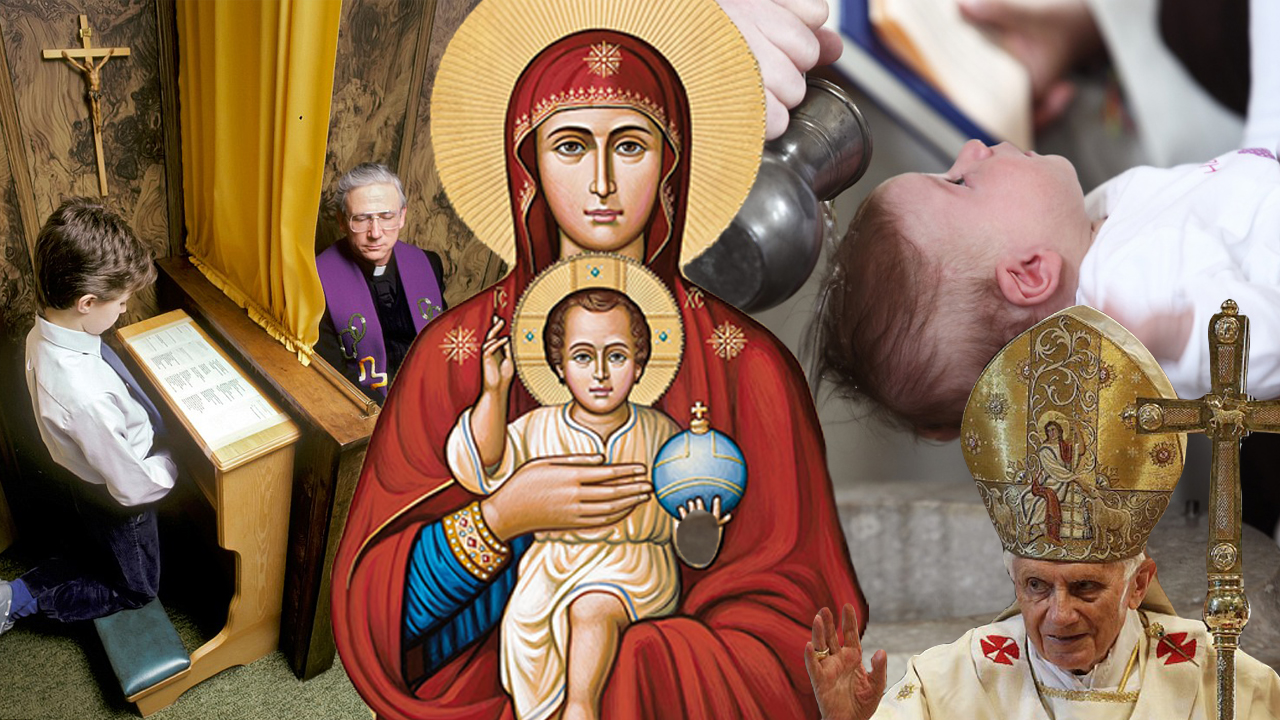
It is often jokingly said that in the “divorce” of the Reformation, the Catholics got the liturgy and the Protestants got the Bible. A reflection of the fact that Catholics emphasized the sacramental nature of God’s revelation while Protestants whitewashed their churches and made the Bible the only thing that mattered, historically, there was definitely a difference in emphasis, and one can understand why the stereotype was born.

This annoys the heck out me.

Like all stereotypes, the kernel of truth that existed 500 years ago has been so overgeneralized that it is, at this point, more of an untruth than anything else, and serves to create a false dichotomy. Just because some Protestants made the Bible their only authority and rid themselves of all other forms of divine revelation doesn’t mean that Catholics have any less reverence for it or that Sacred Scripture is any less important to forming our doctrine. The Reformers may have given up a sacramental worldview, deferring that identity to the Catholics, but the Catholics never gave up their emphasis on Scripture (and, maybe more accurately, weren’t subject to overemphasizing its importance as the Reformers did.)

What I am getting at with this? Often, out of this misunderstood part of history, Catholics face a criticism from fundamentalist Christians that many do not know how to answer. Thinking that Catholics do not care about the Bible and seeing that some of our beliefs are not explicitly stated in Scripture, some will say to us, “Your doctrines are made up” or “read the Bible and you’ll see how wrong Catholicism is.” I would say that I get a comment on a YouTube video to this effect on a weekly basis.

This week on Catholicism in Focus, I hope to address this issue by explaining the Catholic perspective on Scripture. We have the utmost respect for its words and maintain that it is the inerrant Word of God to guide our lives (not to mention that we proclaim as much or more of it at our liturgies than Protestants do). For Catholics, it is an essential form of divine revelation, but certainly not the only form. Looking at how the Bible was compiled, how God interacts with the world, and what Jesus did to form the Church on earth, we recognize that there is more to God’s authority than what is written in Scripture.

This weekend I’m in Bayside, NY giving a day of reflection on our universal call to holiness and preaching at all of the Sunday masses. While it’s impossible to capture the energy of speaking in front of people  just sitting in an empty room in front of a camera, I thought I’d give it a try. Here’s the gist of my homily for this weekend, the 30th week of Ordinary time year B.

Also, forgive the voice… I’ve been sick for the past few days and have been rallying through!

“Sticks and stones may break my bones but words will never hurt me.” We’ve all heard this rhyme many times in our lives, and there’s definitely truth to it. While people may call us names or use harsh words, it is up to us how we feel about them. Words, unlike physical objects, do not have to hurt us. At the end of the day, they’re just words, mere sounds coming from the mouth of another. What damage can minuscule sound waves cause?

And yet, there is something fascinating about harsh words, particularly swear words.

At their core, they are nothing other than words, right? They mean nothing until we give them meaning. Language, though organically developed, is completely arbitrary. If all of us agreed to it, we could start calling computers “griltarings” or “tribos” or any other combination of consonants and vowels that we wanted. There is no objective name for anything, only an agreed upon word with an agreed upon definition. Words have meaning—and power—because we give them such.

In this way, words are not simply sound waves coming from the mouth of another; behind them and giving them life is an entire world of meaning. While most common swear words have lost their umph with overuse, we can still see what I’m talking about in racial or ethnic slurs. The reason that they are so powerful—and contrary to nursery rhymes, do in fact hurt people—is because they come from a world of hatred, bigotry, and oppression. In using any one of these words, we are not simply saying consonants and vowels, we are conjuring up history and meaning and emotions that are wildly offensive. They may just be words, but there is a history of “sticks and stones” behind them.

Some words, despite being just words, do have power to hurt people. And we all know what words these are.

But what about those words that are not overtly offensive, that do not immediately hit us like “sticks and stones,” but have a slower, less detectible effect on us? What about those words that we use all of the time, those words that are seemingly normal, but actually undermine who we are as Christians?

This is the question I ask in this week’s video reflection. Looking at five words that we use often, I want to encourage us to think more about the words we use and how we use them. Words have power, and we should always be wary of what that power is doing to us.

Click to listen

The time has finally come. Br. Tito and I are talking about Stranger Things on the podcast.

In general, we’re revisiting a topic I wrote about two years ago (when I first watched the show) about the power of nostalgia to evoke memory but also to distort our understanding of the past. Why do we love nostalgia so much, but how might it be a bit dangerous?