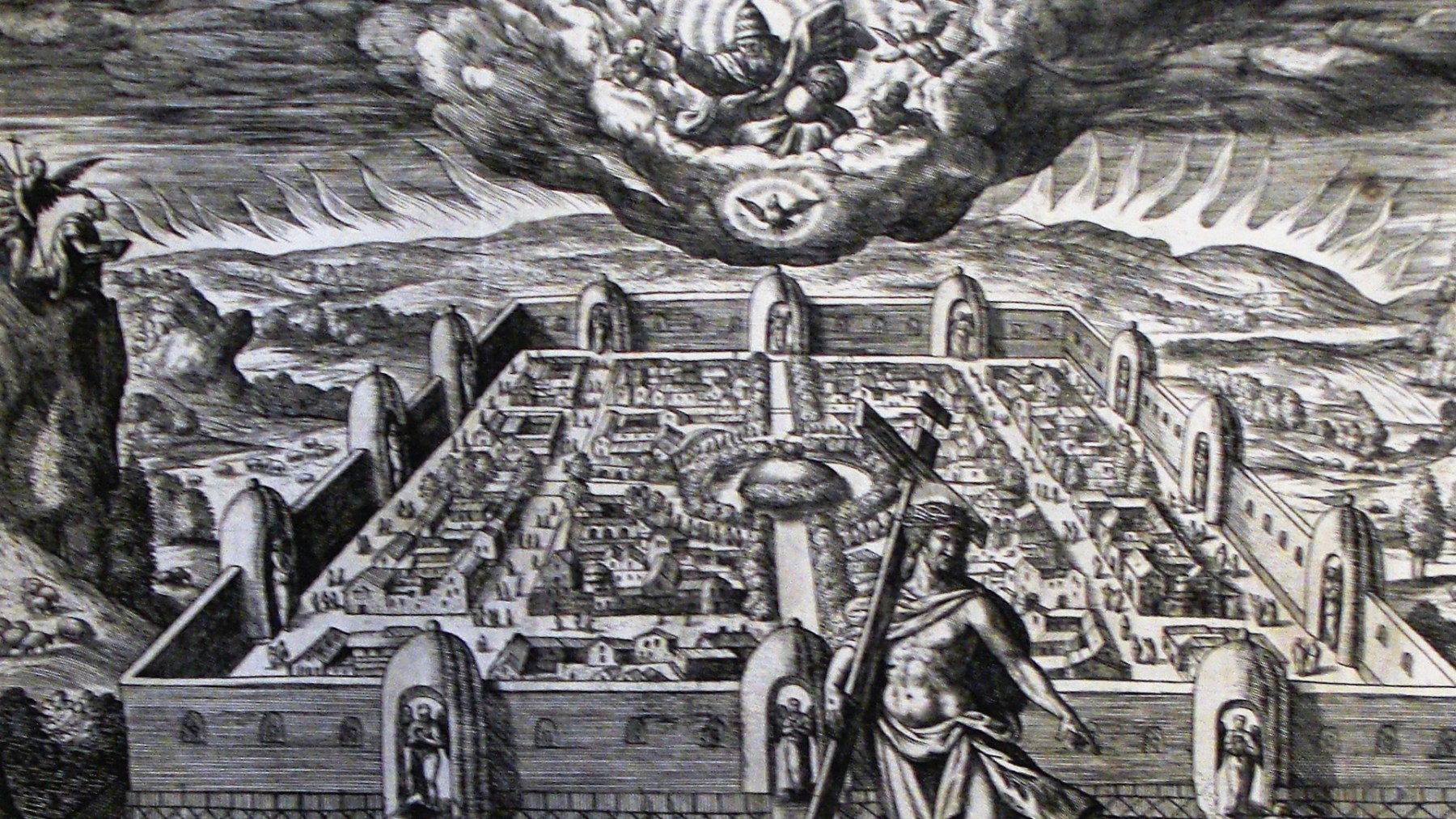
When you hear someone mention the Book of Revelation, what is your first thought? Mine… is to run away as quickly as possible. The reality is that the vast majority of people who quote passages from this book don’t entirely know what they’re talking about and are use its words to promote conspiracy theories, doomsday predictions, and condemnations against the Catholic Church.

Hard pass.

But that doesn’t mean that the book itself is wrong or problematic. In fact, it’s a great book. Surprisingly hopeful. Kind of the exact thing we need in our day. In this episode of Catholicism in Focus, I offer a few keys to approaching the book in the correct way, as well as a brief overview of its contents.

Click here to listen

Have you ever watched a movie from your childhood or revisited a television series that you once loved and found that you were now… a bit underwhelmed? What seemed so great in years past now seems out of touch, maybe even offensive. “How could we watch that? It’s so awful and demeaning!”

Whether its wildly offensive tropes like the use of “black face” or casually offensive side comments about people with mental illness, the values of past productions don’t always match our current ones. In fact, they never do. As time changes, so do our values (to some extent), and so does our tolerance for offensive material.

This is by no means a new problem, but it an important one today. What do we do with our embarrassing past? Some suggest that we remove it, banning or blocking material that is damaging to society. Others suggest that these works need disclaimers and further context. Others simply choose to do nothing, leaving up to the maturity of the audience to decide.

Such is the topic of this week’s episode of Everyday Liminality, the first one of our new season. If you would like to catch up on older episodes, they can be found here. Join us every Tuesday for discussions about art and entertainment in our world today.

Things these days… yeah. They’re not great. As a new priest, I find myself frustrated with all that I can’t do these days, but I can’t say that the outcome of my life has been dramatically changed. I cannot say the same for those in high school today.

At a time when people are trying to find themselves and their place in the world, it seems like the world is falling apart. I feel incredibly sorry for those who have missed out on such big moments in their lives, who find themselves at a loss and without direction. I cannot imagine what it must be like to be 17 today.

And yet, there’s another part of me that is not particularly sympathetic at all. It’s not that I don’t care, it’s that I’m sort of allergic to throwing oneself a “pity party,” of moping around and giving up.

Things are tough, yes, but feeling sorry for yourself isn’t going to make things better.

In this week’s video, I want to highlight a saint for our age. Her name is Claudine Thévenet, and she is someone that I think teenagers can relate to. Although her college plans were thwarted by a pandemic, she did go to high school during the French Revolution and witness two of her brothers being executed.

So… it’s sort of a push, I guess.

She not only survived a tragic time, it made her into a laudable saint. Her resilience, commitment to service, and love of Christ are qualities that we can learn from today.

The following is a homily for the seventeenth Sunday in Ordinary Time, Year A. The readings can be found here.

Our readings today play heavily on the idea of desire. In a dream, God tells Solomon to ask for anything that he wants, to make known the thing that he wants most in the whole world; our Gospel tells of multiple people finding something of great worth, fulfilling a deep desire. Having heard these passages today, we might find ourselves daydreaming, digging deep into the recesses of hearts wondering, “What would I ask for? What do I want above all else?” And that’s great. It’s a fascinating question for sure, one that would serve us all well to ask in prayer, that might reveal a bit about who we are and where we’re going.

Yes, we could spend our morning fantasizing about what we want, but I’m not sure that that would the most fruitful use of our time. You see, so often, we get stuck fantasizing about a perfect world, stuck dreaming about what we really want, that we fail to do anything about it. We think and we wish and we hope for a better life, but it never goes anywhere beyond thoughts and wishes and hopes. Sometimes, sadly, what we truly want is right before us, right within our grasp, being offered to us by God… but we are unwilling to make any sacrifices to get it.

In our Gospel today, Jesus compares the kingdom of heaven to people finding a treasure of great worth, things that they desire above all else. They are not just happy to find them, not just hopeful that these things will one day be theirs: they go out of their way to get them. Without hesitation, the passage says that they sell all that they have to get it. “Take my money, I don’t care. I must have that.” They know how much they want that thing, how insufficient their life will be without it, and so they give up everything to get it. “What good is having all my stuff if I don’t have that?” Sometimes, to get what we really want, to get the greatest things, we have to sacrifice even some of the good things.

It reminds me of a time when I worked at a parish in Virginia about an hour outside of DC. One of the employees, of all things, was a former rockstar. Literally. For years he had toured the country playing music; he had multiple record deals, songs that appeared on major television shows; he even had music videos of his band on YouTube, professionally produced stuff. He never reached universal stardom, you’ve probably never heard of him or his band, but the man had lived the dream. He was a legit rockstar, making a living doing what so many people can only fantasize about.

Which, if you’re me, naturally raises the question: what the heck are you doing here? This was a talented guy who was still pretty young, still loved to make music—working a part-time job at a small parish 3000 miles from home. What are you doing here?

Turns out, rockstars have a certain appeal to women—who knew?—and he met the love of his life. This woman was even more talented than him in her field, and she got offered a once-in-a-lifetime job, something, believe it or not, that is even cooler than being a rockstar… that required them to move from LA to DC… that required him to essentially hang up his career.

And so that’s what he did. He moved to a place where he didn’t know anyone, where there is no music scene, where continuing to live as a rockstar simply wasn’t possible. He did this not because he wanted to give up music—he loved it. He did this not because his wife forced him against his will—they came to the decision together. No, he did willingly, even with some joy, because his wife was the most important thing in his life, not his music. Her happiness, not his career, was what he loved most. As good as his life was before, as much as he loved playing in a band in LA, it wasn’t as great as his wife and kids.

He had found the pearl of great price, and he was willing to sell all he had to get it. What good is holding onto all this good stuff if we let the great get away.

When you put it that way, what Jesus is talking about today seems immensely simple. If you were to have on one side everything we own, everything about us, everything we could ever do, and on the other side you were to have the Kingdom of Heaven—an existence of total bliss, eternity loving and serving God—the decision would be really easy, right? We would all pick door number two. Without question! You can have all my stuff. You can have everything to my name. Take my life! I don’t care. Give me the Kingdom! When you put them side to side, when you see the great treasure next to everything that is ours, there is no real comparison. 

And yet, when I look at my own life—maybe it’s true for you as well—I find myself passively picking door number one. I profess with my lips that all I want is God, that all I want is to live in heaven forever… all the while clinging to stuff that doesn’t really matter. Every single day I am offered the choice between the true treasure of a life with Christ and what I already have, and almost every single day I find myself unwilling to make a sacrifice, unwilling to sell all that I have to get it.

The thing is, it doesn’t have to be possessions or money. Those things, eh, who cares to me. I’m a Franciscan. You can’t tempt me with stuff. But do you know what you can tempt me with? Success. Reputation. What people think about me. There’s something about being good at stuff, winning, having things turn out just the way that I planned that I struggle to sell, that I find myself clinging to from time to time. The treasure is right in front of me and Jesus is saying, “Come, follow me, and I’ll give you the greatest joy you’ll ever know. All you have to do is give up your reputation, your need to be liked, and rest in the success of the cross. Sell all you have and this will be yours.” How simple, right? Who needs control when Jesus is leading the way. And yet, I cling to it.

Maybe you’re like that as well. Or maybe… maybe the thing you cling to and refuse to sell isn’t money, isn’t success, but is actually your need to be in control, to make your own decisions. Maybe, it’s your desire for safety and comfort. Maybe it’s your constant need to be right and inability to admit fault, to say you’re sorry. Maybe it’s the grudges you hold, the anger you carry with you for past hurts. Maybe it’s your fear of the unknown. 

While many preachers will look at these readings today and ask you to think about what you truly desire, I think there’s a far more important question to tackle here: what is it that gets in the way of what you desire? What is it that you cling to, that you refuse to sell, that keeps you from your most prized treasure?

Our Lord may not come to us in a dream and tell us to ask for anything we want, but he is offering us the greatest gift we could ever imagine: eternal life in the Kingdom of Heaven. This gift is free, but it does have a cost. It does take some sacrifice. Sell all you have and receive the gift God is offering us.

The following is a homily for the sixteenth Sunday in Ordinary Time, Year A. The readings can be found here.

As someone who grew up in the suburbs, I have to admit that it is very rare that Jesus’ parables about farming or herding sheep ever touch on anything I have ever experienced, but today is an exception. When I was in my first year with the friars, our director took the whole group of students for a day of service on a farm. Not exactly my idea of a good time, but hey, whatever floats your boat. It was an organic farm, meaning it didn’t use chemicals of any kind, and so every field had to be hand-picked for weeds. Which is what we did… for about six hours. Again… not my idea of a good time.

Besides the fact that we were on our hands and knees all day, a tiring task in itself, what made the job particularly difficult was that the leaves of the weeds looked almost identical to the leaves of the carrots we were supposed to be protecting. I cannot stress this enough… we were not good at this. For every five weeds we pulled up, we accidentally uprooted a carrot, often irreparably damaging the plant . As hard as we worked, I’m pretty sure we did more damage to the field than the weeds themselves. Especially when you consider the fact that one of the friars just gave up and started pulling out the carrots and eating them… we were probably better off just not doing anything. Which… is probably why we weren’t invited back.

It’s because of that experience that I get what Jesus is talking about today. I understand how easy it is to mistake the good from the bad, and to hurt the very thing you are trying to save. I understand the frustration and horror of accidentally doing harm to the good plants.

Of course, the purpose of Jesus’ parable is not to give farming advice; his care is not for the actual wheat. He’s talking about people. He’s using an experience that the people knew well, the difficulty and frustration and even shame of uprooting what is actually good, the loss of of something important, to warn his followers about the dangers of judging people too quickly. “You think it’s frustrating to accidentally ruin a good crop? Yeah, well, it’s far worse when you incorrectly judge a good person for bad and ruin their life.”

Even if you’ve never had an experience like this weeding plants, I’m sure each and every one of us knows what it’s like to misjudge someone, to think we know who someone is only to be proved wrong. 

Sometimes we’re lucky enough to catch our mistakes, to eventually see the person we judged in a different light and find that they are actually quite a good person. Lucky for my sisters and I, this is what happened with my parents—the first time my mom met my dad, she thought he was a buffoon. Really. Everyone thought he was so funny and she couldn’t stand him. And knowing my dad, he probably deserved this judgment, but imagine if she would have stuck to her first impression, judged him quickly and moved on. I wouldn’t be here.

When I entered the friars, I thought one of my classmates was incredibly immature. I couldn’t stand to be around him, and I wondered what he was even doing in the friars. It made me angry, actually, that the friars would accept someone like this. I looked down on him and wanted nothing to do with him. That was, until we moved into the same house and I got to know him a bit more. I saw the person he was under that goofy exterior, and realized that I could not have been more wrong. This was a really good man. A thoughtful man. Oddly enough, a mature man that I respected, and I enjoyed living with him immensely. How easy it would have been to dismiss him, how sad if that’s how our relationship ended.

Unfortunately, this is the case too often in our lives. We make judgments of others, we dismiss them, we say that they are dead to us because of who they are or what they did, and a relationship is broken. Unfortunately, as we well know, permanent harm is done to our families, to our communities, to our world, because of a misunderstanding, because someone jumped to a conclusion that wasn’t correct.

This week in the United States, we have seen the gravest example of this on display as three federal inmates were executed in four days, the first in 17 years. Three men were put death by our government, uprooted from the field before the harvest because they were believed to be weeds. And maybe they were. I don’t know.

What I do know is that we have shown time and again that we can be wrong, that in our pursuit to get the weeds we actually uproot the wheat, we actually kill innocent people. 

In 1983 a convenience store was robbed and the clerk was stabbed to death. Police arrested a man matching the description of the killer walking a few blocks away carrying $149 in cash. A witness, viewing the man through a windshield from the other side of the street said it was him, and he was executed a few years later. No knife was found, the man had no criminal record, and he gave testimony that it was another guy who looked very similar to him, a man who later was arrested for stabbing someone with a knife matching the murder weapon. In 2012, Columbia University completed a six year study of the case, determining that he was innocent.

In 1981, a 17-year old was accused of raping and killing a nun who lived across the street from him—a heinous act for sure. He was executed for this crime, but DNA evidence later showed that he was innocent, and another man confessed to the crime. A 17 year old boy, falsely accused and killed.

These are not uncommon stories. Since 1973, this country has exonerated 170 people from death row. 170 people who were tried in a court of law, found guilty, and sentenced to death, only to find out later that they were innocent. That’s more than 10% of the executions. And those are only the ones that we know about. How many more are wrongly accused? How many innocent people have we mistakenly put to death, weeding out the wheat by mistake?

This is a question that should trouble us as Catholics. Admittedly, for centuries, the Catholic Church did allow the death penalty. It was never a good thing, never to be done our of vengeance, always a lesser of evils that we tolerated. We believed that it was necessary for the defense of society, could quicken the rehabilitation of the guilty, served as a deterrence to crime, and offered retributive justice to those who were harmed. For centuries, popes and saints recognized it as a necessary evil that could produce some good. We believed that we could be a good judge of human beings, that we could remove the weed without touching the what.

Unfortunately, this is not the case. We are not very good at playing judge; we are not as just as God in our judgments. As our understanding of capital punishment began to grow over the years, as we reflected more on this Gospel passage, we began to see that the benefits we once held to were not as great as we once thought, and the evil it inflicted was just too intolerable. In 1992, St. John Paul II promulgated an updated teaching. In the revision of the catechism, he stated that there was only one legitimate justification for capital punishment: the defense of society. As pope, he continued to teach that, when the common good was in question, if there was a risk that the killer could get loose and kill again, the state had a responsibility to protect its people. But as he wrote later, “Such cases are very rare, if not practically nonexistent.”

Very rare, if not practically nonexistent.

Which brings us to pope Francis, who, just two years ago, adjusted the teaching once more. While many expressed their anger towards him, believing that he changed years of Church teaching, all he did was close the loophole: there is no longer any exception for this. The death penalty is a moral evil that should be avoided in all cases.

Effectively, for the vast majority of the world, his words have added nothing to what the Church had already taught as a result of John Paul II. For places like the United States, well-developed countries with effective penal systems, the possibility of defending capital punishment as a faithful Catholic ended in 1992, not 2018. 

But really, the possibility of actually supporting or insisting on the death penalty, ended with Jesus. It may have taken a while to get there, but we know now that we have no right to take a life because it it not our life to take; because Jesus told us to wait until the harvest; because we’re not very good at it. As Christians, there has never been a time in our history in which the death penalty was a desirable outcome, never been a time when seeking revenge, blood lust, or happiness at another’s death was acceptable. Regardless of what any recent popes have taught, we are still a people of peace and mercy, a people who recognize the wonderful gift of life, a people who do everything in our power to protect it. 

As much justification as we might find for taking another’s life in the Old Testament, let’s never forget that we have been ratified to a new covenant in the blood of Jesus Christ, a man who tells us not to judge, a man who tells us to show mercy and forgiveness, a man who knows all too well what it means to be killed for a crime he didn’t commit. May we always be on the side of Jesus, and not his executioners.