Back To School

Three days ago, this desk was immaculate!

Three days ago, this desk was immaculate!

After more than three months of successfully (and futilely) avoiding all school-related activities, the fall session has finally caught up to me. Where has all the summer gone?! Like death and taxes, I guess you could say that it is just one of those inevitabilities for a seminarian.

With the new year comes an entirely new experience. Whereas last year I spent countless hours studying philosophy, this year I will spend countless hours studying theology (a major improvement). On Monday I officially started my degree for ordination, the Master of Divinity (M.Div.) In the next four and a half years, I plan to complete 103 credits of Master’s work in systematic theology, moral theology, biblical studies, pastoral care, history of the Church, liturgical history/theology/practice, and canon law, with a one year “break” for a pastoral internship somewhere in between. For those keeping score at home, that will be a grand total of 133 credits in nine semesters of work. Your prayers in this long endeavor will be greatly appreciated over the next half decade.

But that’s not all that’s new. Whereas last year I spent the entire first semester struggling to transition from novitiate, I start this year with a level of comfort unknown to me last year. I know how to get to school and where my classes are, have already established relationships that I can fall back on, a regular schedule within and without the house, a spiritual director I can call and meet with whenever necessary, and a set of leisure opportunities (golf, movies, gym, restaurants) that I can get right back to rather than search for. Without having to establish all of these things in a new city like I had to do last year, my stress level is next to nothing at the moment. This, I might add, is a tremendous gift at the beginning of a difficult academic year.

Lastly, whereas I taught two confirmation classes for 8th grade boys last year, ministering to a demographic that stretched me outside of my comfort zone, this year I will be working with campus ministry at Georgetown University, ministering to an age group that is a little bit more my speed. I’m not entirely sure what I’ll be doing yet, but I’m excited to be with young people in such a formative time in their lives in any way that I can. I have no delusions that the experience will be an easy one, but I look forward to the challenges ahead.

For now, it’s off to do what I will be doing for the rest of the term, reading, completed with a late episode of The Simpsons with a few guys in the house (a show, I might add, shows its characters in church or discussing religious topics more than any show on television. Really. The Vatican Newspaper even praised the show once. Really! Maybe I can team up with my classmate Ed Tverdek, an avid follower of the show, and write an post about it. I digress…) Blessings on all of you this year, and for those in the academic world, good luck with all your studies!

Commitment is Radical

From left to right, Jeffrey, Michael, and Ross, made a powerful commitment on Saturday. (Photo by Octavio Duran)

From left to right, Jeffrey, Michael, and Ross, made a powerful commitment on Saturday. (Photo by Octavio Duran)

Yesterday morning, I was a part of a beautiful, powerfully inspirational ceremony in New York in which three men committed themselves to a life of poverty, chastity, and obedience in the way of St. Francis of Assisi. To the outsider, what they did was radical, countercultural, and strange. What would possess someone to choose a life “without anything of one’s own,” in celibate-chastity, obedient to both superior and equals? What would possess someone to devote their entire life to the welfare of others, often sacrificing one’s own livelihood in the process? What would possess someone to wear a brown dress and a rope in public?

As I thought about it all over the past week, I realized that what was truly countercultural about their lives was much deeper and yet so simple: at the heart of their life is commitment to something other than themselves.

What was once a problem seemingly exclusive to young men in relationships, I believe that a “fear of commitment” has become a cultural problem in our day. Everyone knows that divorce rates in this country are astronomically high (roughly 50% of first marriages ending in divorce), but what about the declining marriage rate, down 60% since 1974. (Those people sure aren’t all running to religious orders, I can tell you that!) And yet, the problem has nothing to do with the institution of marriage or people becoming less dependent on each other. No, the decline in marriage is one symptom among many of the growing fear of commitment we experience as a culture.

Last week at our sexuality workshop, one of the presenters asked the question, “What is the most difficult part of being celibate?” My response was, “Having to talk about celibacy so much.” And while in jest, there was great truth in it. People are enamored by what we do, not that we don’t have sex, but that we don’t have sex for the rest of our lives. One student pointed out, “For God’s sake, people are up in arms these days that they have to sign a year or two long contract to get a cell phone. How are they ever going to understand what we do?” How true. How very indicative of our culture. When I watch television, I notice more and more that it is not a product that I am being sold, it is a feeling of freedom, a no-strings-attached purchase that can be discarded or traded in for the next best thing whenever I want to. No matter what it is, we are told to follow our impulses, drop anything that gets in the way of our dreams, and to not let anything get in the way of what we want to do. With this way of thinking, there are no wrong choices because you never actually have to make one; without commitment to anything other than your own wants, you are free to drop the previous one on a whim for the next one.

When I look at my brothers having just taken their solemn vows, their final, life-long commitments, the voices of our generation echo in my head. “Think about all of the things they can’t do now.” “What if they want to leave?” “Don’t they want to live a little before settling down?” “Oh, I could never do that. I need my freedom.”

Commitment can be fun. Look at those faces!

Commitment can be fun. Look at those faces!

In each of these responses, there is a false sense of freedom, a false sense of superiority that being free from commitments allows one to do everything, a false sense of having it all. To commit oneself to is deny oneself possibilities. But how many possibilities does one actually have if one never makes a commitment? To stay single leaves open the possibility of marriage and religious life, but it never actualizes either; to switch jobs every two years leaves open the possibility of doing everything, but it never actualizes anything. To commit to something takes away some possibilities, for sure, but it also makes other ones real.

When I look at my newly professed brothers, I see men doing something completely radical, countercultural, and strange: they have committed their lives to finite actuality rather than remaining open to infinite possibility, men that have given up on everything for the sake of something. What they have done is not easy to do. “How do I know what to commit to?” That is the ultimate question, now, isn’t it? How we answer that will determine who we are and where we go, as well as who we aren’t and where we won’t go. The catch to this question is that it cannot go unanswered: to commit to nothing is still a commitment and it will still define you, but it will give back very little in the end.

And so I say, be radical. Be countercultural. Be strange. Make a commitment to something other than yourself. My Franciscan brothers just have, and I hope to do the same in three years time.

The Irony of Being Celibate

Today I attended a three-hour sexuality workshop to fulfill requirements set by the Church and my province. It was the first of two sessions that we will attend this year, the second level of a four-year program. Prior to this, my classmates and I attended three workshops during Postulancy and Novitiate, each consisting of two or three sessions per day for more than three days each. If that’s not ironic, that is, celibate religious men devoting a tremendous amount of time talking about and developing their sexualities, I don’t know what is. But wait, there’s more!

We talk about sexuality much more [intelligently] than before. 

The ironic thing about being a celibate in a religious order is not just that we talk about sexuality much more than we ever did before entering, it’s that we do it much more intelligently than in the outside world. Sure, guys would get together and talk about sex, but when did I ever have a conversation about sexuality? The thing is, sex and sexuality are related but not the same thing. Our schools were required to talk about the practical aspects of sex, but who ever talked to us about attraction, orientation, loneliness, friendships, non-genital expression, boundaries, or addictive behaviors? These topics are vastly underdeveloped in secular education and common knowledge, and were never the topic of my conversations prior to entering the friars. In religious life, these are common place.

Because of this I find myself to be more self-aware and self-accepting of who I am than I ever was when I had the possibility to date. Talking about these topics ad nauseum (and I do mean nauseum) and studying them in an intelligent context has given me the language and skills to identify not only important aspects of my own sexuality, but also to understand those around me much better and to enter into relationships in a much more meaningful way. Why everyone doesn’t take a full two years to understand oneself, how one relates to others, and social dynamics is beyond me. Going through the process of becoming a celibate religious prepared me for dating more than anything else in my life.

Clearer boundaries actually makes for freer relationships.

Because I am very comfortable with who I am and the vocational path I am following, I never enter a relationship confused or plagued by sexual tension. I am certainly still attracted to people and find myself wanting to be around certain people more than others (welcome to being human), but there is a clear boundary in every relationship that was never there before: I do not want to date you. Really. I don’t care who you are. (I still may be speechless or swept off my feet, but I don’t want to date you!) This, I have to say, is one of the greatest freedoms I have ever experienced in being with people.

When I stopped looking at everyone as a potential date, relationships opened up for me.

When I stopped looking at everyone as a potential date, relationships opened up for me.

Before becoming a friar, there was always the internal tension in every new relationship: “Do I find her attractive? Does she find me attractive? Could I date her? Should I try? Am I trying already? What could I do to make her like me? Dang, look at that body! I wonder what she thinks of me?” With clear boundaries, I know that the answer to any one of these questions now means absolutely nothing to me anymore and am free to completely disregard them for a less superficial relationship that before. Do I succeed at this? Not always. Vanity is a tough one to kill and we all want to feel important around attractive people. I will say this though: giving up the desire to date has helped me tremendously in looking beyond one’s attractiveness and has helped me treat attractive women with much more dignity and respect than I did before.

The ironic and somewhat tragic part of this is twofold: 1) Obviously, that it took stepping away from women for me to objectify them less, and 2) more tragically, that I would be so much better of a boyfriend/husband now having spent three years learning how to be in intimate relationships while having absolutely no intention of possession or objectification. Come on! I’m nowhere close to perfect now nor will I ever be, but I often wonder what a relationship would be like with this more mature and respectful approach.

As “men in uniform” and in positions of authority, we are more attractive than we were before.

The last part is a little bit of a joke but true nonetheless: people in leadership positions, especially for organizations of service or selflessness, are very attractive to people. Add a great looking uniform and be under fifty years old and people will come in droves. As friars, we know that we are “attractive” people. We’re friendly; we’re jovial; we’re virtuous (sometimes); we’re in charge of important things. Whether deserved or not, people tend to think highly of “the brothers” and naturally want to be around us. This is a natural attraction that none of us has ever experienced in our lives.

The difficult part of this for some friars is understanding the difference between being attracted to “Br. Casey” and “Casey”. We were told a story as postulants of a well-liked friar that was very attractive to the people he served, particularly the single women. Seeing other options, he left the friars to pursue a relationship in which the girl later realized that it was “Br. X” that she had been attracted to all along, not X, and they never ended up getting married. (If that’s not the most twisted irony you’ve heard today I don’t know what is!) Sometimes, it’s both “Br. X” and “X” that people are attracted to, but the point remains: being a public person in authority wearing a respectable uniform is going to attract more people than we’re used to and we need to be prepared for that.

*

To summarize, I know myself much better, I would make a much more mature and respectful partner, and I find myself with more opportunities than I had before. And this is preparing me for a life alone? Yes and no. While ironic in the sense that it has potentially prepared me for its opposite, celibacy is a gift that has truly prepared me to be a man for everyone, not just a man for someone. In this life, I know myself better, I am a more mature and respectful partner (to all) and I am given more opportunities to love than I would ever have been offered in an exclusive romantic relationship. I guess you could say the real irony of it all is that celibacy deters people from religious life because they are afraid that they will not find the love that they need. In reality, celibacy is a life learning how to love as many people as possible as well as one can possibly love. Wouldn’t you give up something too if you could do that?

Perception and Reality

Picture-2

Sometimes, perception and reality are not the same

Perception and reality are two things that do not always match up. Sometimes, what we see is not exactly what is actually there but rather the projection of our own experience: when we encounter something that is unfamiliar to us, we tap our memory for information that could fill in the blanks to make sense of what we’re seeing. And who can blame us? Given our limited worldview, we simply cannot know everything, and our mind makes great inferences, projections, and connections between what we see and what we know to help us navigate the unknown world.

Because of this, even though what we are perceiving is not the exact objective reality outside of our minds, it is in a very real sense reality. What we perceive, although potentially factually or perceptually incorrect, is a very real experience to us and our worldview. What we experience is what we will think of the world, what we will bring to new situations, and how we will engage new situations. In a very real sense, then, no matter what the actual, objective, outside-the-mind experience really is, our perception is our reality.

I say all of this as a background to the real questions of discernment we face every day as Franciscan Friars: as a radically countercultural and commonly misunderstood people, should we care about the way we are perceived, and, if those perceptions are negative, should we change how we act so as to not create scandal among the misinformed? In other words, if people aren’t going to naturally understand what we’re trying to say, should we give up and change our message, or should we struggle through ignorance to teach them?

The most obvious example of this is our attire. While wearing my habit I have been confused as a monk, a Jedi, a Moses impersonator, and an actor in a medieval play, while others have been confused as being Muslim, working for UPS, or someone early for Halloween. While there are some that immediately recognize me as a friar, many more are confused (and one can only imagine the conclusions that have not been expressed to us.) Do I avoid wearing my habit because perception is reality and I am promoting an incorrect reality for some, or do I use it as a chance to educate people that their perception is not in fact reality?

Another situation that comes up for me a lot, and admittedly is the inspiration for this post, is golfing as a friar. On more than one occasion I have been looked on with judgmental eyes and given some comment about my lack of poverty when I say that I golf. For me, there is no disconnect between being a friar and a golfer: I have discount clubs, I play on cheap public courses during off hours usually running me about 15-25 dollars to play, and I play only once or twice a month. For me, it is exercise in a beautiful environment, and when I’m not swearing at my ball, it is generally a relaxing, social, prayerful experience. Knowing this, and also knowing how others with a “vow of poverty” spend their money, I pushed one of my brothers on it one day. Turns out, his perception of golf was a country club atmosphere in which women and minorities weren’t really welcomed, where caddies carried the golfers’ clubs, and it cost $50 or more to play. His perception was not the actual reality in which I lived, and yet, until properly explained, his perception would have been a very difficult reality for him to reconcile with being a friar. Given his perception, I completely understand his judgment. So, because situations like this that go unexplained, do I give up golf because of the scandal it could bring to the misinformed believing perception to be reality, or do I go on defending myself on a person-to-person basis because perception is not in fact reality?

To muddy the discussion even further, I have one last case of misconception. Let’s say that there is a child all alone walking down a street at night in, let’s say, a neighborhood that you would expect to find friars. Upon seeing this, the “right” thing to do would be to approach the child, ask where his/her parents are, and offer to give the child a ride home for the sake of safety. Clearly a child should not be walking the streets at night and as a religious person, it is good to protect our children. No foul play is even thought of in the situation. What happens, then, when an outsider witnesses the child getting into Brother X’s car, alone, late at night? “What is that child doing all alone with that priest? Where is he taking him/her?” Because perception is a form of reality, assumptions and accusations will inevitably ensue despite an actual reality contrary to the observer’s perception. This is a very, very bad situation that, despite it’s complete disconnect from reality, is something that needs to be avoided at all costs.

And so I ask again: as a radically countercultural and commonly misunderstood people, should we care about the way we are perceived, and, if those perceptions are negative, should we change how we act so as to not create scandal among the misinformed?

Given my examples, I think that it’s clear that there is no easy way to answer this question. In one sense, we are public people in charge of caring for many; to not care about how we are being perceived would make us very ineffective at what we do. On the other hand, what we do is very countercultural and largely misunderstood by those we serve; to serve them in a way that they expect or feel comfortable with would be to do them a great disservice because it is the very things that they do not understand that we have to offer them.

At this point in my friar life, my answer is that there is always room for more transparency and evangelization, but that not every situation is it likely to yield positive changes in perceptions. People may not understand us now, and there’s a good chance that there will always be a large portion of the population that remains in ignorance, but think about all the people that could be enlightened if we wear our habit almost everywhere, if we talk about our fraternities in our homilies, if we invite people over to our house for prayer and dinner, if we open ourselves up to be transparent, public people, willing to share our lives with the world. Maybe we don’t go as Br. Casey to the liquor store or golf course; maybe there are times when it is much more pastoral to blend in than it is to stand apart; maybe there are times we act more like the expectation of our congregation than the way we do in our friaries because people are not ready to see 25 year old, real-human-being Casey, they want pious, well-behaved Br. Casey. Point taken: even though there is nothing wrong with any of these things, there is a time and a place for effective evangelization.That being said, without talking early and often about our lives, people will misunderstand the habit, will misunderstand our fraternities, will misunderstand our hobbies, and will misunderstand why we do what we do.

But it’s worse than that. If our concern for how we are perceived or really, our fear of being misperceived, becomes so great that it discourages us from public action, there is a great possibility that we will not be perceived at all. This, I say, is an actual reality we cannot ignore.

What I Will Take From Camden

Eleven weeks and a seven-and-a-half hour drive later, I find myself back in North Carolina for a much-appreciated week vacation before heading back to school. It’s been a great summer and a great first assignment in Camden, NJ, and there is a lot to take with me to my studies. Here are just a few things that I will take with me as I continue to be formed into a Franciscan Friar:

Adult Education

Of the many highlights of the summer, one of my favorite experiences was teaching a Bible class on Wednesday evenings. Let me be clear: this was not a “Bible study” as is common at churches. What I wanted with this class was to give the average parishioner an academic overview of the Bible so to empower him/her to be able to read, study, and pray with the text appropriately. Over eight weeks, I spanned a couple thousand years of biblical history in order to set the historical context out of which each text was written, highlighting the social and political events that greatly influenced the people of God. My bold guarantee when advertising the class was that, once completed, one would be able to open the Bible to any page and have at least the basic tools to know the context of the passage, and thus, an appropriate interpretation.

While the content of the material was something I personally understood, I had never taught it let alone organized the material into eight comprehensible sections. Could I even fill up an hour of material for eight weeks? Did I have enough knowledge of the Bible to synthesize it or field questions beyond the text? Turns out I could and I did, and I had a great experience doing it. The material will obviously need to be refined and updated as I take more courses in Scripture and theology, but it was very encouraging. My hope is to build on this experience with other adult education courses: church history, liturgy/sacraments, Catholic Social Teaching, and Franciscan history/studies.

Confidence to Preach

This photo is in no way staged.

This photo is in no way staged.

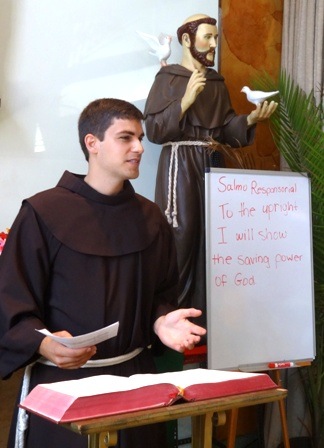
In a similar vein, I was given the opportunity to preach regularly this summer: twice a week at daily mass and two Sundays (the texts of which can be found here and here). While I had had a little experience preaching before this summer, this was actually my first time preaching at a daily mass, something surprisingly different, and more difficult, from a Sunday homily. For starters, it has to be very short and to the point. In a daily mass homily, there isn’t enough time to develop more than one point, and even with that point, not a lot of time to do it. What can I say in 3-5 minutes, that isn’t just fluff or sentiment, to really draw people into prayerful reflection today? 

Another difficult aspect of daily masses is that they happen, by definition, every day. Unlike Sunday homilies that take all week to develop, these reflections must be churned out each and every day. The plus side for seasoned priests is that the shortened length, casual nature of mass, and repetition of readings makes this very easy to be done quickly and mostly off-the-cuff. For me, having never had this experience, I found the experience to be a bit laborious at times, especially the Monday after preaching Sunday. Ugh… what am I going to say?

It is that tiny little bit of pressure, the regularity of preaching no matter the readings or context, that really helped my confidence in the long run. At first, I was very nervous and tried to memorize every word of the “perfect homily” I had written; by the end, I had a few notes jotted down and was able to speak a bit more extemporaneously. The other factor in all of this was that I preached bilingually each mass (and I don’t speak Spanish!) Although I was only reading a translation in Spanish, being able to stand in front of people and speak in a different language made preaching in my own that much easier.

Boundaries Between Work and Home

One of the potential drawbacks of living in Camden is that the friary is attached to the parish offices: 1st and 3rd floors are friars only, 2nd floor is parish offices. This creates a difficult boundary issue to navigate. Are people allowed into the friary portions, and if so, at what times? How do I “get away” from work if it’s only a few feet away? Do I have an obligation to be present ALWAYS? These are difficult questions for sure.

Here’s one example of an uncomfortable situation I faced this summer. I had been working really hard without a full “day off” in a week or so and was pretty tired. I decided I was going to take the day to just relax, prayer, and watch a movie. Nothing special, no vacation or excursion, just a recharge day. I didn’t want to go anywhere, just relax. Naturally, I get a call 20 minutes into the movie, “Hey Brother Casey, sorry to bother you, but one of our volunteers never showed and we have a student here and I’m the only adult. I can’t be here with him alone. Would you mind coming with me and we can drop him off at his house?” Was I really going to say no? Of course not. Well, there goes 45 minutes of desperately needed recharge time.

As someone devoting my life to the service of others, there is never an opportune time to take off. There will always be someone to help, and I will inevitably feel guilty for taking time for myself. I think the key is to set clear boundaries for doing so. Set a designated time or day off and publicize it to the ones being served: “If you want me to be my best to serve you at all other times, please respect this time for myself.” The other thing is to keep clear physical boundaries between work and home. At school this is tremendously difficult because my bedroom is my study room. In Camden, I can only imagine how difficult it is for the pastor to sleep in the same place where hundreds of people need him daily. As best we can, we need to set boundaries.

Take a Walk
While there are probably fifty more things I could reflect on, I’ll end with the one that I will most clearly take with me as I go back to Washington, D.C.: a walk. What I mean by this is not exercise, not a way to calm down, not breaks in study. What I take from Camden is their walks of subtle evangelization.

More than two years ago, the church was a part of a peace walk to end violence. At 6:20 that Wednesday, two parishioners left the church to catch up to the marchers and were mugged. That’s right, on the way to the peace march. In response, the friars have made it a point to walk the streets of their neighborhood every Wednesday at 6:20 for more than two years, missing only Christmas and Fourth of July.

They do not carry signs, nor do they pray the Rosary. Nothing about them is calling attention to violence or injustice. All they do is walk up and down the main street in their neighborhood, in habits, each and every Wednesday at 6:20. What I love about it is that they are a regular, vision presence in Camden. People recognize them and look for them, and for those that do not know them, they strike up conversations about who they are and what they’re doing. It is the story of Francis and a young brother: walking through the city one day, they went through the marketplace, side streets, and fields, not saying anything about Jesus. The young brother, disappointed, said, “I thought that we were going to preach today.” Francis replied, “My son, we have preached. We were preaching while we were walking. We were seen by many and our behavior was closely watched. It is of no use to walk anywhere to preach unless we preach everywhere as we walk!” It is my hope to do this always, of course, but to also make it a regular practice back in our neighborhood in D.C.