Co-Creators Through Christ

Not shown are the other 25 people working to make the campus more ecologically just.

Not shown are the other 25 people working to make the campus more ecologically just.

When we think of Creation, I imagine most people don’t get much further than the first Genesis story: God created the cosmos out of a formless waste, and after six days, God rested. From this story alone one might come to the conclusion that Creation was a static event in history, something that happened at one particular moment and is now finished.

And yet, when we look around our world, we do not see a static cosmos that was created once and for all many years ago: we see an ever-growing, ever-changing existence in which species of life are coming into and out of existence, stars are being created and destroyed, and the whole of the universe continues to expand. How do we explain this change?

The answer, I believe, is in part tied to our conception of the Trinity. As I wrote a few months back, there could not have been one “moment” in time when Jesus was “begotten” of the Father because Jesus is coeternal with the Father; for there to be an exact moment of “begotten-ness” there would have to be a time when Jesus did not exist just prior to that, making him not coeternal. How, then, was Jesus begotten and coeternal? “The only possible answer to this question is that it has always been happening… There can never be a moment in which God the Father is not creating through the Son and in the Holy Spirit, past, present, or future” (A Retreat With Saint Bonaventure).

Thus, when we look at Creation, I think that it is only logical that God, being a Creator by his very nature, is in and through every moment of Creation as it continues to happen. Creation was not a static moment in time, but rather continues to happen as God the Father sends forth his Son in the Holy Spirit.

But as Creation continues to unfold, God is not the only one in control of Creation. As Genesis 1:26 says:

“Then God said: Let us make human beings in our image, after our likeness. Let them have dominion over the fish of the sea, the birds of the air, the tame animals, all the wild animals, and all the creatures that crawl on the earth.”

This is profound to say the least. Not only are we as humans created in the image of God (wow) and entrusted with the care for God’s creation (wow), as rationale beings capable of wielding enormous control over the world in which we live, what God is saying in this passage is that we are actually co-creators with Him through Christ (WOW). It is completely within our power to learn from nature or to manipulate it for our own gain; to bring life or to destroy it; to care for what God is continuing to build or to pollute it and break it down. It is clear, in the unprecedented rise in global temperature, the increasing acidification of the ocean and decrease in life therein, the ever-growing landfills and toxic areas of our planet, and the displacement of so many due to ecological destruction, that humans have the ability to truly shape the world around us and that we have not always lived up to our role as just caretakers.

IMG_4729

For almost six hours we moved dirt and rocks. Not all justice work is glamorous…

No more, said the parishioners of St. Camillus Church in Silver Spring, MD. No more would they be ignorant to the ways in which their church was adding to polluted waters and higher temperatures. No more would they stand idly by refusing to see that energy and pollution were as much “life issues” as anything else. And despite being a place of worship, St. Camillus was as guilty as anyone. You see, as we continue to cut down natural areas and place parking lots in their place, there are fewer opportunities for the water to be absorbed into the ground. When it rains, water collects very quickly and carries off both nutrients from the soil and harmful chemicals from the hard surfaces, flooding drains and streets rather than nourishing the plants and soil, and sending it all to freshwater sources. At St. Camillus, the tremendously-sized roof only exacerbates the problem, pouring a waterfall of rainwater down the hill directly into an unfiltered drain.

As a church, they decided that they could make a difference. On Saturday morning, forty volunteers strong showed up to the church for phase one of the project: removing the top layer of sod, displacing five inches of soil, turning over an additional five inches of soil, and mixing in three inches of fresh topsoil. For six hours, we cut, shoveled, picked, and carried literally tons of dirt and rock from one place to another, laying the foundation for drainage gardens (to be installed next week) and natural water filters made of many layers of rock.

The best part? We had fun doing it. Not only were we putting in an honest day’s work for the sake of the earth and our brothers and sisters throughout the world, we were building community. There’s a true sense of camaraderie and brotherhood/sisterhood when you spend most of a day with people on an incredibly tiring and worthwhile project. How can you not feel a sense of accomplishment when you work together to move a ton of dirt and rocks? How can you not feel a sense of accomplishment when you just did something that will actually care for the extraordinary world that God has created rather than destroy it?

And so I ask: As co-creators with God through Christ, a people endowed with a special gift, what will we add to God’s masterpiece? It is my hope that every part of my life, the way I eat, travel, shop, work, consume, and put back, will be a positive addition to the work God has started, and that it will continue as God continues to create the world anew each and every moment. Won’t you too?

Pray with One Voice

“May the God of endurance and encouragement grant you to think in harmony with one another, in keeping with Christ Jesus, that with one accord you may with one voice glorify the God and Father of our Lord Jesus Christ.” (Romans 15:5-6)

“Wherever friars live or come together, the Liturgy of the Hours is to be their common prayer and as a rule it is to be celebrated in common.” (OFM Constitutions Article 23 §2)

As members of the Catholic Church, we come together on a regular basis to glorify God. There are times to do this privately, but as Christians, and certainly as a member of a religious fraternity, it is critical to who we are that we also do so together. But as I said in the conclusion of my last post, doing things together isn’t always the most efficient way to do something: there will almost inevitably be disagreements. Sure, where two or three are gathered, God will be there, but so will about two or three different opinions about how to worship “him”! (A word that I will get to shortly).

One can imagine, then, that prayer is not always easy, even in a religious house of friars. Quite the opposite, actually. Prayer can actually be the most contentious time of our day if competing values are pitted against one another. What does one do in this situation? Which value is “right”?

Universal Church

I think the starting point of every conversation related to communal Church participation has to be with the official, universal statements. What does the Church proper say about prayer? How has the wider Church, people of different times and places, decided to pray? As members of the Catholic Church, we must always remember that the worshiping community expands far beyond our walls, and as the “universal” Church, Catholics are privileged to be able to take part in the same prayer as people all around the world. This is a tremendous gift as well as an honorable duty to our brothers and sisters to maintain solidarity with them. Because of this, it is a great value of mine that one not stray far from the rubrics at mass or the instructions for daily prayers, even if it means losing a bit of creativity.

That being said (you knew this couldn’t be a post about following rules!) it is important to note that  “universal” Church and “uniform” Church are very different notions, and that the Church has rarely sought uniformity as a value. Besides an emphasis on praying in one’s own language and from one’s culture, the existence of more than ten liturgical rites indicate that there are many “official” ways to give praise to God, and that pastoral concerns to the immediate community are as important as uniformity to the wider church. Liturgy is a living, ever-changing expression of our faith, something that must change and adapt to new understandings. What causes this tension?

Multicultural issues

In the three years that I have been a friar, I have lived with men from the Philippines, Costa Rica, El Salvador, Honduras, Puerto Rico, Mexico, Columbia, Canada, and many regions in the United States. For many of these men, English is not the language that speaks to their heart. What do we do?

One answer would be to say, “Well, in American houses we speak English. Learn English better and it will speak to your heart.” This is a common answer, and while it seems harsh, it does have a strong practical dimension to it. On the other hand, how can we as English-speaking Americans be so inconsiderate to the needs of our brothers that we wouldn’t make sacrifices for the sake of their prayer lives? Obviously we can make compromises so that everyone feels included. But how, and to what extent? A tagalog song (that no one else would know)? Mass in Spanish (that would leave some unable to participate)? Liturgical dance (that would seem foreign and even a mockery to many Americans)? Culture is critically important to one’s prayer and makes for a very tricky situation when multiple cultures come together. Where are lines drawn and expectations set?

Style: Words and grammar that make sense

Once a community has chosen the language, there are still major problems with translations and word choices. One look at the new translation of the Roman Missal reveals a world of words unfamiliar to our daily speech (consubstantial), images that do not make sense (dew fall?) or sentences that follow Latin grammar rules rather than English ones. For many, there is a sense that the words we use are not the words that we understand or that speak to our hearts.

For instance, here is the final prayer of the Angelus prayer:

Pour forth, we beseech Thee, O Lord, Thy grace into our hearts that we, to whom the incarnation of Christ, Thy Son, was made known by the message of an angel, may by His Passion and Cross be brought to the glory of His Resurrection, through the same Christ Our Lord.

What did we just ask for? I challenge you to find a person that has used “beseech” in common language in the past year (or better yet, randomly ask the next person you see if they even know what it means!) The same can be said for the Our Father in which we begin by saying, “Our Father, who art in heaven, hallowed be thy name…” When we use words that do not speak to our hearts, they will not speak from them either; prayer that is memorized but not understood is prayer that lacks the meaning we desperately need in our worship.

Inclusive Language

Which brings us to our final point of contention: what happens when we understand the language, but the images they invoke are contrary to our conception of God. What do I mean by this? Gender-specific language. When we speak of God, God is always masculine. “He” is Father, “He” is Creator, and “He” is Brother. But does this reflect the totality of our theology of God? The official Church says that God is neither male nor female, that words such as “Father” are analogous that attempts to explain what we know about “him”. If that is the case, that human language could never fully capture the essence of God, why not mix in a few feminine words for God to express God’s motherly, sisterly, comforting, wise nature? I’m sure God would love it if we called her our Mother. What did he say?! Our sensibilities have been questioned! How dare he?! God is not feminine! Right. But God is also not masculine and we seem to be okay with that.

For many friars, there is a sensitivity to the fact that neither God nor God’s people are ever described with feminine words despite the many feminine images of God found in the Bible, and the fact that the majority of the people in our Church is female. Even when it would make much more sense to be inclusive (such as praying for “humanity” rather than “men” when there are clearly women present) masculine images prevail over even neutral words in the official prayers. Placed as a high value, one can imagine how this has caused many problems in the way that we prayer.

So what do we do?

What I have presented is three of the MANY ways in which we find ourselves not praying in one voice (along with disagreement on tempo, song choice, frequency of prayer, level of solemnity, and so on). It may sound cynical, but prayer is never going to be a perfect experience in which everyone is in full agreement about what to do. That, then, is not the issue: the issue is how we handle the inevitable conflicts.

On the one extreme, some could say that the community should pray exactly what is said in the book at all times because that is what we’re supposed to do; while I would definitely err on the side of obedience to the larger Church and is the easiest solution, it fails to acknowledge that there may in fact be true stumbling blocks in our prayer and never allows for the liturgy to grow organically through the Spirit.

On the other extreme, some have chosen to simply pray the words that are in their heart and expect everyone around them to do the same; at any given psalm, then, this leads to multiple words being spoken at one time (the one, man, him, woman, her, humanity), failing to ever come together for the sake of the immediate community.

Honestly, the only thing that we can ever do is to engage these issues as a community in a prayerful and open environment. What is it that this community needs to authentically praise God? What can we do as a community to hold ALL of these values in our hands at the same time? These questions are by no means easy to answer. What’s important, it seems to me, is that the conversation be had. As brothers and sisters in this together, nothing could be worse than allowing the cornerstone of our life, communal prayer, be something that is dry, emotionless, exclusionary, incomprehensible, or means for contention; when it is a place of passive aggression or apathy, we have missed the point. Prayer is a unitive activity. Done right, prayer is the activity in our communities that forces us to engage one another around a profoundly important focus, to share what we truly need and to be there to provide for the needs of our brothers and sisters. Thus, it is only when we are able to come together as a community in this way, speaking from the standpoint of commitment, sacrifice, and mutuality, that we truly able to pray with once voice. Let us not be many voices clamoring at once, let us pray with one voice, the voice of a community profoundly committed to God and one another.

When I Grow Up I Want To Be…

As a friar, I will be called upon to do many things for the kingdom of God. What that will be, nobody knows!

As a friar, I will be called upon to do many things for the kingdom of God. What that will be, nobody knows!

It may surprise some to know that I have almost no idea what I will do with my life. Isn’t being a friar a life-long commitment? What’s there to know? While this may be true, being a friar isn’t a job, it’s a lifestyle: we are called to a life of prayer, poverty, and humility within a fraternity. In the spirit of Francis of Assisi, this lifestyle leads us to the margins of society and church where we are called to spread the Gospel in word and deed, to bring peace where there is violence, comfort where there is hurt, and welcome where there is exclusion.

But as wonderful as all that sounds (sign me up!) the astute will notice something very important about that call: it says absolutely nothing practical about what we as friars are to do with our lives. Unlike some orders that are called to be teachers or missionaries and that’s all they do, we are called to live the Gospel of our Lord Jesus Christ in the way most fitting to our time and place. With that criteria, then, we could be almost anything: elementary school teachers, spiritual directors, store managers, retreat coordinators, political advocates, community organizers, artists, musicians, tailors, parish priests, landlords, technicians, and so on. And we have. The beauty about our charism is that it is open to doing whatever church and society needs.

I share that long introduction (there must be a point to this post, right?) to say that I am beginning to think about that question more deeply as I enter studies. I have already discerned a call to be ordained a priest, which narrows the job search down a bit, but there are still so many things that I could do as a sacramental minister.

Parish Ministry

I’ll start with the most obvious: parish ministry. Our province staffs eighteen parishes along the east coast, along with three or four “service churches” (depending on how you classify each) that offer services particular to urban settings such as multiple masses a day and continuous confession. There is a lot to like about parish ministry. Being the smallest organizational block of the church and being the primary connection to the Church for most people, there is a lot to offer: retreats, sacraments of initiation, daily prayer groups, ministry to the poor, faith formation, sick and dying ministry, and so on. Parishes are a place of life and excitement, filled with multiple generations and always being host to some group.

Of particular interest to me at a parish would be adult faith formation. Many people say that Catholics don’t know their faith, and I partially agree: Catholics do not know their faith in a systematic or memorized way that people of other faiths do, but Catholics have a powerful experiential knowledge of their tradition that cannot be overlooked. I would love to build upon this experience and give people the context and facts to organize what they know through many years of worship. What would this mean? Well, the way I see it, I would want to teach at least one eight-week class a semester (Fall, Spring, Summer) on the foundational topics of our faith including the Bible, Church History, Liturgy and Worship, Spirituality, and Social Action. These would be more academic than a traditional bible study or prayer group format, but meant to be attainable for all parishioners.

Campus Ministry

Of extremely high interest at my point in life and formation is working with young people. When I think about my experience in college, I recognize that it is a tremendous time for development in people’s lives: students are away from home and family for the first time, are able to test the worldview handed onto them, and begin to grow into their own understanding of the world around them. As men hoping to shape the world by bringing Christ into people’s lives, I can think of few places in which we can have a greater effect.

Holy Name Province has certainly recognized this opportunity and I hope that it continues to do so as I look for a full-time ministry in the future. Currently we have chaplaincies at the University of Georgia, Clemson University, and my alma mater, Furman University, as well as teaching and administrative positions at Siena College and St. Bonaventure University, two schools founded by our province.

Ministry of the Word

The last possibility that interests me a lot at this time is one I have spoken about before: the Ministry of the Word. As modern day traveling preachers, friars in this ministry go from parish to parish preaching the Gospel and sharing about our life as Franciscans. “Missions,” as they are called, consist of multiple talks over a period of a few days and can be geared toward a specific season (Lent, Advent), have a spiritual or practical theme, or simply be a spark to reignite the fire in a parish.

Traditionally, the friars have done this ministry two-by-two, working together on a mission and sharing their time with the people. As the numbers became smaller over the years, many decided to split up so as to reach more people. This, I feel, is not ideal. What interests me about the missions is that we go out two-by-two, that no matter where we go or what we do, we never do it alone. We are a fraternity even on the road. That is why Jesus sent out his disciples in pairs, and that is why Francis followed suit. Is it because one person is not capable of handling a mission alone? Of course not. But there is something more at play than the words spoken. There is something more than what we say about our life together. When we actually go out as a fraternity rather than simply talking about how we live in one, when people see us laughing together, cutting each other off, and even, dare I say, not getting along at times, there is something powerful expressed that cannot be captured in words. Our life in fraternity is to be lived and shared, not talked about. That’s why I’ve said it many times, working alone may be more efficient than working together (and certainly easier) but it is not more effective.

*

And so, as a student in the first grade declares that he wants to be a doctor when he grows up, I share with you my snapshot in time. As I experience more in ministry and grow in my vocation, I may come to new and exciting opportunities that I had never even considered. As a follower of Jesus, I must be open to wherever I am called, and luckily, as a follower of Francis, I’m free to live that call in many different ways.

Not So Minor

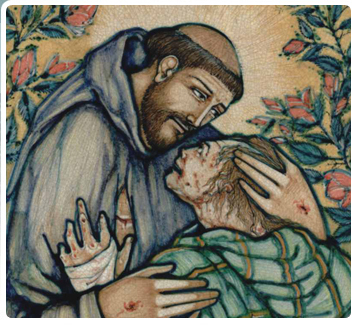
It is in serving the least of his day that Francis experienced perfect humility and minority.

It is in serving the least of his day that Francis experienced perfect humility and minority.

A man of great conversion, Francis is probably most well-known for dramatically renouncing his earthly wealth and high social status in order to minister to the lepers, those people so sick and disgusting that they needed to live outside the city (and wear a bell so that people could run away when they heard them coming.) The Franciscan charism follows in his example: As members of the Order of Friars Minor, the “lesser brothers,” we are called to live a life for the poor, with the poor, as the poor, renouncing any sort of wealth, power, or status, that would nurture a feeling of entitlement or honor. The lowest in society do not expect to be served or cared for, they know that they must serve others. That is what Francis wanted.

When I look at my own life, I struggle to identify a single way in which I am a minor in our society: I am a young, white, college-educated, middle class, heterosexual male, born in the United States to parents that are still married, a member of the largest religious organization in the world, and have no mental or physical disabilities. If that’s not enough, I joined one of the largest religious orders in the Catholic Church, giving me tremendous (and largely undeserved) respect as a religious and future member of the clergy. In literally every way that I can imagine I find myself among the privileged in society.

And unlike Francis who was able to renounce his status in society with a symbolic undressing before the bishop, I can hardly renounce the attributes that make me privileged in this one:

  • As I see racial discrimination continue to boil over in places like Furgeson, and I am reminded how much easier it is to be white. Upon arriving in Camden, one friar told me, “Oh don’t worry, you’re white. The gang members and drug dealers won’t hurt you because they don’t want to scare away their white customers.”
  • As I watch news coverage of the recent boarder crossings and immigration laws in Arizona and Georgia, I know that I will never be “randomly” stopped on the street and forced to prove that I belong, have to flee one country into a country that does not want me, or have to worry about my rights when abroad.
  • As a male, I know that I will never be given less money for doing the same job as a co-worker, fear being alone outside at night, or constantly have to prove my self and my gender as not inferior.
  • As our church and country continues to understand homosexuality, I am made aware that I have never had to worry about how my sexuality or sexual orientation could offend someone, what people might think of me if they found out, or being thrown out of my house by my parents.

This list could go on and on. As I look out into the world, I see people being discriminated against and made “lesser” in our society each day, and it is never me. I doubt it ever will be. And so I’m faced with a challenge. How do I ever become “lesser” in society? How do I ever even approach minority when things like race, gender, sexual orientation, education, and physical capability are not exactly things that can be stripped and handed to a bishop?

It is here that I would normally have a conclusion like, “For me, what’s important is… The key is… I’ve found that the best answer is…” Unfortunately, my reflection today is a little less complete than normal. The fact of the matter is that I simply do not know and I will have to sit with this struggle for a while longer. There are obviously some things that I can change, e.g. how I spend my money, with whom I associate, how intentional I am at being with the poor. As I leave formation and entire into a little more autonomous life as a friar, I know that there will be a little more freedom to choose where and how I live, and what ministry I do, making this a little easier to live out.

And yet, there is a part of me that realizes that I will never be the least in society and I am struggling to accept that. How can I say to be a friar minor, an imitator of Jesus and Francis of Assisi, with so much respect, authority, privilege, and “wealth,” both civilly and ecclesiastically? I don’t know. For now, all I can do is realize that this “great privilege” I have in our society is nothing but a lucky ticket in the womb lottery: I have done nothing to deserve it and ultimately am no better off than anyone else because of it. I am what I am before God, and nothing more. This is a bit of wisdom that I must always keep with me. For though I may never be able to fully renounce all that separates me from the least in our society, I know that there is always a full reserve of pretension, entitlement, and arrogance just waiting to be given up inside me. If I want to be minor in society, it starts with the attitude I bring to every situation: I am here to serve the people of God with perfect humility and minority, and they do not owe me anything because it is God who is truly doing all the work.

One of the best movies I have seen in a while. Not for the faint of heart.

One of the best movies I have seen in a while. Not for the faint of heart.

The following contains spoilers to the movie Calvary (2014).

Last night, I went to the movies with two of my classmates to see Calvary. Last night, I was hit by a train in the theatre.

Calvary is about the turmoil of the Irish people in the wake of the sex abuse crisis in the Catholic Church. The movie opens in the confessional with a man revealing to the priest that he had been sexually abused by a priest for multiple years and, just as he had been innocent and undeserving of such acts, he planned on killing this priest precisely because he was a good priest and had nothing to do with the abuse. He told the priest that he planned on killing him on the following Sunday.

For one week, the viewer follows the priest on his road to Calvary, an “innocent” man on his way to slaughter, through the brokenness all around him. Torn apart by the acts committed by clergymen and completely disillusioned by the hierarchy’s attempt to cover them up, each character has one of two dispositions: 1) Pure anger and disrespect, unwilling to hide their disgust and fully willing to take it all out on him, or 2) in a much more chilling way, mockery at what people find to be completely irrelevant, even a laughing matter, the Church.

And yet, oddly enough, each character in the movie is found at Mass in the opening scene, and throughout the movie, each character is preoccupied with the sins they have committed, freely sharing their faults and failings in hopes that they will be forgiven. It is a strange disconnect between thought and action, an acceptance of faith but denial of virtue, a denial of church but a fear of not attending. Because of this, each and every character is able to recognize their sins, but not a single one shows contrition for what they’ve done. Despite the terrible sins of nearly every single character, there is not one truly repentant heart in the whole movie.

Against the backdrop of the sex abuse crisis, Calvary presents a stunning parallel between the people of God and the hierarchy of the Church. In the scene just after the church has been violently burned down by a disillusioned parishioner, the other priest says to him, “Hasn’t the Church paid enough for these sins? For God’s sake we’re nearly bankrupt because of all we’ve given out. If you ask me, I think it’s time that we forgive and forget” (paraphrase mine). In this one character, Calvary epitomizes what many feel about “the Church”: like the people of God, it is able to acknowledge its sins, and to some extent has even paid greatly for them, but shows no act of true repentance or conversion. Is it sorry for being punished, or does it truly seek reconciliation?

In one of the most gut-wrenching scenes in the movie, the main character reveals to the man wishing to kill him that someone had killed his dog. “Did you cry when you found him?” the man with the gun asks the priest. “Yes… yes, I loved that dog.” “Did you cry when you read in the newspaper what your brother priests were doing to innocent people like me?” (long pause) “No… I was too detached.” It was in this line that I felt the director speaking directly to the audience. “Why didn’t you cry when news broke? Why didn’t you well up with anger at this injustice and put a stop to this?” Like the priest, we may not have abused anyone ourselves, but as the body of Christ, it was the failings of the whole that allowed this to happen, continue, and go un-repented.

Such, I believe, is the nature of all sin and the beauty of this terribly graphic movie. Throughout this movie, the virtuous priest worked night and day to seek out his lost sheep that had been led astray. Confession after confession he remained patient when confronted with the most repugnant of acts: adultery, cannibalism, attempted suicide, domestic violence, corporate theft, abandonment, and sex abuse. With no judgment, he attempted to forgive everyone he met, calling each to focus on positive virtue over past sins. Even though almost every character had been so disillusioned that they felt salvation was no longer an option, he continued to serve God’s people. But he could not save any of them. He could not grant even one person absolution. Were their sins too grave? No, there is no sin that cannot be forgiven, he repeated many times. What was lacking was true repentance. Although they could name their sins, they lacked the virtue to want to live differently. All too often I find myself with the same heart.

All in all, I would say that this was one of the best and most challenging movies I have seen in a long time. As a seminarian, I felt myself pulled violently in opposite directions: on the one hand, “What the heck have I gotten myself into? The Church is broken and irrelevant! Jump ship!” and on the other, “This is exactly why I feel called to this ministry. People need to vent and they need someone willing to walk with them. The world needs more positive images of faith.” Although I would not recommend it to everyone, I think that every single seminarian should see this movie. Rated R for graphic content and language, Calvary is not for the faint of heart, but it is Christian at its core. The fact that the main character is a priest only makes obvious what the entire movie seeks to portray, that God is a merciful God ever wishing reconciliation with us, and, despite our brokenness and pain, we are capable of loving and forgiving those who have hurt us. But we have to choose to do so. God may forgive us, but it is up to us to accept it.