Each year on New Year’s eve, we celebrate the year that was and anticipate the year that will be. As the ball drops and the clock adds another year at midnight, we sense something significant: it’s a new year. And despite the fact that time is relative and the moment is completely arbitrary… there are feelings of elation, catharsis, inspiration, and regret. The changing of the year offers us a clear break from past and future, and opportunity to move on and live better. With each turning year is a chance for a “fresh start.”

It’s no wonder, then, that it is a time for resolutions. “This year, I’m going to …” People focus on losing weight, working harder, improving relationships, eating better, quitting smoking or drinking, traveling more, or just being a better person. It’s a time of motivation, determination, and achievement of feats one didn’t know possible.

So why do I write about this now on November 28th, a full month ahead of time? Am I that organized and forward thinking? Ha! (Maybe there’s a New Year’s resolution somewhere in there…) No, the reason I write today is because today is actually the final day of the Church calendar. As the sun sets this evening and the evening masses begin, Ordinary Time will end and Advent will begin.

Like the Gregorian Calendar, there is a sense that this is an arbitrary change; since the events we celebrate (Christmas, Easter, etc.) were not recorded by exact date nor do they “happen” again each year, we could have chosen to celebrate them on any day and set any day as the start of the new year. And yet, unlike the Gregorian Calendar, there is great significance to the progression of the year: we begin with anticipation and hope for something better during Advent, experience the joy of the Incarnation, our hope fulfilled, at Christmas, begin our Christian journey in Ordinary Time, call to mind our times of failure in Lent so to prepare ourselves for the fullness of life and salvation during Easter, to finally be sent out to make disciples of the world in Ordinary Time again. In a year, we capture the experience of our salvation, from our humble beginnings to our triumphant salvation.

The beauty of it all, at least to me, is that it is by its nature cyclical. It happens again and again and again and again. The seasons of the year are not things to be completed or perfected so as to move beyond them. So it is with our life as Christians. Our experience of salvation history and the stages of our own Christian growth are not things that can be simply completed like years of high school or the items on a checklist. Just because we have been a Christian for many years does not mean that we have graduated from the anticipation of Jesus’ coming, the excitement of a new faith, the sorrow of a forgotten one, or the call to spread it abound. The seasons and celebrations we commemorate throughout the year, models for salvation history, do not always progress in our lives like a ladder, moving forward to never return; they are like a spiral staircase, always returning to where we once were but with new perspective.

This evening as Advent begins, we will find ourselves at the beginning once again, an opportunity for a “fresh start.” It is a time to return to our roots, to focus on what is most essential to us as Christians and to remember the feelings of hope and anticipation we once knew when we first accepted the faith. It is a time for us to recommit ourselves to the journey of salvation. I say, it’s a time for resolutions. On New Year’s eve, we set resolutions to make our year better than the last one. We focus on our bodies, our money, and our careers. Why not set a resolution to focus on what really matters, to commit ourselves to making this year better for our spiritual lives than the last? Prayer. Donations. Service. Sacrifice. For years we may have been doing these things very well. Maybe we haven’t.

Today, we have an opportunity to start again on our journey. What will you do better this year?

As I prepare for my eventual presbyteral ordination, one of the things that my province heavily emphasizes is that students practice preaching in front of people and receive appropriate criticism. It only seems natural: if you’re going to take a job doing something technical, you train to make sure you have the skills to complete said job. In my case, that means taking two preaching classes at the Catholic University of America, preaching in-house at the friary once a month, and getting as much experience speaking in front of people in all capacities during our summer internships.

Over the past two years going through this process, I have found out something rather encouraging: I love to preach. Getting in front of people to talk about faith is one of the most energizing, fulfilling things that I have ever done. For ten (or so…) minutes, I have a captive audience with which to share my faith, offer a witness, and encourage to know God in a new way. And even though I am an introvert, I seem to feed off of the energy around me, and have found the larger the congregation the more comfortable I feel.

But of course, the question is not whether like to preach or if feel comfortable talking to people about faith, it’s whether the congregation wants to listen to what I have to say. Am I a good preacher?

Given all that Pope Francis has said about preaching, notably the burden that bad preaching is on the laity, that is the million dollar question. Am I one of the preachers that Pope Francis is talking about, those who bore their congregations and kill their faith?

The first couple of times I preached, I certainly didn’t think so. People came up to me and told me how wonderfully I talked, how I was an incredible preacher, how I was going to make a great priest. You know, the sorts of things that we want to hear because it builds up our egos. I heard enough of it the first couple of times to feel pretty confident: “Wow… a lot of people complimented me. I must be a better preacher than Fr. X.”

And maybe I am. But it didn’t take long for a little perspective. I was at a parish shortly thereafter and I heard what was objectively a horrible homily. It had no strong beginning or end, it meandered through half a dozen topics, and the priest was completely unrelatable. Not a great homily. And do you know what I saw after mass? Everyone shook his hand with a smile, and quite a few people, not just one, said how much they loved his homilies. Whaaaa? Were they smoking something?

Another time, I was talking with someone from one of our parishes about one of our friars. This friar is not exactly known for his homilies, and that is putting it nicely. And do you know what she said? “Fr. X changed my life with a homily once.” Say what now? Are we talking about the same guy, the one who can’t string three words together coherently? Yup. That one. Changed her life.

It is because of these two experiences, early in my preaching, that I learned two invaluable lessons. The first is that some compliments are akin to a child being potty trained: “Ohhhh! Look who made a doo doo! You’re such a big boy!” People mean well, and I’m sure that they were honestly and completely delighted with every word of my homily, but for some it is not what I said that is impressive, but merely the fact that I am a nice young man who’s becoming a priest and people haven’t seen a priest with hair in a long time. What I say may have genuinely delighted them, and that’s great, but that doesn’t mean that it was actually a good homily. Having seen dreadful homilies receive compliments, I know that good preaching is not about hearing some nice words from people as they leave the church, nor is it appropriate to think that just because ten people said something nice that the other five hundred felt the same way. If all we hear are the good responses, or all we seek are compliments, our preaching will never grow and it will never challenge.

The second point, a much more difficult one to accept, is that we are only ever as good as the Holy Spirit allows us to be. While it may be our insights, nice words, and polished delivery, it is ultimately not in our control whether or not the message takes root or not. I’ve seen terrible homilies change lives and incredible ones forgotten. The Spirit can transform even the dullest words into the words of life, and be so disinterested in our waxing eloquent that our words never reach anyone’s soul. This, of course, does not mean that we just get up and say whatever we want without preparation because the Spirit can speak through us. But it does force us as preachers to approach the homily with humility and prayer, to ask God for the words to speak, and to focus on what’s really important. When we’re looking back and grading how successful a homily was, it doesn’t matter how good or bad we looked, felt, or spoke, it only matters how the hearts and lives of our listeners were changed.

And isn’t that what preaching is all about? It’s not about the preacher and how well liked s/he is, it’s about bringing people closer to God and building up the kingdom. Thus, the effect of good preaching is not found in the words that people say about it, it’s found in the vibrancy of faith and life in the community that hears it. Do these words make us feel good, or do they move us to conversion? That’s the question. And so, as I learn this craft and hopefully continue to grow in it, the image of being potty trained works well for me. On the one hand it keeps me humble: I am being complimented for doing something that is not all that impressive. On the other, it keeps me focused on what really matters. Because, really, the sign of someone who is truly potty trained is not the amount of compliments he gets for using the toilet, it’s how dry his pants stay on a regular basis.


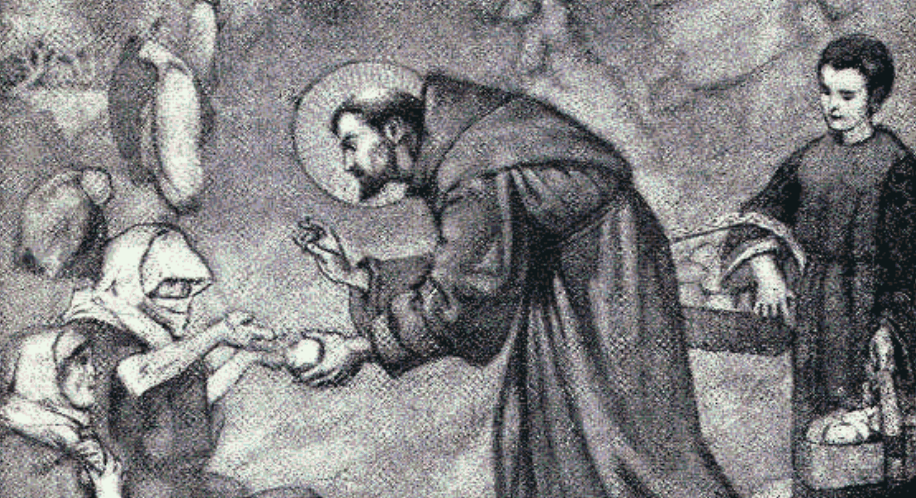
When many people think of St. Francis, there are two things that generally come to mind: preaching to the animals and praying (if you do quick Google image search, these are basically the only things that will come up). After that, many will point out his poverty and will picture a begging Francis with a ripped habit among the lepers.

But what about work? Did Francis spend his entire day in prayer, then beg for food when he was hungry? Is that what we do today? That’s my question for this week on Ask Brother Casey.

One of the first things Francis did, even the Order was formed, was to rebuild fallen churches. Francis worked with his hands. He saw the need for manual labor and a hard day’s work. This is why when the Order was actually formed and he had to write a rule of life, Francis tells the brothers that, while they should not be ashamed to beg, as “our Lord made Himself poor in this world” (ch. 6), work should come first:

“Those brothers to whom the Lord has given the grace of working may work faithfully and devotedly so that, while avoiding idleness, the enemy of the soul, they do not extinguish the Spirit of holy prayer and devotion which all temporal things must attribute” (Rule of St. Francis ch. 5)

And the early friars did work, just as the poor worked. They did not have big trusts of money or salaried positions, they worked as day laborers, earning a living by their efforts in the fields and cities. That was their primary call. When this was not enough or when it seemed fit to give what they had earned to those less fortunate than themselves, they resorted to begging, taking only enough for them to survive.

Today, friars continue this emphasis on work, and are known to engage in any number of careers. While other religious orders have a charism to a particular ministry, say, teaching or missionary work, the friars have never had this; we use the gifts that God has given us to spread the Gospel and care for the poor, whatever those gifts may be. For many of us, that means becoming a parish priest and earning a stipend for our work, but for others, that means any number of things: art, architecture, farming, law, formation, care of the sick and elderly, photography, cooking, cleaning, teaching, writing… there are more than a few ways to live and spread the Gospel!

“Led by the spirit of Saint Francis, the friars, like those who are truly poor, are to consider work and service as a gift of God. For this reason they are to present themselves as little ones of whom no one is afraid, because they seek to serve and not to dominate. Recognizing that work is the ordinary and chief way of providing what is needed, each and every friar should serve and ‘should work faithfully and devotedly,’ fleeing idleness which is ‘the enemy of the soul'” (OFM Constitutions Article 76).

In many ways, then, this is exactly like the rest of the world: we work to make a living, only relying on asking for help when we can’t make ends meet (or more likely, when we are trying to take care of the poor as well). But unlike the rest of the world, we work not to make money or to get rich, but because it is our vocation to do so. All money that we make is shared with the other friars and the poor.

For those on email, you can watch the video here. Be sure to ask your own questions and I might answer it on next week’s segment! Be creative!

Those of us born between 1982 and 2004 are in a special class of people known as the “Millennial Generation.” We were raised in the dotcom boom and technological age, came of age during the attacks on September 11 and subsequent Iraq War, and now enter our adults years after the Great Recession of 2008. Some point out how these factors have developed the confidence and resilience of our generation, that we are widely tolerant when dealing with social issues, and have become more civically minded, volunteering and getting involved to a greater extent than previous generations. Other have pointed to a less noble set of characteristics, that we are driven by a sense of entitlement, detach ourselves from traditional institutions for the sake of the individual, and are particularly more narcissistic than previous generations (selfies anyone?)

All of this, to the extent that it is true, has had an impact on Millennials’ engagement with the Church. By and large, it has meant the acceptance the secular over ecclesiastical, showing a drastic dip in church attendance compared to the previous generation, while engaging the needs of the world but through volunteerism in a more profound way. Some point to the desire among Millennials to recapture aspects of the tradition lost in previous decades, while it seems clear, even if just anecdotally, that Millennials from both sides of the aisle are more comfortable challenging the practice of the Church for what they see to be a more “authentic” way of life.

For these reasons, among others, Millennials raise issues for the Church that previous generations did not, at least not to the same extent. How does one balance the dominant desire of this generation to assert its individuality and “authenticity” with the tradition and teaching authority of the hierarchical Church? As young religious leaders, how do we navigate the obedience we have to our superiors with the obedience we have to our consciences? To what extent can we learn from the Church, and to what extent do our voices need to be heard to challenge it?

These were the questions I asked Fr. Daniel P. Horan, OFM, Franciscan author and theologian. As a fellow Millennial engaged in the political, social, and theological issues of the Church, he offered balanced responses and encouraging insights into some of the issues facing our generation, and how all of us, no matter our age, can faithfully and authentically engage the Church in today’s world. I had a great time talking with Dan about a whole host of topics, the most relevant of which I share here (unfortunately, the bit about Dan being in a bowling league in high school didn’t make the cut. Sometimes you just have to let something go!)

Please feel free to comment on the conversation, ask any questions that you have, and check out Fr. Dan’s blog, Facebook page, and YouTube channel. For those on email, you can watch this video, as well as others, here on my YouTube channel.

With the passing of Halloween, it is officially Christmas season… at least for department stores, television advertisers, and Franciscans. That is an odd combination, I will admit, and some of you may be singing the Sesame Street song “One of these things is not like the other…” Are Franciscans also invested in the commercialism of Christmas? No, not exactly.

I mentioned in passing last year that Christmas was probably the most important celebration for St. Francis. While Easter celebrates the Resurrection of our Lord and the fulfilled hope of our salvation—a pretty big thing to celebrate for sure—Christmas marks the end of our waiting and the beginning of the fulfilled promise. As Simeon says in the Gospel of Luke, “My eyes have seen the salvation which you prepared in the sight of every people, a light to reveal you to the nations, and the glory of your people Israel” (Luke 2:30-32). The Incarnation for Francis was the height of human history: God became human. What a marvel. What a miracle. What a joy of our faith.

So what does this have to do with beginning the Christmas planning on November 1st like those needing to sell us something? Well, because it was such an important feast for St. Francis, he exhorted his friars to prepare for it to an even greater extent than the Church required in the season of Advent: “Let them fast from the Feast of All Saints until Christmas” (Rule of St. Francis III.5).

For us, fasting doesn’t have to mean the literal use of the word, that is, to abstain from food or drink at certain times; fasting can mean abstaining from luxuries more broadly, or even being more intentional with our time so to do something more purposeful, like prayer.

This year, I have come up with something new, and I would like to invite anyone who is interested to try it with me. We all know that humility was probably the highest desire of Francis’ life, that he wished to always be the lowest and least important. We also know that one of his chief reasons for loving this virtue so much was in fact the Incarnation, the humility of God to become human, to be born in such an insignificant way, and to be presented to shepherds, among the dirtiest and least important people of society. For this reason, I will be taking the newly created and aptly named “Franciscan Humility Challenge.”

The purpose of this challenge is to actively seek opportunities to give up control and to be humbled every day. What do I mean by this? Well, so much of our lives is working to get our own way. In our jobs, relationships, families, and interactions with strangers, we find ourselves in conflict with others who want something different from us: Who is in charge? What movie should we watch? Where should we go? Whose turn is it? Who gets to make the decision? Conflicts can range from inconsequential decisions like which station to listen to on the radio in the car, to significant decisions like which car to buy.

For me, what I see in these situations is an opportunity… an opportunity to exercise my ability to be humble like Jesus. The practice of letting go of my will and letting others make decisions, humbly assenting to the desire of someone else, is not just nice pleasantries to keep people happy. It is an active decision to imitate the will of our Lord Jesus, “who humbled himself even to the point of death, death on a cross,” and to put into practice what I pray every day in the Our Father: “Thy will be done.” It’s no coincidence that these words follow immediately after “Thy kingdom come”: the true reign of God’s kingdom is the complete submission of our wills to the will of God. The Kingdom of God is trusting in God above all else.

But how can we expect to do that, a great task, if we struggle to give up our wills in even small situations? Like anything that is difficult, we need practice and preparation to be ready. Why not do so now as we prepare for Christmas, the celebration of God’s great act of humility?

If you feel up to the challenge, I feel a need to clarify two things. The first is that humility cannot be confused with being a doormat, that is, letting others cause us harm because we are unable to stand up for ourselves. Submitting our will to another must always be done willingly, and from a position of privilege and self-assurance. It is our very confidence in our situation, in who we are and who God is, that allows us to give up our will and accept the consequences. If it is done out of fear, under compulsion, or desperation, this is a different situation. There is a huge difference between humility of will and allowing ourselves to be abused, and we need to make sure we know the difference.

The reason for this is the second point, and ultimately the whole point of the challenge: we are doing this to imitate Jesus and so share in the Father’s joy. If we submit our will to another but in doing so feel angry or hold resentment towards the other, we have missed the point. The point is to be free of our need to be in control, and to take joy in the fact that God is in control. This is the great joy of our Christmas celebration, and the truth that we hope to make true in our lives.