IMG_1748-0

No, it’s not the Ritz Carlton, it’s our dormitory at La72

As you might have noticed from my first post a month back, Christian and I are living in pretty tight quarters during our time here in Mexico. Not only are there six men in one room sharing a barley functional bathroom (you don’t want to know), our room is between the girl’s dormitory (six women sharing one room and one bathroom) and the common room, an all-purpose room for the volunteers to eat, talk, relax, play guitar, nap, and whatever else we like doing in our free time. Located on the second floor of the main building, it is open to all volunteers, not just the ones in residence, and so usually has at least 2-3 people present at all hours of the day.

This, honestly, has been one of the most difficult aspects of the trip.

Sure, the food is different and my body has struggled to adjust. Naturally, the weather is oppressive to someone acclimated to air-conditioning. And of course, trying to think and speak in another language provides more than enough headaches. But do you know what? I mentally prepared for these things. I expected them. And while they’re certainly don’t make what we’re doing a vacation, they are things that I have become relatively accustomed to over the past month.

I did not prepare for two months without privacy. When I go to bed, someone is in the bed next to mine; when I use the restroom, someone is just outside the door; when I sit down to read or study, someone is there making coffee, playing guitar, dealing with a problem. For almost five weeks now, everything I’ve done has been in the presence of others.

For an introvert, this is tiring to say the least.

But this post is not a cry for sympathy, nor is it a complaint of any kind. You see, as difficult as the conditions have been for me to endure coming from my comfortable life in the United States, it takes but a single look outside of my window to see how comfortable I still have it. When I walk down the stairs of the volunteers’ quarters to the common area of La72, I see hundreds of people that would love to have what I have right now. A bathroom that only 6 people share? A bed to myself? A room with a door to close so I only have to be with three people, not 200As much as La72 is a Godsend to so many people, a place where people can breathe easily because they don’t have to worry about getting caught, facing violence, or finding their next meal without any money, it is not a comfortable living environment. The vulnerable groups (women, minors, and LGBT) each have a room to share with themselves while the men all sleep on mats under the pavilion or on the basketball court; they all share their meals in common; and there are just a handful of bathrooms and showers for everyone.

Seeing this makes me think of a number of things.
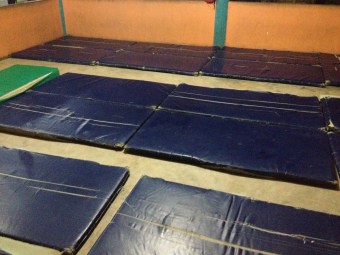
So that there is room for everyone, the men sleep four to two mats

The most obvious lesson, of course, is “be thankful for what you have.” So often we think about what we don’t have failing to see what we do and failing to see how rich our own circumstances are compared to others. This is a reminder I think we could all use.

But I think there’s something more to it than a cliché. What I am experiencing is a challenge to two strongly held values in our western world: privacy and autonomy. We like walls and fences over open layouts, suburban homes and rural fortresses over apartments.  I want my room, with my stuff, during my time. And who can blame us? Sharing is difficult. No matter if you’re five or sixty five, sharing requires that we give up something that we enjoy so that someone else can enjoy it instead of us. Sometimes it is difficult enough to share possessions that we are not even using. But what about our time? Our space? When we share these, relinquishing a little of our privacy and autonomy, we not only give up the right of use to something we enjoy, we allow ourselves to be bombarded with other people’s lives. Without walls or fences, without clear distinctions between yours and mine, we’re forced to interact with people outside of controlled environments, to meet them where they are rather than on our own terms.

And it makes me wonder: are privacy and autonomy due the amount of emphasis we give them? What if we were bombarded with people’s lives a little more, forced to interact with people not when we were prepared and ready but when the moment naturally developed?

What I—and to a much greater extent, the migrants—am experiencing is certainly the extreme case. Living two months without any privacy may not be the healthiest of lifestyles and I am surely not recommending it as the norm. But there is something here. There is something about being thrown to the extreme that has made the “normal” setup seem equally as distorted. Whereas in the US I am an autonomous individual that seeks out community when I see fit, here, my primary identity is as a part of a community and I have to actively seek privacy from the group.

Now of course, proximity does not necessitate community and togetherness does not necessitate intimacy, but there is something clearly different about this situation than my normal life at home: here, there is no denying that I am in this life with others. Like it or not, for better or for worse, I can’t think about myself or act in any way without being in relationship with another person. There is no escaping the larger group. Oppressive? A little. Claustrophobic? At times. But it’s an important question to ask ourselves as Christians: in all that we have and all that we do to maintain our privacy and autonomy, are we reflecting community and oneness, or we building structures of exclusivity and selfishness? Here, more than anything or anywhere else I have experienced, I have a sense that we are in this together.

Our neighborhoods, our Church, and our world would all be better places if we more tangibly knew what this felt like.


While I may be in Mexico right now and unable to post any new videos, that doesn’t mean that new things aren’t happening with the ones I’ve already made. I’m proud to announce that Catholic TV, the Massachusetts-based Catholic programming network, has requested and begun to air a few of the Breaking In The Habit videos on television. How cool is that??

Since most of the videos are fairly short and so are unable to fill an entire block of programming, they’ve decided to use them as necessary to fill open blocks of time. For that reason, it’s difficult to known when they’ll appear on a weekly basis, but one video has already aired five times this week and I’ve been told that two videos will air tomorrow: the Ask Brother Casey video about my summer assignment will air at 6:00am EST, and the Ask Brother Casey video about work and Holy Name Province Ministries will air between 9:00-9:30am.

If your service provider includes Catholic TV, check it out! If not, stream the channel live by clicking here! Sure, it’s the same video that you can watch on YouTube, and sure, you’ve probably already seen it, but c’mon! It’s on TV!

There is one Spanish phrase that I have used more than any in my three weeks here in Mexico. No, it’s not “See you later”; thankfully, it’s not “I need a bathroom, fast”; but unfortunately it’s not “Thank you for the beer.” No, of all the phrases that I have used on a regular basis, the one phrase that I use more times per a day than I care count is, “I’m sorry, I don’t understand.”

As you can imagine, this is a a frustrating thing to have to say on a number of different levels.

The first, quite simply, is that it sucks to be dumb. For someone who has always done well in school, has a fairly good grasp of the English language and is more than comfortable expressing personal and complex thoughts and feelings, to routinely have to say that “I don’t understand” and ask that they repeat themselves more slowly is humiliating. If, by chance, they are patient enough to speak to me like a small child—only adding to the feeling of inadequacy—I’m likely to understand the gist of the question or comment, but am left with another dilemma: What do I say in return? “Yes, I like cheese,” or “I am from the United States,” or “I need food.” Simple, direct, and extremely limited in expressing any sort of complexity or affect. So often I find myself wanting to say something just beyond the ordinary—a wish, a conditional statement, something with subtlety—but have to filter my ideas through my vastly inferior speaking ability.

And for casual conversations, this sort of embarrassment or frustration is to be expected, and most of the volunteers are helpful enough to make every conversation a teaching moment rather than get frustrated with me in return. But what about in conversations with the migrants, those who find themselves in great physical, emotional, and spiritual need? When a volunteer asks if I have seen such-and-such a person but I don’t understand the question, there’s really no problem; when a migrant asks me where they can get some food, tells me about their home country, or seeks help about some issue they have, to stare back at them blankly, request that they speak slower, and repeatedly have to say, “I’m sorry, I don’t understand,” it’s a different story. I feel stupid, yes, but often they do too. For some, my inability to understand them looks poorly on me as a student of the language (which is fine), but for others, the experience only furthers their feelings of doubt and alienation. “You don’t understand me?” It’s not about the language, per se, but feelings of inadequacy, feelings of being unintelligent, feelings of not being understood by others.

It’s a complex situation and I have mixed feelings about my experience thus far. On the one hand, there is tremendous benefit to being put in such a vulnerable situation, stripped of my confidence and forced to feel as so many do everyday. It is truly a “minor” position, and even if the conversation yields no tangible results for either party and I don’t necessarily grow in my Spanish-speaking ability, it is an experience worth having. On the other hand, though, there is definitely a sense that I would benefit more under controlled conditions, speaking to people who are not so vulnerable themselves, and who, frankly, are able to annunciate and articulate themselves in a simple enough way for me to grasp what is going on. (People from one country in particular are almost impossible to understand, even for the Mexican volunteers. For example, in one conversation this morning, one women said “De-SAY.” After a few seconds of confusion, I realized that what she was saying was dieciséis, the word for sixteen, pronounced, Dee-es-ee-SAYes, not “De-Say.”) To have “conversations” in which I am consistently lost from beginning to end doesn’t seem to be the best way to learn a language.

But who knows. Now just under three weeks in, Christian and I have another six weeks in Mexico to make the most of it. Our classes each day (for three hours) have been going well, I’m constantly studying vocabulary on an app on my phone, and I’m starting to notice results. I’m picking up more words in each sentence, I’m beginning to get more comfortable speaking, and just today, Christian said that he thought my vocabulary had noticeably improved already. Here’s hoping! For now, I’ll just have to get used to the fact that I’m not going to understand everything, and that that is okay.

Prior to coming to Mexico, my understanding of American immigrants from the south was a fairly broad and all-encompassing category: these were people who had left their country of origin for a better life in the United States, risking detection, deportation, and life to do so. For many, if not all, this is technically a fair definition. Those who come to this country are usually not leaving riches and safety behind, and they usually are willing to risk a lot to be more successful in the US.

Now that I’ve had some “up close and personal” time with hundreds of people here at La72, I realize that that broad and all-encompassing category does little justice to the situations people face and the distinctions between different categories of people. While all migrants are created equal, their situations and legal status vary greatly. Here at La72, there are roughly four types.

Seeking Work

The vast majority of people here are middle-aged men who have come alone. Coming from countries with tremendous poverty, they are traveling north, either to Mexico or the United States, to find work. This is their highest priority. When asked where they plan on going after they leave here, almost every single one has a particular city in mind, stating that “there’s a lot of work there.” The type of city, its location, climate, or culture bare almost no meaning, all that matters is the likelihood of work. Sometimes, this factor is so strong that plans can be as vast as, “I’m going to go to either Houston or Miami,” as if they were similar in any way.

For many, their goal is not to remain in Mexico or the US indefinitely, it’s simply to find a way to make a living, often sending a large portion of their money back to their friends and family in their original country. Because of this, and unlike the next three categories of people, this group tends to spend very little time here at La72, spending just enough time to recuperate from their journey to catch the train that goes through Tenosique every three or so days. They care little about legal status—mainly because it would never be granted to them anyway—and seek to move quickly.

Women

This is quite different from the final three categories of people, each of which are at La72 to gain legal status in Mexico, and often remain here for three months while the process is taking place. (This is a slightly complicated process with a lot of stipulations, but basically, if one can prove that the hardship they face is not particular to their situation but rather a systemic issue that cannot be avoided by moving to another part of the country, they can be granted permanent refugee status in Mexico. La72 is an internationally recognized asylum for people to safely apply for this status, and the Mexican government is not allowed to enter the facility.)

Among the most common are women. Growing in greater number in recent years, women are a particularly vulnerable migrant group that often flee for different reasons than men and face heightened risks along the way. The main reason, as I can tell, that women flee is for the sake of their children. Either accompanied by small children (there are quite a few little kids right now) or carrying an unborn child, these women know that their children will have no future in the home country. Either due to economic hardship or violent men in their lives, their children are at tremendous risk, and so they take a huge risk.

And what a risk it is. Unlike the men that must fear being robbed and killed, women migrants must fear sexual assault and human traffickers, a horrifying reality that more than a few migrants will inevitably endure along the way.

Unaccompanied Minors

Unfortunately, children don’t always have a parent to accompany them, and often we have teenagers traveling alone. Many will remember the mass exodus of children from countries like El Salvador and Guatemala five or so years ago, all unaccompanied. This is still going on, albeit to a much smaller extent. As unconscionable an idea as it may seem to Americans—how could their parents send them alone into danger like that?—for many, it is a much greater alternative than staying. For little boys in many places in Central America, gangs are less of a possibility than an inevitability. The power of the gang is so strong that in some places, boys are expected to join. At 12 or 13 years old, they’re approached and given an ultimatum: join or die. Being very unlike the Fresh Prince, these boys do not have a rich uncle on the other side of the country to take them in and to give them a new life. Heck, even if they did, “the other side of the country” in El Salvador is only 200 miles away, well within the grasp of interested gangs. As tragic and unconscionable as it may seem, their choice is clear: it’s safer to go through Mexico alone than it is to stay here.

LGBT

Finally, we get to the newest, rarely talked about, and most vulnerable group at La72: our gay, lesbian, bisexual, and transgender brothers and sisters.  Despite the horrific events in Orlando on Sunday and the repeated instances of someone being fired or denied benefits because of one’s sexual orientation, the situation in the US for LGBT people is comfortable and welcoming compared to that in Latin America. While each of the other groups faces bigotry, hatred, lack of opportunities, and violence in parts of their country and outside of the compound on their way, the LGBT migrants face it across Latin America, and to some extent, even inside the safety of the compound. In some places for some people (and for my Latin American readers, I hope not to generalize completely), there is no sense that same-sex attraction is a sin in which one should “love the sinner hate the sin,” there is simply “hate the sinner.” LGBT migrants are often migrants against their will, being thrown out of their homes by their parents or made unwelcome in their town, and unfortunately, the misinformation, inhospitality, and fear that they faced at home can follow them into La72 with the other migrants.

For me, it is critically important that these people be welcomed and given our attention for two reasons. The first is that, as Pope Francis exhorts us to go to the “periphery” of society, there is no more marginalized group here in need of Christian fellowship and love. To be hated and made to feel unwelcome because of who one is cannot be tolerated, and I applaud the friars here for making it a point to officially welcome them with their own dormitory and special status. But it doesn’t stop here. As Christian and I were talking the other day, the existence of LGBT people here offers a powerful opportunity for conversion in all of the migrants. Just as the other migrants have been victimized by oppressors and forced out of their way of life, so too, if done correctly, they may see how they have also been oppressors in their lives in the way they have unfairly treated their LGBT brothers and sisters. The acknowledgement that we are all not only hurt and oppressed by others but also have the capability to hurt and oppress others, even in subtle ways, opens the door for all of us to seek forgiveness and to forgive, and hopefully, to be in solidarity with one another.

Isn’t that what the Kingdom is all about? The inspiration to welcome LGBT migrants is no different from the original mission of the friars: to go to the margins, find those who are being left out, and welcome them into a home for all.

After nearly two weeks of being here in Mexico, there are a lot of things that I want to share. Difficult things. Moving things. Heart-breaking things.

For right now, though, I don’t want to do any of that.

Lest all my posts give the impression that my experience is nothing but struggles or political statements about immigration, I present to you the adventure of a day off that was yesterday.

Being that neither Christian nor I speak Spanish very well, leaving the compound and venturing into the city is an adventure in itself. Ordering food, taking a taxi, or finding our way around the small town almost always has some hiccup in the form of a miscommunication.

You can imagine, then, how confident we felt as we left yesterday to find the “place where people swim” in the river. We knew the name of the place and roughly how to get there… and so we just went. (This, I would like to point out, is not something I would ever do on my own.) We took a small taxi into the town (about 5 minutes), found the place where the “bus” (a glorified van) took people out into the country, told them where we wanted to go and started our journey. Twenty minutes later, we found ourselves at a restaurant and park overlooking the river.

IMG_2714

Promising situation?

Great success? Not yet. As we looked into the river, there were a few boats, but no swimmers. There really wasn’t a shore or grassy area to get in the water, and frankly, the river looked disgusting. Do people actually swim hereSurely, if they did, there would be people swimming at 11:00am on a Saturday. Despite having ten or so people in the park area, we knew we had missed something. The existence of towels and coolers told us that we weren’t far off though.

Being that it was just before lunch and we had no idea what we were doing, we decided to stop in the restaurant to grab a bite to eat and ask for directions. “Do people swim here?” No. “Oh, where do they swim?” Santa Margherita. “Where’s that?” You need to take a boat north for 20 minutes.

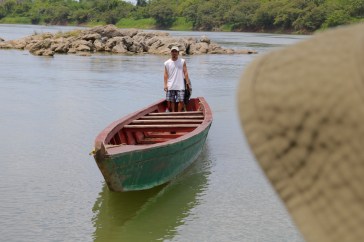
Shoot. A boat? In our broken Spanish, we talked to a guy who said he could take us and that it would cost 400 pesos (only about $22, but relatively expensive given that lunch for the two of us was around 150 pesos.) “Uh, no thanks,” we told him. When we had first arrived, and once while we were eating lunch, we saw a larger boat taking 10-15 people up north, so we figured we would wait for that instead of commissioning a private, small boat. All we had to do was wait for that boat to come back south, which seemed to be on a 30 minute schedule.

Yeah… it wasn’t. An hour-and-a-half later, still sitting at the dock with our feed in the water and sunburn developing on our arms, we had to ask the question both of us had been thinking but neither wanted to ask: “So… what should we do?” Feeling that we had made a big mistake, and dreading the embarrassment of having to go back to the compound and tell the volunteers that we had somehow misheard their directions and never actually found a place to swim, we prayed, threw a 50 cent piece into the river, and hoped for a miracle.

At the top of the hill, a car arrived. People. People with a cooler. And towels. And a little girl in a bathing suit and life jacket. We must be in the right place… right? Mustering our strength, we sheepishly walked up to these Spanish-speaking strangers, hoping that they could point two dumb Americans in the right place. As we approached, we both laughed. “Isn’t that the volunteer from Doctor’s Without Borders from La Setenta Dos?” To our great surprise, and relief, she recognized us before we even opened our mouths. What. A. Blessing. There with her family, the explained that you could either wait for the big boat or commission a smaller one and that it was 400 pesos, not each, but for the whole boat. With 8 of us, that was not only a lot cheaper, but also a lot more reassuring that we would get to the right place. (Knowing that the place we wanted was called Santa Margherita is great, but having people who actually know what it is and how to get there is a little better!)

IMG_2745

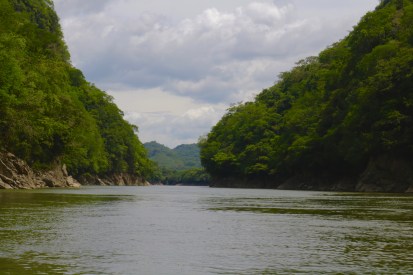
We were out in the middle of nowhere

I tell you, the boat ride would have been worth the full 400 pesos each had we known what we were doing. Traveling up an undeveloped part of the country, it was like we had entered the Amazon: trees lined either side of the bank as far as we could see, mountains and shear canyon faces surrounded the trees, and there was not a single sign of human life for the whole twenty minute ride. Half expecting to see piranhas jump into our boat, we were out there. And it was incredibly beautiful and so peaceful. With our new friends, we were motoring up a vast river into uncharted lands without only the slightest idea as to where we were going. We knew that we were going the right direction… but where would that ultimately lead us?

At first, it was pretty underwhelming and a bit confusing. We pulled up against a rocky, kind of dirty bank and were told that this was it. There were little lagoon cutouts into the land, and so we figured that’s why people came here: it was shallower, had no current, and might be cut off from wildlife. But it was still pretty dirty…

We walked, and we walked, and we walked. Maybe 200 yards along this thin strip of land past lagoons we walked, personally unimpressed. And then we saw it. Up ahead there was a freshwater spring shooting out of the rocks into an enclosed canyon. The water was clear. There were people jumping from the rocks into the surprisingly deep water, games being played, and people sitting on the edge drinking. When we jumped in, we realized that, not only was the water clean, it was cold. We’re talking ocean temperature before summer hits. It was an amazing. Hidden behind the murky river, surrounded by countless miles of untouched and inhospitable land, there was an incredible, mildly-civilized oasis to find refreshment. Christian and I spent about three hours there, the time away from the Casa an oasis in itself. For a few hours, our body temperatures lowered, our focus on those with such desperate situations all around us faded, and we were able to just relax on a beautiful day.

How we ever ended up in this beautiful place, having left with the faintest ideas of a plan, I have no idea. But it was wonderful.

[For more pictures, check out my Facebook page at: www.facebook.com/BrCaseyOFM.