Over the past three or four weeks, I’ve experienced a fair amount of disappointment. From the trivial (watching a favorite sports team’s season go up in flames; giving up on a failed video project after many hours of work) to the substantial (realizing that major parts of my internship year plan are no longer possible; attending a heart-wrenching funeral), and everything in between (being yelled at by parishioners on separate occasions over the election; having plans to see close friends cancelled because of hurricane Matthew; feeling a few close relationships slip away), it has been a difficult month at times. While there have been some tremendous moments as well, and overall, these moments of disappointment pail in comparison to the tragedies that many have to go through each day around the world, there is no denying that the lows for me lately have been lower than normal. Having been shaken out of the normal routine and forced to deal with unwanted situations instead, there is a strong sense of uneasiness in my life now as I walk on uneven ground.

And yet, in this same time, I have also experienced a sense of confidence and clarity that I haven’t felt in a long time. When many things around me have wavered, my prayer life has flourished.

As many of you know, I am someone with great ambition. I am wired in such a way that I am constantly looking to the future, setting goals, and finding ways to accomplish things that are important to me. As much as I know that the world is absolutely not a meritocracy, there is something deep inside me that believes that I can accomplish anything I want with enough effort, and that, because I’m a “good person” and work hard, my life will ultimately be filled with success and good things. In essence, I can control my fate if I work hard enough.

Ha!

When said like that, such a sentiment is obviously ridiculous. Of course I can’t control my own fate. Of course I need God in my life because God is my all and the reason for everything good in my life. And yet, when things are going well, these things are easy to forget. My faith formation classes are successful because I’m a good teacher. Duh! My relationships are healthy and fruitful because I’m mature and self-giving. Naturally! Things in my life go as planned because I think ahead and work hard. If only others were like me! Even though there’s not a one of us who would say that God is not the most important part of our lives and the ultimate reason for our successes, when things are going well, it’s very easy to see oneself as the impetus of one’s success, and not turn to God with the same longing.

Not in times of trial. Not over the past three to four weeks for me. No, when standing on uneven ground, when the world has been shaken up and we find things well outside of the norm, the focus and intent of prayer changes dramatically. We begin to actually believe what we say, realizing that there is no one greater than our God, no good thing that doesn’t come from Him, and truly nothing else that matters.

I think St. Paul captures this sentiment perfectly in his second letter to the Corinthians in describing his many trials:

“That I might not become too elated, a thorn in the flesh was given to me, an angel of Satan, to beat me, to keep me from being too elated. Three times I begged the Lord about this, that it might leave me, but he said to me, “My grace is sufficient for you, for power is made perfect in weakness.” I will rather boast most gladly of my weaknesses, in order that the power of Christ may dwell with me. Therefore, I am content with weaknesses, insults, hardships, persecutions, and constraints, for the sake of Christ; for when I am weak, then I am strong.” (2 Cor. 12:7-10)

The beauty of this passage is not that he prayed to God and God gave him what he needed, it’s that he came to realize that faith in God is not dependent on one’s current situation, good or bad. Sometimes God not answering his prayer to remove his suffering sounds harsh, but it was probably the best thing for him: had God simply answered his prayer and took his suffering away, Paul might have continued to judge the sufficiency and meaningfulness of his life on the things around him. My life is good because things are going well. Instead, having to deal with weakness, he came to realize that his life was good because God has given him grace… because the power of Christ dwells in him. It is this, not the external blessings or hardships, that makes one life meaningful. It is in giving up one’s desire to be Lord, that futile attempt to control everything, that he came to realize who was really in control and had the strength he needed.

This has precisely been my experience of late. By no means has my life been worthy of its own Lifetime Original Movie, but there has no doubt been a little turbulence. My plans have not exactly panned out the way I had hoped and I have come to realize (once again) that I am not strong enough to make everything go well in life. And I’m extremely happy because of this. In having to face disappointment and accept that there are things outside of my control that I will just have to deal with, my dependence on God and commitment to this relationship has strengthened considerably. Taking these issues to God in prayer—the trivial, significant and everything in between—I have begun to care less about the issues themselves as a gauge for my life, and begun to gain much more satisfaction in the one who truly matters, our God. I know that I cannot control everything (or anything) in life, but I surely know that God’s grace is enough. It is only with a thorn in one’s side that we can truly know this.
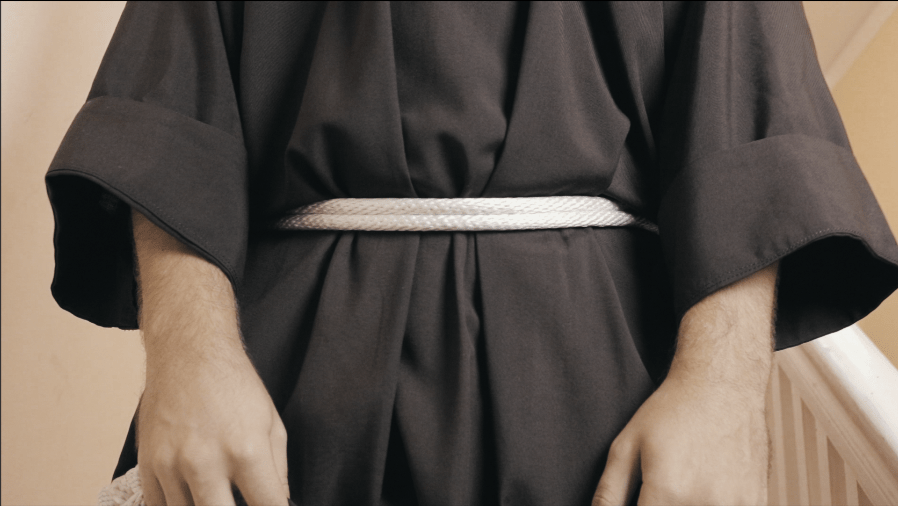

Everyone knows that the Franciscan habit is a powerful symbol. While everyone may not know exactly what it is, it universally speaks to religion, peace, and approachability. That’s not a bad thing to be recognized as when meeting people on the street, especially when someone is looking for prayer or guidance.

What everyone does not necessarily know is that wearing a habit can be a rather difficult task. With long sleeves, loose fabric, and hanging rope, there are innumerable ways to embarrass oneself, break things, and even end up tripping on the floor.

By no means an exhaustive list, my newest video hopes to capture a taste of the things that we face every day in our habits, and the many mistakes that I have made in such a short time. Hope you enjoy!


Email subscribers click here to watch the video! If you’d like to sign up to receive blog posts by email, click here.


The other day I had an unfortunate run-in with someone on Facebook.

Scrolling through my newsfeed, I found an acquaintance of mine had posted something about the election from the viewpoint of the Catholic Church. Not recognizing the news source (not a good sign) and seeing a provocative title (something like, “Vote correctly or see your church close in November”) I hesitantly clicked. Apparently, some priest was telling everyone that if a “certain party” was elected, Churches would be forced to accept new doctrines, decided on by the government, or they would be forced to close because it was the goal of this party to destroy the family and shut down all churches.

Ugh. Talk about fear-mongering and dangerous rhetoric… and in the name of the Church.

While I try not to get involved with things like this when I can, I felt that, as a representative of the Catholic Church and knowing that this person had influence, I needed to make a public statement about the article. Responding via comment, I said that I was very disappointed in the priest and article, that it is yet another example of people trying to manipulate voters with fears that are not based in reality, and assured people that neither party has stated it plans to (or is even capable of) repealing the First Amendment, and that despite statements like this over the past eight years, religious houses of worship have always been granted exemptions to issues of religious freedom. This person’s response? “I’m entitled to my opinion and so are you.” The problem I had with this article, of course, was not that it shared opinions different from mine, but that it shared “facts” that were not true. No one is entitled to say things that are not true.

After writing this as a response, I was not only “defriended,” I was blocked entirely. Ouch.

The reason I write this is not to dwell on this particular encounter, as this is a nice person and I do not mean any harm, nor is it to discuss the issue of religious freedom and the interplay of government and religious institutions, as that is a topic for another day and another time. Instead, I have something very specific, and very important on my mind: we need to learn how to argue with each other.

This may sound like a strange statement coming from a man of peace, but I think the very fact that it does is one of the great failings of our current society (and Church!) and why we are as polarized as we are today. Arguments are not evil encounters that only exist with bad people and so should be avoided at all costs. No! Arguments are simply situations in which people who have come to different conclusions about something engage one another in conversation. Sure, they can be heated. Of course, passion may drive the conversation. But choosing to stand up for one’s opinion rather than ignore the situation or immediately assent to the other’s is not a bad thing, and it most certainly doesn’t have to end in punches or defriending. It can be a very good thing. At least, if it’s done well. As a Catholic and as a Franciscan living in a pluralistic United States, I think that we absolutely have to engage people, but that we need to do it with a few things in mind.

Arguments are not meant to be “won” The biggest issue for many is a conceptional one: the point of a good argument is not to defeat one’s opponent, it is to improve the understanding of the issue at hand for everyone. If the goal of each is to simply “win” the argument, the conversation becomes less about the issue itself—presumably something important worth doing—and more about determining who is “right” and who is “wrong.” But is there ever really a case in which one person is 100% right and the other 100% wrong? Likely not. No matter the situation, there is guaranteed to be something that both parties can walk away with better off than where they started.

But let’s say that there is such a case and one person is just categorically wrong and refuses to accept the truth, i.e. someone who believes that vaccinations cause autism. What is truly gained from seeing each other as enemies and creating winners and losers and making it one’s goal to belittle them? In those cases, I think we as Christians are called to go below the surface of the argument, to seek to understand the person a little better so as to know why they see the world as they do. There might in fact be something very true—a life experience, a fear, a hope for the future—that is shared between both parties and may help to bridge the gap of understanding. This is a situation in which everyone wins, no matter what they ultimately conclude.

Some arguments are just bad… but that doesn’t mean people are In a class years ago, a student shared an opinion that I felt misinterpreted the situation. I raised my hand and said, “I see where you’re coming from, but based on X and Y, I have to disagree.” After class, he came up to me and asked what I had against him. Huh? I don’t have anything against you! For him, there was no distinction between one’s ideas and one’s self, and so me attacking his idea was interpreted as me attacking him.

The fact of the matter is that sometimes good people have bad ideas and bad people have good ideas. In entering a debate, we need to always make the distinction between who someone is and what they’re arguing, and not a) let our emotions get the best of us and become offended by disagreement, or b) belittle an argument based on the character of the one saying it. If God has taught us anything in history it’s that the weakest and least likely people are are just as capable of speaking the truth as the wealthy and well-learned. Truth exists not because of the merit of the one who says it, but because it’s true in itself. In arguing, we are seek the truth irrespective of who says it.

Humility can go a long way The opposite is also true. Certain friends or family might find this final statement a bit humorous coming from me, but one of the most critical traits one has to have to argue well is the ability to admit to being wrong and change when necessary. Being impervious to change and unrelenting in one’s opinion does not make one “faithful,” it makes one dogmatic and an ideologue. Jesus denounced these people when he walked the earth and he certainly doesn’t need people like that now to build up his Church. What he did need, and what he desperately needs now, are men and women who have a firm foundation in the truth of God and God’s creation, but are willing to admit that they themselves are not omniscient or omnipotent—people who are willing to work from a foundation but adapt to the pastoral and cultural “signs of the times.”

Does that mean that everything needs to be on the table at all times? Of course not. For what it’s worth, I will probably never change my opinion on the human and divine nature of Jesus, the holiness of human life, and the need to care for the poor and marginalized. These are non-negotionables for me, and we all have them. What must always be open to change, however, is what these things mean in the modern world and how we are to live them out. And if this is can be true for something as important as how we honor the holiness of human life (something that has drastically changed every century in Church history), then it seems only fitting that we be able to do the same when it comes to taxes, education, daily habits, liturgy, where we eat dinner, foreign policy, and bed times.

***

We live in a world with seven billion people, all going in different directions with different sets of values. Thinking that we will always get along, or worse yet, that we should avoid anyone who disagrees with us for fear of conflicts, is not for Christians. It’s not the way Jesus lived by any means. When we commit to living by a radical worldview, we should not only expect arguments with others, we should welcome it. Evangelization does not occur when people already agree with us, it occurs when we engage people who have come to different conclusions about the world than us. As Christians, are we going to treat these people as our enemies, putting them down or running from them, or are we going to welcome them into peaceful, fruitful dialogue in which we learn to seek the truth together?

In Franciscan life, there is not one way to live together. When we look at factors like size of the community, ministerial focus, liturgical preference, community engagement, recreation, and even house governance, there is almost nothing that unites the friars universally. In our own province now in the 21st century, we have houses with more than 25 guys in which meals are prepared by a staff and ministerial duties are individual to each friar, while we also have houses of 3 guys in which they share both domestic and ministerial responsibilities.

While both are legitimate expressions of Franciscan life and both provide their own set of benefits and challenges, I have made clear before that I have a strong preference in the matter: small houses are the way to go for me. Even though I’ve had good experiences in houses of 10, 21, 30, 25, and 19, have been able to accomplish great feats, throw great parties, and make great friends, the experiences that inspired me to be a friar in the first place and keep me here after five years have almost always come in the houses of 5, 3, and now 4. With fewer guys, there are fewer opportunities to find community and fewer people to share the load, meaning that there is a greater opportunity for interdependence, active responsibility, and flexibility.

What does all that mean in real life? Among other things, it means that I get to cook again. For four of out my five years as a friar I have lived in houses with cooks. With 25 people in the house, it just makes more sense to have a full-time staff person manage the workings of a kitchen rather than having a host of different people all buying, cooking, cleaning, fixing, breaking, and wasting all at the same time. I get that.

But there’s also something intangible lost in that, something that doesn’t show up on a budget report. At the most base level, there’s just more control: choosing the types of foods and brands, getting to pick what we eat and don’t, being flexible when a craving hits. On another level, there’s something very satisfying about taking responsibility for the domestic duties of the house—buying, organizing, cooking, serving, and cleaning—rather than having someone else do it for you.

But even more important than those, for me at least, is the intentionality that meals can have for a community when done together. Eating together is not simply a practical activity for the sake of nutritional nourishment, it’s a time to bond, to share, to laugh, to plan, and to let loose after (or in the midst of) a long day. Not that there’s anything against guests in the house or meals prepared for us, there’s just something about congregating in the kitchen while someone is cooking, helping to set the table, and working together to clean up, with just us present, that makes the whole experience more meaningful to me. It’s a time to remember, each and every day, that we’re in this life together.

Is it without it’s difficulties? Of course not. Not all meals are winners, having to stop to cook and clean up when there’s a lot of work to do can be a pain, and sometimes it can just be difficult with the same four people gathering together every day. Sometimes you just get bored of each other! For me, though, that’s where the fraternity has meaning and where this life gets its purpose. In fraternal life, as in cooking, the most satisfying experiences are not the one’s given to us through someone else’s labors, they’re the ones that we have to make with our own hands.

Outside of rare circumstances, all priests in the Catholic Church are required to be celibate. You can choose ordination or marriage, but not both. For many, this is a heavy burden to carry, requiring one to either be “heroic” in their denial of the goods of marriage, sacrificing what many want in order to serve the faithful. For many, this burden is simply too much, and is cited as a major reason for the lack of priests in the modern world.

And maybe it is. Maybe some who are married should be allowed to be ordained as well. Being that clerical celibacy is a discipline of the Church and not a doctrine or dogma, it’s conceivable that we could see a change in the future.

But that is a question for someone else. For me, the more interesting question is not whether those who are married should be allowed ordination, but why the practice was instituted in the first place and what benefit has the Church seen in it for centuries. Time and time again people have questioned it, and time and time again the Church has maintained it. Why? What’s so important about it?

After taking a course called Ordained Ministries, and with the help of Msgr. Paul McPartlan, esteemed member of the Catholic University of America faculty, I want to suggest something rarely stated on the matter: celibacy is a gift to the priest and the people of God. That’s right: a gift. While the idea of going one’s entire life without getting married or experiencing the joy of having kids is certainly difficult for some, the idea that celibacy is simply a “means to an end” and that it has no merit in itself lacks vision, imagination, and an understanding of the reason for the practice in the first place.

For subscribers on email, click here to watch the video.