Taking a step back from the normal focus of these blog posts, I want to address an issue that may at times seem overly simplistic yet fundamentally important: what is faith?

By its very nature, faith is a rather elusive subject. It is difficult to define, lacks a lot of agreed upon evidence, and is held by people with diametrically opposing opinions on some of religion’s most fundamental qualities. Some people have a lot of faith. Some people have no sense of what faith even is. And that’s just among those who claim to have it.

On the pendulum of perspectives, I find the two poles to be very common, and very dangerous.

On the one end, there are those who will say that faith is something that can and should be proved. What scientific, verifiable evidence does one have the the existence of God? In the group, there is a desire for certainty, a desire to know without a doubt that God exists and what we’re doing is what God wants. Naturally, this is a group populated by agnostics and atheists who find faith absolutely absurd because they have yet to see the credible evidence, but oddly enough, it is also quite common among the strongest of believers: there are people of all faiths who want (and sometimes believe they have) undeniable proof of their beliefs. Expeditions to find the lost ark of Noah; looking for scientists to perform tests on the consecrated host, relics, or the famous Shroud of Turin; sucked in by articles that begin, “Science has unlocked the mystery of…” For people in this category, faith is simply a subset of fact: there is enough evidence to convince you and another of its truth.

On the other end of the extreme are those who believe faith to be something entirely up to the individual, completely independent of objective reality or evidence. I can’t say why I believe, I just know that I’m right. In this group, there is no desire to test what one believes or “has faith in” against the experience of others or empirical data. I believe what I believe, and nothing could ever change my opinion. Faith, then, is simply believing something despite any evidence to support it, an assent to a doctrine or belief simply on principle. For people in this category, faith is simply a subset of opinion: there is not enough evidence to convince you or another of its truth.

Naturally, I find both expressions to be lacking. Faith is by no means a subset of fact, something merely waiting to be proved correct: what would there to have faith in if we could simply know it with scientific certainty? And if faith was simply a personal set of beliefs with no connection to experience or reality, then faith is merely a construct of the individual and has no connection to the lives of others. Surely, neither answer can be correct.

For me, the answer lies somewhere in the middle. There is evidence to guide us in understanding, but not so much on the scientific/certitude level. We have the confessions of others, we have our personal experience, we have a world that points to order and intelligence. Can any one of these things be verified beyond even a shred of doubt? Of course not. Does that mean that they don’t exist. Of course not. Thus, statements of faith are those things for which there is enough evidence to convince you, but not enough to convince another of its truth.

So, do we have evidence that God exists? Yes… and no. That’s the topic of the newest “Ask Brother Casey,” found below or by clicking here.

Every year in formation, the Franciscans of my province host an event called “Intersession,” a meeting of all levels of formation between the sessions of school for a workshop and time for fellowship (hence intersession and not intercession). Without school or ministry on our minds and removed from our normal routines and comforts, it’s usually a welcomed time of intentional fraternity, prayer, and good ol’ fashioned doing nothing.

In that respect, this year was no different. From Thursday until Sunday, I spent time with the postulants, novices, and simply professed friars, catching up on how their year was going, playing games, staying up too late, and eating more than I would normally like. Basically, what you do on intersession. And it was great.

And yet in another respect, although I had attended it three times previously, this week seemed completely unrecognizable to me.

For starters, it was the first ever interprovincial intersession (gotta love religious jargon…) Instead of hosting it at a retreat center somewhere in Maryland or Pennsylvania like usual, everyone flew out to the tundra of Chicago’s Mundelein  Seminary, and instead of consisting solely of formation students from Holy Name Province, we invited all formation students from all US provinces to attend. Yeah, this was going to be different. Even though some of the provinces were not able to send all of their guys because of the distance, our group of normally 10-15 swelled to 31, not including formators and directors. That’s a significant group.

And a young one at that. For the first time in my friar life—I repeat, for the first time—I attended a gathering of friars and I was not the youngest person. Eight people were younger than me, making me not only “not the youngest,” but in fact outside the youngest 25%! How did that happen?? I was pleasantly surprised at this enormous breath of fresh air, and felt a clear difference in the dynamic of the group. Instead of simply sitting around and talking or watching a movie each night (like normal, and not bad at all), guys played animated board and card games, made a heck of a lot of noise, and even (and no, this is not a mistake), organized a four-on-four basketball game in the on-campus gym. First time for everything, I suppose!

But beyond all that—and those things were certainly significant—the thing that struck me the hardest was looking around and realizing that I was the most senior class in attendance. Like my words in I’m On Deck last year, I realized that “there is no one in front of me.” As young as I am, as unprepared as may feel at times, in this gathering, there was no one with more experience in formation than me. With a small handful of others, I was an upperclassman, someone now 4-5 years removed from the experiences of the new guys and the one answering all the formation questions rather than asking them. I was attending my last intersession.

Like so many moments throughout this year so far, it was a moment of pause . . . of reflection . . . of anxiety . . . of comfort . . . of joy. While my regular day-to-day life of being a friar is not considerably different now, nor will they be much different after I profess my vows, these moments remind me how far I’ve come so far and how far I plan to go in the future.

The view from the top is always the clearest, and only makes sense after the long journey to get there.

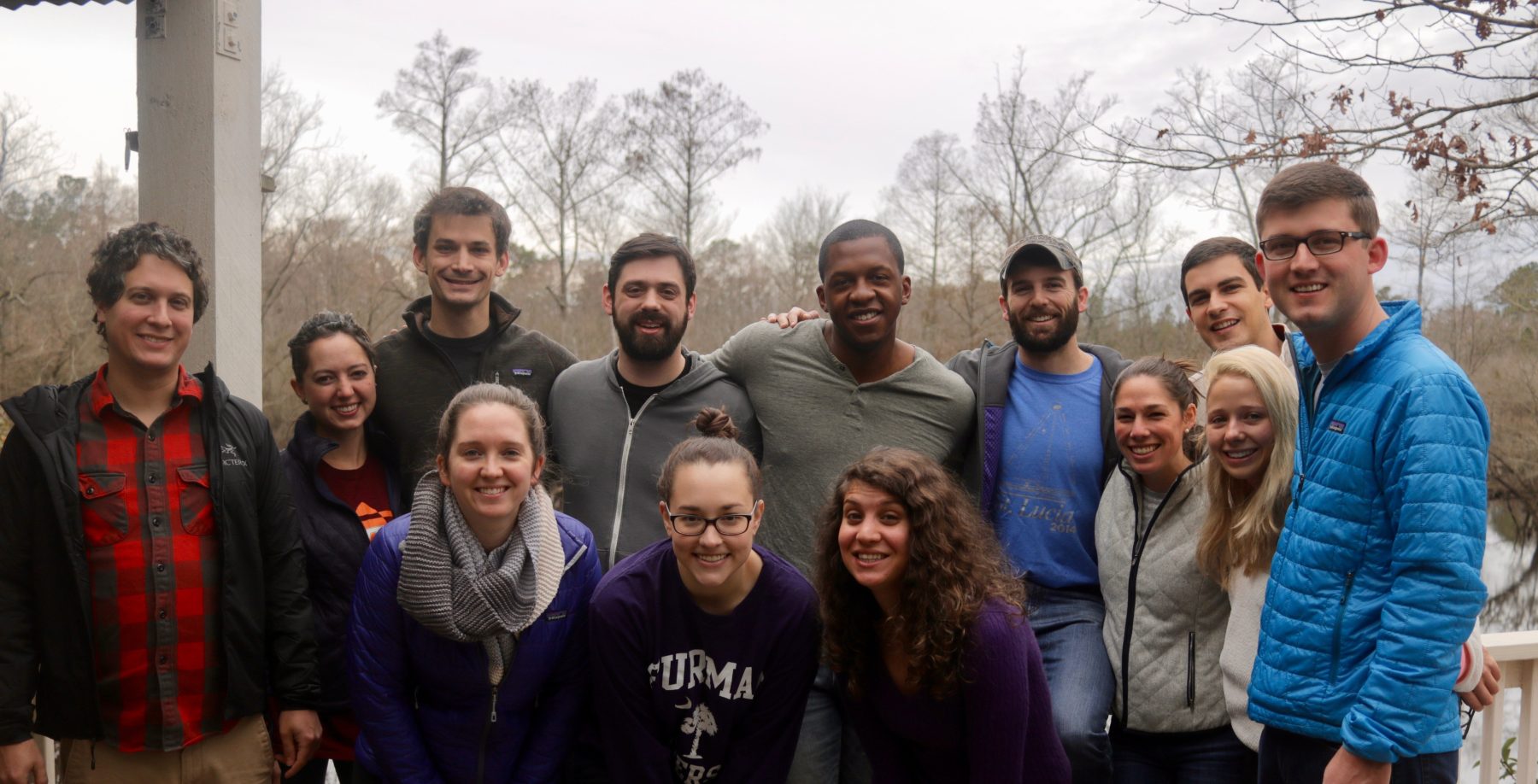
For the past four years, I’ve spent New Year’s Eve renting a house with friends I met freshman year of college. For two, sometimes three nights, we catch up, play games, and just enjoy the company of people we have known for nearly a decade, reminiscing on old times as we make stories worth telling next year. Now nine years removed from the time we all met living in the same freshman dormitory, twelve different people have attended at least one weekend and seven of us have attended them all. To say that it’s one of my favorite times of the year is an understatement.

As the years roll on, so do our lives, and it’s amazing to watch my friends grow up, to see their careers take off, and most significantly, to be a part of their lives as their personal relationships become more serious. While we have always included new boyfriends/girlfriends into the fold and “couples” have generally made up more than half of the group, this year marked a distinct step. Of the thirteen people attending, ten were with someone with whom they have been dating for more than three years (with the longterm boyfriend of another unable to attend and the other having just ended a serious two-year relationship with a former attendee), two sets of couples had gotten a pet together in the past year (and brought it with them), and one couple had even gotten married since last year.

And then there was me. Not in a relationship, not looking to be in one. While my friends are all really mature when it comes to the setting and are in no way exclusive or publicly affectionate while in the group, the gravity of the situation was impossible to miss: when each night was over and people went to bed, when we said our goodbyes and went our separate ways, everyone else had a partner. Everyone else had someone else on the journey, someone to share a conversation with, to share their lives with.

Me? I had the radio. And it was a jerk.

“An’ here I go again on my own
Goin’ down the only road I’ve ever known,
Like a drifter I was born to walk alone.”

With my friends on my mind, the first song I heard on the radio was “Here I Go,” by Whitesnake. Yeah… I didn’t listen to the rest of the song.

But it got me thinking. As I continue to discern my life with the friars and my imminent decision of whether or not to make final vows in August, am I really choosing a life “on my own”?

The immediate and obvious answer is “no.” As I shared during my first year and have reiterated numerous times since, just because I am choosing to remain unmarried does not mean that I am choosing to forgo intimacy. There are multiple ways to love and be loved and I’m simply saying no to one of them. There is still the intimacy of platonic friends supporting each other through struggles, of work colleagues pouring their lives into a project, of academics challenging one another intellectually, of “the guys” working out and playing sports together, and of course, of the brothers in the fraternity committing their lives to one another, among many more. As a friar, I have and will continue to experience intimacy on many levels, feeling a part of something greater than myself, finding a permanent home with men who welcome unconditionally, and sharing in a common vision of life and Church. In a very true and important sense, I will never, ever be alone because I have the brothers.

And yet, five and a half years with the friars has shown me that, no matter how significant and important it is, a fraternity most certainly is not an equivalent alternative to a spouse. While, yes, both are lifestyles of intimacy and commitment, both are intended to be unconditional and lifelong, and both offer stability and produce fruit for the Church and world, they are fundamentally different in focus and lived experience: a marriage is based on a one-to-one, finely-chosen relationship while a fraternity consists of hundreds of unchosen ones. As similar as they may seem and as fruitful as both can be, choosing to love and making a commitment to one romantic partner will never, ever be the same as growing in and learning how to love a group of diverse, transient people. Like a married couple, I can say without question that in times of crisis and times of joy the fraternity will be there to share in and support me, but I cannot say with certainty who the individual men will be, where they’ll be when I need them, or when I will see those most important to me. Very much unlike marriage, my decision to stay or leave the fraternity is not dependent on the individual members of it, and in fact, some of my closest friends within the fraternity have left the order, will eventually leave, or will ultimately die within my lifetime. Thus, even though there exists many intimate relationships, my life within the fraternity will always have a sense of being “on my own.”

Is this some unforeseen revelation that I’ve just now had? Am I beginning to question my life as a friar or fear what might be ahead? No. Not at all. As much as we can equate this life to being married or “having a new family,” I knew even before I joined that these things were meant analogically. Similar, but not the same. Fraternal life can never fully replace true family life; fraternal intimacy is simply not the same as exclusive one-to-one intimacy.

But here’s the thing: it doesn’t need to be. As I grow in my life as a friar and prepare for my final vows, it’s even more obvious to me that some people are simply not called to such an intense, one-to-one relationship, that, even though such relationships are the norm in most cultures they are not necessarily the best way to love or build communities. Maybe some people, not for lack of love or ability but because of an abundance of both, are called and gifted in such a way to love whomever they are with, living intensely in the present moment without the longterm commitment of the future; maybe some people can live anywhere with anyone doing anything because their life is not defined by the intense love they find and share in one person, but rather by the desire to be in relationship with the source of love itself and to share it in a broad sense with all.

Are these people—am I—”on [their] own”? In a sense, yes: they will never have the unconditional one companion with which to share all their thoughts, fears, desires, and struggles. And maybe they can’t live without that. But in a sense, no: they will always be guided by the One who loved first, both in their relationship to that love and in making it present in the world. And maybe I can’t live without that.

On December 25 every year, the Christian world celebrates the greatest mystery in human history: the Incarnation. At a moment in time, the eternal, omnipotent, and patently-outside-of-time God entered history to become ephemeral, weak, and finite in time and space. The creator became the created. Wow.

But as we move throughout this twelve-day season (yes… Christmas has just begun) and the romance of the mystery starts to wear off, some of us can’t help but turn into annoying five-year-olds: “But why?” Why did Jesus come? Why did God do something so counterintuitive, humbling Godself to become a part of His limited creation?

For many, the answer is simple: to take away sins. And Jesus certainly did that. But is that the primary reason, the reason that would trump all other reasons? If you say yes, you, like St. Thomas Aquinas, must conclude that had we never sinned the Incarnation would have never happened. If you say no, however, you might just have a Franciscan heart…

For those subscribing by email, you can watch this video by clicking here.

This time of year is one of traditions: traditions of decorating Christmas trees, singing carols with neighbors, and of course, getting upset when people say “Happy Holidays” instead of “Merry Christmas.” You know, the things we look forward to all year!

While, no doubt, Christians throughout the world are persecuted for their faith, disenfranchised and even killed because of what they believe, I want to suggest that this situation is not one of them; our choice of holiday greeting is not between a Christian and an anti-Christian one, but in fact two fundamentally Christian greetings. The Second Vatican Council said so.

Okay, you got me. No, the Second Vatican Council did not comment on the appropriate holiday greeting for Christians. But I think the words of wisdom offered from it helps to guide us today. In its landmark document on the Church, Lumen Gentium, the bishops reflected on what it meant to be Church, what the boundaries of the Church were, and how salvation might be understood for those outside of it. After a reflection on the fundamental connection between all Christians, Catholic and non-Catholic alike, they looked beyond:

Finally, those who have not yet received the Gospel are related in various ways to the people of God. In the first place we must recall the people to whom the testament and the promises were given and from whom Christ was born according to the flesh. On account of their fathers this people remains most dear to God, for God does not repent of the gifts He makes nor of the calls He issues.

The Jews, being the people to whom God spoke and led, the people into whom our savior was born, are related to the People of God in an important way. This makes natural sense, but the document continues:

But the plan of salvation also includes those who acknowledge the Creator. In the first place amongst these there are the Muslims, who, professing to hold the faith of Abraham, along with us adore the one and merciful God, who on the last day will judge mankind.

Muslims, being one with us in our father Abraham and acknowledging the same creator of all, are privileged in the eyes of Christians as brother and sisters as well. Amazing! But we’re not done yet…

Nor is God far distant from those who in shadows and images seek the unknown God, for it is He who gives to all men life and breath and all things, and as Saviour wills that all men be saved. Those also can attain to salvation who through no fault of their own do not know the Gospel of Christ or His Church, yet sincerely seek God and moved by grace strive by their deeds to do His will as it is known to them through the dictates of conscience.

Presumably speaking of Hindus in their great philosophies, Buddhists in their striving for something beyond this fading world, and pagans in their transcendent mysteries, the council recognizes those people who seek the God we know even if they do not know it is truly Him. These people, too, are related to the people of God. But we’re still not done:

Nor does Divine Providence deny the helps necessary for salvation to those who, without blame on their part, have not yet arrived at an explicit knowledge of God and with His grace strive to live a good life. Whatever good or truth is found amongst them is looked upon by the Church as a preparation for the Gospel. She knows that it is given by Him who enlightens all men so that they may finally have life. But often men, deceived by the Evil One, have become vain in their reasonings and have exchanged the truth of God for a lie, serving the creature rather than the Creator. Or some there are who, living and dying in this world without God, are exposed to final despair. Wherefore to promote the glory of God and procure the salvation of all of these, and mindful of the command of the Lord, “Preach the Gospel to every creature”, the Church fosters the missions with care and attention.

Yes, even in those who do not follow any religion or have any specific theologies or rituals, they too are related to the People of God. Together with its document specifically on the relationship with people of other religions (Nostra Aetate), the Second Vatican Council, “rejects nothing that is true and holy in these religions. She regards with sincere reverence those ways of conduct and of life, those precepts and teachings which… often reflect a ray of that Truth which enlightens all.” In essence, wherever God can be found—which is in all religions, to varying extents—God and the people God inspires should be cherished.

So with that said, I speak to all Christians who will celebrate Christmas tomorrow and Orthodox Christians who will celebrate it on January 7; to all Jews who will celebrate Hanukkah starting tomorrow; all Muslims who celebrated Maulid al-Nabi earlier this month; and to all other people of faith or spirituality who find this time of year to be holy in some way, whether religiously or secularly…

Happy Holidays!