Where are Catholic Teachings in the Bible?

It is often said by fundamentalist Christians that Catholic doctrines are made up, that we’ve disregarded God’s Word to follow the laws of man. It’s utterly ridiculous. Catholics were the first Christians, and we were the ones who compiled the Bible. Anyone who has ever read a papal encyclical or official document of the Church knows that there are references to Scripture in every paragraph.

Everything we do finds its foundation in Scripture.

But that doesn’t mean that everything exists today just as it did 2000 years ago. The Church grows and develops. Implicit or minor teachings in the Bible took on flesh as the Church became greater aware of its mission. To suggest that every detail of what we do now is found in Scripture is not a fair claim—no Christian community could live up to that standard.

The problem, unfortunately, is that many Catholics (or other Christians) don’t know where the foundation is for many of our doctrines. In this week’s Catholicism In Focus, I offer the biblical foundation for some of our most contested beliefs, showing exactly where and why we believe what we do.
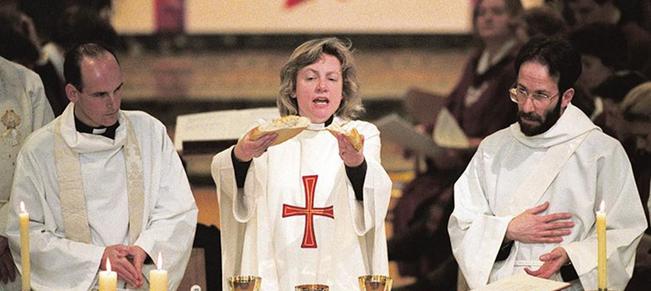
The question of ordaining women to the priesthood is not open to debate. At least, not according to John Paul II. In his 1994 letter Ordinatio Sacerdotalis, he states, “I declare that the Church has no authority whatsoever to confer priestly ordination on women and that this judgment is to be definitively held by all the Church’s faithful.”

In other words, the Church will not and cannot ordain women to be priests.

The point of this week’s Catholicism In Focus is not to spark a debate. I have no interest in sharing my own opinions or hearing others’. What one thinks about a doctrine is of no consequence, really, especially when few people know what the doctrine actually says.

The purpose of this video, then, is to look at the rationale given in this definitive statement and to understand its limits. Why can women not be ordained priests, according to the Catholic magisterium? How does this limit their scope of leadership in the Church? In what ways has this doctrine been inappropriately applied to prevent women from active participation? These are the questions I seek to answer, particularly the final one.

Women may not be able to be ordained priests, but that doesn’t mean there aren’t ways for them to have legitimate influence. Until those ways become the norm and not the exception, we’ve got some work to do.

What is a Mortal Sin?

Do you know what really grinds my gears? Finding parish or youth group websites posting lists of mortal sins. Not only does no such list exist in the magisterial teaching of Catholic Church, it would be impossible to make one.

For starters, as I discussed in a previous video, there is no such thing as an act that always bears culpability. The act itself is important, but one must always consider the intent of the actor and the circumstances in which they acted.

On top of that, for something to be a mortal sin, it must have more than just “grave matter.” Simply being serious (or what these homemade lists believe to be serious) isn’t enough. There must also be full knowledge and complete consent on the part of the actor. If they don’t know what they’re doing or are not completely free to say no, it cannot be a mortal sin.

Again, for those sitting in the back. Just because someone has done something grave doesn’t make it a mortal sin. In fact, there are many times in which it isn’t.

So when you see a list suggesting that illegal drug use, theft, gossip, anger without justification, superstition, and pride are all mortal sins, without any reference to intent, circumstances, knowledge, or freedom, please remember what the Church actually teaches. There is no such thing as something that is always a mortal sin no matter the circumstances. There are things that consist of grave matter, yes, but that’s not the same as being sinful, and it most certainly isn’t the same as culpability.

Are Marian Apparitions Real?

It is not an uncommon experience for me to get a message from someone asking about the prophecy of Mary or some saint. Generally, they’re terrifying. Mary is nothing like the docile, “do unto me according to your will” mother that we find in the Bible, but is much more a tyrant usurping her son’s throne to inflict some harm.

It’s easy for most of us to dismiss these things as fabrications or the work of the paranoid, but how do we respond to these things? Surely, there must be an objective way to evaluate such apparitions for some semblance of authenticity.

In fact, there is! In this week’s Catholicism in Focus, I look at the Church’s standards to evaluating miraculous encounters and what they mean for us.

Believe it or not, this was one a controversial question. Today, many “mixed marriages” take place every year, joining together people of different faiths into one. While it may seem commonplace and routine today, this is only because of major shifts in the Church’s approach to ecumenism, leading to a reform of the liturgy.

If you’re preparing for your own wedding today, the USCCB has some great resources for you to use.