It is not an uncommon experience for me to get a message from someone asking about the prophecy of Mary or some saint. Generally, they’re terrifying. Mary is nothing like the docile, “do unto me according to your will” mother that we find in the Bible, but is much more a tyrant usurping her son’s throne to inflict some harm.
It’s easy for most of us to dismiss these things as fabrications or the work of the paranoid, but how do we respond to these things? Surely, there must be an objective way to evaluate such apparitions for some semblance of authenticity.
In fact, there is! In this week’s Catholicism in Focus, I look at the Church’s standards to evaluating miraculous encounters and what they mean for us.
Believe it or not, this was one a controversial question. Today, many “mixed marriages” take place every year, joining together people of different faiths into one. While it may seem commonplace and routine today, this is only because of major shifts in the Church’s approach to ecumenism, leading to a reform of the liturgy.
If you’re preparing for your own wedding today, the USCCB has some great resources for you to use.
Is there anything wrong with being rich? This is America. And in America, we reward hard work and ingenuity. You can be anything and anyone you want, right, as long as you work for it. If you work hard enough and have enough skill, you deserve everything you get. Millionaire? Billionaire? Richest person in the world? This is the sign that you have worked hard, and everything you earn is rightfully yours. No one can take it away from you.
Okay. But what if that person is a Christian?
The question of what we do with our money is arguably the most important issue found in the entire Bible (in the Old Testament, second only to the issue of idolatry.) More than an insistence on peace, more than politics, far more than sexual ethics, Jesus spends most of his earthly ministry caring for the poor and preaching about wealth. He tells his disciples how they are to approach it, preaches against the rich, and raises up the poor. Truly, if there is one thing that Jesus cares about more than anything else, it’s what we do with our money.
Understandably, then, the Catholic Church has a few things to say on the topic. Drawing from the social encyclicals, papal pronouncements, and ecumenical council documents, this week’s Catholicism In Focus offers a brief overview of the Church’s stance on but one economic topic: private property.
Can a Christian be rich? In general, the Church has no problem. But it definitely depends on what one does with their riches.
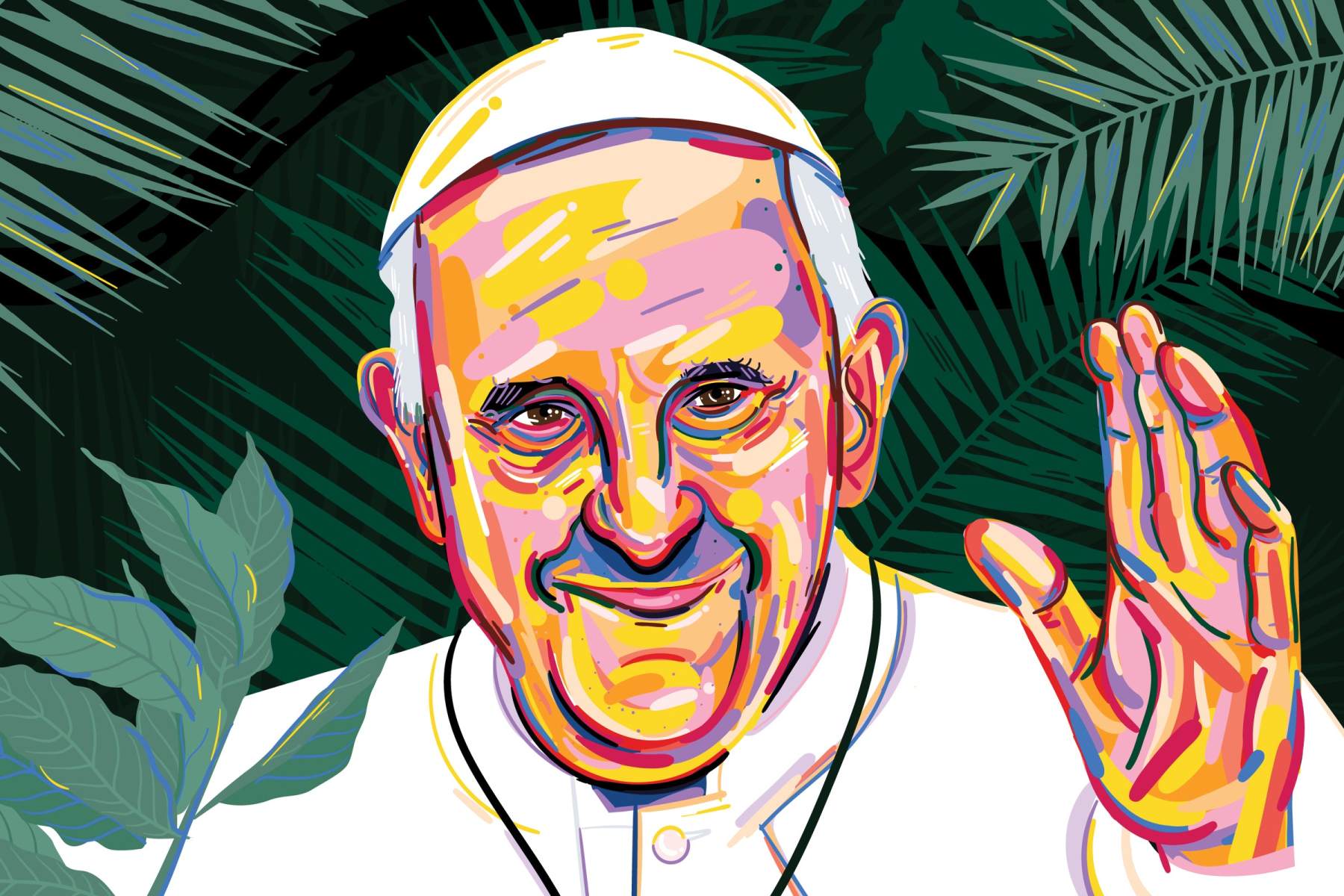
If you’ve followed Catholic news much over the past year, you know that there has been a lot of attention give to the Amazon region. Pope Francis convened a synod to explore the needs of the people and what the Church should do in response.
On most people’s minds, there was only one question that mattered: will the pope allow married men to be ordained priests in a region that desperately needs sacramental ministers? This is what the news covered almost entirely, and so for many people, it was seemingly the only issue at hand.
Thus, when Pope Francis remained silent on the issue, many moved on without giving much attention to the post-synodal document. This is a shame, to say the least.
In this week’s Catholicism In Focus, I unpack what the pope actually did say, and why it matters to us. It is a short document (relatively speaking) and so I strongly encourage everyone to read through it yourself. You can find it in its entirety here.
This week’s video is a lesson in public discourse and attention to detail. That’s not what the video is actually about, but the reaction to it warrants that lesson.
You see, my videos often deal with complex topics of philosophy and meaning, things that can never be taken at face value. My titles and thumbnails are designed to attract viewers, and if one is not careful to listen to the actual words I’m saying, they might be misled into hearing what they think I’m going to say, rather than what I’m actually saying.
In this case, I made a video about the role of traditions in our Church. The purpose of the video was to show that traditions are never static, that they never have a purely objective, unchangeable meaning to them, but rather that their place in the Church and how they are perceived grows and adapts as the culture around them does. What something meant to a people in 1200 is necessarily going to be different than what it means to people today.
As an example, I pointed to the cassock. There was a time when it was the main clerical garb of priests. Everyone wore it. It was normal. Today, that is not the case. The same garb, largely unchanged, is perceived differently in our Church and world because it is now the minority expression, because it represents a particular ecclesiology, because it is distinct.
The way traditions are expressed and experienced changes over time. There’s nothing controversial in saying that, and I was not in any way criticizing those who choose to wear it. I could have very well chosen to highlight the latin language, rosary, Franciscan habit, Friday fish fries, or any other tradition, as their role and perception has changed dramatically over time as well.
And that’s fine. There is no judgment one way or another.
My point in sharing this was to move away from a rigid, static understanding of the world, one in which we believe that supplanting a tradition from the past into our world will capture everything that that tradition meant in its time. You simply cannot recreate the past today; the world around the tradition has changed.
This is not to say, though, that I am against traditions, that old things can’t be renewed. In fact, my inspiration for the video was to show the complete opposite! Old things can and should be brought back from time to time with a renewed life to them, repurposed for our world today. The habit may have fallen out of favor with many religious because it came to be associated with clericalism and entitlement, but that’s not how the tradition is being experienced today. The world has changed, and many young people yearn for public witnesses. Unlike those of previous generations, they do not see it as a sign of separation, but rather a sign of evangelization, availability, and commitment. The tradition of old has disappeared because the world that defined it has disappeared, but the action itself has taken on a new life.
Hence the title: you can’t bring back old traditions. As that world fades away, the way the tradition is lived and experienced will necessarily be new. And that’s a good thing!
But that’s not how people read the title. They missed the subtly of the point. Instead, they saw a modernist who hates tradition. They saw someone with a contradictory point because he wears a habit but “belittles” the cassock. They saw a heretic looking to ruin the Church.
And they didn’t hold back from telling me such.
Yes, this video was intended to be about the new life of old traditions, but what it turned into was a lesson in public discourse and attention to detail. It served as a reminder that sometimes things aren’t always as they first appear, and when we jump to judgment and condemnation, we undermine our lives as Christians. I wrote the below message to my subscribers to draw attention to the problem:
“If you believe that I’ve said something that contradicts our Catholic faith, is mean-spirited, or illogical, especially on a highly nuanced theological topic (especially if you don’t have training in that topic) maybe ask for clarification before you jump to calling me heretic or unsubscribing. I’m pretty good at responding to questions. With a little patience and offering me the benefit of the doubt, you might come to see that what I’m saying isn’t actually contradictory, mean-spirited, or illogical.”
In some ways I find the response appalling. Literally hundreds of comments in less than 24 hours questioning my priesthood, angrily yelling at me, or calling me an idiot. Plenty of others got the point I was making perfectly, repeating it back to me with confusion: “why are people so angry? They’re completely missing the point.” It has left me frustrated and a bit cynical, wondering if it’s even worth presenting complex takes on theology if the masses are going to misconstrue my words. Is it my responsibility to be concerned with how people will misunderstand my comments and be led astray by them? Even if many got the point exactly? Isn’t that on the ignorant, not me? Frustrating, difficult questions.
And yet, what an interesting opportunity. So often, all we do is preach to the choir. So often all we ever hear is positive feedback from those who already agree with us. Had I made this video or not, there would have remained plenty of ignorant people on the internet, plenty of people with underdeveloped, fuzzy, or even incorrect theologies. With a video that angers people to respond—even if that response is a bit inappropriate—there is an opportunity for dialogue. I have responded to many of my accusers and have clarified my words. I’ve listened to their complaints and have attempted to speak to their experience. Have I changed the world? Hardly. At times, I was not as charitable as I would have liked to have been. But some connections were made. Some people began to see things a bit differently, to grow in understanding.
And ultimately, wasn’t that the point of the video in the first place?



 Breaking In The Habit