Yesterday was just like any other day. I woke up around 6:30, prayed morning prayer with the brothers, and went to Catholic University for many hours. Oh, and how could I forget? We ordered pizza for dinner because we didn’t get home until 8:30. Other than that, pretty normal.

Said no one in D.C.

Yesterday was one of the craziest, most chaotic, exciting, and uncomfortable days of my life. Yes, I got to see the pope. From less than 15 feet away, actually. But the day was much more than just that. It was an adventure.

Our day started at 10:00 when five of us left Holy Name College for downtown. I would like to point out that the mass did not start until 4:15… This selfie, taken by Michael Reyes, OFM and posted by Christian Seno, OFM, was picked up by CNN and NBC and allegedly aired on television. We’re famous!
12042991_1659369094307139_4599877105188709193_n

Because the whole area was a mess, and because the DC Metro is not known for its reliability or success in keeping trains from catching on fire, we parked at the Franciscan Monastery of the Holy Land and walked the few blocks up to campus. Or that was our plan, at least. This picture was taken when we were just a block away and thought we were almost there.
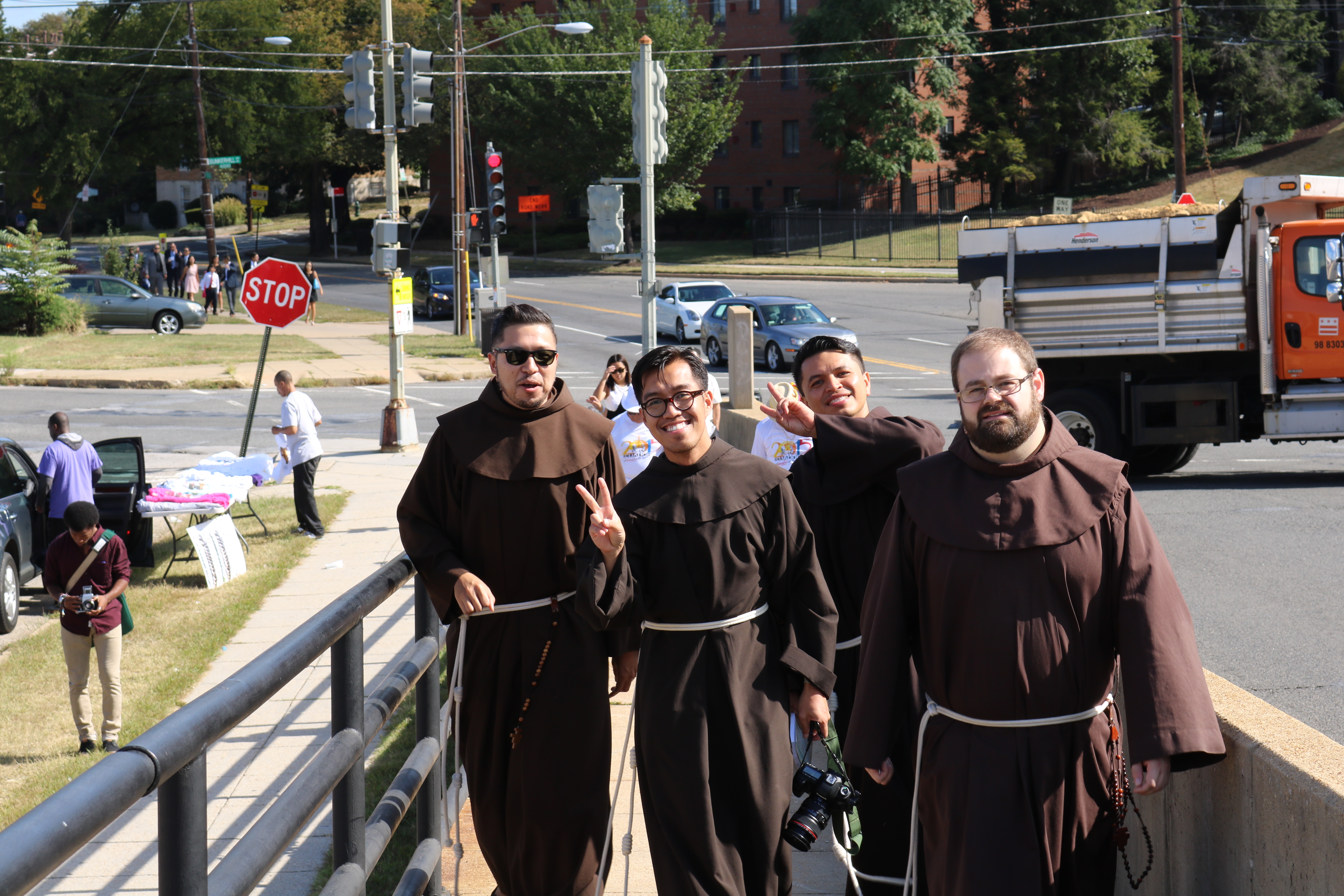
IMG_0810

This was our view on the other side of the bridge. Yikes! There were four entrances designated by color on one’s ticket. We needed to get to the purple gate, on the other side of this mess, but were obviously not allowed through this mess. So… we walked to the left and completely around. Total, we walked about 2.36 miles, not 100% sure if we were going the right way until we arrived.

IMG_0814

When we arrived, we were disappointed to find two things: the line was equally as long and slow-moving as the other gate, and they were accepting all tickets at all gates, so we walked for 40 extra minutes for no reason. The line was unbearable slow, taking between one and two hours to make it through.

IMG_0822

There was one perk to waiting in line, though. There amidst the crowds was Cardinal Tagle of the Philippines, patiently waiting with everyone else and graciously speaking and taking pictures with anyone who asked. There is a reason that he is so liked and why many believe his humility could land him a job in the Vatican after this Francis guy is done…

12002438_10154433748583561_5683227384027695301_o

Eventually we made it in, along with 25,000 of our closest friends. It was a beautiful day, and the energy was just wonderful. I didn’t particularly like to see all of the venders around selling trinkets and merchandise–I’m not sure how Pope Francis would feel about being the literal face of consumerism–but it was incredible to so many excited people.
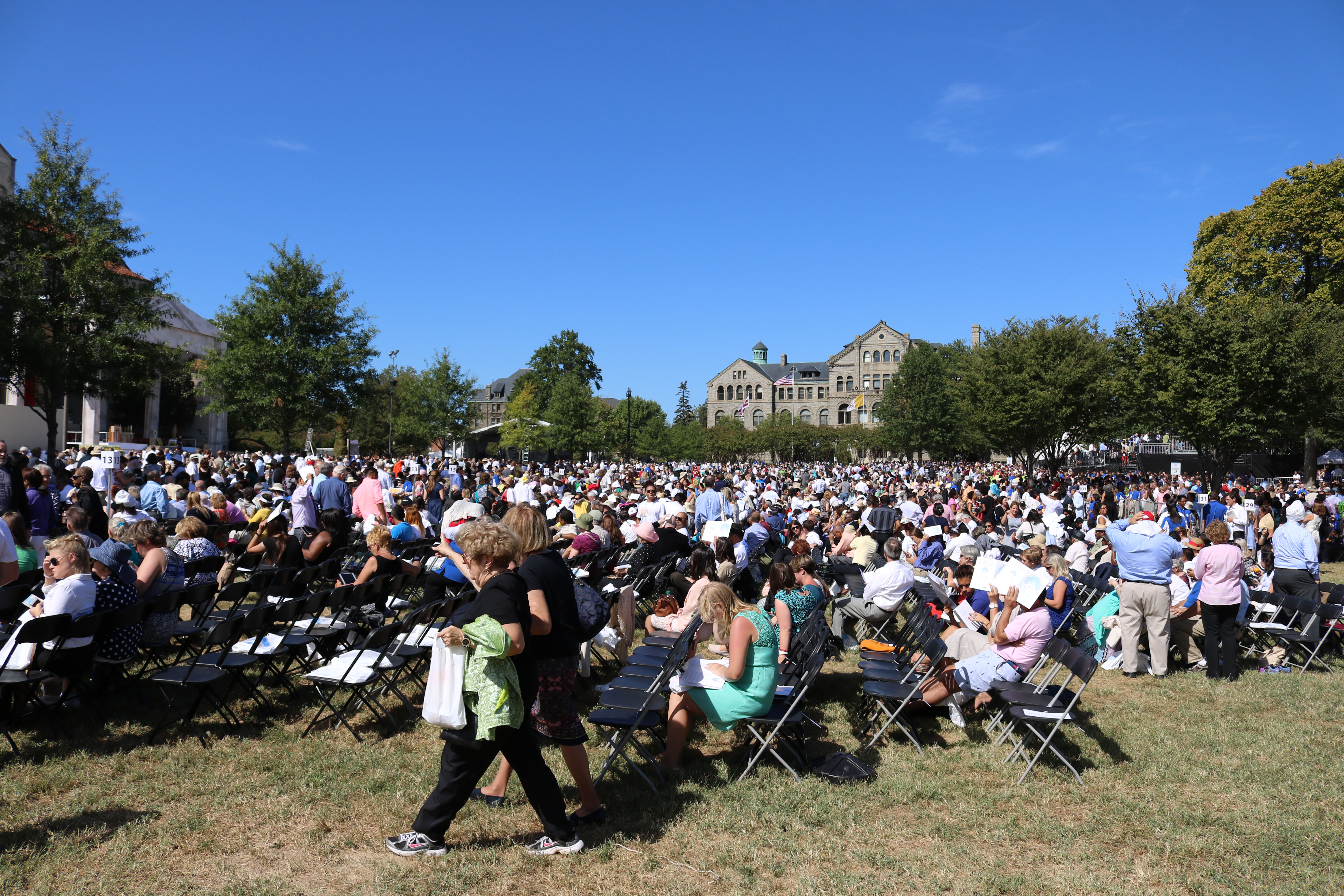
IMG_0892

As seminarians and religious, our seats were inside, a bit of an irony on two levels: they were the most comfortable due to the air conditioning (something that Francis would probably not reserve for the shepherds!) and the farthest away from the actual mass, which was outside. Where we sat was off to the side, and so we couldn’t see him processes in…

IMG_0971

…but we did get to see him process outside! Where we were sitting was only four rows from where Pope Francis walked by to celebrate mass; we were within 10-15 feet from him!

IMG_1033

As far as the mass goes, it was pretty nice. I’m definitely not one for pomp and circumstance, and some of the ritual just seemed intentionally over-the-top, but there were definitely some amazing things I doubt we would have seen with the previous two popes, being from Europe. The mass was in Spanish, not Latin, and many of the songs represented Latin American culture. There were definitely high Latin aspects of the mass, songs set to the organ and chanted responses, but there were also powerful Latin-American songs that seemed to be more “of the people,” if I may. (This song, for instance, was written and performed by the music director of our Franciscan parish in Silver Spring, MD.) His homily was also quite good.

Overall, there was a lot to love about the day. We got to meet a few cardinals (saw Cardinal Seán again), had a close-up view of the pope, and we got to experience not only his first mass in the United States but the first ever canonization mass on American soil (and it was a Franciscan, fitting given that the first mass ever celebrated on US soil was by a Franciscan). And that was all great for sure. The highlight of it all for me, though, was definitely seeing the people all around. I can’t say that I’ve ever seen anything quite like it. Yeah, I’ve been to professional sporting events. Yeah, I went to the “March for Life” last year. But this was something else.

At this point I can’t fully describe what it was like, and by no means do I want to elevate it beyond some of the truly transcendent and personal moments I’ve had in my life, as, let’s be honest, there are far more meaningful things to life than the pope visiting (at least I hope!)… but I will say, it was an inspiring and exciting day, brought to us by a man that continues to inspire our Church to be who we are meant to be as Christians. This pope gives me hope!
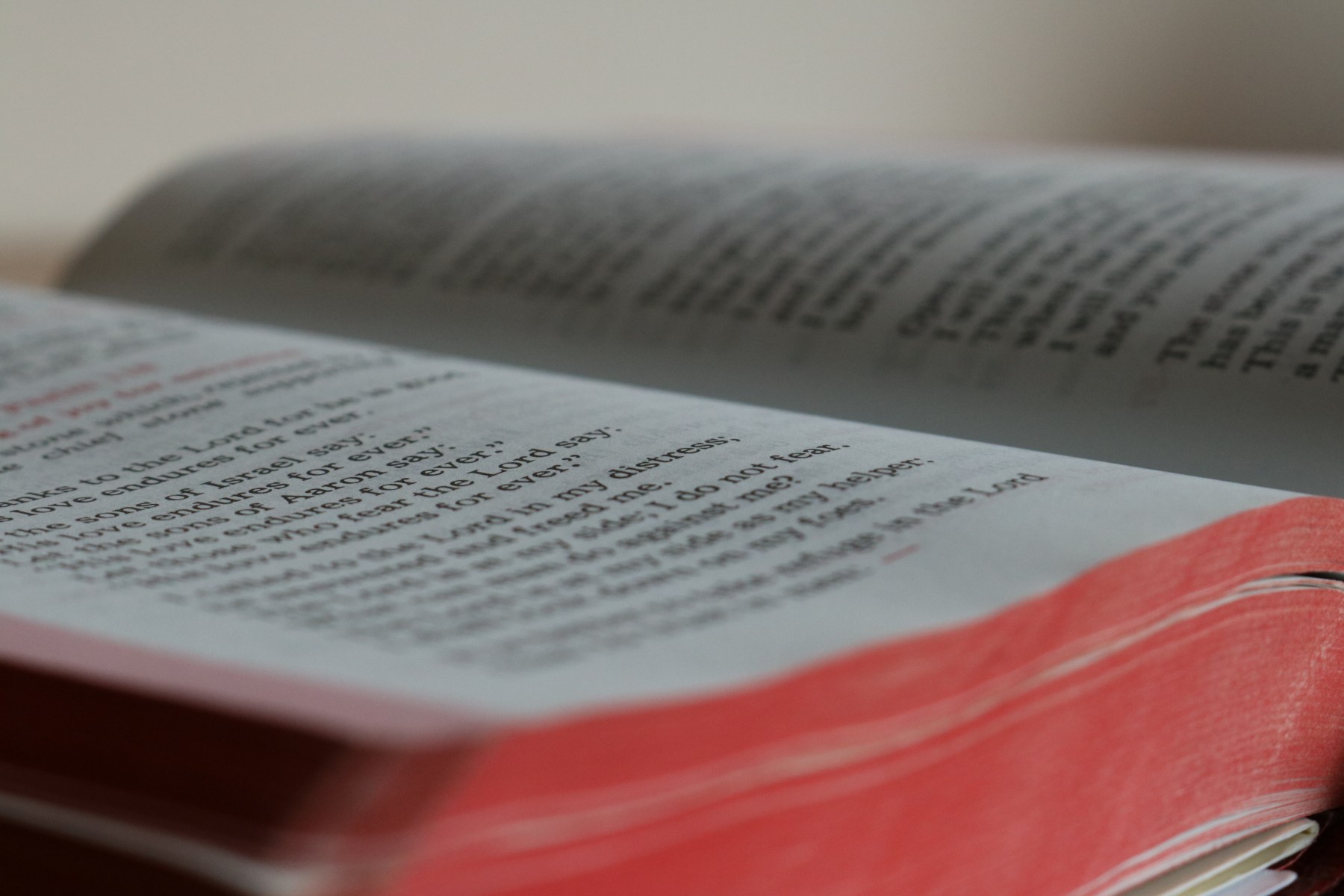
 

As friars, prayer is essential to who we are. You may not think about it much, given the amount of ministry and work we do, but the Franciscan charism is rooted in an experience of God through prayer. We could not do what we do, nor do I think we could find the motivation to even try, if we didn’t start with a relationship with God.

So how to do we pray? The short answer is “any way we feel called.” There is no true “Franciscan” way of praying that all of us do every day. Some pray in silent meditation, others sing loudly as prayer; some focus on relieving their mind of all of life’s trouble through centering prayer, others fill their mind with the words of Holy Scripture. There are devotions such as the Rosary and the Stations of the Cross, and ancient prayers like Lectio Divina. Each friar has his own set of prayers that fill him and guide him back to God.

With that said, there is one prayer that unites us all as it is the universal prayer of the Church: The Liturgy of the Hours. Also known as the Divine Office or Breviary, the Liturgy of the Hours is a prayer that pre-dates even the New Testament in its earliest forms. For those who know much about the Mass in the Catholic Church, it is similar in many ways to Liturgy of the Word, as Scripture and prayer are its focus: there is a hymn, multiple psalms and canticles, a reading from Scripture, a Gospel acclamation, and intercessions. The reason that it is called the Liturgy of the Hours is that it designates certain times of day to pray and specific prayers for each hour. In the Catholic tradition there are seven possible times to pray: Morning, Midday (consisting of Mid-Morning, Midday, and Mid-Afternoon), Evening, Night, and the “Office of Readings,” which can be prayed at any time. (This is a lot like the later-developing Muslim prayer, Salat, in which Muslims will stop to pray five times a day.) As religious, we are required to pray the major hours, Morning and Evening prayer, but are encouraged to say one or two of the minor hours as well.

I did my best to share what I like best about praying the Office in this week’s “Ask Br. Casey” segment, but there is definitely a lot I left out! If any of these reasons interest you, you can try praying it yourself using a breviary, downloading any number of cellphone apps (iBreviary, Divine Office, Universalis) or finding the prayers online (Divine Office or Universalis, among others).

Click here for the video.

Bringing Calm to the Chaos

Happy Friday, and happy Fourth of July weekend! To celebrate both, I present to you a twofer: a video AND a blog reflection. Although focused on the same topic–the way in which Jesus calms the storms of life and then calls us to do the same for others–the two mediums, written and video, offer very different perspectives from one another. I hope you enjoy them both, and since this is America on the Fourth of July, celebrate your freedom: it’s up to you which you enjoy first!

(Here’s the link to the video for any email subscribers)

Being that it’s Father’s day, I thought that I would start with a story about my father. My father is a great guy. He’s smart, he was an all-American in high school, a great coach and teacher. And oh my gosh is he funny. My dad was born without the ability to feel embarrassed, so it doesn’t matter where we are or who’s around, he will do something stupid to make us all laugh, whether it’s intentionally tripping down the steps or pretending to play soccer with a statue. Actually, now that I think about it, he might just be crazy. That’s just who my father is, and I love him very much.

But that’s not what makes him a great father. Yes, it’s great to have someone who is silly and easy to get along with, but there’s more to being a father than that. What makes him a great father is what happened my senior year of college. After four years of driving 70 miles each day for a job that offered tuition exchange, the only way I would have been able to go to college, he calls me: “Hey Casey, I just wanted to let you know that I got let go today. They’re downsizing the department and had to cut someone.” I was devastated. Why him? He’s such a good man. I started thinking about a lot of things: how were they going to pay the bills, how was this going to effect their marriage, how was this going to effect his pride/was he depressed? I said, “Dad, I’m so sorry. Are you okay?” I’ll never forget his response: “Why wouldn’t I be okay? Don’t you see how God has blessed us? When you were looking to go to college, there was no way we were going to afford it. God provided me with a job that made that possible. Now you’re graduating, and I don’t need this job anymore. I’m just so thankful for the blessing we had for four years.”

Wow. That is what makes my dad a good father. When I was ready to focus on the negative, fall into despair at what I didn’t have, my dad was calmly there pointing me to our Father in heaven. In the midst of chaos, my dad brought me the peace of Christ.

All too often I find myself playing the role of the disciples in our Gospel. When things go wrong, when the world comes crashing down on me, my first reaction is to let the chaos get the best of me. Like the disciples, sometimes I forget that Jesus is right there in the boat, waiting for me to awake him. No matter what is happening all around us, no matter who we are, no matter what we’ve done, Jesus is always there offering himself.

And I want to focus on that for a second. Sometimes we hear some things so many times that it loses its effect; we hear it doesn’t touch us like it should. “God is always here; Jesus loves us; the Eucharist is the real presence. Yeah, I know these things.” But really, take a moment to let this Gospel image set in a little. In the midst of all the chaos of our lives, the problems with money, children, careers, loneliness, bullying, whatever it may be, whatever our storm is… Jesus is right there in the boat, waiting for us to call on him. Jesus is here… now. I mean, seriously. When we listen to the word of God, when we share this meal together, we’re not just doing nice things… we are experiencing the living and true creator of the universe. Wow. There is no chaos too strong for our Lord; no problem too big. With him in the boat with us, there is nothing we could ever fear, even the raging sea. And why is that? Because if we believe with all our heart that what we’re doing is more than some nice gesture but really is the living and true God giving himself for us, if we let him take hold of us and become a part of us, how could we we ever fear or be concerned with anything else? The peace of Christ that we receive conquers every pain, every worry, every suffering, and every misplaced desire that we can ever have, and makes us whole again.

And if I stopped there, you’d probably think to yourself, “Well that’s nice. Good encouraging message from Br. Casey… and it was short! Nice!” And I could stop here, but that’s not the whole story, is it? As nice and true as it is to be reminded that God is always there to take away our pain and to calm the chaos, to stop here gives us the image of our God as the powerful psychiatrist in the sky, a genie that fixes our problems. God becomes someone who exists solely for the sake of making us feel comfortable and happy. To stop here leaves out an essential part of what it means to be Christian: mission.

Having experienced the love and peace of Christ in our lives, the transformative nature of the Eucharist that fills us with joy and hope in the midst of chaos, we are now called to do the same for others. Remember how our Gospel passage started: Jesus told the disciples to get into the boat. He led them into the chaos, not away from it. Why would he do this? Why would he put them in harms way? As Christians, those who know the power of Christ to heal wounds and bring peace, we are not meant to flee from pain and despair, but to be the first ones running towards it. We are called to get into that boat and to bring Jesus where he is needed most.

A quick look at our world shows that there is no shortage of chaos all around us. Everywhere we look a storm is brewing and ships are sinking. People are being shot in churches; pope Francis reminds us that we are turning the earth into “an immense pile of filth”; there is human trafficking and spousal abuse; bullying and loneliness; war and mass migrations. Given it all, we could easily say that it is not our problem, claim that it doesn’t affect us, and just wait for someone else to take care of it. We could hide in our safety and comfort. But what if, as Christians, those who truly know the power of Christ to heal wounds and bring peace, what if we were the first ones running towards the chaos, bringing Jesus to those who need him most? What a world that would be…

And so I pray, on this our Father’s day, that we may always remember two things. The first is that there is no amount of chaos that could ever overwhelm our God. No matter what we are going through, no matter how crazy it may seem, God is there, waiting to be awakened to calm our storm. The second is that, once we have received this great gift, the only thing we can possibly do is go to those in the chaos, go to those in the place that we were before we knew Christ, and bring them the love and peace that we have received. It’s the story of the Gospel and it is our Christian mission. In the midst of chaos, may we always be as my father was to me: calmly pointing others to the Father in heaven.

A Look At Where We’ve Been

Before we hit the open road, it's time to look back at where we've been

Before we hit the open road, it’s time to look back at where we’ve been

Over the past few weeks much of my focus has been on where I’m going. I’m going to Triangle, VA for my summer assignment. I’m going on a road trip across the country. I may or may not be going somewhere outside of the country at the end of the summer… My focus has been almost exclusively on the future, on things that will or may happen.

Before all that happens, though, I need to take some time to focus on what has actually happened throughout this year. That’s right, it’s time for the annual “Retreat to Move Forward” (kudos to anyone who gets the reference). Starting this afternoon and going until Thursday, the temporary professed friars of Holy Name college will be resting, praying, and reflecting together at the Bon Secours Retreat and Conference Center in Marriotsville, MD.

A vehicle for completing our year end self-evaluations, the retreat will be self-directed and focus on six categories: Life with God, Fraternal Life, The Vowed Life, Personal Growth and Self-Understanding, Work, and Vision. Each morning/afternoon, we will be given roughly two hours to privately pray, reflect, and answer a series of questions related to each category. (For example, how and in what ways have you contributed to the fraternal life of the friary?) After enough time has been given, because so much of our life as Franciscans is fraternal, we will then come together to reflect as a group. This serves two important purposes: 1) For the extroverts especially, it is good to process one’s thoughts out loud and to hear affirmation or feedback from the ones who know us best, and 2) our identity is more than just individual and so time needs to be given to reflect on how we have lived up to this life together, not just how have by myself. How have we as a whole house fostered a life-giving fraternity? Supported one another in our vows? Progressed in the way we treat one another? As much as personal growth is important, when one plans on living the rest of his life together with others, communal growth has to be equally evaluated. While I foresee the possibility of these conversations being a bit tedious, even contentious, I think coming together to reflect as one is arguably the most important part of this retreat and our life together.

A Bible, breviary, and a few spiritual books are all I'm taking.

A Bible, breviary, and a few spiritual books are all I’m taking.

What’s also significant about this retreat is that it is a point of transition: last year is over, summer is about to begin. When our time is complete on Thursday, we will drive back to Holy Name college and go our separate ways. Some will go to summer assignment right away; a few will take a few days of vacation; I will be on my way to California. But it’s more than just a transition for summer plans. Because our house is highly transient, many of the guys will be transitioning to the next stage of their formation and will not return in the fall. This year, Ramon, George, and John will all be heading out for a year internship in the province with John being the only planning to return for more school. In this very real way, then, this retreat marks the end of our lives together, at least in this context. The fraternity that we knew this year is coming to an end and a new one will have to be built in the fall with the arrival of a new class. This is of course bittersweet, and my hope is that we may take joy in the time we have with one another this week.

Overall, I’m really looking forward to the week. I could really use some time to put away the computer, turn off the phone, and spend quality (QUIET!) time with my God and my brothers. So much of our lives is spent looking to what may or may not happen that we miss what has and is happening right now. It may seem obvious, but there is no future without the present, and there is no use planning what is ahead if we’ve forgotten where we’ve been.

If you have any prayer requests send them to me before 3:00 today and you will be in my prayers all week.

Doing Lent Together

As Church, we follow the path of those gone before us. As Fraternity, we follow that path together.

As Church, we follow the path of those gone before us. As Fraternity, we help each other along the way.

It’s that time of year again. Lent is upon us. Put away the green vestments, get the ashes ready, and hide the chocolate, it’s time for some penance and conversion!

Lent is always an especially fruitful time of year for me, a season of intentionality and clarity. More than any other time, I am forced to look deep within myself, call to mind the ways that I have wavered from the right path, and do what I have to do to be ready for our Lord’s resurrection. It is a time of knowing deeply who I am in all of my gifts and failings, and remembering all that Jesus did/does for me (and you!)

That being said, I don’t think I have to tell you that it is also a time of great struggle, proving the adage “no pain, no gain” to be right. Fasting is the worst. Rearranging my schedule is inconvenient. Realizing that I’m not perfect, that there are times in which I am actually bad, is the last thing I want to spend time thinking about. Although I can look back and clearly see how much I have benefited from acts of penance and conversion throughout the years (from somewhat trivial things like not eating candy and refraining from “That’s what she said” jokes to praying more and developing a habit of using my resources for others) they were dreadfully painful at the beginning. Nobody likes change. It’s even harder when what’s bad for us is easy, comfortable, and feels so so good.

So why do we so often do it alone? Why do we go down the path of conversion without a guide or partner every step of the way? When you ask the majority of people what they’re doing for Lent, you’re likely to get, “Oh, I’m going to pray more,” “I’m going to donate more to charity,” “I’m going to fast on Fridays.” I’m going to do something. For most people, including myself before entering religious life, Lent was a private devotion and a personal conversion. Others at times knew what I was doing, but it was ultimately my cross to bear, no one else’s.

There are two things I want to say about this.

The first is that, as Church, we need to support one another in our conversions. As Christians, we walk together, not alone, following the path of those who have gone before us and benefiting from two thousand years of faithful living. We don’t have to reinvent the wheel; the Church has shown what is spiritually life-giving. Prayer. Fasting. Almsgiving. But these things are not to be done solely in private devotion and personal conversion. No, penance and conversion are public and communal acts that build up the community through mutual support, and evangelize others to follow the path with us. Think about how powerful of a witness it is to see someone vulnerable enough to share the ways in which s/he needs to be converted and asking the community for help, and how encouraging it must look to an outsider to see the whole community answer the call for one another.

Putting ashes on our forehead is not a private devotion but a public sign of our need for conversion.

Putting ashes on our forehead is not a private devotion but a public sign of our need for conversion.

And yet, being Church is more than simply joining an support group, as important as support may be. It is uniting in word and deed with other people of faith around a common mission. When this happens, when we truly become Church, we begin to adopt a communal identity, a “we” in belief and action. This is a tremendous step. When it happens, we no longer look simply at the ways in which “I” have sinned, but now in the ways that “we” have sinned. We begin to realize that the Church is in need of conversion and that we are all a part of that.

What does this look like? Well, there are at least three levels to look at. The first and most important is the family, the principle building block of the Church. Coming together as a household, the family must look at its life together and determine the ways in which the culture of the house could better promote the coming our Lord. Maybe there is a weekly prayer night. Maybe money is saved by not going out to eat as much and donated to a charity. From there, one looks to the worshiping community. Is there something special the community can do together throughout the season, an additional prayer service or community service day? Lastly, one looks to the Church/society as a whole. Have we, directly or indirectly, supported injustice in our world? Maybe there is something we need to change in the way we treat certain people or issues, in the way we act and are perceived publicly.

What about me, you ask? What I am doing that I need support from the community and how am I doing Lent together with others?

Personally, I hope to do three things that will touch on a few of my biggest struggles. The first is to read scripture for 15-20 minutes each day, in additional to the thirty minutes of silent prayer I have [mostly] kept since Advent. The Word of God is always right there to be proclaimed and heard, but I don’t sit with it enough. The second is to give of myself more freely to the poor and to continue to grow in my comfort with and respect for those who are homeless. The third is my fast, but it doesn’t have anything to do with food. As I have mentioned before, taking myself off the dating scene has helped me to focus less on attractiveness when entering into a relationship, shaking off the natural tendency to see women as objects. This is by no means a completed process, however, and I want to take this time to be intentional about how seriously I take the vow of chastity.

Communally, it is much more difficult to find specific things that apply to each member of the house, especially when there are twenty guys living together, but we also agreed on three things: 1) On Wednesdays and Fridays we will have soup and bread for dinner, no dessert, 2) At Evening Prayer on those days, we will read one station of the cross and reflect on it together, and 3) The house will match any donations we make out of our stipends for the CRS rice bowl. For me, these things are critically important to the life of the house. Sure, they may not cause the greatest conversion in any one of us, but there is just something so important about recognizing that we are in this together and making an effort to show it. We’re all busy people and we all have our own preferences when it comes to lifestyle, but it speaks volumes to me that we can do something with and for each other.

In this way, I think religious life is a powerful witness to the rest of the Church and the rest of the world, that we are something greater than our individual identity, that there is something life-giving about giving up personal autonomy for the sake of the group. And in a way, isn’t that what Lent is all about? Giving up what we don’t need to build up the Kingdom of God. That sounds good to me. Would you like to do it together?