Our first day of our “Southern Exposure” began with a tandem of ministries in central North Carolina: Raleigh and Durham. To say that it was a busy weekend is an understatement. Besides being the feast of the Ascension, it was also Mother’s Day, graduation weekend for a few of the area colleges, first communion at Immaculate Conception Durham, and there was even a baptism at one of the masses. Put in the context of two of the largest parishes in the diocese of Raleigh (more than a couple thousand families each) and you have yourself a busy weekend pulling the friars every which way.

And yet, we still had a great opportunity to spend time together, share a few meals, get a tour, and hear about their lives.

From a ministerial standpoint, St. Francis of Assisi Parish in Raleigh and Immaculate Conception Parish in Durham are among the liveliest, most efficiently run parishes that I’ve experienced.
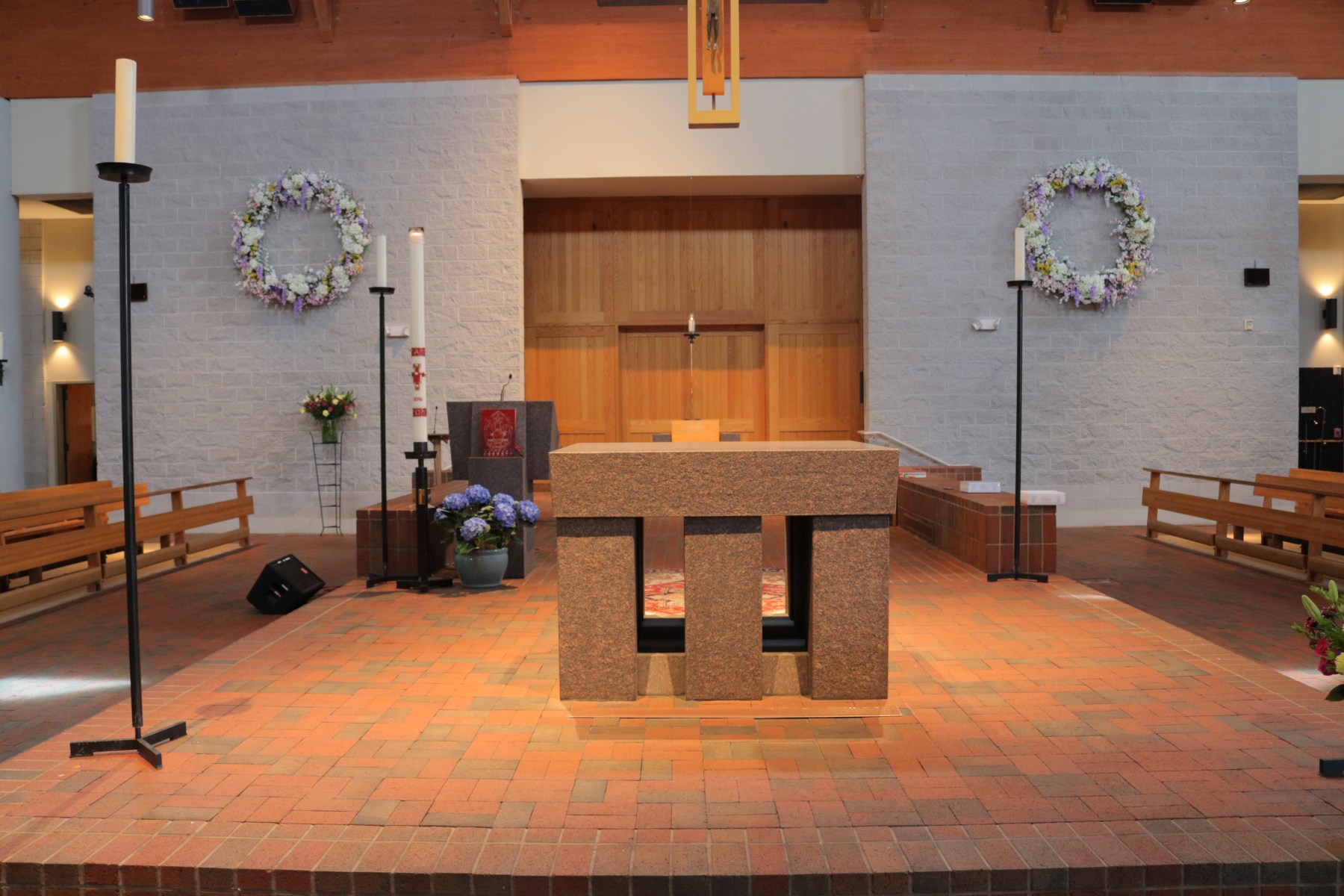
St. Francis is a very large, very beautiful church with thousands of people attending each weekend

What caught my eye immediately about Raleigh—besides the sheer size!—was how involved the laity was on a large scale. At one of the masses, I counted 25 eucharistic ministers, complete with two assigned to oversee the refilling of patens and chalices in stations that ran empty, and they all knew exactly what to do. There was no needless standing around, awkward pauses or stumbling over one another. They all knew how to receive, where to be, and how to make it move. For a congregation that amassed more than a thousand people, there was no sense that things were taking too long; it flowed much more efficiently that parishes I’ve seen that are half the size! Is this the best aspect about this parish, the way it distributes communion? Of course not. But it is representative to how St. Francis is run: smoothly with a well-trained and highly involved lay staff. When you look at their ministries—a whole two pages of one-line listings in the bulletin—you see a different lay person taking charge and leading it. This is not a parish in which “Father” comes up with everything or oversees everything strictly. This is a parish in which the people realize their baptismal call to be priests, prophets, and kings, and the friars are there to walk with them, not for them. Truly a remarkably run parish.
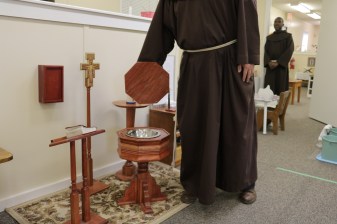
Sometimes the best way to learn is to do, using all of one’s senses!

Similarly run and designed as St. Francis in Raleigh (they share an architect and founding pastor), what caught my attention about Immaculate Conception in Durham was the culture: culture of the people, the town, and the parish. Unlike St. Francis that leans on the homogenous side of things and is located in the suburbs, IC is split almost 50/50 between English speakers and Spanish speakers in a traditionally African-American neighborhood, is located on the main street of a historically significant but newly thriving city complete with art, leisure and great restaurants, and is just minutes away from one of the finest universities in the country in Duke. Although smaller than St. Francis in Raleigh, its location and ministerial focus makes it seem much busier, adding a dash of chaos to the creative mix of ministries. One  thing in particular that got my imagination going was one of their elementary religious education classrooms: complete with a mini altar, baptismal font, giant rosaries, and religious symbols, tiny children are taught through a hands-on approach, getting to “play mass,” pretend baptize baby dolls, and learn about the prayer life of the Church by leading it themselves. What an amazing way to teach students in an experiential way that transcends language and culture!

But this trip is not all about ministry and so our time was not spend simply at mass or in tours but also with the brothers at table. On Saturday night, the three traveling brothers sat down with the friars in Raleigh for a delicious dinner prepared by one of the friars, and on Sunday evening the friars from Durham joined the friars in Raleigh for a cookout. This, I have to say, is when friars are at their best. Having met all of these men before but not particularly close with any of the six, we all immediately felt at home, laughed almost constantly, and found ourselves included in the fraternal teasing by the end. We talked about the Church, our lives, politics, ministry, school, sports, art, philosophy, you name it. And we had a great time doing it.

Unfortunately, though, our time was short-lived, and come Monday morning it was off to our next stop: Macon, GA. Our newest ministry, it is unlike Raleigh and Durham in almost every way, and yet an incredibly place in itself.

For more pictures of Raleigh and Durham, be sure to check out my Facebook page here all week!
In my last post I made two major announcements about what life would hold for me over the next year, beginning with two months in Mexico on May 31. I’ve appreciated all of the comments and the congratulations, and thank all of you very much!

But there is another announcement to be shared now. As some of you may have been wondering, and a few of you even asked, why there is a big gap between now and May 31. What exactly will I be doing until then?

How about another road trip?

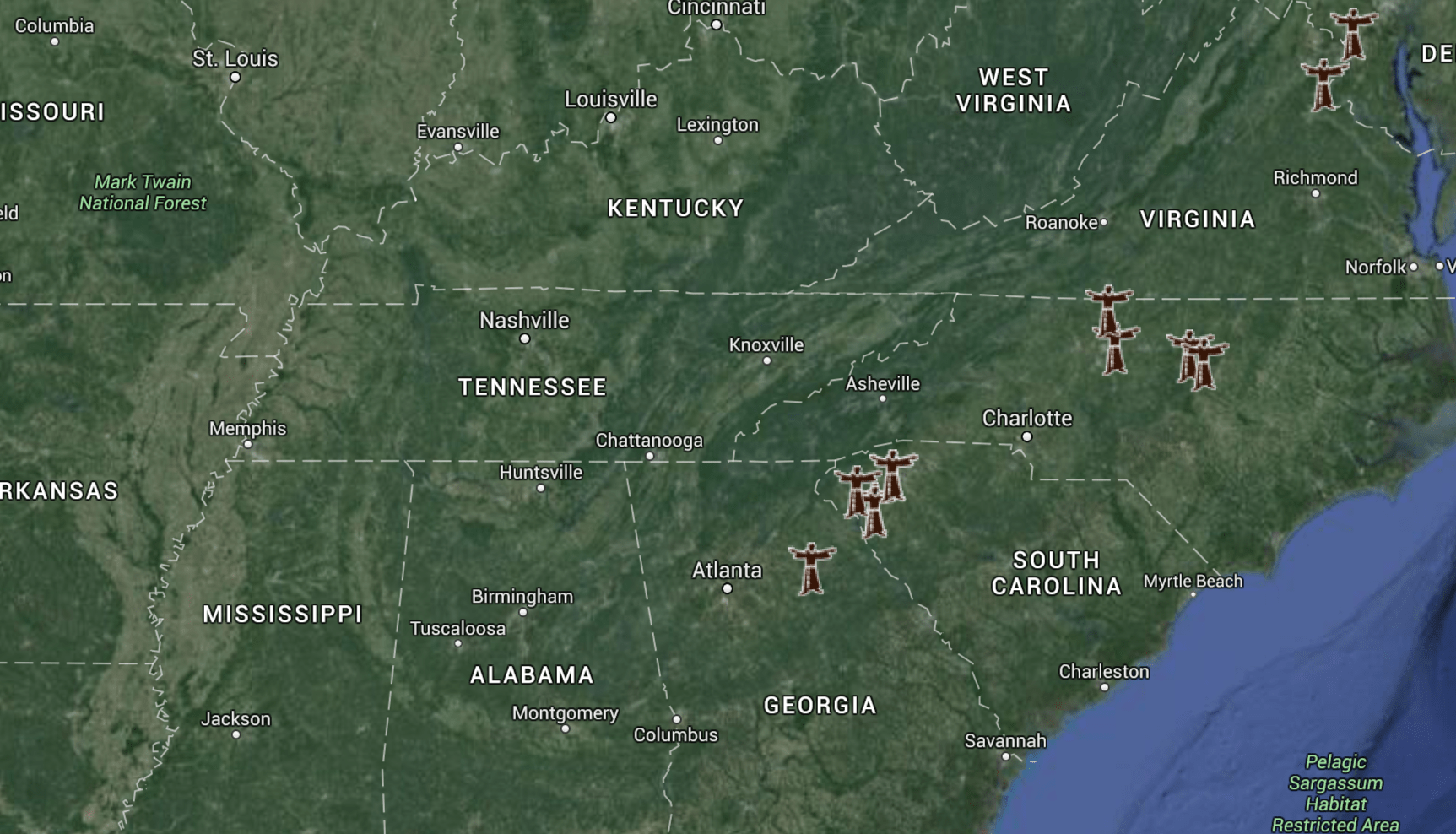
As some of you may remember, I traveled from San Diego to Washington with a classmate of mine last year, writing about our journey and beginning my filming “experiment” on the road. This year, our trip is less practical as it is fraternal: traveling with two other friars in formation, we plan to visit all of our “southern” ministries over a period of a week, spending some time with the friars and getting to know their life and ministry.

Even though we’ve always had friars living in the south (and, if you ask me, our best places in the province today are in the south) it is sometimes treated as “mission territory” among the friars of the “New York” province because it is not located in Manhattan. As a result, most guys in formation don’t get a chance to see many of our places or get to know the southern church.

Just over 1500 miles in 8 days, this trip will be less about the road and more about being with our brothers.

No longer. Starting from Washington, D.C., we’ll stop in Raleigh/Durham NC, Macon and Athens GA, Clemson, Anderson, and Greenville SC, Stoneville NC, and conclude with a stop in Triangle VA before heading back to DC. In a span of eight days, we’ll get to see six parishes, two universities, and a retreat center, not to mention 23 different friars living in nine different friaries. Unlike last year in which much of our time was on the road and all of the things I shared (videos and blogs) had to do with the sights and tastes of each region of our country, this year we’re hoping to spend most of our time with the friars, sharing more about the Franciscan presence in each area. I don’t plan on making any videos this trip, but will definitely be blogging and posting to the Facebook page. (If you’re interested in seeing pictures, you’re definitely going to want to “like” the Facebook page.)

This was my mom’s reaction when she saw me at church today. Worth it.

As a final note, being that we we’re starting day three of the trip today and will be behind in sharing come the first post, you might be wondering why I didn’t announce this in the last post with the other announcements or get ahead of the story with more pictures or posts. Funny story. We planned this trip two months ago and I told my mom about it. Being that my parents live two hours away from Raleigh/Durham (where we are staying now) and were not planning on adding two hours to our 1500 mile trip, she accepted the fact that we wouldn’t see each other and forgot about it. Since it was Mother’s Day yesterday, however, she later made plans to see my sisters in Raleigh and to attend mass at the parish we’re staying out now, forgetting the fact that I would be here. When my sisters and dad found this out, we decided not to remind her, and since she reads this blog, I decided not to announce it. Her reaction was worth the wait…

Back at the beginning of Lent, I said in a video that Lent was a time of preparation for the renewal of our baptismal promises. Because the video was mostly about Lent, I didn’t give a full explanation of what that meant, and I’m sure I left a number of you thinking, “What promises? I was a baby… I didn’t make any promises.”

Maybe so. But your parents and Godparents did for you.

You see at baptism—whether its done as a child or as an adult—all of us Christians are incorporated into Christ and Christ’s Church by being cleansed of our sin, permanently marked on our souls, and commissioned to live the threefold office of Christ: priest, prophet and king. Lumen Gentium, the 1964 Dogmatic Constitution on the Church promulgated at the Second Vatican Council (essentially the highest teaching authority on the Church), had this to say:

These faithful are by baptism made one body with Christ and are constituted among the People of God; they are in their own way made sharers in the priestly, prophetical, and kingly functions of Christ; and they carry out for their own part the mission of the whole Christian people in the Church and in the world (Lumen Gentium, 31).

It is for this reason that baptism is considered entry into the “royal priesthood”(1 Peter 2:9) making all the faithful, myself and likely you included, “priests” in a very real sense. Did you know that you we were priests?! Obviously different from our brothers with the title “father” in front of their name, what we are called to is no less significant in the life of the Church.

Called to offer sacrifice

Traditionally, the role of the priest is to offer sacrifices to God; this is the case for the Levitical priests in the Old Testament, this is what Jesus did when he offered himself as a sacrifice, and this is what Catholic and Orthodox priests do today on the altar. They interact directly with God and make the world holy because of their actions. But guess what: there are other ways to make the world holy than celebrating Mass! Just because we as non-ministerial priests cannot offer the “Holy Sacrifice of the Mass” doesn’t mean that we’re free from this office of Christ! Once again, the Second Vatican Council had this to say: “The supreme and eternal Priest, Christ Jesus, since he wills to continue his witness and service also through the laity, vivifies them in this Spirit and increasingly urges them on to every good and perfect work” (LG, 34). All of us as Christians are called to be priests like Christ in the sense that we are to offer sacrifice and make Christ present through our works. Even the ordinary lives of the faithful—going to work, being married, praying at home, even enduring hardships—can be done in a way to “consecrate the world itself to God” (LG, 34). This is an extraordinary reminder and a powerful commission we should take seriously: we are called as baptized Christians to make the world holy through our actions.

Called to be make God known

In the Old Testament, prophets were not so much the people that saw the future as they were people who saw the present as God does. They were people so close to God and attuned to God’s Word that they could look out into the world and proclaim what needed to be done to build God’s world (and even sometimes how God was going to react if we didn’t!) Jesus was the greatest of the Prophets because he was at the same time the one delivering the message and the message itself; his very existence proclaimed God and taught people about what God wanted for us and the world. As sharers in this office of Christ through baptism (yup… you guessed it) all of us are called to be prophets in the world as well. While ordained ministers are entrusted to teaching and preaching in an official sense, the council was clear that all Christians are a part of this mission, even taking on a part particular to them: “Now the laity are called in a special way to make the Church present and operative in those places and circumstances where only through them can it become the salt of the earth” (LG, 33). In other words, we are all called to spread the Word of God in the world, but the laity, living and working in the secular world, are able to reach people and places that the ordained generally can’t. Does this mean that everyone is expected to start reading the Bible at their workplace or asking fellow soccer moms if they know Jesus? No, not necessarily. Evangelization is not always so explicit. But it does mean that the way we live, all of us, needs to proclaim ourselves as Easter people, people who know the joy and life of the Resurrection and a God who loves us. There are infinite ways to show this!

Called to lead others through service

Finally, we all know that Jesus is the true King, the “anointed one” of God awaited in the Old Testament, ruling now on his throne in heaven. He is the all-powerful, just judge that governs all of Creation. The king of glory comes the nation rejoices! In an official way, ordained ministers take on this role as the ones who govern the Church, leading the people and making laws for proper life and worship of all Christians. But once again (last time!) the laity are not off the hook! As baptized Christians who live and work in the world, the laity are not only part of this commission, they are given a special role in it. Think about it. If we’re supposed to build the kingdom of God as Jesus announced, who is going to be better able to act with justice in the world: the priest running a parish or a regional manager of a bank? While ordained ministers might be better equipped to govern the Church, the laity, in fact, are better equipped to build a just society because they live and work in it. Doctors, lawyers, bankers, sales reps, social workers, factory workers, minimum wage clerks, authors and musicians. Each one of these professions is intimately connected with the wider world and the economy, and each Christian working in these places has insider knowledge about what needs to be done to create a better world. Being incorporated into Jesus’ “kingly” office means using the authority, knowledge, and ability one has to “serve others rather than be served.”

A priestly people

Taken together, all of us baptized Christians constitute a “priestly people” unto God, a royal priesthood of believers. As such, we are given a special commission to be priests, prophets, and kings in our world in a way that fits our way of life. One does not have to be an ordained minister to make Christ present, and in fact, there are ways that only someone who is not an ordained minister can do it. In this time of Easter, having purified and prepared ourselves in the time of Lent, we are sent out into the world to begin living this again in a renewed way.

How will you be a priest, prophet, and king today?

On December 8 of last year, Pope Francis officially opened the doors to the “Year of Mercy,” a focused effort to remind us of the mercy God shows us each and every day, and a call to show that mercy to others in our world. His document announcing the year and it’s purpose (found here) is a wonderful source of inspiration and something that could easily serve as a guide to our year’s prayer life.

And how could it not? Mercy is an essential aspect of our life as Christians, right up there with love, justice, sacrifice, and faith in terms of our most used words. Christianity, by its very nature, is a religion of mercy. The good news of Jesus Christ is that God has come to be like us, has shown us love, and offers us a new path despite our sins and failings. Rather than give us what we deserve, God gives us what we do not deserve: forgiveness and eternal salvation to those who follow.

For this reason, I recently sat down with Fr. Patrick Tuttle, OFM, Franciscan Friar and pastor of St. Anthony’s Catholic Church in Greenville, SC. Not only has Fr. Patrick personally shown me great mercy over the years, he was the first friar that I met when I was in college and has been a tremendous influence in my life, inspiring me to be a better Christian, to take leadership in the Church, and to eventually join the Franciscans. As a spiritual mentor, fellow Franciscan brother, and close friend, I wanted to get his take on what this year could mean for me training for the priesthood and for all of us Christians. We came up with three things worth sharing: Forgiveness, Joy, and Confession.

For those on email, click here for the video.


After a two-week long hiatus, I’m back on the blog and ready to start the new year. I had a fantastic ten-day vacation (once again traveling nearly 1200 miles!), spending four days with my family, visiting three friar communities, and opening the new year with ten friends from college. It was good to go home, but after it all, it’s also great to be back.

Or, at least it was… for the hour that I made it back to D.C. on Sunday. After my final leg of the 1200 mile vacation extravaganza, I was back in the car for a three-and-a-half hour drive to New Jersey with the friars. Another vacation? Not exactly…

12491797_10153930733136424_4081137593281048207_oEach January, all of the friars in formation (minus the novices in Wisconsin) attend a workshop together on a Franciscan topic related to our life and ministry. These are no “cupcake” topics either. In years past, we’ve had presentations about the Franciscan theology of the Trinity, the relationship between the Franciscan Order and Islam, and the contemplative dimension of leadership (given by a former Vice President of a Fortune 500 company). This year was no different: we were privileged to welcome Fr. Michael Blastic, OFM, one of the foremost Franciscan scholars in the English-speaking world, to discuss the connection between St. Francis, the Second Vatican council, and Pope Francis. As one would expect, the content was fantastic and our discussions were lively and fruitful.

And alone, it would have been great; a quality workshop for our intellectual formation. But intersession is not just a workshop. As Franciscans, our formation is not just intellectual, it’s prayerful, emotional, and absolutely social.

Outside of the designated times for lecture and discussion each day, when we weren’t praying or at meals, we spent our time together truly enjoying each other’s company. Away from school and ministry in the comfortable confines of a retreat center, without stress or distraction, we were free to simply be ourselves, together. It was time to catch up with the guys out on their internship year (final year of formation before solemn profession) and to mix a little more with those in different levels of formation. All told, it may not sound like much, but is always a blessed time of the year filled with laughter, relaxation,  and brotherly love, a time to share our lives with the other men going through the process together.

And alone, it would have been an inspiring and rejuvenating week. But there was more.

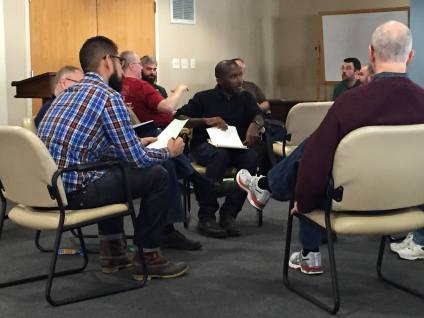
12493410_10153930734676424_7948693549053161023_oNot only did the friars from SPUFY (Solemnly Professed Under Five Years… we love acronyms in religious life) meet at the same time and place as us, offering a unique opportunity for recreation each night, on Wednesday we welcomed 50 of the 70 friars in our province under the age of 55 for an unprecedented meeting about the future of the Franciscans as we enter a period of restructuring and revitalization. For 24 hours, we discussed our vision for the Franciscans in the country, shared our hopes and fears, and debated on the best way to make that happen. Although I can’t share the specifics of what we discussed, there are few things that stuck out to me:

  1. The numbers are so much more significant when they have faces. So often in the Church we talk about declining numbers, lack of vocations, and a very bleak future. In our province, we talk about how few guys we will have in the future to run our ministries. And it’s all true… based on the expectations of the 1950s. But standing before me this week were fifty men who have devoted their lives to radically living the Gospel. And that’s not even all of them. To think that we have seventy men in the peak of their lives, in our province alone, that are committed to the same life as I am, is incredibly encouraging (not to mention the 240 other men who happen to be 56 or older, many of whom run the province). Too often you see a religious community with 2-3 new members, men or women, under the age of 55, surrounded by 100 others on the verge of retirement. Not the Franciscans. Not Holy Name Province. There is a strong future ahead of us.
  2. I love these guys. Not only are there enough men to create a viable community for years to come, there are enough quality men to sustain me for the rest of my life. For many, I’m sure it was nothing more than another tedious meeting (and parts of it was…); for me, it was a strong re-affirmation of my vocation. These men make me laugh. They do incredible work. They love each other. They inspire me. Whether we all want to admit it or not, there are really only two questions that we ever want to answer: Who am i? and Who’s going to love me? Being with a group like this, even for a day, reminds me how blessed I am that I can answer both of these questions with joy and confidence.
  3. We don’t have to get along to be brothers. While the love of Jesus and his Church certainly bound the men in the room, very little else did. In the fifty guys present, it was hard to miss how diverse we are at times when it comes to country of origin, culture, political leaning, vision for the Church, definition of friar life, ideal lifestyle, and personality. It was hard to miss how we don’t get along sometimes. It was hard to miss how, dare I say, certain guys actually don’t like each other. Gasp! Sounds kind of like… I don’t know… every other situation in the world! While some would point to conflict and division as signs of weakness, I see it as one of the strongest points of witness that we have to offer the world. Here we are, men with personalities, egos, issues, etc., and yet we’re willing to come together for something greater rather than giving up on the people and things that annoy us. Do we do it perfectly? Absolutely not. But what I saw in this gathering was enough to brag about: we have at least fifty men that are willing to at least try to follow Jesus in his mission, accepting each other, not because we want to but because Jesus did it first.

In total, it was a rejuvenating, inspiring week with my “young” peers. Together with the guys in formation, those recently professed and navigating their first assignments, and those men who are coming into their prime of their friar lives, I saw that there is a lot to look forward to as a province, and a lot of inspiration for my own personal road ahead. I do not know what the restructuring and revitalization of our Order in the US will look like in five years, but I’m excited to be a part of it.

***

As a final note, I’m in the process of working on two new videos and planning a few more after the semester gets started, so check back soon!

(Cover photo by Christian Seno, OFM. Body photos by Basil Valente, OFM.)