Breaking In The Habit

  • Home
  • Newsletter
    • Posts
    • Sign Up
  • Social
    • YouTube
      • Breaking In The Habit
    • Podcast
      • Everyday Liminality
      • Gospel Meditations
      • Minor Characters
    • TikTok
    • Instagram
    • Facebook
  • Vocations
  • Press Kit
  • Books
  • Donate
    • One-Time
    • Monthly

Growing in Solidarity
How do you respond?

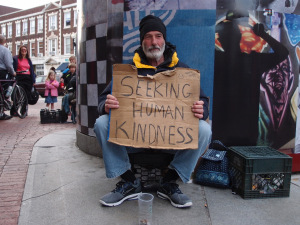
How do you respond?

What do you do when you see a homeless person on the side of the road? How do you react when you hear about violence in Syria? What is your response to the overwhelming scientific evidence that humans are the result of the dangerously changing climate? For any number of social sins in our world–a list that would take days to compile-it is impossible for us not to respond in a way that reflects our own social consciousness. (Even doing nothing, outside of shear ignorance, reflects a support of the status quo.)  What I have before you today are five stages of response reflecting our level of social consciousness. Because there are so many issues, we will inevitably find ourselves in multiple stages at once, very conscious of one issue and very indifferent about another. What is important is that we allow ourselves to be vulnerable to the world around us, open to conversion wherever necessary.

Indifference

The weakest response we can have is indifference. Eh, who cares? That doesn’t affect me. At its most basic (and very understandable) level, we recognize that our minds and hearts simply cannot care for every issue under the sun, and while we know that it is happening, even if we wish it wouldn’t happen, we cannot spare even our sympathy lest we be stretched too thin. For many issues, I find myself in this stage as a defense against burnout. How can I spend my day thinking about human trafficking, immigration reform, AIDS in Africa, sweatshops in Asia, poorly educated schools, the fight for a living wage, the privatization (and immense profit) of prisons, political corruption, AND pollution? One person simply cannot be the defender of all things and so we willingly, though unfortunately, choose to remain unaffected.

Indifference is less understandable, even sinful in itself, when we attach ourselves to incorrect ideologies or facts so to negate the need for a response in the first place. Poor people are lazy. Climate change is a hoax. AIDS was sent as punishment from God. Immigrants are lesser people. Indifference in this respect is dangerous and hurtful, reflecting a level of social ignorance towards our brothers and sisters.

Sympathy

As issues become more personal, usually through a direct experience in our lives, we may find ourselves responding with some emotion. For many of us, I think the perfect example of this is the “pennies a day” commercial we see on television: showing images of children living in destitution, how can we help but feel sorry for hungry children? At this point, our knowledge of an issue has moved out of the intellect and into the emotion: we see something tragic and we respond by showing pity. Wow, I didn’t realize how hard those people had it. I feel really bad for them. Because the experience has touched us in a new way, we might even be moved to give something of our own, a donation of money to the organization or a dollar to the homeless person, to help alleviate the problem.

On the other hand, emotions fade, and as the commercial ends, so might our pity. The reason for this is that sympathy, while it might move us to help another (a very good thing), it will not move us any closer in relationship with the other because sympathy focuses exclusively on the situation of the one suffering, investing nothing of oneself. As a result, the relationship will only ever be one direction: the suffering receive pity from us while we remain virtually unchanged.

Empathy

What shows a greater connectedness to our brothers and sister is empathy, the ability to understand and share the feelings of another. When we see homeless people on the street, do we feel bad for them, or do we place ourselves in their situation to know how we would feel in their place? Wow, I would be in a bad mood too if I slept on a bench in the rain last night. Knowing how cranky I get when I miss a meal, I would be a wreck if I never knew where my next meal was coming from.

What is so critical about this stage is that we begin to recognize the common humanity in the other. By introducing ourselves into the situation, connecting our experience with those before us, we allow ourselves to be moved by those we serve. Something in us has changed, and something in our relationship has changed. The homeless man is no longer some nuisance on the street, he is a brother in Christ living in a way that we can no longer bear to see because we can feel his pain. When we reach this stage of consciousness, we simply cannot turn back to indifference. Something must be done to help.

Conversion of lifestyle

As empathy grows, so does our self-reflection. How am I related to this issue? Have I contributed in some way? Is there something that I can do in my own life to stop it? If we truly put ourselves in the place of the suffering, sharing in their pain and allowing ourselves to be moved with great humility and vulnerability, we begin to realize that we are not completely innocent to our brothers and sisters’ pain: the way we live contributes to the social structures causing injustice.

This is a difficult point to accept:

We’re not responsible for human trafficking! Yes, but we did buy jeans from the store that is uses child labor. We care a lot for creation! Yes, but we also eat three times the amount of meat the rest of the world does and drive our cars everywhere. We didn’t do X, Y, or Z. That was the government. Yes, but we also didn’t vote, write letters to our representatives, or exercise any of our civil rights for the sake of justice.

When we are in love, we are willing to sacrifice of ourselves for the happiness of another. We do not count the cost. We do not do so grumbling. It is out of love that we do everything in our power to alleviate the pain in the other. If we find that this step is particularly difficult, that we’re unwilling to give up the luxuries of our lifestyle, it is not that we do not care or that we are bad people, it is that we have yet to make a loving connection with people affected by our lives. A “cause” will not convince someone to give up their life but a person will, especially if we take Jesus’ words seriously: “Whatever you did for one of the least of these brothers [and sisters] of mine, you did for me” (Mt 25:40). For if we truly saw Jesus in the sick and suffering, and knew that we were responsible for his suffering in any way, wouldn’t we do everything we could to change our lives? That is the pinnacle of social consciousness, the point to which each of us strive as Christians.

(Self-Identification)

While I identify one more stage to this progression, I want to leave it in parenthesis because, frankly, it is not something everyone is called to (or even should be called to). We find in figures like Francis of Assisi and Mother Theresa a complete self-identification with the people they served. Not only did they understand and share the feelings of the poor, they lived them completely as the poor, refusing to accept distinctions between themselves and the people they served. The took on the material sufferings of the people around them so completely that they began to see themselves as poor too. They were reckless and cared little for themselves, and were criticized for such then and now. Maybe they were. Maybe they should have taken better care of themselves so that they could have helped more people. But then again, maybe their witness is the witness for us all: when you see Jesus in your brothers and sisters, how can you help but drop everything to be like him, leaving behind the worries of the world?


 2 Comments

 Posted on October 22, 2014 by CaseyOFM

 Justice, Ministry

     activism, Catholic social teaching, conversion, Emphathy, environment, Francis of Assisi, homeless, Inderference, Jesus, justice, Mother Theresa, social issues, solidarity, Sympathy

Do Grades Matter?

How important are these in your life?

How important are these in your life?

With midterm week(s) upon us, papers and tests are consuming students around the country leaving many to wonder, “Does this even matter?” It is a rhetorical question that I’ve asked myself many times, attempting to justify the amount of work I was unable/unwilling to finish or to comfort me with less-than-perfect marks. “Eh, what do grades matter anyway?’ While I have never “struggled” in school and my grades were by no means bad, such a philosophy always inhibited me from achieving the higher grades that were within my capability. So now I wonder a very non-rhetorical way, as a graduate theology student preparing for ordination, “Do grades matter?” Should I have studied more as an undergrad so that my GPA would have been .25 higher?

Yes and no. (Did you expect a straight answer?)

I wish I could emphatically say yes, that what I’m doing is of the utmost importance and that grades accurately reflected the amount of work I do and that they will predict how well I was going to be a priest in the future. That’s just not the case, because, frankly, no one cares how you did in “Canon Law of Sacramental Ministry” or “Ancient and Medieval Church History”. Even in more practical courses like “Advanced Preaching” or “Reconciliation” no one is out there wondering, “I wonder if he got an A…?” In life after school, either in ministry or professional degrees, no one is ever going to ask for or even wonder about how well someone was able to read a text and write a paper about it; what people want to see is someone who is knowledgeable and competent, who is able to integrate classroom information into real life situations.

Because our degree is a combination of intellectual and practical knowledge, it is fitting for people continuing on to higher academic studies as well as for people entering pastoral fields; because our degree is a combination of intellectual and practical knowledge, there are aspects of the degree that will serve absolutely no use to someone planning on only entering pastoral fields (this is also the case for every undergraduate degree. Do I really need Chemistry 101?) As a pastoral minister in the Church, do I really need to know the different liturgical rites of the Eastern Churches for baptism; the history of the Nestorian controversy and how the Councils of Ephesus and Chalcedon responded to it; or the differences between Scotus and Aquinas on the Absolute Will of God? Probably not. Does it matter, though, if I can give a personal (and theologically accurate) testimony of Jesus Christ in the life of the Church, offering consolation and guidance to someone having just lost a loved one? Absolutely.

With this is mind, knowing that we are in school not for academic pursuits but rather to better serve the people of God, there is a sense that we need to discern what is important and what is not, focusing less on the grades we earn and more on learning what will be useful. For example, the other day I was assigned a primary text of an ancient theologian that bored me to death and presented no practical application. Should I have a) read the treatise anyway, getting what was important to know for the test, or b) read the optional, supplemental material that gave a historical overview of the Church at that time, placing the theologian into the context of the whole Church? For me, even though it would not help my grade any more than doing nothing at all, I found the latter to be much more helpful in the long run of my ministry, and that’s how I spent my time.

I wish I could say that this is the solution to the question, that grades are merely letters with no significance at all and that all that matters is discerning what information is practical for ministry. This I simply cannot say. The fact of the matter is that grades do matter. While they should not be the determining factor to one’s happiness nor will they guarantee any success in the long run, they are helpful in keeping students on task and evaluating how well they were able to comprehend difficult material. Is everything in the course necessary for one’s ministerial career? Probably not. But how can one know what exactly will be useful in the long run? As the number of ministers in the Church continues to diminish, new ones will be called on to be all things for all people, expected to be prepared for anything and everything that comes along.

Similar to this, I think that there is a level of trust and obedience that can be exercised as a diligent student. Rather than discerning what is and is not useful, essentially dismissing the professor as unable to do his/her job, why not show some humility and give up one’s will in the matter, doing what is asked of oneself? I am fairly sure that graduation will not mark the end of trivial assignments or stressful work, so why not train the will, not the intellect, to be patient, obedient, and open-minded? I have found on more than one occasion that things I did not think were useful ended up being life-changing events. Who knows where God will speak?

Ultimately, while I wish that I could say that they don’t matter to me and that school is about what one learns, grades do matter to me, and that’s not a bad thing. Grades are an effective way to manage and motivate what I learn and how hard I work. As long as I remember that they are not ends in themselves and they do not give reason to boast in any way, that they are merely a tool to encourage me to learn more about God and serving God’s people, then I think they serve a great purpose. That’s the key, I guess. Whether it’s becoming a priest or going to tech school, learning is something that should always be done to build up the kingdom of God and should never be kept to oneself for pride or personal glory. Do grades matter? I guess it all depends on why one wants them.

 Posted on October 10, 2014 by CaseyOFM

 Ministry

     grades, Kingdom of God, school

When I Grow Up I Want To Be…

As a friar, I will be called upon to do many things for the kingdom of God. What that will be, nobody knows!

As a friar, I will be called upon to do many things for the kingdom of God. What that will be, nobody knows!

It may surprise some to know that I have almost no idea what I will do with my life. Isn’t being a friar a life-long commitment? What’s there to know? While this may be true, being a friar isn’t a job, it’s a lifestyle: we are called to a life of prayer, poverty, and humility within a fraternity. In the spirit of Francis of Assisi, this lifestyle leads us to the margins of society and church where we are called to spread the Gospel in word and deed, to bring peace where there is violence, comfort where there is hurt, and welcome where there is exclusion.

But as wonderful as all that sounds (sign me up!) the astute will notice something very important about that call: it says absolutely nothing practical about what we as friars are to do with our lives. Unlike some orders that are called to be teachers or missionaries and that’s all they do, we are called to live the Gospel of our Lord Jesus Christ in the way most fitting to our time and place. With that criteria, then, we could be almost anything: elementary school teachers, spiritual directors, store managers, retreat coordinators, political advocates, community organizers, artists, musicians, tailors, parish priests, landlords, technicians, and so on. And we have. The beauty about our charism is that it is open to doing whatever church and society needs.

I share that long introduction (there must be a point to this post, right?) to say that I am beginning to think about that question more deeply as I enter studies. I have already discerned a call to be ordained a priest, which narrows the job search down a bit, but there are still so many things that I could do as a sacramental minister.

Parish Ministry

I’ll start with the most obvious: parish ministry. Our province staffs eighteen parishes along the east coast, along with three or four “service churches” (depending on how you classify each) that offer services particular to urban settings such as multiple masses a day and continuous confession. There is a lot to like about parish ministry. Being the smallest organizational block of the church and being the primary connection to the Church for most people, there is a lot to offer: retreats, sacraments of initiation, daily prayer groups, ministry to the poor, faith formation, sick and dying ministry, and so on. Parishes are a place of life and excitement, filled with multiple generations and always being host to some group.

Of particular interest to me at a parish would be adult faith formation. Many people say that Catholics don’t know their faith, and I partially agree: Catholics do not know their faith in a systematic or memorized way that people of other faiths do, but Catholics have a powerful experiential knowledge of their tradition that cannot be overlooked. I would love to build upon this experience and give people the context and facts to organize what they know through many years of worship. What would this mean? Well, the way I see it, I would want to teach at least one eight-week class a semester (Fall, Spring, Summer) on the foundational topics of our faith including the Bible, Church History, Liturgy and Worship, Spirituality, and Social Action. These would be more academic than a traditional bible study or prayer group format, but meant to be attainable for all parishioners.

Campus Ministry

Of extremely high interest at my point in life and formation is working with young people. When I think about my experience in college, I recognize that it is a tremendous time for development in people’s lives: students are away from home and family for the first time, are able to test the worldview handed onto them, and begin to grow into their own understanding of the world around them. As men hoping to shape the world by bringing Christ into people’s lives, I can think of few places in which we can have a greater effect.

Holy Name Province has certainly recognized this opportunity and I hope that it continues to do so as I look for a full-time ministry in the future. Currently we have chaplaincies at the University of Georgia, Clemson University, and my alma mater, Furman University, as well as teaching and administrative positions at Siena College and St. Bonaventure University, two schools founded by our province.

Ministry of the Word

The last possibility that interests me a lot at this time is one I have spoken about before: the Ministry of the Word. As modern day traveling preachers, friars in this ministry go from parish to parish preaching the Gospel and sharing about our life as Franciscans. “Missions,” as they are called, consist of multiple talks over a period of a few days and can be geared toward a specific season (Lent, Advent), have a spiritual or practical theme, or simply be a spark to reignite the fire in a parish.

Traditionally, the friars have done this ministry two-by-two, working together on a mission and sharing their time with the people. As the numbers became smaller over the years, many decided to split up so as to reach more people. This, I feel, is not ideal. What interests me about the missions is that we go out two-by-two, that no matter where we go or what we do, we never do it alone. We are a fraternity even on the road. That is why Jesus sent out his disciples in pairs, and that is why Francis followed suit. Is it because one person is not capable of handling a mission alone? Of course not. But there is something more at play than the words spoken. There is something more than what we say about our life together. When we actually go out as a fraternity rather than simply talking about how we live in one, when people see us laughing together, cutting each other off, and even, dare I say, not getting along at times, there is something powerful expressed that cannot be captured in words. Our life in fraternity is to be lived and shared, not talked about. That’s why I’ve said it many times, working alone may be more efficient than working together (and certainly easier) but it is not more effective.

*

And so, as a student in the first grade declares that he wants to be a doctor when he grows up, I share with you my snapshot in time. As I experience more in ministry and grow in my vocation, I may come to new and exciting opportunities that I had never even considered. As a follower of Jesus, I must be open to wherever I am called, and luckily, as a follower of Francis, I’m free to live that call in many different ways.

 2 Comments

 Posted on September 12, 2014 by CaseyOFM

 Ministry

     campus ministry, career, franciscan friars, job, Ministry of the Word, ordained ministry, sacramental ministry

Calvary: A Call for Repentence

One of the best movies I have seen in a while. Not for the faint of heart.

One of the best movies I have seen in a while. Not for the faint of heart.

The following contains spoilers to the movie Calvary (2014).

Last night, I went to the movies with two of my classmates to see Calvary. Last night, I was hit by a train in the theatre.

Calvary is about the turmoil of the Irish people in the wake of the sex abuse crisis in the Catholic Church. The movie opens in the confessional with a man revealing to the priest that he had been sexually abused by a priest for multiple years and, just as he had been innocent and undeserving of such acts, he planned on killing this priest precisely because he was a good priest and had nothing to do with the abuse. He told the priest that he planned on killing him on the following Sunday.

For one week, the viewer follows the priest on his road to Calvary, an “innocent” man on his way to slaughter, through the brokenness all around him. Torn apart by the acts committed by clergymen and completely disillusioned by the hierarchy’s attempt to cover them up, each character has one of two dispositions: 1) Pure anger and disrespect, unwilling to hide their disgust and fully willing to take it all out on him, or 2) in a much more chilling way, mockery at what people find to be completely irrelevant, even a laughing matter, the Church.

And yet, oddly enough, each character in the movie is found at Mass in the opening scene, and throughout the movie, each character is preoccupied with the sins they have committed, freely sharing their faults and failings in hopes that they will be forgiven. It is a strange disconnect between thought and action, an acceptance of faith but denial of virtue, a denial of church but a fear of not attending. Because of this, each and every character is able to recognize their sins, but not a single one shows contrition for what they’ve done. Despite the terrible sins of nearly every single character, there is not one truly repentant heart in the whole movie.

Against the backdrop of the sex abuse crisis, Calvary presents a stunning parallel between the people of God and the hierarchy of the Church. In the scene just after the church has been violently burned down by a disillusioned parishioner, the other priest says to him, “Hasn’t the Church paid enough for these sins? For God’s sake we’re nearly bankrupt because of all we’ve given out. If you ask me, I think it’s time that we forgive and forget” (paraphrase mine). In this one character, Calvary epitomizes what many feel about “the Church”: like the people of God, it is able to acknowledge its sins, and to some extent has even paid greatly for them, but shows no act of true repentance or conversion. Is it sorry for being punished, or does it truly seek reconciliation?

In one of the most gut-wrenching scenes in the movie, the main character reveals to the man wishing to kill him that someone had killed his dog. “Did you cry when you found him?” the man with the gun asks the priest. “Yes… yes, I loved that dog.” “Did you cry when you read in the newspaper what your brother priests were doing to innocent people like me?” (long pause) “No… I was too detached.” It was in this line that I felt the director speaking directly to the audience. “Why didn’t you cry when news broke? Why didn’t you well up with anger at this injustice and put a stop to this?” Like the priest, we may not have abused anyone ourselves, but as the body of Christ, it was the failings of the whole that allowed this to happen, continue, and go un-repented.

Such, I believe, is the nature of all sin and the beauty of this terribly graphic movie. Throughout this movie, the virtuous priest worked night and day to seek out his lost sheep that had been led astray. Confession after confession he remained patient when confronted with the most repugnant of acts: adultery, cannibalism, attempted suicide, domestic violence, corporate theft, abandonment, and sex abuse. With no judgment, he attempted to forgive everyone he met, calling each to focus on positive virtue over past sins. Even though almost every character had been so disillusioned that they felt salvation was no longer an option, he continued to serve God’s people. But he could not save any of them. He could not grant even one person absolution. Were their sins too grave? No, there is no sin that cannot be forgiven, he repeated many times. What was lacking was true repentance. Although they could name their sins, they lacked the virtue to want to live differently. All too often I find myself with the same heart.

All in all, I would say that this was one of the best and most challenging movies I have seen in a long time. As a seminarian, I felt myself pulled violently in opposite directions: on the one hand, “What the heck have I gotten myself into? The Church is broken and irrelevant! Jump ship!” and on the other, “This is exactly why I feel called to this ministry. People need to vent and they need someone willing to walk with them. The world needs more positive images of faith.” Although I would not recommend it to everyone, I think that every single seminarian should see this movie. Rated R for graphic content and language, Calvary is not for the faint of heart, but it is Christian at its core. The fact that the main character is a priest only makes obvious what the entire movie seeks to portray, that God is a merciful God ever wishing reconciliation with us, and, despite our brokenness and pain, we are capable of loving and forgiving those who have hurt us. But we have to choose to do so. God may forgive us, but it is up to us to accept it.

 6 Comments

 Posted on September 1, 2014 by CaseyOFM

 Discernment, Ministry

     calvary, Catholic Church, forgiveness, Ireland, Jesus, R rated Christian movies, sex abuse crisis, sin

What I Will Take From Camden

Eleven weeks and a seven-and-a-half hour drive later, I find myself back in North Carolina for a much-appreciated week vacation before heading back to school. It’s been a great summer and a great first assignment in Camden, NJ, and there is a lot to take with me to my studies. Here are just a few things that I will take with me as I continue to be formed into a Franciscan Friar:

Adult Education

Of the many highlights of the summer, one of my favorite experiences was teaching a Bible class on Wednesday evenings. Let me be clear: this was not a “Bible study” as is common at churches. What I wanted with this class was to give the average parishioner an academic overview of the Bible so to empower him/her to be able to read, study, and pray with the text appropriately. Over eight weeks, I spanned a couple thousand years of biblical history in order to set the historical context out of which each text was written, highlighting the social and political events that greatly influenced the people of God. My bold guarantee when advertising the class was that, once completed, one would be able to open the Bible to any page and have at least the basic tools to know the context of the passage, and thus, an appropriate interpretation.

While the content of the material was something I personally understood, I had never taught it let alone organized the material into eight comprehensible sections. Could I even fill up an hour of material for eight weeks? Did I have enough knowledge of the Bible to synthesize it or field questions beyond the text? Turns out I could and I did, and I had a great experience doing it. The material will obviously need to be refined and updated as I take more courses in Scripture and theology, but it was very encouraging. My hope is to build on this experience with other adult education courses: church history, liturgy/sacraments, Catholic Social Teaching, and Franciscan history/studies.

Confidence to Preach

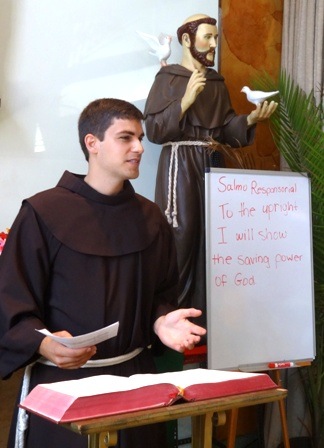
This photo is in no way staged.

This photo is in no way staged.

In a similar vein, I was given the opportunity to preach regularly this summer: twice a week at daily mass and two Sundays (the texts of which can be found here and here). While I had had a little experience preaching before this summer, this was actually my first time preaching at a daily mass, something surprisingly different, and more difficult, from a Sunday homily. For starters, it has to be very short and to the point. In a daily mass homily, there isn’t enough time to develop more than one point, and even with that point, not a lot of time to do it. What can I say in 3-5 minutes, that isn’t just fluff or sentiment, to really draw people into prayerful reflection today? 

Another difficult aspect of daily masses is that they happen, by definition, every day. Unlike Sunday homilies that take all week to develop, these reflections must be churned out each and every day. The plus side for seasoned priests is that the shortened length, casual nature of mass, and repetition of readings makes this very easy to be done quickly and mostly off-the-cuff. For me, having never had this experience, I found the experience to be a bit laborious at times, especially the Monday after preaching Sunday. Ugh… what am I going to say?

It is that tiny little bit of pressure, the regularity of preaching no matter the readings or context, that really helped my confidence in the long run. At first, I was very nervous and tried to memorize every word of the “perfect homily” I had written; by the end, I had a few notes jotted down and was able to speak a bit more extemporaneously. The other factor in all of this was that I preached bilingually each mass (and I don’t speak Spanish!) Although I was only reading a translation in Spanish, being able to stand in front of people and speak in a different language made preaching in my own that much easier.

Boundaries Between Work and Home

One of the potential drawbacks of living in Camden is that the friary is attached to the parish offices: 1st and 3rd floors are friars only, 2nd floor is parish offices. This creates a difficult boundary issue to navigate. Are people allowed into the friary portions, and if so, at what times? How do I “get away” from work if it’s only a few feet away? Do I have an obligation to be present ALWAYS? These are difficult questions for sure.

Here’s one example of an uncomfortable situation I faced this summer. I had been working really hard without a full “day off” in a week or so and was pretty tired. I decided I was going to take the day to just relax, prayer, and watch a movie. Nothing special, no vacation or excursion, just a recharge day. I didn’t want to go anywhere, just relax. Naturally, I get a call 20 minutes into the movie, “Hey Brother Casey, sorry to bother you, but one of our volunteers never showed and we have a student here and I’m the only adult. I can’t be here with him alone. Would you mind coming with me and we can drop him off at his house?” Was I really going to say no? Of course not. Well, there goes 45 minutes of desperately needed recharge time.

As someone devoting my life to the service of others, there is never an opportune time to take off. There will always be someone to help, and I will inevitably feel guilty for taking time for myself. I think the key is to set clear boundaries for doing so. Set a designated time or day off and publicize it to the ones being served: “If you want me to be my best to serve you at all other times, please respect this time for myself.” The other thing is to keep clear physical boundaries between work and home. At school this is tremendously difficult because my bedroom is my study room. In Camden, I can only imagine how difficult it is for the pastor to sleep in the same place where hundreds of people need him daily. As best we can, we need to set boundaries.

Take a Walk
While there are probably fifty more things I could reflect on, I’ll end with the one that I will most clearly take with me as I go back to Washington, D.C.: a walk. What I mean by this is not exercise, not a way to calm down, not breaks in study. What I take from Camden is their walks of subtle evangelization.

More than two years ago, the church was a part of a peace walk to end violence. At 6:20 that Wednesday, two parishioners left the church to catch up to the marchers and were mugged. That’s right, on the way to the peace march. In response, the friars have made it a point to walk the streets of their neighborhood every Wednesday at 6:20 for more than two years, missing only Christmas and Fourth of July.

They do not carry signs, nor do they pray the Rosary. Nothing about them is calling attention to violence or injustice. All they do is walk up and down the main street in their neighborhood, in habits, each and every Wednesday at 6:20. What I love about it is that they are a regular, vision presence in Camden. People recognize them and look for them, and for those that do not know them, they strike up conversations about who they are and what they’re doing. It is the story of Francis and a young brother: walking through the city one day, they went through the marketplace, side streets, and fields, not saying anything about Jesus. The young brother, disappointed, said, “I thought that we were going to preach today.” Francis replied, “My son, we have preached. We were preaching while we were walking. We were seen by many and our behavior was closely watched. It is of no use to walk anywhere to preach unless we preach everywhere as we walk!” It is my hope to do this always, of course, but to also make it a regular practice back in our neighborhood in D.C.

 4 Comments

 Posted on August 12, 2014 by CaseyOFM

 Formation, Ministry

     Adult education, Bible, Camden, formation, St. Anthony of Pauda Church, summer assignment

« 1 … 9 10 11 12 13 14 »

Breaking In The Habit

Create a free website or blog at WordPress.com.

  • YouTube
  • Twitter
  • Instagram
  • Facebook
  • Podcast
Privacy & Cookies: This site uses cookies. By continuing to use this website, you agree to their use.
To find out more, including how to control cookies, see here: Cookie Policy
  • Subscribe Subscribed
    • Breaking In The Habit
    • Join 4,772 other subscribers
    • Already have a WordPress.com account? Log in now.
    • Breaking In The Habit
    • Subscribe Subscribed
    • Sign up
    • Log in
    • Report this content
    • View site in Reader
    • Manage subscriptions
    • Collapse this bar
 

Loading Comments...