Breaking In The Habit

  • Home
  • Newsletter
    • Posts
    • Sign Up
  • Social
    • YouTube
      • Breaking In The Habit
    • Podcast
      • Everyday Liminality
      • Gospel Meditations
      • Minor Characters
    • TikTok
    • Instagram
    • Facebook
  • Vocations
  • Press Kit
  • Books
  • Donate
    • One-Time
    • Monthly

Not Called to “Build Bridges”

In the wake of yet another tragedy yesterday, after yet another clash of ideologies that has resulted in violence, many Church leaders have called upon all Christians to “build bridges.” Taken at face value, who can argue with that from a Christian perspective? We are called to love our enemy, to include those who are different from us, to welcome the stranger, and to forgive those who offend us. Of course we are supposed to build bridges, we say.

But that’s not what I’m going to do. At least, not in the way that it’s normally meant.

You see, a bridge is a wonderful structure that connects two isolated areas and allows people to travel freely from one side to another. Generally, this is a good thing, as people who would otherwise never encounter each other are able to come together in the middle—maybe even go to the other side—to learn from someone else’s perspective before returning to their own side. When dealing with different, but logical, positions on a particular topic, this is absolutely where Christians need to be, bringing together people of different faiths, political stances, and cultures to build a better world.

Emphasis on the logical.

In the case of white supremacy, I will not meet in the middle. In the case of any systemic hatred, bigotry, exclusion, suppression, violence, and terror, acts and ideologies not concerned with seeking the truth, building a peaceful society, or living with equitable justice, I will not go to the other side. As nice as “building bridges” sounds in an official statement or tweet, it makes little sense when we are dealing with objectively evil platforms. As Christians, we are not called to compromise or meet in the middle as a general rule. The middle ground is not always the right answer. We are called to justice, to protecting the inalienable human dignity of each person, to upholding the values of the kingdom of God, and to standing against evil in unwavering ways. How can we “build bridges” with harmful and violent ideologies? We would never compromise on our stance that life begins at conception. We would never meet in the middle about God’s love for all people, especially the poor.

But that’s what some are suggesting. One Church leader put out a statement yesterday saying, “I pray that those men and women on both sides can talk and seek solutions to their differences respectfully.” And normally, say, in the case of a fight between the Republicans and Democrats, I can see this as an appropriate statement: both sides have their points, and both sides can learn from one another. But how exactly, I might ask, is a person of color supposed to “seek solutions to their differences” with a white supremacist? How exactly are we supposed to learn from someone who wants nothing more than the reduction of rights, enslavement, deportation, or even execution of all people of color, homosexuals, Catholics (yes, we are not welcome), and immigrants?  Sometimes, we are not dealing with a situation in which “both sides” have something to learn and “both sides” are equally at fault, and leaders who try to play the middle ground and appear balanced actually betray the very Gospel life they are entrusted to lead.

Sometimes, there is just no bridge to be built with that ideology, and I won’t try.

But that doesn’t mean that I’m building a wall or condemning people with heinous perspectives. No, as a Christian, I am always called to love my enemy no matter how destructive their ideology is. And in fact, I will “build bridges” to anyone who holds such beliefs. But these bridges are not meant for us to learn from each other and then return to our normal ways of life. No, in cases of objective evil and destructive behavior, we are called to build bridges to free people from the evil that surrounds them. Rather than offering free passage back and forth, this bridge is meant to get people off of the exclusive and destructive island they are on, to live with more love, peace, and inclusivity than they are capable of right now.

If we truly love someone as Jesus loves them, caring intimately about their soul and their place in the kingdom, letting them continue down a road of hatred and “respecting” the fact that they have a different belief is not enough. The kingdom of God is many things but it is not filled with hatred and bigotry, and it does not allow people who want to dominate others or be supreme. If we really want to love as Jesus did, we need to reach out to them—not to affirm what they think or do—but to affirm their inalienable human dignity and rightful place with God so to offer them another path than they have chosen. 

But that path does not have to be our path. They do not need to be Christians or have any faith at all. They do not need to share the same political beliefs with us or like the same sports teams. For those situations, more bridges, with greater humility and openness on our part will be needed. But in cases of major affronts to the human family, in the case of racism, sexism, homophobia, xenophobia, or any other systemic hatred, bigotry, exclusion, suppression, violence, or terror, we cannot waiver as Christians and we cannot meet in the middle. The only bridge we can build in good conscience is one that helps our brother and sister free from the destruction all around them.

Looking around the world and mourning over recent events, I’d say we need a few more bridge builders like that.

 10 Comments

 Posted on August 13, 2017 by CaseyOFM

 Justice

     building bridges, Catholic Church, Catholic social teaching, Charlottesville, Christianity, KKK, nazi, racism, white supremacy

Don’t Look Away

The last couple days have been… shall we say… grim. Besides the official election of a controversial and volatile president sparking protests and further tearing our social cohesion at the seams, an ambassador was assassinated in cold blood and on live television in Turkey, twelve people were killed at a Christmas celebration in Germany as a crazed truck intentionally drove into the crowd, and the evacuation efforts in Aleppo continue to reveal to the world just how terrible the Syrian situation is. Before that, the State Congress of North Carolina (led by a lame-duck governor) held a secret, surprise session effectively changing the rules of the state before the new electors take office, the CIA and FBI agreed (a rare, unsettling feat in itself) that Russia hacked the US with the intention of swaying the election, and the Vatican’s newly-issued statement about homosexual clergy served only to reignite angry debates in the Church. Oh, and there was of course the 10,000 children of the world under the age of five who died from preventable causes, the 28,000 people in the US who were physically abused, and the 4,600 US residents who were diagnosed with some form of cancer, all of which happen every day.

Yeah, it was a grim day.

If you’re an idealist like me, someone who takes our collective “created in the image of God” seriously and thinks that we’re but one human family, days like these can be extremely troubling. How can there be so much wrong in the world? When days like these happen—when the reign of God seems further away than the day before—I find myself pulled three different ways.

Look away 

Especially this time of year, it can be really easy for me to disengage from the problems of the world. At a time when we’re supposed to be merry and celebrate “peace on earth,” the existence of cruelty, sadness, and downright evil can overwhelm me and ruin the atmosphere of the season. Other times, I’ll admit, I’m just too exhausted to care about anything else—my heart simply can’t handle more bad news. I know that there are bad things in the world, but I can’t do anything about it but weep, and so all I can think to do is look away. Turn off the news. Sign out of Facebook. Don’t read the newspaper. Just pretend it doesn’t exist.

Give up

At the same time, there is a part of me that can’t look away… but also can’t do anything about it. I’m a silent, helpless spectator watching a car crash. At these times, there is a strong temptation to resort to cynicism. The world is messed up. Nothing is ever going to change. What can I really do? Whether it’s enormous, systemic problems like global poverty, or minuscule, petty problems like the unrelenting bad habit of a roommate, my frustration and dissatisfaction can get the best of me and I can be left in a state of emotional and spiritual paralysis, unable to work or hope or live for something better. The only thing left to do is give up trying.

Trust

But there is a third voice that calls to me. Beyond the initial defense mechanisms of denial and learned helplessness, deeper than my gut reaction to run from pain, there is a voice that is not guided by fear, but by trust. In the midst of a torn apart world, it calls to me not to look away, but to let my heart be broken by what I see. When it feels like nothing can be done, it calls to me not to flee, but to go down with the sinking ship. Letting myself be truly moved by the horror of the world—to the point of anger or tears—is not time wasted. It is time spent converting my heart to the heart of God. Refusing to give up in the face of imminent failure—potentially losing something in the process—is not futile stupidity. It is an act of solidarity with those who cannot run away, who cannot give up, who cannot stop trying. There are some who are not afforded these privileges. All they can do is trust. Trust that reminds me that there’s more to the story than I can see and more being down that I can know. Trust that reminds me that, even in failure there are opportunities for growth and love and progress. Trust that reminds me that the world has survived much worse in the past, and yet keeps turning. Trust that reminds me that God created all that is, came to be a part of it, and never left us alone to figure it out.

It is from that trust—something, I will admit, is not always present—that I am able to see through days like yesterday into a greater world. I am able to see that it is this world, our broken and imperfect world, that Jesus chose to come into. Despite the chaos and the disappointments, the tragedies and confusions, the messiness and defects, God chose and still chooses to act in this world. It is tempting to turn away and not look, to give up and no longer try. And I get that. I’m chief among those who shut down when things aren’t perfect. But I also know that when we look away or give up, we fail to see God entering in our midst.

Don’t look away.

Don’t give up.

Trust in the God who is with us.

 5 Comments

 Posted on December 20, 2016 by CaseyOFM

 Justice, Prayer

     Aleppo, assassination, Catholic, prayer, terrorist attack, theodicy, Trump, trust

Our Work Has Just Begun

After one of the longest and most negative campaigns in US history, many hoped that our lives would go back to normal come November 9th: no more ads on tv, no more divisive Facebook posts, no more talking about politics in everyday life.

And certainly no posts on Breaking in the Habit about politics.

Unfortunately (and my deepest apologies about that last one), that is not where we are. In some ways, the political talk has increased in number and severity. Protests have begun. Arguments have flared up even more on Facebook. People are retreating to their corners—proudly victorious or ashamedly crushed—to remain as far apart as ever.

There exists a great divide in our society and in our Church.

And as much as we can point to the outcome of the presidential election as the direct cause of this added division and turmoil, that, had it have gone differently—had our candidate won, or had “X” won the primary instead—there would not likely be the crazy turmoil we face now—numerous protests, spike in hate crimes and planned KKK rally—the fact of the matter is this election did not cause our problems… it simply brought them to light. 

The problems of hatred and divisiveness we feel in our society and Church today existed long before these candidates ran for office. And they will exist after them too.

No matter how one feels about either candidate (and Lord knows there are some strong and diverse opinions among BitH readers) neither one is ultimately responsible for situation we are in. Donald Trump did not create racism, sexism, or xenophobia; the fact that he exhibits such behavior and has emboldened people to express such sentiments more publicly in recent months is disappointing, but those things existed, silently and not-so-silently, long before him. Hillary Clinton did not create abortion; the fact that she supports it as a policy is disappointing, but people were getting abortions long before Hillary voiced her support of it.

In many ways, what we see in these candidates (both the things we love and hate) is not so much something new or transformative, an attempt to convince people to adopt an altogether new opinion. No, what we see in these candidates is a reflection of the world we live in and how we treat each other. As radical as one may find either’s policies or rhetoric, what they have presented is merely the calculated sum of opinions that were held before them and will be held after them.

I point this out, not to downplay the effect that this election has had on the nation or to somehow diminish the power that the president can have on shaping its future (as Mr. Trump’s formidable 100 day plan indicates.) I point this out to say that, no matter who was elected on November 8th, the destructive opinions of the losing party were not simply going to go away, and the constructive opinions of the winning party were not going to solve everything.

As Christians, those who only have one King (and He’s in heaven), we knew from the start that the winner of this election would not be able to bring us the Kingdom we await. No matter who won and no matter what positive policies were put into place, we knew that there were gaps that needed to be filled and areas of justice needing defending. We knew, no matter how much we liked one candidate over the other, that it was not up to him/her to be our savior, and that, in some ways, they would even bring trouble. We knew that.

And so, as much as we were all hoping to our lives would go back to normal, that we could check out and let others take care of our problems, we’ve always known that that could never be the case. Voting for and electing officials is an important part of our life as Christians, but it is never the end in itself; we vote for and elect officials as means to a greater end, a just and peaceful society for all to authentically develop. Let’s never stop short of that end, and never forget that our work has just begun.

 6 Comments

 Posted on November 11, 2016 by CaseyOFM

 Justice

     Catholic, Christian, Clinton, election, response, Trump

Pretty Black and White


The other day I saw a video with an interesting message. In it, a presenter at a conference held out a glass partially filled with water. While one expected her to ask, “Is this glass half-full or half-empty,” she actually asked the audience, “How much does this weigh? Does it weight a lot?” People responded with their guesses, all giving quantitative measurements—10 ounces, 1/2 pound, 200 grams—all concluding no, it was not heavy. But she wasn’t looking for quantitative numbers. She said, “Well, actually, it depends, doesn’t it? If I hold up this glass for ten seconds, it’s pretty light. If I hold it up for thirty minutes, my arm is going to get pretty fatigued. If I try to hold it up all day, my arm will suffer permanent damage because of the weight.”

Her point was that little stresses at home and at work may seem like nothing—say, as “light” as a glass of water—but if they go unattended and are carried for long periods of time, even the smallest things can cause major health problems and psychological distress.

Besides being a helpful example for busy people in the corporate world to understand and combat stress, it is also the perfect example to describe something far more pervasive and much less discussed than stress: racism.

Race-RacismWhen we think about acts of racism, my guess is that many people—at least many white people—think of extreme and historical examples: Martin Luther King’s civil rights movement, the Holocaust, Rwanda, apartheid, the Klu Klux Klan, and the treatment of Native American nations, to name a few. When we think about racism, we think about the large, conscious efforts of one group to suppress another with violence, making it easy for the majority of us to distance ourselves from it, or worse yet, to deny that it still exists today.

For most people, though, racism is not conscious and it is not violent. It’s found in the small and seemingly insignificant events of daily life, unnoticed by the majority.

Here in Mexico, this is felt in the near-complete absence of people of color on television. When I first noticed this, it was sort of humorous: being the only white person in a store or restaurant, I found it out-of-place to see only white faces on the screen, ironic dissonance. Now, however, it infuriates me. Telenovelas. Music videos. News casters. Even the commercials. All you see is white face after white face.

You may think to yourself, “Well, this isn’t really racism, is it? It’s not saying people of color are bad or anything, it’s just choosing to show other people.” It’s just a glass of water. But imagine it the other way around. Imagine that, when you turned on the television, all of the faces were different from your own. Imagine not seeing anyone like you. The glass feels a little heavier. Now imagine experiencing this as a child… as a teenager… for years and years; imagine never seeing someone like yourself on television. What does that do to one’s image of self? How does that make someone feel within the community? Now, something as light as a glass of water comes to weigh your whole person down and define who you are: different, not good enough, absent, silent, unimportant.

It is through this lens that I now experience the recent tragedies in the United States, the killing of two non-violent black men who were shot and killed by police officers when violent force seemed unnecessary, followed by the events that took place in Dallas last evening. It is through this lens that I look beyond the immediate injustice of the killings, as terrible as they are, and see the long term effects of these repeated occurrences. What does a situation like this do to the psychological stability of a minority? One occurrence is tragedy, for sure, but for many it is ultimately just a glass of water. But then another. And another. And you begin to notice that these sorts of things are not isolated to a particular place or situation, they happen everywhere and have happened for a long time. The glass gets heavier. And every time situations like these fail to bring justice to the victim and the police officer is let off with but a warning—a sentence unthinkable if the victim were white—people are forced to hold the glass up longer. That is the glass of water that many minorities carry with them throughout their entire lives, a glass of water that many white people will never even have to pick up.

It’s because of this, I truly think, that race relations fail to happen constuctively. When tragedies like this happen, or even when it’s simply acts of micro-aggression or minor inconveniences that affect people of color, people who are not forced to hold up a glass of water their entire lives fail to see the whole story. They can’t understand the stress, the anger, and the feeling of defeat that people bring to the situation in the first place. When Arab-speaking Americans are kicked off of planes because of a perceived terror threat simply because they were speaking Arabic (happened twice last year on SouthWest), Hispanic-looking citizens are required to verify their ID on demand because they “might” be illegal (thank your Arizona and Georgia), and African-American children on a field trip to the zoo are called “animals” by a stranger (actually happened at one of the friars’ elementary schools), it’s never about just the situation itself, no matter how difficult; the reaction is always the compounded effect of constantly dealing with an identity of other, different, less-than. “Here we go again…” many think.

Sometimes, the response is not so nice. Sometimes, it’s not civil and respectful. In 1988, the rap group NWA famously released a song entitled “F*** the police.” Vulgar? Yes. Angry? You bet. But rather than writing it off as “angry black men,” or “thugs,” rather than being offended by it or demanding that they be sensible, I ask myself, “What’s behind this song? What drives someone to feel so angry and trapped that this is how they need to express themselves?” I absolutely do not condone violence as a response to violence and surely don’t want to condone their message some 28 years later, but I do want to affirm their anger and their right to express it even if it doesn’t make me feel comfortable. While it would be wonderful for us in the majority if all reformers endured their injustice patiently, were polite to those who denied them rights or failed to come to their aid, and ended up being saints like Martin Luther King and Gandhi, the moral character of the oppressed really doesn’t matter. It is completely unfair to tell someone how they are allowed to get angry, and worse yet, to dismiss the injustice they endure (and turn them into the culprit) because they don’t meet the majority’s standard of morality. One does not need to earn the right to be free from racism and injustice by being a good person.
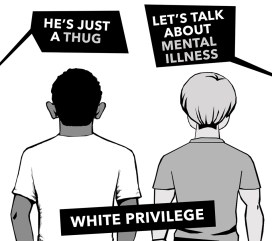
whiteprivBut some still expect it. When issues of race occur in this country, as is the case right now, the first thing that some people do is analyze the character of the victim. Did he have a criminal record? Was he a nice boy? If not, then he was just an angry thug. “I realize you’re angry,” some will say, “But why can’t you speak civilly? Why didn’t you follow the law rather than rioting and causing violence?” The words of someone who has never had the system fail them. The words of someone who has never had to hold up the glass for more than a few seconds and so cannot understand what is behind the anger.

And so the injustice is dismissed. For many, it’s not out of malice or hatred for another but simply out of shear ignorance or indifference. When one is a part of the majority, it is very easy to see only what benefits oneself without seeing how the current system may not be the best for everyone. “There are a lot of people that look like me on tv.” “I’ve never been pulled over for no reason.” “I’ve never had to prove my identity while at a park with my kids.” The world must be fine.

For many others, though, such injustices are dismissed actively and defensively because they pose a threat to one’s own way of life. There is no racism in America, they say. To recognize an injustice in the world opens us to the possibility that we might somehow be involved, that we might have to do something about the problem, and worst of all, that we might have to give up some of the undue privilege we exercise at the expense of others. Those who benefit from the status quo never want the status quo to change, even if it’s not good for everyone.

How do we as Christians feel about either of these responses?

For me, it is an issue that I have struggled with for many years as I’ve tried to live the life of a Franciscan friar. How does someone who is not a minority in any way (white, male, straight, young, middle class, etc.) live the life of a “friar minor”? The more I experience of the world the more I am sure that I have been given privileges as a white man that others do not enjoy. I have been sheltered from so many of the hardships that people of color deal with, not because of merit, but simply because I won the “womb lottery.”

This, to me, is not the Kingdom of Heaven that Jesus announced to us. This is not the will of God that Mary proclaimed in her Magnificat. A world in which people are consistently held down and made to feel inferior while a majority class enjoys special benefits is not the Kingdom, it is the Roman world in which Jesus lived, spoke, and denounced.

Maybe you don’t see it that way and this post is a long, activist-driven rant that has more to do with party politics than it does Christianity. If so, thanks for reading. I promise the next post will be lighter (and shorter). But maybe you do see it that way. Maybe you do notice that the world is unjust and that certain people carry heavier burdens than others. As a Christian—as a white person, perhaps—what are we do to?

Short of taking experimental sun-tanning pills and getting a perm so as to experience the world as a person of color (the plot to the 1986 movie Soul Man), if we are white, there is likely no way that we will ever be in true solidarity on the issue. We simply cannot know the full extent of what the system does to people. But we can do something.
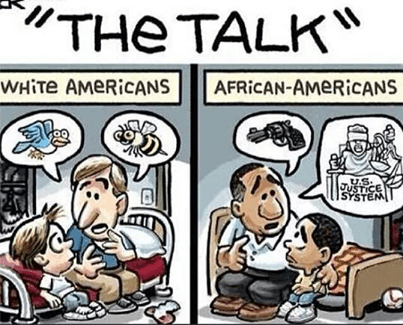
white-privilegeWe can begin to notice. Maybe we have been so sheltered throughout our lives that we simply don’t know what people go through. It all starts with a relationship, getting to know someone different on an intimate level. When we do that, stepping outside of our world to enter into another, we learn things and we change. In my own life, I find it amazing how differently I saw the world when I started attending a black church in college, forced to hear other people’s perspectives and enter into their experiences. At first, it was jarring because it told me that my narrow worldview was not complete. But then I began to see a little wider, to see with their eyes (to a very small extent), and I began to notice so much more of the world. I saw things that had always been there but never seemed important because they didn’t affect me (e.g. an all-white cast in a tv show or movie.)

Having our eyes opened is a start, but it needs to go further. For those of us who do not share in the pain of minorities, we need to begin to share in their anger. When tragedies like these happen, it cannot be only a group of black people that mourn a casket; it cannot be only a group of black people that feel crushed and helpless. When tragedies like this happen, they happen to one of our brothers, a member of the human family. And maybe we do when they get tremendous press from the media and we’re inundated with the stories. But these are spikes on the radar, effects that don’t always reveal the underlying issues and the countless other, smaller events that led up to it. Do we get angry at the micro-aggressions and minor inconveniences, the fact that many stores and banks won’t build in black neighborhoods, the distrusting looks or snide remarks, the slightly racist joke that’s “just a joke”?

Once we’ve seen and begun to share in the anger that is already present, we as Christians, those meant to build the Kingdom of God, need to be a voice for change. In many ways, this is a black and white issue: if we have had our eyes opened to the injustices people endure, we have to do something about it. We have to. It is not politicking, it is not liberal activism, it is not communism. When there are those who have rights and privileges that others do not, and these rights and privileges prevent people from authentic human develop free from undue burden, the Gospel calls us to fix the situation. Sometimes it means questioning and removing the structures that keep people apart, as Jesus did with the Pharisees, with the ritual purity laws, and in the Temple. These things are easy for us to conceive, and the don’t require us giving anything up. The change is out there on a large scale. But sometimes the answer is quite the opposite: it is close to our lives and requires a major change in us. Sometimes it means imitating Jesus’ kenosis, acknowledging that we, white people, have something that others do not—a privilege that we did not earn and do not deserve that protects us from so much of the frustration and humiliation that others have—a doing our best to give that up. Jesus did not want to be treated special, he came as a lowly peasant. He did not demand rights that others didn’t have. And maybe we shouldn’t either.

This last part is particularly difficult and some will argue that it is impossible for white people to give it up anyway; what we possess is a universal currency that cannot be renounced. Maybe that’s true. But that doesn’t mean we shouldn’t try, and that starts with acknowledging that it exists. Acknowledging that the world is not the way it should be, and just because something seems light to us, just a glass of water, does not mean that it is such for other people. We may not be able to hold up the glass for people, but we can work to make sure everyone knows that the glass exists and do everything we can to make it disappear.

 5 Comments

 Posted on July 8, 2016 by CaseyOFM

 Justice

     Alton Sterling, Christian response to racism, Philando Castile, racism, United States, white priviledge

A Home For All

Prior to coming to Mexico, my understanding of American immigrants from the south was a fairly broad and all-encompassing category: these were people who had left their country of origin for a better life in the United States, risking detection, deportation, and life to do so. For many, if not all, this is technically a fair definition. Those who come to this country are usually not leaving riches and safety behind, and they usually are willing to risk a lot to be more successful in the US.

Now that I’ve had some “up close and personal” time with hundreds of people here at La72, I realize that that broad and all-encompassing category does little justice to the situations people face and the distinctions between different categories of people. While all migrants are created equal, their situations and legal status vary greatly. Here at La72, there are roughly four types.

Seeking Work

The vast majority of people here are middle-aged men who have come alone. Coming from countries with tremendous poverty, they are traveling north, either to Mexico or the United States, to find work. This is their highest priority. When asked where they plan on going after they leave here, almost every single one has a particular city in mind, stating that “there’s a lot of work there.” The type of city, its location, climate, or culture bare almost no meaning, all that matters is the likelihood of work. Sometimes, this factor is so strong that plans can be as vast as, “I’m going to go to either Houston or Miami,” as if they were similar in any way.

For many, their goal is not to remain in Mexico or the US indefinitely, it’s simply to find a way to make a living, often sending a large portion of their money back to their friends and family in their original country. Because of this, and unlike the next three categories of people, this group tends to spend very little time here at La72, spending just enough time to recuperate from their journey to catch the train that goes through Tenosique every three or so days. They care little about legal status—mainly because it would never be granted to them anyway—and seek to move quickly.

Women

This is quite different from the final three categories of people, each of which are at La72 to gain legal status in Mexico, and often remain here for three months while the process is taking place. (This is a slightly complicated process with a lot of stipulations, but basically, if one can prove that the hardship they face is not particular to their situation but rather a systemic issue that cannot be avoided by moving to another part of the country, they can be granted permanent refugee status in Mexico. La72 is an internationally recognized asylum for people to safely apply for this status, and the Mexican government is not allowed to enter the facility.)

Among the most common are women. Growing in greater number in recent years, women are a particularly vulnerable migrant group that often flee for different reasons than men and face heightened risks along the way. The main reason, as I can tell, that women flee is for the sake of their children. Either accompanied by small children (there are quite a few little kids right now) or carrying an unborn child, these women know that their children will have no future in the home country. Either due to economic hardship or violent men in their lives, their children are at tremendous risk, and so they take a huge risk.

And what a risk it is. Unlike the men that must fear being robbed and killed, women migrants must fear sexual assault and human traffickers, a horrifying reality that more than a few migrants will inevitably endure along the way.

Unaccompanied Minors

Unfortunately, children don’t always have a parent to accompany them, and often we have teenagers traveling alone. Many will remember the mass exodus of children from countries like El Salvador and Guatemala five or so years ago, all unaccompanied. This is still going on, albeit to a much smaller extent. As unconscionable an idea as it may seem to Americans—how could their parents send them alone into danger like that?—for many, it is a much greater alternative than staying. For little boys in many places in Central America, gangs are less of a possibility than an inevitability. The power of the gang is so strong that in some places, boys are expected to join. At 12 or 13 years old, they’re approached and given an ultimatum: join or die. Being very unlike the Fresh Prince, these boys do not have a rich uncle on the other side of the country to take them in and to give them a new life. Heck, even if they did, “the other side of the country” in El Salvador is only 200 miles away, well within the grasp of interested gangs. As tragic and unconscionable as it may seem, their choice is clear: it’s safer to go through Mexico alone than it is to stay here.

LGBT

Finally, we get to the newest, rarely talked about, and most vulnerable group at La72: our gay, lesbian, bisexual, and transgender brothers and sisters.  Despite the horrific events in Orlando on Sunday and the repeated instances of someone being fired or denied benefits because of one’s sexual orientation, the situation in the US for LGBT people is comfortable and welcoming compared to that in Latin America. While each of the other groups faces bigotry, hatred, lack of opportunities, and violence in parts of their country and outside of the compound on their way, the LGBT migrants face it across Latin America, and to some extent, even inside the safety of the compound. In some places for some people (and for my Latin American readers, I hope not to generalize completely), there is no sense that same-sex attraction is a sin in which one should “love the sinner hate the sin,” there is simply “hate the sinner.” LGBT migrants are often migrants against their will, being thrown out of their homes by their parents or made unwelcome in their town, and unfortunately, the misinformation, inhospitality, and fear that they faced at home can follow them into La72 with the other migrants.

For me, it is critically important that these people be welcomed and given our attention for two reasons. The first is that, as Pope Francis exhorts us to go to the “periphery” of society, there is no more marginalized group here in need of Christian fellowship and love. To be hated and made to feel unwelcome because of who one is cannot be tolerated, and I applaud the friars here for making it a point to officially welcome them with their own dormitory and special status. But it doesn’t stop here. As Christian and I were talking the other day, the existence of LGBT people here offers a powerful opportunity for conversion in all of the migrants. Just as the other migrants have been victimized by oppressors and forced out of their way of life, so too, if done correctly, they may see how they have also been oppressors in their lives in the way they have unfairly treated their LGBT brothers and sisters. The acknowledgement that we are all not only hurt and oppressed by others but also have the capability to hurt and oppress others, even in subtle ways, opens the door for all of us to seek forgiveness and to forgive, and hopefully, to be in solidarity with one another.

Isn’t that what the Kingdom is all about? The inspiration to welcome LGBT migrants is no different from the original mission of the friars: to go to the margins, find those who are being left out, and welcome them into a home for all.

 9 Comments

 Posted on June 15, 2016 by CaseyOFM

 Justice

     franciscan friars, immigrants, immigration reform, La72, LGBT, Mexico, migrants, refugee status, unaccompanied minors

« 1 … 3 4 5 6 7 … 11 »

Breaking In The Habit

Create a free website or blog at WordPress.com.

  • YouTube
  • Twitter
  • Instagram
  • Facebook
  • Podcast
Privacy & Cookies: This site uses cookies. By continuing to use this website, you agree to their use.
To find out more, including how to control cookies, see here: Cookie Policy
  • Subscribe Subscribed
    • Breaking In The Habit
    • Join 4,772 other subscribers
    • Already have a WordPress.com account? Log in now.
    • Breaking In The Habit
    • Subscribe Subscribed
    • Sign up
    • Log in
    • Report this content
    • View site in Reader
    • Manage subscriptions
    • Collapse this bar
 

Loading Comments...