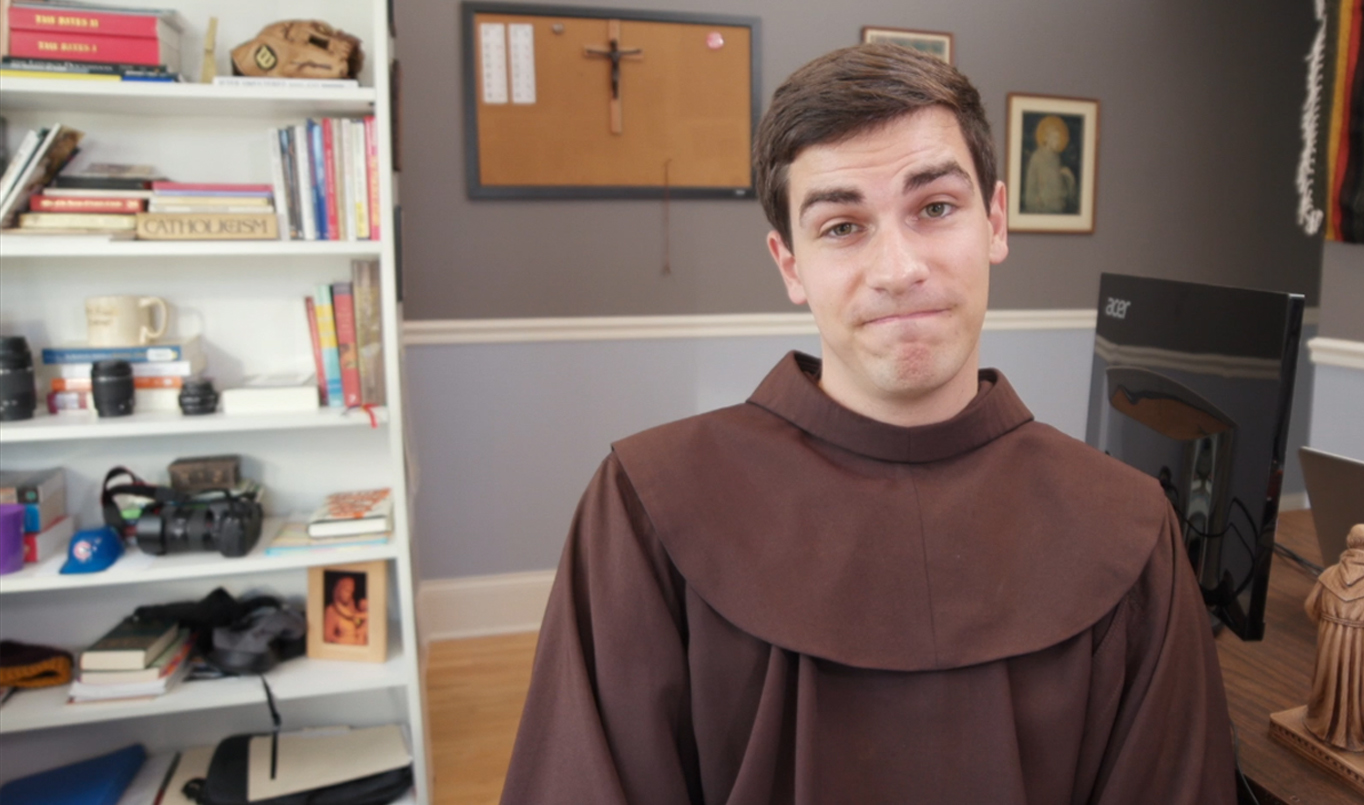
Better late than never, right? With all of the chaos of starting the mission tour this week, I completely forgot to post this video to the blog. My apologies to all, hopefully you haven’t been waiting around to hear the decision!

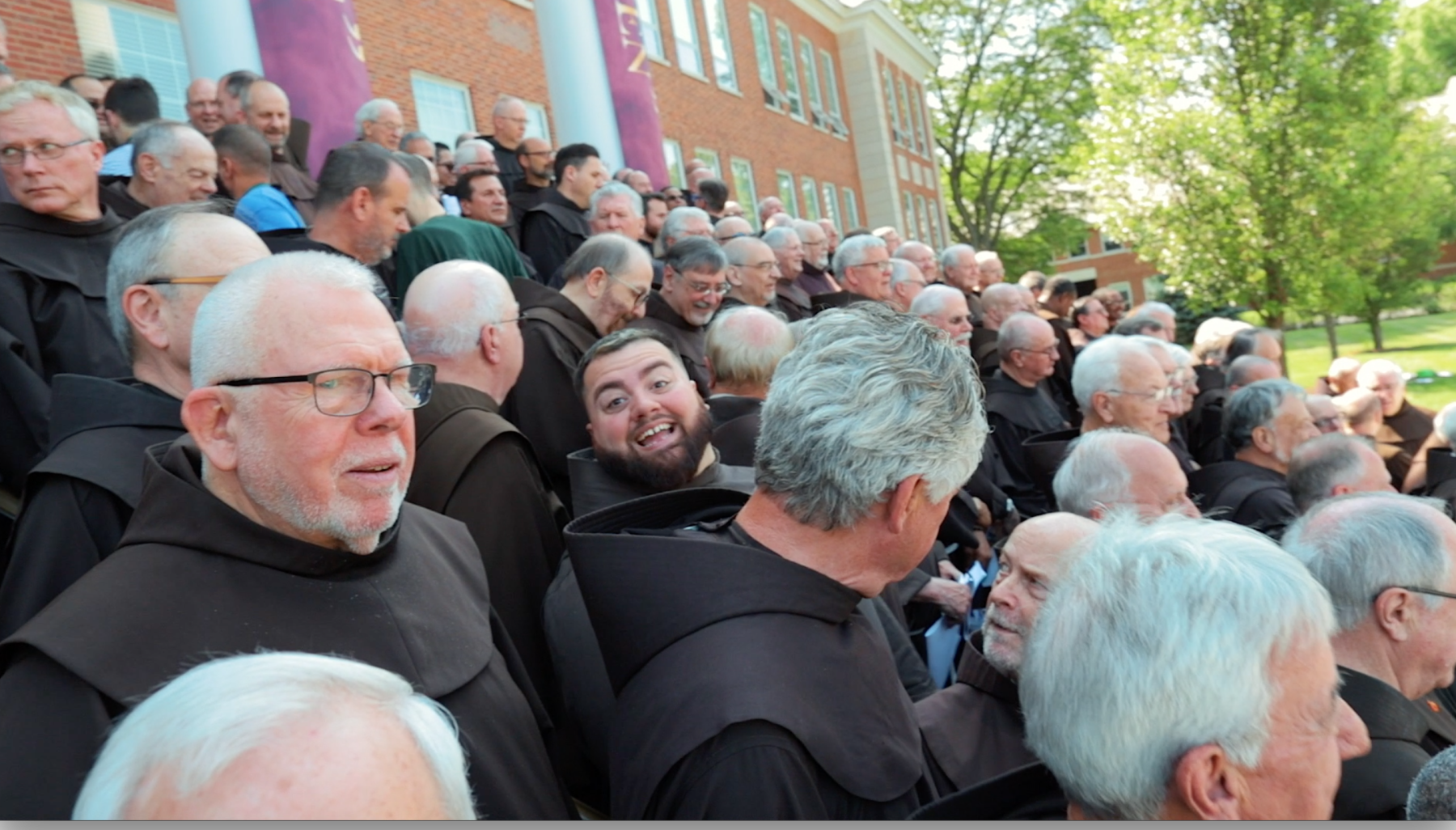
Anyway, the vote passed among the six OFM provinces of the United States, and we’re looking forward to our future together. More details certainly to come, but thank you for your prayers and be sure to continue to pray for us!

As the world changes, so too does religious life. 150 years ago, there were thousands of women and men religious in the United States running schools, hospitals, orphanages, and centers for the poor. The significance of women religious in particular was so great in founding this country that Congress actually thanked them some years back.

Now, they represent but a remnant of their past glory. Even more than men’s religious groups, women’s religious groups have diminished almost out of existence. It would be very easy to say that there is no future for such groups.

At least, “no future” for the way that they operate today. That was the theme of this weekend’s talk by Sr. Carol Zinn, SSJ at the gathering of the Poor Handmaids of Jesus motherhouse. Honoring the Poor Handmaids on their 150th anniversary in the United States, she recounted their past and their great accomplishments, how they were among the tremendous labor force of the Catholic Church to build institutions and evangelize the new world. Their thousands were necessary to do the work of God. But not so much now, she said. Looking to the future, she turned their sorrow of diminishment into something for the future: “When the Church needed a labor force, we provided it. We served as teachers and nurses and founders when there was no one else to do it. But now, the world and Church have those things and does not need that from us. Rather, what it needs us to be is the leaven, the agent that inspires and lifts the already-working institutions. That is our role for the future.”

Sr. Carol went on to remind the sisters that religious institutions have often gone through cycles of growth, death, and rebirth over their histories. Every three hundred years, she said, a movement needs to either transform or die. We are at that point now. What will we do?

Her response spoke very true to my own experience of religious life. She told us that gone are the days when we could define ourselves narrowly by what we do and people would be attracted to that. Among other reasons, one of the greatest reasons for decline in religious life came at the Second Vatican Council (and no, not because Vatican II is a bad council… ugh) when it insisted on the primacy of baptism and the universal call to holiness. Now, one did not need to be a brother or sister to be holy; now, one did not need to take final vows to teach, care for the poor, help the sick, or do extraordinary work. In the case of women, it was also at this time that women across the world began to break the barriers of the workplace, able to do incredible work and be taken seriously even without the backing of a religious order. The greatest decline in religious life came not because of some theological reason or because of lack of faith, but because people began to realize that they could do almost anything a brother or sister could do… and still have a family. If a religious order is simply a workforce, why would someone go through all of the troubles and sacrifices when they could do the work anyway?

This is the shift that religious life needs to make if it wants to survive: rather than defining itself by the work that it does, it needs to focus on the life that it lives. No matter how robust its ministry may be, a religious community is first and foremost a brotherhood/sisterhood of people wanting to live the Gospel in prayer and humility. What defines religious life is the life together. It is only from that life with God and each other that any ministry makes sense; it is only from that life with God and each other than anyone will want to join us.

For me, this is what we need to (re)claim if we want to have a future. As important as ministry is—and it is critical to this life—it must always be seen as the fruit of our life rather than the substance. People join us not because of what we do but because they are seeking an intentional community to live the Gospel. They join us for intimacy and support, for inspiration and foundation.

And we need to give it to them. Too often, in my experience, our houses are not houses of prayer—they are domiciles for workers, barracks for priests. This is not enough. We need to make sharing meals with one another a priority. Common prayer a necessity. Routine faith sharing, recreation, spiritual nourishment, and times to just be together are not luxuries, they are the very things on which our life rests.

For me, that is where the future of religious life lies: in communities that are so filled with love and support of one another and the Gospel that they cannot help but go out and spread it to the whole world. If that is our focus, religious life will absolutely have a future.


A few weeks ago, the friars in our community had a House Chapter, a regular meeting where we discuss fraternal or spiritual issues to grow closer and build up the fraternity. The topic was on fraternal correction: how we do lovingly approach a brother when issues arise.

Overall, it was a fantastic meeting that showed how mature every member of my house is (not always the case…) One brother brought up a story that has stuck with me for weeks. He shared how here was a friar in one house who no one could stand. He was annoying to be around, self-centered, and just problematic to live with. Finally, the brothers got together and requested the he be transferred to another house. In many ways, this part of the story is sadly not uncommon; sometimes, guys just don’t get along. No, what was striking about it was how that brother reacted. Shocked and hurt, he could only respond, “Why didn’t anyone ever tell me I was difficult to live with?”

So often, we are blind to our own weaknesses. Whether it’s because they’re difficult to spot or simply because we don’t want to see them, others are always better equipped to point out those areas within us that need the most growth. Without a community around us who is mature (and loving) enough to step in a correct us, to point out our blindspots when we can’t see them, we will go through life hurting and annoying others without a care in the world.

I’m not sure about you, but ignorance is not bliss.

For so many of us, it is not that “we don’t know what we don’t know,” it’s that “we don’t even know THAT we don’t know.” We are completely oblivious (or completely deny) that there is even anything in us that needs to change.

And so before we walk away thinking that this reflection is all about others and how we need to fix them, let me bring it back to our poor brother. He was most certainly blind to things that caused trouble for him in his community, and no one can outright fault him for not seeing what he could not see, but it is not entirely up to others to take responsibility for our behavior. Knowing, of course, that we ALL have blindspots—that we all have failings we cannot see, that we all have rough edges that do not reflect the kingdom of God—it is most certainly our responsibility to have the humility to accept this in ourselves and the courage to do something about it.

How we go about that seemingly impossible process… is the topic of this week’s video.

Sometimes, life is hard.

Yeah. That’s the sort of amazing insights that keep people coming back to Breaking in the Habit.

Throughout our life, we face challenges, difficulties, frustrations, setbacks, and feelings of immense stress. At the midpoint of my first semester back in school, those words have a particular familiarity to me right now.

But what’s interesting about the situations that these words describe is that nothing ever starts out that way. No, normally, we begin a new project or stage in our life with excitement and joy. A fresh start. A new opportunity. We begin with idealism for what might come, for all that we can accomplish.

And maybe that’s what makes our frustrations that much more frustrating: we expected something very different than we got. Our idealism has been replaced with a disappointing reality.

That was the topic of my reflection this week, something that I found in the readings at Wednesday’s daily mass. For email subscribers, click here to watch the video.

If you’ve followed anything I’ve written or said in the past six years, you know that fraternity is a pretty important part of being a Franciscan and one of the main reasons why I chose this life. While our public lives may look the same as diocesan priests or dedicated lay volunteers, there is just something different about our internal lives that makes this whole thing meaningful to me.

At least, ideally there is.

The problem, sometimes, is that we conflate “living together” with “fraternity.” While the former is pretty essential to developing the latter, it does not guarantee it. Sometimes, even when a Franciscan house has all the right elements—communal prayer, meals, recreation, shared work—it is not truly a fraternity. Sometimes, it is just a group of guys that share a common domicile and peacefully interact with one another on a daily basis. In other words, sometimes we’re just roommates to one another. In such cases, the life of the fraternity is left up to the personalities of the inhabitants: if they get along it’s “good fraternity” and they enjoy each others’ company, and if they don’t get along it’s “bad fraternity,” and they live largely anonymous lives under the same roof.

I didn’t join this life for a roommate. I don’t think I’ll survive in this life if it’s completely dependent on personalities.

No, for me, fraternity means much more than casual encounters. Fraternity, at its best, is the act of giving one’s life to another to create something more than oneself; of being vulnerable and interdependent with a group of people, in making sacrifices on behalf of the group, to become a part of someone else’s life and to let them be a part of yours. It’s not enough to be in the same place at the same time doing the same thing. At its best, fraternity requires a genuine desire to know and support one another as a brother, someone whom we care about and want to walk with.

I can’t tell you, though, how many guys I have lived with over the past six years and had no idea what they were going through or who they really were. Or who didn’t know me. Especially when living in a big house with busy people, it can be almost impossible to get to know everyone in a meaningful way. We go about our lives, praying the scripted Liturgy of the Hours and exchanging small-talk at dinner, without ever knowing what is going on in someone’s life.

And really, that’s not a knock on any person or house, that’s just the reality of the situation: dinner is not the usually the best time to share about one’s struggles in prayer or relationships, and most of our communal prayers are pre-written without room for additions. Unless a problem (or joy) is extraordinary, it’s probably going to be kept private or shared only on a personal basis, never reaching the life of the fraternity as a whole. In many cases, I have seen a group of men yearning for an opportunity to be more intimate with one another without an outlet to do so. The large group becomes very formal and business life, stuck in small-talk and superficiality, with intimacy and friendship reserved for later in the one-on-one encounters with those personalities that best fit us. In essence, there really isn’t a fraternity but a house of potential friendships.

For me, as forced or artificial as it sounds, I think you just have to schedule time for fraternity. We schedule time for food, prayer, work, meetings, and so on. Why don’t we schedule time to simply be one another?

One of my favorite examples of this, something that many in our house this year have begun to do, is faith sharing. Each Thursday night after dinner, a group of us meets in the living room for Lectio Divina and community time. Over the course of an hour, we listen to and silently reflect on the Gospel for the upcoming Sunday, share with one another what the reading means in our lives, and conclude by checking in with one another, offering to the group what’s going on in our lives and what we might need prayers for.

It is truly one of the best parts of my week.

Built around a basic structure, the act itself is not what’s important and we’re flexible each week to do something different. What makes the time meaningful is that we have decided to be with one another, for something, and come knowing that it is a space to share our lives with one another. Sometimes, the conversation is light and relaxing. Other times, guys share deep personal struggles and fears. Either way, I leave better knowing my brothers (and they knowing me), having taken the time to build a relationship.

Naturally, there are any number of ways to do this in a fraternity and the need for intentionality is not limited to a group of religious. Families need this. Spouses need this. Friends need this. Churches need this. As connected as we may feel in one sense through social media, we are a tragically disconnected world today, many people going through life feeling alone and yearning for greater intimacy. You don’t need to be in a religious community to find intimacy and joining a religious community will not guarantee it. What you truly need—what truly need—is to simply find the time with the people that matter to me so that we can share our lives with one another.