I think it’s safe to say that 16-year-old me would be very surprised to see what 28-year-old me is doing these days. Nowhere on my radar was the idea of joining religious life or becoming a priest. The thought of going to college for religious studies would have been preposterous. Heck, at 16, getting me to Church and enjoying it would have been almost unimaginable. And as for social media… WordPress was less than two years old and there weren’t too many “bloggers,” Facebook was a year old and not open to the public, Youtube was in its first year and mostly unknown, and neither Twitter nor Instagram existed. My life has amounted to things that I could not even have conceived of at the time.
And yet, here I am. What a journey it’s been with God so far. As I share in this week’s video, the road was not always straight and it wasn’t always lead with the greatest intentions. God had a way of guiding even my most selfish decisions to work out for the glory of the kingdom.
It’s because of this that I have a very simple lesson to teach from my journey: start doing, figure things out later. While I don’t mean that we should be reckless or thoughtless in our actions, I think we put way too much trust in our own ability to shape our future and not enough trust in God’s ability to shape our decisions for good. It is certainly important to take discernment seriously and prayerfully engage the questions of our day, but too often we worry about finding the “perfect” answer that we never act at all. Truly, I believe, God would prefer that we be running in the wrong direction than sitting lifeless, worried about which direction to go. Sometimes, we have to just start running and let God change our direction if necessary.
Did you hear about Pope Francis’ new Apostolic Exhortation, Gaudete Et Exsultate? It’s pretty amazing, if I do say so myself. Not only is it the spiritual food that our world and Church needs today, it’s not too theological, and it’s short! (Don’t get me wrong: I loved Evangelii Gaudium and Laudato Si, but man… they could have used an editor!)
If you haven’t had a chance to read it yet, this week’s Catholicism in Focus serves as a good guide to what an Apostolic Exhortation is, what this one is about, and most importantly, what it’s got to do with you!
In the meantime, here is a collection of my favorite quotes!
1. The Lord asks everything of us, and in return he offers us true life, the happiness for which we were created. He wants us to be saints and not to settle for a bland and mediocre existence.
6. “We are never completely ourselves unless we belong to a people. That is why no one is saved alone, as an isolated individual.”
22. “Not everything a saint says is completely faithful to the Gospel; not everything he or she does is authentic or perfect. What we need to contemplate is the totality of their life, their entire journey of growth in holiness.”
28. “Needless to say, anything done out of anxiety, pride or the need to impress others will not lead to holiness. We are challenged to show our commitment in such a way that everything we do has evangelical meaning and identifies us all the more with Jesus Christ.”
37.”Thanks be to God, throughout the history of the Church it has always been clear that a person’s perfection is measured not by the information or knowledge they possess, but by the depth of their charity.”
66. “Let us allow his words to unsettle us, to challenge us and to demand a real change in the way we live. Otherwise, holiness will remain no more than an empty word.”
94. “Accepting daily the path of the Gospel, even though it may cause us problems: that is holiness.”
102. “We often hear it said that, with respect to relativism and the flaws of our present world, the situation of migrants, for example, is a lesser issue. Some Catholics consider it a secondary issue compared to the “grave” bioethical questions. That a politician looking for votes might say such a thing is understandable, but not a Christian, for whom the only proper attitude is to stand in the shoes of those brothers and sisters of ours who risk their lives to offer a future to their children.”
116. “The saints do not waste energy complaining about the failings of others; they can hold their tongue before the faults of their brothers and sisters, and avoid the verbal violence that demeans and mistreats others.”
119. “Here I am not speaking only about stark situations of martyrdom, but about the daily humiliations of those who keep silent to save their families, who prefer to praise others rather than boast about themselves, or who choose the less welcome tasks, at times even choosing to bear an injustice so as to offer it to the Lord.”
125. “Hard times may come, when the cross casts its shadow, yet nothing can destroy the supernatural joy that ‘adapts and changes, but always endures, even as a flicker of light born of our personal certainty that, when everything is said and done, we are infinitely loved.'”
134. “Like the prophet Jonah, we are constantly tempted to flee to a safe haven. It can have many names: individualism, spiritualism, living in a little world, addiction, intransigence, the rejection of new ideas and approaches, dogmatism, nostalgia, pessimism, hiding behind rules and regulations. We can resist leaving behind a familiar and easy way of doing things. Yet the challenges involved can be like the storm, the whale, the worm that dried the gourd plant, or the wind and sun that burned Jonah’s head. For us, as for him, they can serve to bring us back to the God of tenderness, who invites us to set out ever anew on our journey.”
137. “Complacency is seductive; it tells us that there is no point in trying to change things, that there is nothing we can do, because this is the way things have always been and yet we always manage to survive.”
164. “Those who think they commit no grievous sins against God’s law can fall into a state of dull lethargy. Since they see nothing serious to reproach themselves with, they fail to realize that their spiritual life has gradually turned lukewarm. They end up weakened and corrupted.”
171. “The Lord speaks to us in a variety of ways, at work, through others and at every moment. Yet we simply cannot do without the silence of prolonged prayer, which enables us better to perceive God’s language, to interpret the real meaning of the inspirations we believe we have received, to calm our anxieties and to see the whole of our existence afresh in his own light. In this way, we allow the birth of a new synthesis that springs from a life inspired by the Spirit.”
Well long-time blog readers, you know what time it is. Three years in a row as summer has approached, I’ve made a big announcement about my summer plans. The first summer, I drove cross country with my classmate, then went on my first international trip for a mission trip. The year after that, I led a tour of the southern half of our province for two friars who had never been to the south, followed by a two-month trip to Mexico to learn Spanish. Last summer, I joined two other friars on a massive road trip filming a (failed) documentary, and then spent a month in Italy for my solemn vow retreat.
Noticing a pattern? While I won’t need my passport this summer, it’s going to be my most ambitious one yet!
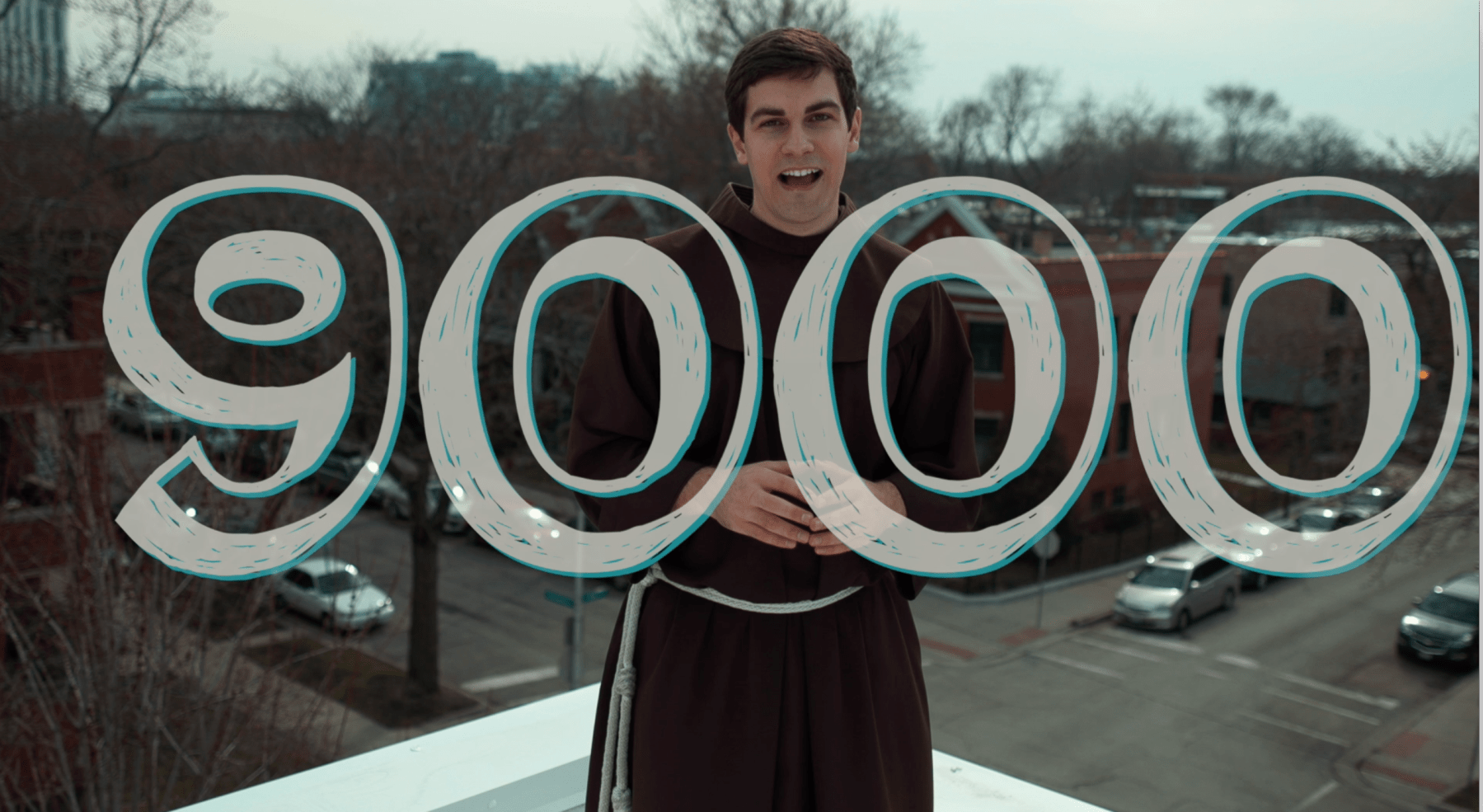
Starting the first week of June, I will be spending my entire summer traveling the country on a preaching mission. For three months (11 out of 13 weeks, actually) I will be spending a week at a different Franciscan parish in the country, preaching at all of the masses and offering a two-day mission during the week on the themes of discernment and discipleship.
You might have heard me talk about these themes before. Yes, well, they’re kind of central to my book Called: What Happens After Saying Yes to God, and so there will be opportunities to talk about the book, answer questions, purchase a copy, and have yours signed.
As of now, all but the final stop (New York) have been confirmed, and so if you live near a Franciscan parish in that city, you can almost guarantee that it will be yours that I’m stopping at. Since Cincinnati has multiple parishes, I’ll clarify by saying that I’ll be at St. Monica-St. George, and it is likely that the New York stop will be a brief one-day event rather than a full mission.
When I talk to Catholics “of a certain age” who have either left the Church or wish to return to the Church of their childhood, the practice of abstaining from meat on Fridays—or more accurately the Church’s decision to abandon the practice—comes up with an interesting regularity as to one source of their dissatisfaction. (For those unfamiliar, Catholics used to abstain from meat every Friday of the year, not just during Lent, and it became a strong social marker of one’s identity as a Catholic as it brought us together for fish-frys and separated us from Protestants who did not follow the practice.) Longing for the days of old and disillusioned that the Church could just change what was considered a sin depending on how it felt, this devotional practice remains a point of contention for them.
Frankly, I find the issue to be very complicated and absolutely fascinating.
This week, I’d like to start with the video itself and expand on it. If you haven’t had a chance to watch this week’s Catholicism in Focus, placed above, take a minute to catch up on that before continuing. Don’t worry, I’ll wait.
…
…
…
Okay, great. What’d you think? Actually, no, nevermind. Moving on.
As I showed in the video, the Church did not abandon the practice, as some think, but actually sought to grow deeper in its penitential acts on Fridays by—get this—treating us like adults and letting us make decisions for ourselves! Instead of just “obeying the law of the Church,” Pope Paul VI wanted us to obey the law of our hearts, prayerfully listening to the Word of God and putting our faith into practice in a personal way. For a world that wants to personalize everything and only do things that we’re passionate about, he was ahead of his time.
There is also a sense that no matter what he did, all that was being changed was a discipline of the Church, the lowest level of Church teaching. To leave the Church because of or spend too much time complaining about a changed discipline suggests to me that many did not quite understand the teaching of the Church. This was not a radical move in which everything was now on the table and it was only a matter of days before Jesus was going to be declared “only human” or the Eucharist “just a symbol”; unlike Dogmas that cannot change and Doctrines that develop slowly over time, disciplines can and should change as our Church and world changes, ever reflecting the faith of the people in a current situation. In this case, the overall spirit of the Church remained the same, in continuity with the whole history of the Church. Only the specific practice changed.
Unfortunately, what resulted from this decision was not what he intended. For the most part, people just abandoned the practice altogether. As a result, there is definitely a sense that something has been lost in the process. While on paper it was both “fitting and right” to change the law, something the Pope had the authority to do and in the best interest of the faithful to help us grow deeper in Christ, one has to wonder if it was ultimately the right decision: although not free to choose the practice, at least people were doing something before, and in doing so, we formed a valuable corporate identity in the process. For better or for worse, there was an ethos to being Catholic prior to 1966, a common sense of identity through uniform practice. Sure, it may not have meant much to many people, just a law to be arbitrarily followed without much understanding of the reason, but it was something we did together. Through mutual submission to a common action, it formed something greater than oneself and brought people together.
Ultimately, this is what our Sunday worship is supposed to do, so it is not as if we no longer have a corporate identity at all. And doing something that is meaningless or even detrimental to one’s faith in the name of community is not spiritually beneficial. But it does raise an interesting question: might we have lost something in the process worth recapturing? In the search for more personal meaning, might we have sacrificed the equally important sense of togetherness? I’m not suggesting that we return to the practices of 1965 or that we arbitrarily impose new rules on the faithful just so we can do something together. I’ve been through novitiate… I know that that doesn’t always go well. But I am suggesting that we take this issue seriously. Let’s recognize that something truly was lost in 1966, and make sure that it was not lost in vain. Our practice may have changed, but the Tradition that guides it has not. Maybe this Friday will be the week that we take up our crosses again. Maybe we’ll even come together with a friend or in groups to do something together.
Last week, I went to the greatest show on earth: the Paschal Triduum of the Catholic Church. (If you don’t know what that is, check out my video for this week.)
In reflecting on my experience over the past week, and in defense of the title I chose, I thought I would share a bit about the difference between a “show” and a liturgy, and why I think the Triduum is a wonderful example of this.
Participation
When we go to a show (or watch something on television or computer), we are a passive spectator. Communication goes in only one direction: we sit and information is given to us. While our occasional laughter, cheers, or clapping may effect the experience of the performance if we are in attendence, in reality, we add nothing to what is actually going on; the show goes on just the same whether we are there or watching on television.
A liturgy, on the other hand, depends on our presence. We do not attend as passive spectators waiting to receive entertainment, we attend as active worshippers, coming together to create something new. Not only are their parts of the mass that are rightfully the responsibility of the congregation and inappropriate for a priest to take on himself (e.g. responses such as “and with your spirit”) there is a sense that there is more to the reality of the service than simply what is going happening “on stage.” In our greeting one another, singing in the pews, offering a sign of peace, walking in procession, offering our personal prayers and sacrifices, and so on, we are not simply watching a show, we are making the liturgy (hence its name, from the Greek, which means “the work of the people.”)
And how this is even more true for the Triduum. We are not simply attending a concert or beautiful commemoration of past events put on by actors, we are, together, building an environment where that mystery is made present. Even more than our already active, “Catholic calisthenic” worship services with standing and kneeling and moving all around, we make ourselves a part of the work of the people during the Triduum with special gestures, processions, elaborate songs, and special roles.
Entering a symbolic reality
And yet, it is not as if we are simply attending an improvisation theatre production with major audience participation; a liturgy is not just a play that involves its audience. As theatrical and dramatic as a liturgy is, what we do is not a matter of recreating the past with actors and scenes, attempting to mimic past events with historical accuracy. No, liturgy is the act of entering into a symbolic reality of what those past events represent, offering praise and thanksgiving from our own cultural and historical reality.
What do I mean by this? Well, liturgy is not a passion play in which we take the Bible and make a script out of it, trying to get everything exactly right. Rather, it is an act in which we look at the reality of what happened (e.g. Jesus humbled himself and died on a cross) and create an environment in which the importance of that action makes the most sense to us today. There is no need for costumes; we don’t need to have every detail included or follow the exact order. We do not speak in the language that Jesus did; we do not sing the songs that the disciples did; there is no need to make the gestures exactly as they would have. What is significant is not the historical events as they happened, but making present what we find significant about them. What we do is speak our own language, sing our own songs, and make our own culturally appropriate gestures that capture what the original meant.
How true this is with the liturgy of the Triduum. With old and new coming together, we find an expression of ourselves and our history making the reality of Jesus known. Surely, he did not use a Paschal candle, sing the exultet, wear priestly vestments with specific colors and designs, process as a whole community to wait in the night, and so on. But these images and symbols and gestures make sense to us, evoke some meaning from our own lives, that help us to enter into his historical reality.
—
And so, was the Paschal Triduum the “Greatest Show on Earth?” Technically, no, because it was not a show at all. It was a liturgy, the act of a community coming together to build a reality that makes another, deeper reality present. It is not like the circus or a performance of Hamilton or even a contest in which the audience participates by voting. And yet, what an amazing job it does of capturing our attention and entering us into a reality far from our own, just as “shows” do. That, for me, is what makes it the best “show” around: it pulls from the technique and quality of those shows we love to watch, while also calling us out of our safe space to be an active part in making it present. Truly, there is nothing better.


 Starting the first week of June, I will be spending my entire summer traveling the country on a preaching mission. For three months (11 out of 13 weeks, actually) I will be spending a week at a different Franciscan parish in the country, preaching at all of the masses and offering a two-day mission during the week on the themes of discernment and discipleship.
 Breaking In The Habit