The following is my homily for this weekend, the 18th Sunday of Ordinary time, Year B.

I’m not sure about you, but I love movies with twist endings; you know, those types of movies that pull the rug out from under you at the last second and completely surprise you. Movies like The 6th sense, The Others, Fight Club, Shutter Island, Memento, Scream, even the new Pixar movie Coco has an element of this. Movies where the main character was bad all along, the trusted character turns out to be the murderer or was dead the whole time or maybe just a hallucination of another character. You’re just left at the end of the movie going… wow! How did I miss that!?

And I think that’s the best part of it, right? Because when you go back and watch it again, you just think, “Oh my gosh. It was so obvious! It was right there the whole time, staring me right in the face!” In one of my favorite movies, they give away the twist of the movie in the very first line. The writers and director want us to figure it out, but we miss it. Hidden in plain sight, we don’t see it. 

And while that might seem like a strange introduction to a homily, it’s that sort of feeling I get when I hear our readings proclaimed today. A sense that the very thing we’re looking for has been hidden in plain sight the whole time, yet the people don’t seem to see it.

In our first reading, the Israelites are wandering in the desert, complaining about their situation, and demand a miracle. They’re going to starve to death, they say. They would rather have stayed slaves than be out in the desert, that’s how hungry they are. Hearing their plea, God sends down manna from heaven, provides them with quail to eat. God provides them with an amazing miracle, showers them with grace and new life. And how do they respond? They look at one another and ask, “What is this?” God was in their midst and they didn’t even see it.

Eventually they catch on and realize what God is doing, and by the time of Jesus this is what they expect. They want God to send down manna from heaven, they want a sign from God that God is still with them, providing for them in their great hunger. And so they demand this from Jesus: “What sign can you perform so that we may believe in you?” they ask. They have seen no manna, no quails, and so they believe, once again, that God is not with them, that they are starving in the desert. 

And you can almost picture Jesus’ puzzled face, can’t you. His confusion at their demand for a sign. “So… let me get this straight. You don’t believe in me, but you would if God sent down nourishment from heaven, bread, flesh maybe, something that would feed you and keep you alive, an extraordinary miracle that shows God’s glory… Have you not be following me for months now? Have you not seen me heal people? Have you not heard me say that I have come from the Father, that the Father and I are one? Okay, let me make this clear to you: I am the bread of life. I am manna come down from heaven. My flesh is the flesh that will nourish you. Got it…?”

Now, I’m sure Jesus was probably tiny bit less snarky than I’m portraying him, but you can definitely imagine him being a bit annoyed or at the very least confused, right? There he was, revealing the Father’s glory, performing miracles in plain sight, placing salvation right in front of their noses, and they couldn’t see it. How could they not see what was right before them?

And it makes me wonder. Looking back 3500 years to the desert, 2000 years to Capernaum, it’s very easy for us to pick on the people of the Bible, to look down on them for not seeing the twist ending of the movie that seems so obvious to us. But are we any different today? For so many years I read the Bible and was amazed by the miracles in them. In awe of how God used to interact with God’s people. I wondered why my life was so ordinary, why God didn’t call me or others like he used to. I looked for signs, demanded miracles so that I would believe. “Send me manna from heaven so that I might believe,” I’d say. “Do something extraordinary so that I won’t have any more doubts.” And I imagine that Jesus was just left shaking his head. Smiling and loving, but shaking his head.

“Don’t you hear my word spoken to you every week, calling you to follow? Don’t you see the sacrifice I offer you on this altar, my very flesh and blood to give you nourishment and strength? Don’t you see my love and grace poured out for you, the mercy and forgiveness offered each and every day?” But I didn’t. Hidden in plain sight, God was all around me but I didn’t see.

And maybe this is the case for you. Maybe you find yourself asking the same questions and wonder what to do. If that’s the case, I think the answer is really simple: we have to look harder… or maybe start looking at all. Seriously. Just. Start. Looking. It’s like when people tell me that they’re struggling with their faith. I ask them what they’re doing, what are they struggling with that they can’t get, and they say, “Well, I don’t know, nothing really.” No, you’re not struggling! You’re just not trying. You’re hoping that everything will just be easy and right without doing any work! Sometimes we tell ourselves that God is hidden, that we can’t find God, that God doesn’t perform miracles like God used to… when what we really mean is that we really haven’t looked that hard.

That was the case for me until a few years ago. The friars in my house decided to meet each week for faith sharing. Once a week we would sit down, read a passage from scripture, and answer a simple question: how did we see God working in our lives this week. At first it was difficult. At first I didn’t know what to say. But as I heard others share their stories, as I thought about it all week, really focused so that I would have something to say—in fact, actually looked—what I realized was that God was there all along, right in front of my face, hidden in plain sight, waiting to be seen. 

And then it was like he was everywhere. After I saw God once, it was like watching a movie already knowing the ending. The evidence was there, so obvious, jumping right out at me, leaving me to wonder how I missed it for all these years.

God wants you to know him. God wants you to find him. Sometimes, as simple as it sounds, all we need to do is look. For one day, maybe all this week, look for God in everything you do—in your work, in your family life, in what you do for fun—make an active effort to see God right before you, reaching out to you… and you might just find that he was there all along, hidden in plain sight.

I’m in the midst of my summer vacation at my parents so I’ll keep this quick, but I have a great announcement that I would like to share with everyone about my ordination: it’s going to happen! Well, that’s not exactly news, but the date and location are set. On June 22, 2019, I will be ordained a priest at Immaculate Conception Church in Durham, NC by Bishop Luis Rafael Zarama.

At this point, that’s all I know, but I will certainly keep everyone updated as the process progresses.  For now, I’m enjoying a lazy and quite rainy Monday afternoon watching the Office on Netflix, so… I’m going to get back to that! I’ll be up and running again by the weekend where I’m headed to Raleigh, NC for stop number 8 on the Called Mission Tour! Catch you soon!

When I went to college, I was really excited about my faith. I was proud to be a Catholic and I wanted other people to know about it. There was only one problem: I knew very little about my faith. (Small detail…) Living in South Carolina at the time—a place with fewer Catholics than those who do not like Catholics—I found my faith challenged on a regular basis.

“Why do Catholics worship Mary?”

“Catholics aren’t real Christians.”

“The Pope is a made up power ploy.”

“That’s not in the Bible.”

I needed to learn about my faith. I needed to learn how to defend my faith. Luckily for me, our Church has a long history of defending itself from outside attacks, dating all the way back to the second century with people like Justin Martyr. And even though things didn’t exactly work out for him (…) his work was instrumental in keeping the faith alive at a time when attacks were not only verbal but also violent. Rather than responding with violence, Apologists, as they were called, defended the faith with intellect and charity, allowing the faith that they believed in to speak for itself and stand up against criticism.

These “apologies” continue today, although in varied forms. In its best form—that which I encountered in college—truth and charity work together, sharing what we know to be accurate about our faith without compromising on the life we live, engaging our enemies while also loving them. This form of apologetics defends without being defensive, knowing that if something is true it will stand up to questioning, and more importantly, recognizing that sometimes the most powerful argument we have is not with our mouths or intellect but with the way we treat others.

Unfortunately, this is not the only form of apologetics known to our Church. Sometimes, as sad as it sounds, we find those in the Church that choose truth or charity, picking one without the other. Armed with the truth of our faith, they treat those who do not believe as we do as enemies, dangerous individuals that need to be defeated at all cost. While the content of their speech is (often) accurate, the speech itself fails to live up to the expectations of the Gospel; as we say, what you say is not as important as how we say it, and sometimes apologetics undermines its truth by saying it with hate.

But this is not the only problem we need to be aware of with modern apologetics, which is the subject of this week’s video.

I’ve been to Rome and I’ve stayed in Assisi. I’ve stood on the top of the Alps in Austria and swam in the crystal clear ocean of Mexico. I’ve prayed in churches all around the country of many different styles. There are certainly some amazing places in this world where God’s presence is all but tangible. But there is none like this place.

St. Anthony’s Church, Greenville, SC.

No, that’s not a punchline. While it may sound strange to put this small Catholic mission to the African American community in the same category as the other places I’ve listed, I couldn’t be more serious: in all of my life, I have never found a place where God’s presence is easier to see and feel. Really.

For a first-time visitor, someone who has no connection with the place, this might not be the case. Unlike St. Peter’s Basilica or the hills of Assisi, there is very little about this place that takes your breath away with its beauty. The church is old and in need of repairs, the grounds are fairly humble, and outside of a new elementary school, most everything is rather small and ordinary.

But what makes this place so holy is not the transcendent views or mind-blowing architecture, it is the people. Here, more than any place I have ever been, you will find a community that understands its call to the be a part of the mission of Jesus Christ. They are in tune with the needs around them and never hesitate to act in building up the kingdom. Whether it be repairing homes in their neighborhood for low-income housing, running a food pantry, educating underprivileged youth, praying for vocations, supporting college students, bringing in speakers for adult faith formation, or helping pregnant women, St. Anthony’s just leads the charge. Despite being a relatively small parish, they raise more money, engage in more ministries, show up to more events during the week, and pack a church better than congregations double their size.

To me, this is what holiness looks like.

When people come to St. Anthony’s, they can’t help but feel the energy of something special. It’s absolutely contagious. In my travels, I have seen many churches in this country, and it sort of goes without saying that congregations are a mix between the super-faithful and those “fulfilling an obligation.” I could be completely wrong, but I never sense a single person in the latter category at St. Anthony’s. No, in watching how people receive communion, seeing their faces during the homily, feeling the fullness of voice in their songs and the joy in their conversations, people come to St. Anthony’s because they have seen the power of the Holy Spirit at work and want to be a part of the mission. People just want to be there.

Which is why I go back. Every year, at least once. It is the place of my college education and where I found my vocation to the Franciscans, but it’s also the place where I am renewed. I go to remember the past, yes, but more importantly to rejuvenate myself for the future. In this community, I get a taste of the kingdom of heaven and am reminded of what is possible throughout the world. Oh how I wish the rest of the world were as on fire as this place! What a world it would be.

And so I share just a snippet of my trip, just a taste of my experience. While it may seem strange to the outsider, and this video may honestly not capture it at all, I truly believe that I was on pilgrimage last week.

Okay, okay! I’m sorry! I’m just one man! I know this video is super late, but in my defense… I just forgot to do it.

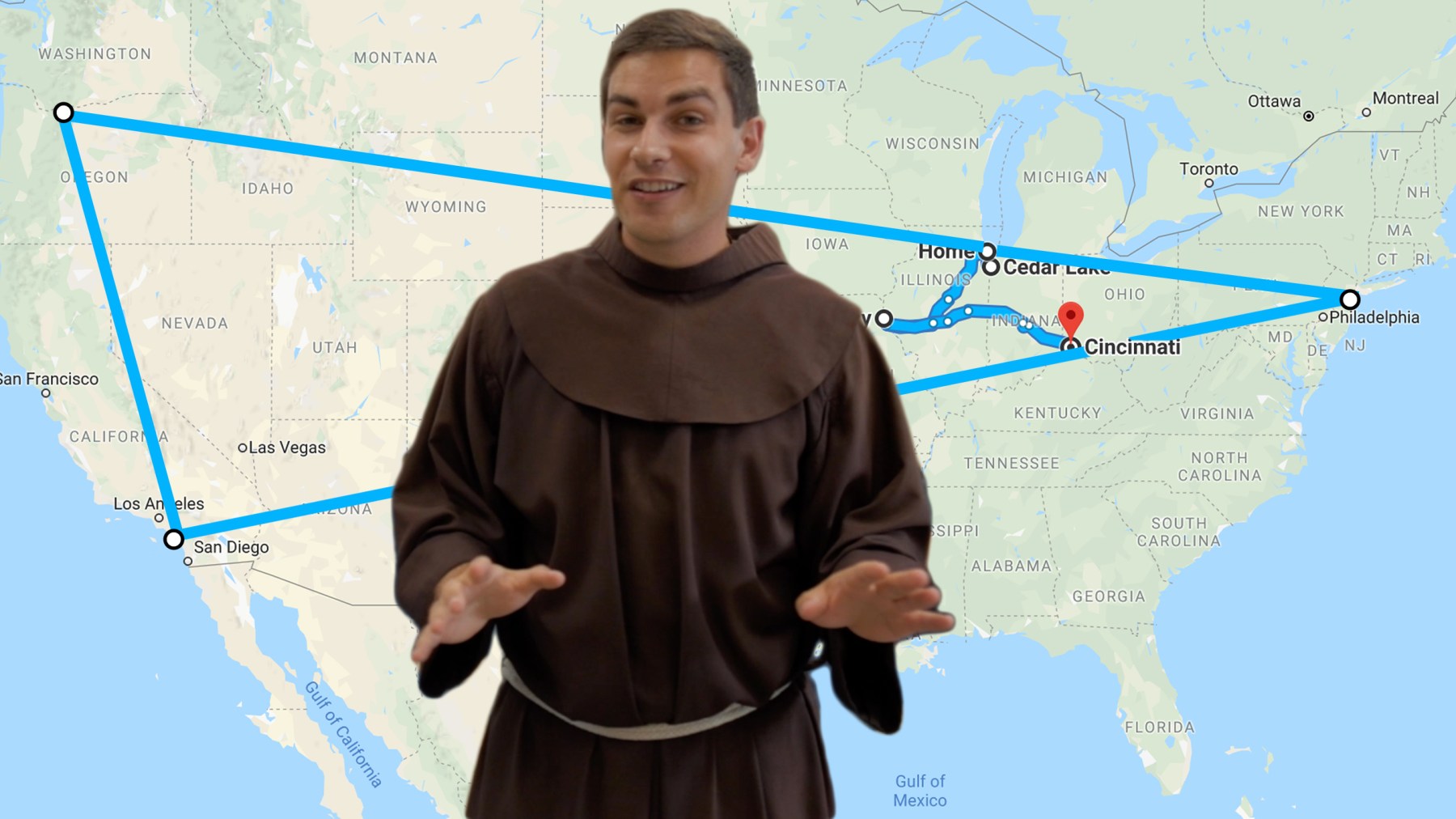
Yeah, not a great defense. But better late than never, right? As I prepare to leave Greenville, SC tomorrow, take a moment to catch up on my last stop, Cincinnati, OH, and see how the trip is progressing. I find that even halfway through the trip and having covered more than 6600 miles… things are still seem pretty new! Be sure to check out why this video and be sure to check YouTube on Friday (because there’ no guarantee I’m going to be on time here on the blog!) for the next video!