The Patience to Serve

As Francis continues to remind us, we are called to serve, not be served. One of the ways is listening.
As Francis continues to remind us, we are called to serve, not to be served. One of the ways is listening.

A few times a month, the simply professed meet together for a presentation and a discussion about relevant pastoral issues we may encounter in our life as a friar.  A few weeks ago, we were given a presentation about interacting with and empowering the laity, focusing heavily on our need to learn from the ones we serve.  It was a great message for all of us to remember, and something that Pope Francis has reiterated heavily for months now, emphasizing service as the priest’s primary duty.

We are often told about the young, zealous priest, fresh out of seminary and ready to change the world, who goes into a well-functioning church of faithful people and tries to “fix” things that don’t need fixing.  There are even more stories of a church changing pastors and the new pastor dismantling everything the previous pastor did for the sake of his “vision”.  Sometimes it happens to even the most well-intentioned and capable priests: they walk into a situation with a spirituality unlike their own and, unable to recognize the merit in the congregation’s expression, either become indignant or apathetic.  In these cases, there is a need to wait, to listen, and to learn from the people of God.

As we discussed our experience of this issue further, we stumbled upon a dilemma:

How, then, do we reconcile this with our emphasis on studies, requiring everyone to get a Master’s degree in theology and/or pastoral studies? It would seem that the reason we do this is so that we can be a source of knowledge and guidance for the people we serve. If this is the case, what do we do when, informed by our many years of studies, we find that there is something being done that is objectively wrong and potentially harmful to the people we serve, but they do not recognize the problem or are unwilling to change?

There are definitely situations in which something is legitimately wrong, and there needs to be someone able to teach, inspire, adjust, or even force change. If a priest enters a new parish and the choir isn’t singing the songs he likes, this might be something to leave alone. But what if the majority of congregation is praying the rosary during mass; the choir sings “O Come O Come Emmanuel” during Lent because they really like the song; or the church as a whole engages in no ministries outside of mass and devotions, refusing to help the poor, care for the sick, or visit the imprisoned?  These are extreme examples (and thankfully have never experienced myself) but I think they prove a point: there would seem to be situations in which change needs to be instituted, and sometimes, these changes will not be at the instigation of the people we serve. What do we do when our will is not that of the people we serve?

For some, the first inclination would be to use one’s credentials as a way of claiming authority and using that authority to be the decisive leader.  This is a less-than-ideal first move, especially in regards to faith.  An authoritative approach that makes changes without consultation, even if in the name of orthodoxy or orthopraxy, is a well-intentioned way of alienating those one serves and driving people away from the church.  Because faith can be a very personal and touchy thing for most people, telling someone that he/she is wrong (no matter how wrong he/she actually may be!) is a terrible approach, at least at first, because it will most likely result in denial or resentment, not greater faith.

So where is the balance for us as ministers?  How do we teach without making everything we do a reflection of our personality and preference? How do we remain open to an experience of God in the “real world,” an experience that cannot be learned in books, without an “anything goes” policy?

As is usually my answer to conflicts, I think that education and patience are the best solutions.  As ministers of the people, our highest aim must always be to foster a relationship between God and the people we serve.  The best way we can do this is to invite, to inspire, and to model people to a deeper experience of faith.  Instead of telling someone that he/she is wrong for praying the rosary during mass, we can be a witness of the power of the liturgy by singing and being fully engaged.  Maybe we could begin with a question such as, “What do you get out of the liturgy?” and then share what we get out of it by participating with the priest and congregation.  It pains me to think about how uninformed the average Catholic is, but this will never change without opportunities for questions, invitations, sharing of one’s own experience, and information sessions.

More importantly, there needs to be the recognition that things will not change overnight.  We must not become impatient judges wondering why everyone is not where we are and resort to sweeping authoritative measures to “fix” the problem. The problem of uninformed or apathetic faith may appear resolved in its superficial external expressions, but the root of the problem cannot be fixed with rules and administrative decisions.  This is a problem that can only be solved with tireless efforts to invite, inspire, and model, and unwavering patience when it doesn’t work.

I’m not naive to think that this solves the problem of having to make decisive (and even divisive) decisions.  Issues of great importance, whether it be liturgical, canonical, financial, or personnel, cannot be democratic, and there are times when things simply need to be done a certain way.  But (speaking from my ignorance) I don’t think that there is ever a situation in which at least a few members of the laity are not informed about and consulted for their opinion, because, quite frankly, it is their church.  When we are given an assignment in a new place, they will remain there.  Our role is to recognize this and to serve the needs of the people as best we can.  For this, may God give me patience and humility.

A “Lectio Divina” of Life

Progress isn't always a straight path.

Life isn’t always a straight path.

Lectio Divina, or “divine reading,” is a powerful way to engage Sacred Scripture in a prayerful way. Dating back as one of the oldest practices in the Church, Lectio Divina is the process of reading Scripture as the living Word of God.  Rather than approaching it as something to be studied or dissected, this process invites the one praying to enter into the text and to be moved by it.

The first step is an obvious one: read the text. There’s no specific criteria for choosing which part of the Bible to read, but the Gospels are always a good place to start. After one has read the text (it is preferable to read it aloud so that it can be proclaimed and heard, even if doing it alone) time is taken to meditate on what was just heard.  This is a time to focus on a particular word or phrase that captured the attention of the reader, thinking about the significance of that word or phrase in the larger context of the passage, and to offer a response. “What did this passage mean to me? How is it calling me to change my life?” Essentially, it is the human response to the Word. Once the reader has exhausted the meditative process, it is appropriate to move into a time for prayer. This can be personal and spontaneous, or communal and pre-written, but the purpose of this portion is to turn one’s will over to God and to ask for God’s aid in prayer. Words are not even necessary for this portion; all that is necessary is a will like Mary as she says, “Thy will be done.” If this is truly achieved, one enters finally into contemplation, the height of mystical prayer. This level of prayer is not easy, and I must admit I have very little experience with it, but it is in essence being so free from one’s own will that God is able to respond to our prayer. Think of it as surrender or radical openness, a time for God to gaze upon the one praying and be in union with them. The mystics have experienced this as a state of ecstasy, but it does not always have to be so radical. Often times, this is simply the time when God chooses to speak to our hearts.

But this is not the end, for the end is just the beginning. With each finished cycle brings the start of a new one, returning to the text to read the passage again. By repeating the process multiple times in one session, each prayer builds upon itself, calling the one praying to a deeper experience each time.  The text does not change, but the one hearing it, having now mediated, prayed, and contemplated on it with God, now comes back to the text with a different perspective. Words or phrases that seemed unimportant before may take on a new meaning or be heard in a different way. The text calls the reader to a deeper consciousness each time. This is the essence of the Living Word.

This, however, is incomplete for us as Franciscans. Lection Divina can only be considered an appropriate prayer with the addition of a final step: action. Once we have read, meditated, prayed, and contemplated, there must be something that takes root in our lives to inspire a conversion. How has the passage or life experience moved us closer to God? How are we converted by God’s presence in our lives?

It was after a wonderful conversation about just this that my spiritual director made the connection that the process we follow in Lectio Divina is the same process we follow in our own lives.  What he meant by this was that the journey of our life is something that can be prayerfully entered into, rather than just analyzed, and that we can experience God in reliving, or rereading our life’s journey. In some ways, the stories of our past are unchanging, set in stone. But as we read our life’s stories and allow time for meditation, prayer, and contemplation, we are called to a deeper understanding of what each event means to us.

The clear example I have right now is my novitiate. I believe very strongly that the majority of the stuff that “happened” to me during novitiate, the bulk of what we may call “revelation,” occurred in the first three months. The remaining nine months I believe I spent trying to understand and integrate what I had experienced into myself.

What I also realized was that life is a cyclical set of situations that recur on a regular basis; progress, then, looks much more like a spiral staircase than it does a ladder.  We want to think sometimes that we can find a solution to our problems that will leave them in our past, stepping up a step on the ladder never to come back down. And yet, a short period of time later, we find ourselves face-to-face with the same problem. Have we regressed? Not necessary. Just like in Lectio Divina and just like walking up a spiral staircase, each step brings us somewhere new and yet ever closer to where we first began.  While I found myself becoming frustrated with the lack of “progress” in my life, I realized that with true introspection, by recognizing the situation, meditating on it, bringing it to prayer, and then contemplating with God, there was something new that I could bring to the situation. I may have be standing in the same spot as before, but my perspective had changed; one floor higher, there was a slightly new vantage point on the same situation from which to act. Once I chose how to act, there began a new cycle of prayerfully reading that situation into the corpus of my life.

My advice, then, is twofold. The first is to read scripture in this way, prayerfully engaging the text and letting it speak to you in a way that studying cannot. A common practice is to find the Gospel reading for the upcoming Sunday and to spend time during the week going through this process. It will change your week and will most definitely change your experience at mass. The second is a bit more demanding, but potentially more fruitful: keep a journal. I cannot tell you how powerful it has been to reread my entries from the past two years, to notice patterns, and to identify growth.

Either way, know that life is not something to be solved once and for all, and that “growth” is not in leaving our problems behind. The best we can ever be is a people humble enough to know our own failings, smart enough to learn from them, and faithful enough to ask God for help.

A Life Ordained By God

Ordinations are elaborate services that include a lot of people

Ordinations are elaborate services that include a lot of people

At the beginning of Postulancy I had the privilege of attending a solemn profession of two of our brothers within the first week. In my post at the time, I mentioned that it was a great experience to have before starting because it offered a clear picture of what would be to come if I continued in the Order. Yesterday, I was afforded a similar privilege.

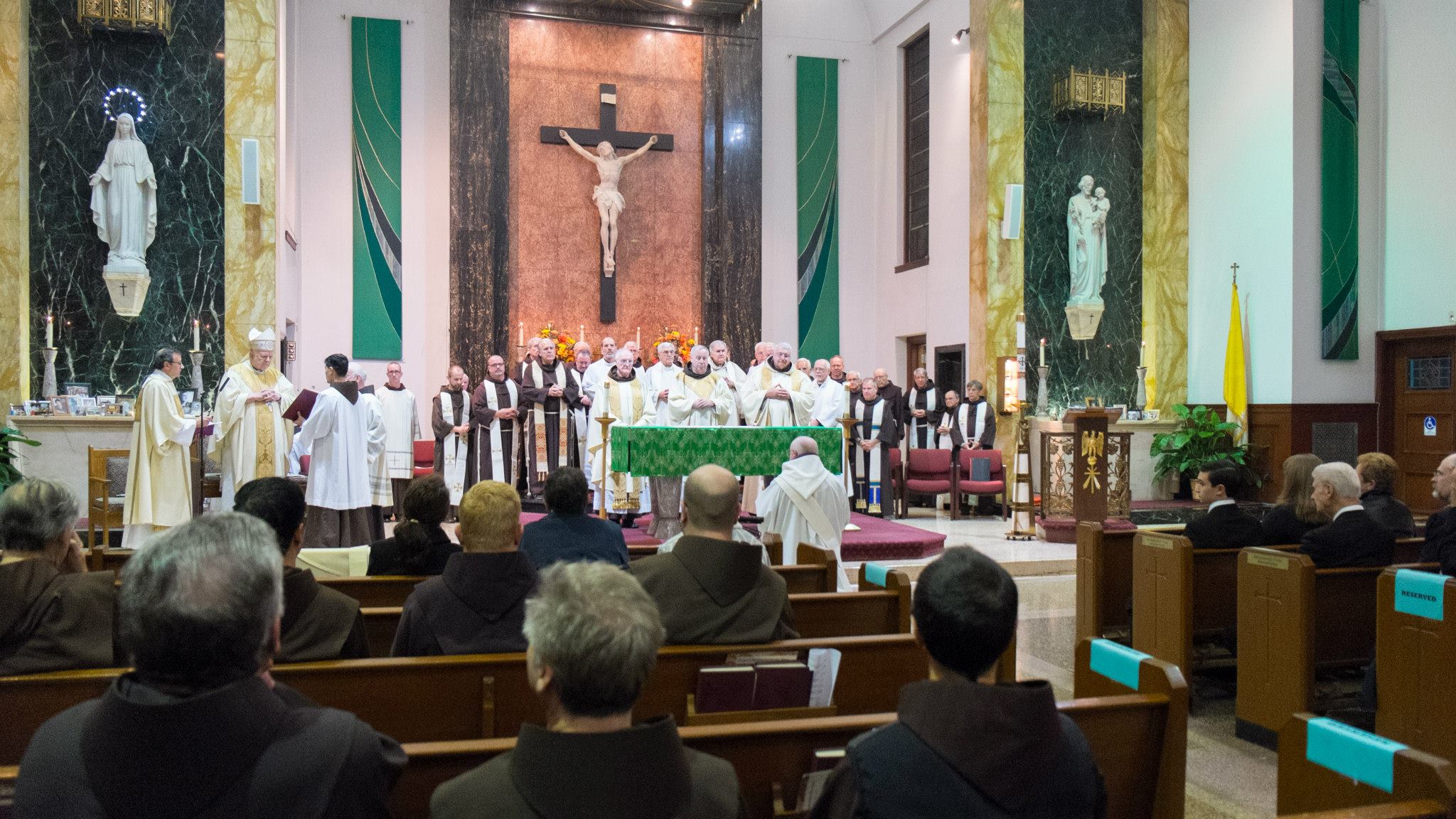
Joined by roughly forty friars, a packed church of lay people, and a bishop, the simply professed friars in this house took part in the ordination mass of Paul Keenan, ofm, yesterday at Assumption of Our Blessed Lady Church. As is usually the custom, the simply professed friars served at the mass as acolytes, responsible for carrying the cross, miter, and crosier, setting up the altar with the gifts, preparing the incense, and assisting the master of ceremonies in anything else that needed to be done (which is a lot whenever a bishop is involved!)

Like the experience I had at the solemn profession two years ago, I couldn’t have been happier and more confirmed in my vocation after this experience. Seeing Paul standing in the place where I hope to be standing in four or five years was really inspiring; thinking about Paul standing where I was a few years ago was pretty surreal; hearing the bishop speak about the role of the priest in the church, that of servant of the people, was humbling.

Beyond all of that, though, I was touched most profoundly by the presence of the friars who came from all around, on a Saturday evening, to support our brother Paul in his acceptance of this vocation. There surely cannot be a greater image than seeing four rows of friars coming up one-by-one to lay hands on the kneeling candidate, offering their blessing on him before he is officially ordained. The feeling of brotherhood was overwhelming and the emphasis on being a “Franciscan” priest was unmistakable.

As I begin my studies to one day stand where Paul stood and to walk where he now walks, I have in my mind a clear bit of inspiration for the future. The road ahead is going to be long and difficult, and it will certainly be easy to lose focus on what’s important amidst a sea of books. At the heart of it all, I must remind myself of this experience and what this call means to me.

I am called to live in fraternity in the way of St. Francis. I am called to serve my brothers and sisters. If I can remember these two things, everything else will fade away.

Formation Rolls On

As St. Francis reminds St. Anthony, sacred theology is a great thing to learn, as long as it does not "extinguish the Spirit of prayer and devotion."
As St. Francis reminds St. Anthony, sacred theology is a great thing to learn, as long as it does not “extinguish the Spirit of prayer and devotion.” Bonaventure and Aquinas, are great men to read, but we must always remember why it is we study in the first place.

Now that I’m nearly three months into my third year of formation, I can definitively say that there is a major difference between the first two years (postulancy and novitiate) and the remaining four years (simple profession) of initial formation. Rightly so, the first two years focus heavily on human and spiritual formation, breaking down personal barriers that inhibit proper growth in fraternity and prayer. This meant going to workshops on prayer, sexuality, personality, addictions, interpersonal skills, and the vows; meeting regularly with a counselor to evaluate group dynamics and personal problems; and numerous opportunities for extensive and intense prayer experiences by way of retreats.

While there are still opportunities for such experiences (we continue to go to sexuality workshops, are required to have a spiritual director, and will go on a retreat each year), the emphasis has clearly shifted from theory to practice. Unlike the first two years of evaluation and growth, the third year and beyond appears to focus much more heavily on ministry: preparation, experience, and processing.

The largest part of this, which I mentioned before without explaining in detail, is our heavy load of intellectual formation. For those of us that feel called to be ordained to the priesthood, there is a heavy academic burden that must be endured. The USCCB has developed a Program Of Priestly Formation that they believe best prepares one to be a priest in the Catholic Church. Academically, this means taking 30 credits of philosophy (with 20 credits soon to be done and each course being 3 credits, I’ll be finished by the summer), and 90 credits of theology in the form of a Master of Divinity (M.Div.) degree. For those scoring at home, that’s a minimum of four years. Courses are to be fulfilled in a wide range of categories including scripture, theology, history, canon law, moral theology, liturgy, spirituality, counseling, and preaching, clearly preparing us for a wide range of situations, but because of obvious constraints, unable to provide extensive depth into any one category.

Luckily, as I’ve learned in the past three months, our intellectual formation is not the only formation we receive in our years here. The simply professed friars meet every Monday evening for an hour and half to discuss relevant pastoral topics related to our lives. Usually led by one of the friars in the house, we begin with a presentation on a ministerial experience or skill and then spend time discussing our own experience on the matter. Topics are wide in range and scope with the intention of creating an environment for faith sharing, pastoral growth, and intimate fraternity.

Besides the daily ministry experience (of which we are required to get eight hours per week) and our supervisor meetings, we will each be assigned to a friary in our province each summer for a more intensive ministry experience. Stepping completely outside of the academic world, we’re able to apply all we’ve learned in the classroom and in our seminars to the “real world” in hopes grow in our pastoral skills and to have something substantial to bring back to the classroom the following year. Prior to our solemn profession (usually after our third year of studies), we are required to extend one of these summers into full year-long internship devoted entirely to ministry experience.

Overall, the nature of our formation is clearly different this year than it was in the previous two years as it is much more laissez-faire and dependent on the individual to develop his own formation. Please don’t misunderstand me: this does not mean that it is any less important or rigorous. What I mean to say is that there is no longer the feeling of being micromanaged with clear boundaries and high structure; we have an opportunity, now having been formed in the way of St. Francis for two years, to reengage the world with what we’ve learned in ways we see fit. It is a time of tremendous life experience as we are given the chance to try new things, to both succeed and fail, and to be stretched by a little bit of “real” stress in our lives. It’s an exciting time with a lot to do! Formation rolls on!

Really, Would You Do It With Me?

In my last post, I mentioned that I was in Greenville, SC and that I was going to be speaking at four masses and appearing on a student radio show. I cannot begin to explain how well it went. Besides getting to see a lot of people that had influenced my vocational journey, I gained some invaluable pastoral experience. After a number of requests, I’ve decided to post the text of my reflection Sunday. I hope that God is able to speak through this to you, or to someone else you might know that could use this. If you would like any information about a vocation in the church, I would be more than happy to help.

[After a brief introduction specific to each community], and so I’m here to share a little bit about how God has worked in my life over the past four years, how I felt a call to follow God, and how I believe that he is calling each of you.

And what better way to begin than with our first reading and psalm: “The Lord hears the cries of the poor.” We are reminded once again that God knows our concerns, cares about us, and is willing to intercede for us. Just as he heard the cries of his people when they were slaves in Egypt, the Lord has heard our own cries and has come to free us from our burdens.

How often have we been a poor and oppressed people? How often have we looked around and asked, “How am I ever going to get through this?”  Whether it’s been a demanding job, a difficult relationship, bills that keep piling up, or just lack of direction, we’ve all felt the weight of oppression, have been tempted to lose hope.  DON’T LOSE HOPE! God is here to answer our prayers! All we have to do is cry out to him. In my own life, money has always been a worry, and school is very expensive.  Each year in college I would pray that I would have enough to get by, that they wouldn’t kick me out or that I’d run out of money half way through the year. God answered my prayers, and each year I made it through.

But it’s been my experience that God is not one for theatrics, that he does not answer our prayers through shock and awe miracles, but through our brothers and sisters we see each day. When I was struggling to find a way to pay for college, I didn’t happen to find the money miraculously sitting in my back account one day, nor did twenty-dollar bills fall from heaven like manna.  No, it was the sacrifice of my dad who changed jobs, drove over an hour to work each day at a job he hated because they offered tuition exchange.  It was the dedication and perseverance of my mom who has worked at the same job for more than 25 years that has kept my family above water and made it possible for me to get an education at all. It was a teacher who saw potential in me and invited me to apply for a program with a scholarship.  God heard the cry of the poor, but he answered my cry through the works of others who were willing to be God’s hands and feet.

Which got me thinking. If I truly believed that God heard my prayers and answered them through others, if I truly believed that I was nourished by God in the Eucharist and in the word, that God truly dwelled in me, then it meant that it was time for me to start hearing the cries of the poor as well, and to be God’s hands and feet. I realized that God was calling me to his service. I realized that God was calling me to a life devoted to others in prayer, poverty, and fraternity.

But there is a great danger in stepping up and being God’s representative. I’ve seen it in myself and I’ve seen it others: the moment that God starts working through us and letting us bring his grace to others, we are tempted to turn into Pharisees.  You see, the sin of the Pharisee was not that he fasted. Fasting is a good thing. It is not that he paid tithes. How else would we have this church and new school? It’s not even that he prayed in public, seeking validation from others. We’re doing that right now.  No, the sin of the Pharisee is that he began equating the grace God had worked in him with his own ability. Since he was a Pharisee, God had no doubt blessed him with a good education, a stable upbringing, and enough money to remain comfortable.  He did not deserve these things, he did not earn them. The reason that he had everything was because of the grace of God, God’s freely given, unmerited favor.  And how did he thank God? By praising himself and judging his neighbor. “I pay tithes. I fast. I did all of these things without anyone else’s help, so why can’t you?” How ugly! The Lord says, “Whoever exalts himself will be humbled, and whoever humbles himself will be exalted.”

There’s a story of a group of scientists that got together and figured out a way to create life, not by putting together things that were already living, but by simply mixing together chemicals and water and dirt and a few other things. They created life out of nothing.  So proud of their own skill, they called up to God and said, “Hey God! We don’t need you anymore. We can make life ourselves.” “God responds, “Oh. Is that so? All by yourself? Where’d you get the chemicals and water and dirt? Your ability to think, your passion for science, and the life you have? Did you make those things too?”

These scientists, like the Pharisee, forgot how blessed they were, how you can’t even walk out the door without running into God’s grace. This is an absolute tragedy because it is the acceptance of a lie. We are fooled into thinking that we are in control, that we determine our own fate, that all we have to do is work hard and we can accomplish anything all on our own.  It is a lie in believing that we do not need God. As St. Paul tells us, this could not be further from the truth. He says,

At my first defense no one appeared on my behalf,
but everyone deserted me.
May it not be held against them!
But the Lord stood by me and gave me strength,
so that through me the proclamation might be completed
and all the Gentiles might hear it.

I’ve experienced it and so have you: people will let you down. It’s a fact of life.  Your kids will disappoint you. Your parents will embarrass you. Your church, your government, and your best friends will do things that infuriate you. I will let you down, and at times, you will even let yourself down.  When we try to be our own lords and do things without God’s help, we will let each other down.

But God will never let you down. God will never abandon you. God will always be there at your defense, hearing your cries.

All you have to do is act as the tax collector did, and return to God will humble heart and be open to God’s grace working through you. We don’t know what the tax collector did to make him a sinner.  But does it matter?  His example to us is that he knew that he couldn’t make things right without God. He knew that God would listen, and he showed to tell him.  He could have let his sin get in the way of his relationship with God, too afraid to ask forgiveness; he could have chosen to deny the fact that he had sinned at all; he could have acted prideful, believing that he was big enough to handle it on his own.  But he didn’t.  He recognized that all that he had been given up until then was grace, and if he was ever go to make it to another day, it was going to be because of more grace.  He recognized that his life meant nothing without God. “Whoever exalts himself will be humbled, and whoever humbles himself will be exalted.”

My life as a Franciscan friar has just begun, and I couldn’t be happier.  I could speak for hours about how free I feel, how much fun I have with my brothers, how my mind has been stretched so far with philosophies and theologies about God, how I have been challenged to do work that I would have never done otherwise, work that, frankly, no one else is doing. But we don’t have that sort of time.

Instead, I’ll end with a question for you. If you believe that God has worked wonders in your life, that God is capable of great things in you, that our world is in need of God’s faith, hope and love, and that our church is something worth preserving; if you believe all this,

Would you be God’s ears to hear the cry of the poor and his hands and feet to answer their prayers? 

Would you live a life for the life of the Church?

Would you let God poor you out like a libation wherever he needs you?

I pray that you may be given the openness to hear God’s call, whatever it may be, and the courage to answer it. I’m here to tell you, you won’t regret it. It’s the best decision I’ve ever made and I couldn’t be happier. But I don’t want to do it alone. And so I ask you,


Would you do it with me?