God With Us

God is with us, but why?

God is with us, but why?

As a Franciscan, Christmas is the celebration of the most terrific moment in human history: God became like us to be with us. Being born into poverty, surrounded by animals and filth, and visited by those who were far from being ritually clean (shepherds and foreigners), it is a time to recognize how the triune God works in and through the mundane, gritty, material aspects of our existence, appearing to us in the least expected of places. It is an act of humility, love and justice.

Which brings up a pretty significant question if you ask me: Why? Why did God choose to lower himself by taking on an imperfect form and nature? Why did God “empty himself, taking the form of a slave”? Why did God come to be with us?

My guess is that the majority of people would answer this question having been largely influenced by some form of atonement theology. “Jesus came to save from our sins/to offer a sacrifice in our place/to pay our debts.” For many, Christmas is significant only in its relationship to Easter as it is the foreshadowing for what is to come, for what really matters. This is evident in the way most answer this popular medieval question: “Had humanity not sinned, would Jesus still have come?” The answer that I most often get, and the one that is most popular in the history of the Church is “no”. Without even realizing it, Jesus is relegated to utilitarian role in which he is a use to us.

But as Franciscans have said for centuries, and as I would like to humbly remind, there is more to Jesus than just some divine “get-out-of-jail-free” card. Jesus is the second person of the triune God, existing before all creation, and the one through whom all was created. Jesus existed well before we did, and his coming to be a part of creation was not some afterthought of God to fix a mistake. Rather, it seems to me that he would have come, even if humanity had never sinned, for the sole reason of being in relationship with us. God taking on flesh is certainly a way to make a blood sacrifice, but it is also a way to become our brother, our teacher, our example of holiness, and our king. God planned from the beginning of time to be with us in this very intimate way, to know and love us, and for us to know and love him.

May you have a blessed Christmas as we celebrate together the mystery of the God with us and yet who is still yet to come.

My [Continued] Struggle With Poverty

With the conclusion of this four part series on poverty, I would like to begin right where I left off because I believe that my motivation for writing these posts over the past few weeks is encapsulated in this paragraph:

But at the same time, it’s easy to see that there are clear limitations to what one can do and still consider oneself “poor.” At some point, using that word is an insult to those whose lives in no way resemble ours. As one friar put it, “the poor can always smell a rat.” I think that’s true, and I think that’s why our first step must always be to listen to and imitate the poor, erring on the side of going too far. Until we are able to do that, to put our health, safety, and dignity on the line, how can we ever begin to be compared to those who do it everyday without any choice in the matter? Our poverty is voluntary, and we will never be able to fully rid ourselves of the safety nets around us, but at some point we need to dive in and live poverty the way the real poor people do.

When I look at my life and the life of this Order, I struggle to see “poverty” in any real sense. Who, honestly, would confuse me for a poor person? This is a great disappointment of mine and a struggle I know that I will face for the rest of my life.

Being Institutionalized

As someone in formation, there is an overriding and unavoidable nature to the way we live: within an institution. Unlike the majority of our friars, friars in formation tend to live in large houses. (My postulancy house was 10, novitiate was 21, and now post-novitiate is 25.) With that many people, and without the skilled brothers we once had, it is both necessary and fiscally responsible to obtain external help cooking, cleaning, and maintaining the structure of the house. It is necessary and fiscally responsible to buy things in bulk and to have many options at hand at all times. It is necessary and fiscally responsible to have a fleet of cars, each assigned to an individual so as to keep it well maintained and organized.

There are, however, unintended consequences to these “necessary” and “fiscally responsible” measures. For one, there is a lost sense of cost in our houses. Laundry detergent magically appears in pallet-sized quantities; food shows up on our table without work or sacrifice; and satisfying the desires of only a few individuals still leaves us with 6 different soda options, 4 types of snacks, and an endless supply of ice cream. While it’s probably true that we live more cheaply per person than a house of four does, there is not such a thing as an unfulfilled need here. Sure, we may not have our first choice, but boy do we have a lot of choices and an endless supply!

The other problem I see with this is that it is very easy to slip from “external help cooking, cleaning, and maintaining the structure of the house” to “my personal chef, maid, and handyman.” With a house this size, I don’t see a problem with filling in the gaps with a professional, but I begin to feel uncomfortable when outside help replaces our own work. Yes, I’m in school, and don’t exactly want to come home after a long day and cook dinner and clean out the gutters, but I’m sure that the poor do, and I know for sure that students of other religious orders have to do that. For me, it’s not the idea of having employees that bother me; it’s the amount of work we allow them to do that I believe strips us of poverty and minority.

Rationalizing or Redefining Poverty

Another struggle I face each is the inability to come to consensus on what poverty is in our lives. This is not to blame my brothers, as I know my opinion is just one opinion, and I do not expect others to assent to it. It just makes it difficult to decide how to live if we are all working from different starting points.

That’s not to say that I think all opinions are created equal, as there are two “rationalizations” that really annoy me (and yet I find myself doing both of them!) The first is making poverty a purely spiritual matter. “It’s not really about what you have, it’s about how attached to it you are. I could very easily give up my flatscreen TV if I needed to.” Right. But you haven’t. While spiritual poverty is what I believe material poverty is leading us to, a freedom from desire and dependence on God, I don’t see how it can be separated from actual, material poverty. Knowing that one could go without something is quite different from actually going without it.

The other problem I see is more prevalent: allowing ministry to reign supreme. We all love the people of God and have committed ourselves to building up God’s kingdom. That’s no in question. But all too often we make compromises to our way of life for our work of life. Eating meals out rather than cooking at home; each friar having their own car instead of carpooling or using public transit; the newest and latest gadgets for “productivity” and convenience; and employees taking care of our house so that we can take care of others. Ultimately, especially for priests, we may decide that our work is so highly specialized and in such high demand that we must do anything we can to do as much ministry as we can. That’s very selfless for sure. But we are more than ministry machines. Let us not be shortsighted in sacrificing what gives our ministry such high quality, our poverty, minority, and fraternity, in order to provide a greater quantity.

Caught in a Safety Net

The last struggle that I must face comes with the reality that I may never be able to free myself from it. Ironic and insulting to most Americans, the burden I must face in this life is know that I will always have local and provincial safety nets to protect me. This means having medical insurance, retirement facilities (and brothers who will care for me financially and fraternally), and the comfort of never being too far away from a “transfer” if things get too bad. Sure, I will care about the success of ministries and people we serve, but I know that, even in the worst case scenario, I will never starve, never be alone, or be without sufficient aid.

On a day to day basis, I find the presence of an overarching structure to be a subtle challenge to my spiritual poverty and that of my brothers because of the ability to say these simple words: “The house will pay for that.” In most of our houses, we are given a stipend for personal expenses and the ability to charge to the house any necessary expenses, e.g. gas, oil change, and books, outside of that original stipend. Again, how do we define necessary? For me, even though the house will pay for lunch if we’re at school, I would have never spent money like that before becoming a friar: pack a lunch or don’t eat. Like the employee with the company credit card, however, the abstract entity that is the “province” or the “house” becomes the ever-flowing well that can always be pumped, and without malice or ill intent, we allow ourselves to rest, spend more, and care less about how we live because the safety net will provide. When I’m running behind, there is a temptation not to pack a lunch because, “the house will pay for it,” so there’s no need to go through the extra trouble. This is a seed, a seed that I do not want to plant. It is the seed of safety and complacency.

True and Perfect Joy

As so I conclude this post, but my struggle is just beginning. On the one hand, I must live within a system that is not ideal with people that vary from apathetic to fanatical on the subject. I must accept that we as a community will never meet the ideals I wish to achieve. In a very positive way, I have accepted that struggling on this issue together is more important to me than succeeding alone. Our charism recognizes that love is messy, that the world is not filled with easy answers, and that God is found in the struggle.

On the other hand, I know that I am given a tremendous amount of freedom when it comes to my personal decisions related to poverty. In some ways I succeed: I don’t have to eat everything that is placed before me, nor do I have to spend everything that is given to me, and so I often avoid meat and return part of my stipend or donate it. In some ways I struggle to do better: I could probably use public transit more often, go without some of my possessions, or offer to do more work where needed.

With that, I will close this belabored series and winded post with the story of St. Francis called “True and Perfect Joy” and an insight from my formator and guardian, Fr. Joseph Nangle, ofm. In this story, Francis teaches that true and perfect joy is not felt from great successes, incredible miracles, or powerful skills, but rather in showing up to a friary, cold and wet, and after being turned away by a fellow friar because the friar believes him to be a “rascal” trying to fool the friar, he accepts these insults and maltreatment with patience, that is perfect joy. Fr. Joe, in his book Engaged Spirituality, writes this:

Francis felt that being treated as a poor person, being mistaken for one, even by a fellow friar, was “perfect joy.” He had reached such a sublime point in his own conversion process where his option for the poor showed itself when others saw and treated him as a poor person.

My reading of this story before had always been focused on Francis’ patience and humility, but how true is this sentiment to me today? Given what I’ve said in the last four posts, and the struggles I will undoubtedly face in my future as a friar, I cannot think of a more perfect joy than to be truly mistaken as a poor person. To live a life so authentically like the poor, with the poor, and for the poor that I become poor enough myself to mistake my own brother is the life I wish to live.

How To: Poverty

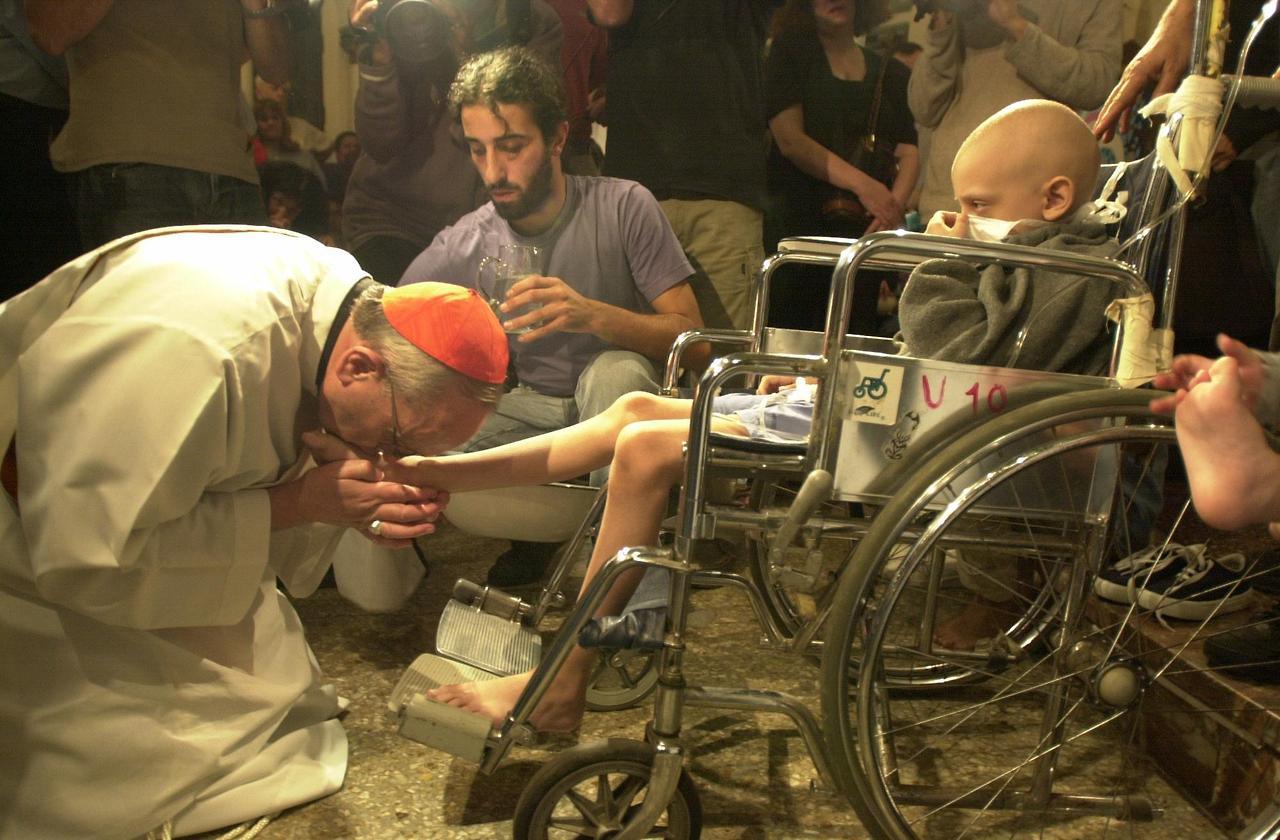
Like the pope, we will probably never "really" be poor. That doesn't mean we shouldn't get our hands dirty and try.

Like the pope, we will probably never “really” be poor. That doesn’t mean we shouldn’t get our hands dirty and try.

After my overwhelmingly persuasive and thoroughly inspiring post about why we should voluntarily choose poverty, all of you have undoubtedly sold all of your possessions and are waiting in joyful anticipation for more details, am I right? Well, even if that’s not the case, we’ll press on.

Despite the potentially misleading title, I don’t believe that there is only one way to live Gospel poverty authentically, and so this post will refrain from being overly specific; poverty is a very relative term, and there are things that would fit one’s life that would not fit another. Instead, this “how to” of sorts will identify a few universal values and attempt to offer critical options for particular expressions in a 21st century American context.

Imitate the poor around us

While Jesus is certainly a great figure to imitate, and I in no way want to diminish his witness, following someone who lived 2000 years ago, from a different culture, in a different region, literally, may not be our best blueprint for action in 21st century America. Jesus simply did not have the conception of healthcare, economics, national security, or personal property that we do (which is not to say that our conceptions are better, just to say that there is a context in which we live that puts very real limits on our possibilities.)

Because of this, a much better “role model” for living poverty today is very obviously the poor of our time. How do the poor in our country/region/city live? What do they own? What are they [not] able to do? What are their needs and concerns? What are their social/political/economic struggles?

In a very clear sense, we ask these questions to be more like the poor, in love and in solidarity. As pope Francis has famously said, priests (and ministers in general) should be “shepherds living with the smell of the sheep.” Wow. How beautiful of an image and powerful of a reminder of our role is that? A shepherd is not an administrative authority, well-learned in books and capable of making decisions; a shepherd is someone who comes into close contact with those s/he serves and can only say to have served his/her flock if s/he takes on the situation of the flock. If we are to be authentic, we must be willing to let ourselves be affected by the same conditions that affect them. Taking this seriously helps to form an “upper limit” to the amount of things we can own, luxuries in our life, and privileges we are allowed.

Educate and guide the poor

There is, however, another value that needs to be kept in mind that will undoubtedly muddle this discussion: we must be a witness to the poor. All poverty is not created equal, and we must not fall prey to romanticizing it or making it our absolute goal. Some things that happen to the poor (or are done to themselves) are destructive to the human person and even dehumanizing. Every day, people die of malnutrition, preventable and curable diseases, unnecessary violence, and as a result of inhumane living conditions. This level of poverty, poverty that strips people of their dignity as sons and daughters of God, is disgusting and intolerable.

In this way, poverty is not always something to be imitated because poverty is not the ultimate goal we seek. This is clear even in the witness of Jesus, who, though very poor, was not the poorest person of his day. To seek otherwise would be to seek a bottomless pit, a goal that could never be achieved, short of death by starvation. There will always be someone poorer. Thus, just as an imitation of the poor helped to form an “upper limit” for our own lifestyle, an acknowledgement of an unacceptable level of poverty helps to form a “lower limit” for our lifestyle, keeping us from making poverty an end rather than a means.

Living in this tension

This tension of values makes living Gospel poverty a very tricky and relative thing. We are at the same time called to be in solidarity with a person’s undesirable condition, forced to give up our comfort to experience their grief, while drawing an almost arbitrary line as to what is considered “subhuman” conditions. You can see why “poverty” takes on very different expressions within the Franciscan Order, and why we can seldom agree.

These questions are endless in number:

  • Should we live with the poor or in more comfortable places so to recharge and  better serve them?
  • Should we eat healthier, more expensive foods, or cheap foods that lack nutrition?
  • Should we have cars, or use public transportation? If cars, should we buy reliable cars that are more expensive, or cars more like the poor can afford?
  • Should we even have health insurance, and if so, how comprehensive?
  • Should we buy things in bulk because they are cheaper, or live day-to-day?
  • Should we buy higher-quality products that will last, or cheaper ones that the poor generally use?

For each issue, it’s clear to see how one could be swayed either direction depending on which value is most important and how one defines “subhuman” conditions. For some, it is an affront to humanity to have to share a bathroom. For others, it’s eating the same processed foods every day. Some won’t stop until they’re sleeping on the floor with six other men in the room, without heat or running water, having only eaten one meal that day.

But at the same time, it’s easy to see that there are clear limitations to what one can do and still consider oneself “poor.” At some point, using that word is an insult to those whose lives in no way resemble ours. As one friar put it, “the poor can always smell a rat.” I think that’s true, and I think that’s why our first step must always be to listen to and imitate the poor, erring on the side of going too far. Until we are able to do that, to put our health, safety, and dignity on the line, how can we ever begin to be compared to those who do it everyday without any choice in the matter? Our poverty is voluntary, and we will never be able to fully rid ourselves of the safety nets around us, but at some point we need to dive in and live poverty the way the real poor people do.

Why Poverty?

There's actually great wisdom in seeking to have less money.

There’s actually great wisdom in seeking to have less money.

Before we enter into a potentially lengthy and superfluous discussion about how one should live a life of poverty, it would seem appropriate to make clear why one would even want to be poor in the first place.  Given that it is pretty much the antithesis of what most in the modern western world would consider to be a worthwhile life pursuit, it’s a fair question. Why would one want to spend their life trying to be poor? I believe that there are at least four reasons for each and every Christian to consider.

1. Jesus was poor

As we prepare for Christmas in this season of Advent, we recall that Jesus became flesh not in a castle but in a dirty manger; we recall that the first people to visit him were the shepherds, the ritually and materially “unclean” outcasts of society. Jesus coming in this way is an example of how he “emptied himself, taking the form of a slave.” As Christians, those who follow Christ, we wish to be like Jesus by imitating his simplicity and humility; as Franciscans, those who follow Christ in a very literal sense, we wish to be like Jesus by imitating his material situation as well. While the next post will discuss how we do that (because in some ways it might actually be inappropriate to adopt a literal approach) the point remains: Jesus was poor and we want to be like Jesus.

2. Jesus called his followers to be poor, for the poor

That being said, there are a number of things that Jesus did that we’re probably not all called to imitate, e.g. die on a cross. Because of that, we must look to his words and exhortations. When Jesus called his disciples to follow him, “They left everything and followed him” (Lk 5:11, 5:28, 12:33, 14:33, 18:22; Mk 1:16-20; Mt 4:18-22). Leaving their nets, money, family ties, prestige, and occupations behind, the disciples became poor in order to follow him. When he sent them out, he told them to go without walking stick, sack, food, money, or second tunic (Lk 9:2, Mt 10:9, Mk 6:8).

And what did he preach to the people? “Blessed are you who are poor, for the kingdom of God is yours” (Lk 6:20). Given the religious climate of the Pharisaical purity laws, it would have been revolutionary enough to say that the poor were more than worthless afterthoughts of God. To say that they were blessed, that there was something particularly special about their situation, was something so cataclysmic to our fallen nature that I believe it has yet to be fully realized in the Church. The poor are special, not in their relation to our charity, but in the very fact that they are poor.

3. We seek justice against a corrupt system.

Because of that, there is an important distinction that needs to be made in order for us to live Gospel poverty appropriately and to relate to the poor compassionately: poverty that promotes virtue, which should be imitated, and poverty that demoralizes and dehumanizes, which should be eradicated. An excellent reason to remain poor is to take a stance against unjust systems that do not allow authentic human development and to stand in solidarity with those affected.

What sorts of stances does this entail? According to the United States Conference of Catholic Bishops in their 1986 letter, Economic Justice for All, this includes anything and everything that could adversely affect the poor:

Decisions must be judged in light of what they do for the poor, what they do to the poor, and what they enable the poor to do for themselves. The fundamental moral criterion for all economic decisions, policies, and institutions is this: they must be at the service of all people, especially the poor. (no. 24)

The way we eat, save, spend vote, travel, reside, and shop all have an impact on the poor. Do we ever stop to wonder how the way we live is possible? How else could our t-shirts be so cheap if it weren’t for child labor? How else could our fast food so cheap if it weren’t for dehumanizing wages?  The list goes on and on. Unless we curve our insatiable need for “stuff” and change our lifestyle, these atrocities will continue to happen to the poorest in society.

As St. John Chrysostom writes, “Not to share one’s wealth with the poor is to steal from them and to take away their livelihood. It is not our own goods which we hold, but theirs.” I believe very strongly that the extra coat one has in one’s closet belongs to the poor; to keep it unused in one’s closet rather than giving it to the poor is a grave sin.

So pervasive are these issues that they in fact take on a structural nature. As Pope Francis writes in his latest papal encyclical Evangelii Gaudiam, reiterating years of papal teaching, these structures need to be challenged.

Some continue to defend trickle-down theories which assume that economic growth, encouraged by a free market, will inevitably succeed in bringing about greater justice and inclusiveness in the world. This opinion, which has never been supported by the facts, expresses a crude and naïve trust in the goodness of those wielding economic power and in the sacralized workings of the economic system. (no. 54)

4. Wealth too easily becomes a false god.

Which brings us to the fourth and final reason to live a life of poverty: you cannot serve both God and mammon. The reason that our economic system in the west is so detrimental to the poor is because it has replaces God with money, a transition that is easy to make and difficult to break.

On the one hand there are those who have made it their life’s pursuit to acquire money, equating wealth with happiness. This is a sad state of affairs. Many people fail to recognize that money cannot satisfy such an insatiable appetite, leading some to resort to morally reprehensible things to obtain or maintain wealth.

The answer, however, is not to become a miser, refusing to spend one’s money on anything. Ironically enough, this is also a form of idolatry because it takes an exorbitant amount of time and energy away from things that actually matter.

***

It is because of all of this that I choose a life of poverty. I choose to imitate Jesus as closely as I can; to obey his word; to reject any system that may inhibit the authentic human development of my brothers and sisters; and to do all that I can do keep the Trinitarian God as my one and true God. I choose to live a life that is simple, without the distractions of useless possessions and futile pursuits. I choose to live a life that focuses entirely on a life with Jesus. That is why I choose to life a life of poverty. Now how do I do that? The next post will attempt to answer jus that.

My Struggle With Poverty

tnhybgr
Sometimes we find ourselves intending to worship one God, but acting like we worship another. I struggle with this discrepancy in my life, especially as a vowed religious.

Let’s be honest right off the bat: who am I to talk about poverty? I am the product of a lower middle class household that has always made ends meet, I attended an expensive university that lacked diversity of social class as much as it lacked diversity of race, and now I am a part of a province known for its affluence within the comfort of one of the Church’s largest institutions. My house has a cook, all of my basic expenses are paid for, and on top of that, I’m given a modest stipend to spend on “extra” things each month. I have had the horrifying and humiliating experience on more than one occasion of showing friends and family around one of our houses and receiving the response, “Wow. So this is how the friars live.” For many, myself included, we as friars do not always appear to be the people we say we are and want to be.

And yet, I continue to write despite the apparent lack of credentials on the matter. I write in this case not to give answers, but to allow others into my life and to share in my struggle.

I have not had an authentic experience of poverty in my life but I choose to live poorly, I want to live poorly. My attraction to this life as a friar was to be like the poor, with the poor, and for the poor. For both good and bad reasons, with personal and structural factors, I have not yet lived the ideals I hold. That does not mean that I don’t have them, nor does it mean that I am not working to live them more fully. This is what I would like to share.

With a topic as controversial and sensitive as this one, it is important to remember the words of our brother Francis: “I warn and exhort them, not to despise or judge men, whom they see clothed with soft and colored clothes, using dainty food and drink, but rather let each one judge and despise his very self.” The fact that my brothers and I do not live up to my ideals, that the institution may at times be a hindrance to poverty by its very nature, is a fact of life. To point out ways in which we fall short, then, is is not intended to be a judgement, but rather an encouraging exhortation.  As a brotherhood of friars and a community of Christians, I believe that it is our right, dare I say responsibility, to invite our neighbors to a more authentic example of Gospel living.

If you agree, and believe that a desire to live Gospel poverty is credibility enough to speak about it, I invite you to join me over the next few posts in a discussion about living Gospel poverty in a more authentic way. The topics I wish to discuss will focus primarily on my struggles so far as a friar, but will no doubt be universal enough for any Christian wishing to follow Jesus more closely in the 21st century.

In the meantime, I offer you the following articles previously posted related to poverty as a further introduction:

What Can’t I Live Without

Solidarity With The Poor

Seeking Insecurity