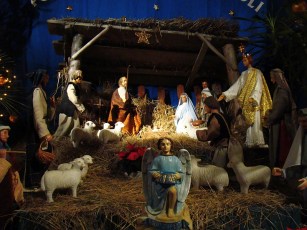
04567_Christmas_nativity_scene_at_the_Franciscan_church_in_Sanok,_2010The so-called “Nativity Scene” is a staple this time of year. Found on the lawn of nearly every church and in the home of nearly every Christian, they can be big or small,  life-like or cartoonish, full of animals or simply Mary with her newborn child. Some churches even put on a “living nativity,” complete with costumes, live animals, and a crying baby. For many, it’s just not Christmas without a depiction of the birth of Jesus, and it’s amazing to see the level of creativity from one year to the next.

Overall, it’s a wonderful thing. There’s something about being able to experience the event for ourselves, to use our senses to capture all that the original scene must have been like, to make the story from the Bible come alive. It’s why Francis of Assisi created the first nativity scene back in 1223 (trivia for you!) and why Christians have continued the tradition for 800 years.

And yet, there is something tragically lost in so many of our depictions, and I can’t help but wonder if we miss the true spirit of Christmas because of it. Yes, all nativity scenes capture gist of the story: Jesus was born to Mary outside because there was no room in the inn and was eventually visited by either three men bearing gifts (Matthew) or shepherds (Luke). And no, there’s nothing wrong with themes like “peace on earth,” joy, and giving to one another. But like so many Biblical stories, this one has become so familiar to us that our depictions of it are often white-washed and sterilized, glossing over the truly challenging parts of the story for something that makes us feel nice inside.

When we look at the Gospel accounts of the birth of our Lord, what we see is not a happy, feel-good moment, but rather an act that was provocative, controversial, and even upsetting to the religious elite of the time. The nativity scene is a sign of subversion and ultimate conversion.

Take the situation of Mary and Joseph in its context. When we look back on this situation with the eyes of faith and the privilege of history, we can call them the “Holy Family.” But to their contemporaries, especially the religious elite, there was nothing “holy” about them. Even though Joseph takes her into his home rather than exposing her, people had to have known that Joseph was not the father. Irregular marriage and child out of wedlock? Strike one. Embarking on their journey, they find themselves foreigners in a distant country. Immigrants? Strike two. And let’s not forget that this was hardly a wealthy family. They did not have a caravan of camels and servants, they did not stop at fancy places and dine with princes. Joseph and Mary were poor peasants with no political or religious power. In their world, they were essentially worthless to both the Jews and the Romans. Strike three.

And yet, this is the situation into which God is born. The creator of the universe, the King of Kings, was not born in a palace to a noble family. He was brought into this world by poor, seemingly-worthless immigrants in an irregular marriage.

Another powerful, yet mostly overlooked point, is the symbolic place of his birth:

She wrapped him in swaddling clothes and laid him in a manger, because there was no room for them in the inn.

To many, this simply continues the theme of his humble situation: Jesus was laid in the manger because Mary couldn’t afford a nice bed or crib. But it’s more than that. The problem is that most of us think we know what a manger is… but actually we don’t. A manger is not a synonym for crèche, has nothing to do with a barn, and is not a normal 1st century crib; a manger is a trough where animals eat. Seriously. In other words, “She wrapped the poor child and laid him the chafing dish.” An odd statement, to say the least. Sure, given the circumstances, it might have been the most comfortable and convenient place to lay a baby and Luke may have just been recounting the practical details. But I don’t think so. Of all the themes in his Gospel, nothing is more significant than the institution of the Eucharist from their table fellowship. Luke, even from the point of Jesus’ birth, is announcing Jesus as food for the world.

To us, that’s a nice little detail, a cool foreshadowing to things to come. We love the symbolism and it helps us understand who Jesus is for us. But for the people of his time, this was blasphemous. Eat what? Who does this person think he is? From the very beginning of the Gospel, Luke makes the message clear: Jesus is the way to salvation, not the law. To accept this and follow him meant stepping outside of the status quo, rejecting the practices and teachings of the religious elite of the day, and having the faith to follow a radical man who upset a lot of people.

Finally, no nativity scene would be complete without a few visitors. Whether we highlight the magi in Matthew or the shepherds in Luke, their presence is highly significant, and highly controversial. For now, though, I want to focus on Luke’s account of the sheep.

So the shepherds went in haste and found Mary and Joseph, and the infant lying in the manger. When they saw this, they made known the message that had been told them about this child.

We’ve been so desensitized to the idea of shepherds that it seems normal. How could we have a nativity scene without a shepherd and a few cute sheep? It seems almost obvious to us. But to the people of the time, this would have been absolutely scandalized by them.

The whole issue is over ritual purity. For the Jews, certain things were clean and certain things were unclean, and exposing oneself to certain situations made one ritual impure, meaning they were excluded from the community and temple worship until they were ritually washed. Shepherds were very unclean. Not only did they spend their entire lives with livestock, no doubt encountering blood and other unclean substances, they were basically stuck in an institutional state of uncleanliness: as long as they remained a shepherd they were unclean, and if they took the time to enter the city to purify themselves, they would lose their flock. In Jesus’ time, shepherds were outcasts and undesirables, and they were not alone: for many, the law was a burden that inhibited community, created an entire class of people unfit for worship.

This is the situation that Jesus enters. These are the people that visit our Lord at the moment of his birth. It was not the chief priests or the ritually pure; it was not the most charitable or most liked; it was not the noble or important. The people connected to Jesus’ birth are the outcasts and unclean.

The savior of our world did not fit into religious categories, and was probably not regarded as important by the religious elite of his day. Think about what it means that  Jesus is the outcast and the unclean.
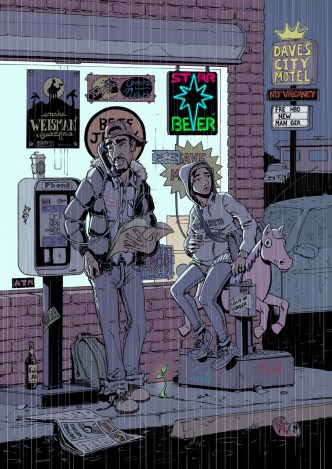
JoseyMariaWebTaken altogether, the birth of our Lord, captured in our nativity scenes, is a provocative, controversial, and downright upsetting symbol of our faith. His birth is yes, in a way, a sign of peace on earth and holy giving, but only if it is understood with an unmistakable sense of subversion. Jesus came to upset the religious and political systems of the day, to bring a new order contrary to what was expected.

As we look at own nativity scenes this time of year and glory in the birth of our Lord, my hope is that we may experience something more than a Hallmark moment. Recreating this scene as we do offers us an opportunity to see and feel how radically upending his birth really is, in his world, and in ours. It’s an opportunity to realize that, if our Lord were to be born today, many of us would not be among the outcasts or undesirables included in this scene, we might be among the religious elite, shocked by the blasphemy of it all, concerned with the ritual laws of our day, and unknowingly overlooking something quite extraordinary in our midst.

This Christmas, may we capture once again the true spirit of Christmas, that spirit that upholds the poor, welcomes the outcast, is open to conversion, and lives as a community gathered at table. I hope you all have a Merry Christmas!

Not my problem. Do you ever have a situation thrown on you, find a mess somewhere, and just say those words? “Not my problem.” Clearly I did not cause it, this has nothing to do with me, I’m not getting involved. A few months ago I walked into a bathroom at our friary only to find baby powder all over the floor. True story. I took one look at the mess and just said, “Nope. Not my problem,” and decided to use the other bathroom. Another day, I opened up the drawer in the kitchen to find that someone had just dumped all the silverware instead of separating the forks, knives and spoons. I grabbed a spoon, shut the drawer, and said, “Not my problem.” #friarlife

Whether it’s a mess in the house or a frustrating situation at work, the not-my-problem approach is definitely a way to stay sane. As busy as we are, as many problems we have to deal with, it’s relieving to look at a situation and realize that we didn’t cause the it, it has nothing to do with us, and it’s not our battle to fight. Sometimes we just have to let people fix their own problems.

But to what extent?

Say your best friend comes to you for help, even though she didn’t take your advice, and is now in big trouble. Not my problem? Say your child comes to you at 8:00 at night with a science fair project due the next day and he hasn’t even started. Not my problem? Say a close relative calls at 2:00am, having just gotten into an accident because he was drinking and driving, and needs your help. Not my problem?

No matter how inconvenient and unrelated to our own actions, these situations, like it or not, are our problems. It is the responsibility we take on when we enter a relationship, live in society, and call ourselves Church.

It’s situations like these, those times when people bring us their problems and we just want to run from them, that remind me of St. Joseph. Often overlooked, Joseph’s contribution to the Christmas story in our Gospel reading yesterday is not only important to the life of Jesus, it is inspiration to our own situations. The way I see it, Joseph had three options:

1. He could have responded by divorcing Mary publicly, calling attention to her situation. This was probably the most common reaction, the one most people in his society would have expected him to do. He would have been justified by the law, and his reputation would have been held intact. “I did nothing wrong, God does not act in that way—Mary is a liar. Why should I help her? Not my problem.” No one would have faulted him for this option.

2. The second option, which he originally chose, was to divorce her privately so that she wouldn’t have to die. In this option, he runs the risk of losing his good reputation, even being subject to the law, but he lets her live. Maybe he believed what she said, but had some doubts. “It sounds peculiar what Mary told me, but if she is telling the truth, I don’t want to be against God so I’ll let her live and wait and see if she was telling the truth.” Joseph is a “nice guy” to let her live…but he also doesn’t put himself completely out there to stand up for her either.

3. After his dream, he comes to believe that what she says is true, and realizes that her problem is his problem too: This child will take away the sins of the world. He not only lets her live, he welcomes the child into his heart and life, raising him and caring for him, even though it is not his own. In doing so, he accepts not only the public shame from his neighbors but also a major burden on his life, having now to sacrifice time and money for something that he didn’t cause and has almost nothing to do with him.

In our lives as Christians, as we approach the great feast of Christmas, the day the Church celebrates God becoming a human being, we are also given three choices like Joseph:

1. We could choose to be cynical and reject what is hard to believe or inconvenient to us. “It is impossible for a virgin to give birth.” “God cannot become a human.” “Why should I have to help others? It was their mistakes, not mine.” This is the easiest and most acceptable response in our society. If we were to take this road, the road of “not my problem,” not only would we not be shamed, we might even be praised.

2. Our second option, like Joseph, is to profess our faith—with hesitancy. We come to mass, we believe that God could have done something like this, but we’re not really confident enough to let it change our public lives. Religion is what we do in this building on Sundays, and we like it, we’re good people. But like Joseph divorcing Mary privately, we’re not really willing to let other people know what we believe or let our beliefs “inconvenience” our lives.

3. But there is a final option, a perfect option God is calling us to in this season of Advent: to follow St. Joseph in accepting Jesus with our whole heart and let him transform every part of our lives. It’s one thing to let a child live; it’s another thing to raise him as if he were one of our children. To have faith like Joseph means not only believing, but being proud of what God has given us, our faith, and letting it change our private lives, our social lives, even our financial lives to let it grow.

When we look at our lives and out into the world, we see so many things that are “not my problem.” The human family is not exactly known for its great decision making, and we find so many people putting themselves in harm’s way, bringing heartache upon themselves and others. Unwanted pregnancies, drug addictions, major credit card debt. There are also those who maybe because of the fault of someone else are in a bad situation. Immigrants and refugees, mental illness, human trafficking. For each of these situations, it is easy to say that we did not cause these situations, it has nothing to do with us, and so we shouldn’t get involved. Especially this time of year: “C’mon, it’s Christmas, it’s a stressful time for all of us, and I just want to enjoy it with my family and not have to worry about anyone else’s problems.” 

And we could respond in this way. We could focus on how we feel, how we don’t want to be inconvenienced, and how we are free from responsibility. “Not my problem Mary. I’m busy enough as it is.” But I tell you, like it or not, if we love the person, it is our problem. We would never ignore our best friend, we would never let our child fail, and we would never let our close relative deal with a great struggle alone, even if it is not our fault. Like Joseph, we do not get to choose what God asks of us; all we get to decide is how we are going to respond. God is asking of us, in this final week before Christmas, to prepare to receive his son in this world. When we see him, when we see the body of Christ broken and battered, when we see the suffering of our brothers and sister in Christ, will we welcome him into our lives with open hearts like Joseph, or will we turn from the inconvenience and say to our Lord, “not my problem”?

On December 8th of every year, as we celebrate the feast of the Immaculate Conception, you can almost count on one question: who was immaculately conceived, Mary or Jesus? More than a few times I have been called to intervene in disputes, Catholics on each side confused as to the meaning of the day.

So, who was immaculately conceived? Well… technically both… but that’s not the question.

For the real answer to this question, an explanation of the doctrine, the misconceptions surrounding it, and how it fits in our Advent season, check out my newest “Ask Br. Casey” video on the Breaking In The Habit YouTube channel.


Happy feast day!

In the wake of the 355th mass shooting—of this year—many politicians sent out condolences in the form of prayers to the people of San Bernadino, CA. Things like, “Our thoughts and prayers go out to the victims of this tragedy,” and “Praying for peace and safety for our first responders today,” were in high number. And there’s nothing wrong with either of these statements: my thoughts and prayers were also focused on those affected by the tragedy, and I too was concerned for the first responders who were putting themselves in danger. These are great sentiments for sure.

God Isn't Fixing ThisAnd yet, prayers like these have caused quite the outrage in recent months. After the mass shooting at Umpqua Community College on October 1 of this year (at that point, we had only had 294 mass shootings in 274 days), President Obama emphatically remarked, “Our thoughts and prayers are not enough. It’s not enough. It does not capture the heartache and grief we should feel, and it does nothing to prevent this carnage being repeated somewhere else in America.” Today, the New York Daily News responded in a similar way with the headline, “God Isn’t Fixing This,” calling a number of politicians “cowards” for their “meaningless platitudes.” In both cases, as with the many people who have suffered at the hands of gun violence, there seems to be a growing dissatisfaction with the prayer.  We cannot depend on God to fix all of our problems, many say. We need to do something ourselves.

What do we as Christians make of this?

In each of these cases—the politicians who Tweeted their condolences, President Obama calling for more than prayer, and the NY Daily News calling for anything but prayer—”prayer” is understood in a rather narrow, private, and disconnected sense. When we pray, it seems to all of them, we present desires or wishes to something or someone outside of ourselves in hopes that they will be granted. In this sense, prayer is a way of expressing what it is most important to an individual, and for those who “believe in the power of prayer,” it offers a sense of comfort that everything will ultimately be alright; God listens to and answers our prayers, we say and believe, so this many people praying must work out in the long run, right?

But I’m not convinced that this is the definition of prayer that we want to rest on. While, yes, intercessory prayer is definitely a component of a full prayer life, by itself, understood as it has been presented, it is a tragically incomplete experience.

Think of it this way. If God is eternal, perfect, and unchanging, how is it that we can change God’s mind about something so as to cause God to intervene? (We can’t!) There is no possible desire or request that we could ever express that God doesn’t already know, hasn’t been thinking about for all eternity, and is currently intervening to the extent God sees fit (how and why God intervenes is a topic for another post…) We may ask for something, but God already knows what’s best for us and will give us all that we need when we need it. In other words, our prayers do not change God’s mind or control God’s actions.

For some, it may sound like I’m saying that we should abandon all intercessory prayer. “If God doesn’t change, why even ask for help? God’s going to do what God’s going to do with or without my prayer.” In a way, yes, this is true: God cannot be “moved” by anything outside of Godself. But that doesn’t mean I’m saying we shouldn’t seek God’s intercession… it means that we should understand prayer in a deeper way. Instead of thinking about prayer as a way for us to change God, why not see it as a opportunity for God to change us?

You see, prayer is more than a one-way communication of “pleases” and “thank-yous” in which we speak and God chooses to answer or not; it is a multi-direction, active experience of God in which we not only communicate our desires or emotions to God, God communicates with us in such a way to transform, convert, and inspire the very desires and emotions we share. Prayer is not a time in which God listens patiently and conforms to our desires (ha!), it is the time when we open ourselves up enough to listen patiently to God and conform ourselves to God‘s desires.  In other words, prayer is an experience that makes us more like God, not God more like us. 

imrs.phpIf this is our understanding of prayer—getting back to politicians dealing with our tragic situation of repeated gun violence—true prayer is not an expression of our sentiments or a way to express our condolences, it is an act that gives us the clarity and motivation to act more like God in the world. True prayer is transformative. It does not end when we say “Amen” and go about the rest of our day. That’s when the prayer truly begins.

And so, while I find president Obama’s speech lacking in nuance and the Daily News’ article misunderstanding the role that prayer can play, their frustrations are rightly directed: “prayer” that does not result in a new way of thinking or acting, that does not seek to reconcile the situation or prevent new tragedies from occurring, is far from the experience that it can and should be. Prayers by politicians that are accompanied by inaction, or worse, action that deliberately works against the prevention of more tragedies, are not enough.

After 355 mass shootings in less than a year and thousands of more fatalities as a result of gun violence, it’s clear that something needs to change. Some have suggested that, “Our prayers are not enough.” And I agree. But the problem is not that we pray. It’s that we don’t let our prayer transform us into the people of action and justice we need to be. Prayer that only asks God to fix our problems, without allowing God to transform us in the process, is not enough.

Good art has a way of changing our emotions, sparking our imaginations, touching our souls, and moving us to action. Think about how powerful your favorite movie was the first time you saw it, or how you feel when you get to watch it again. Think about how the right song can stop you in your tracks, lift you up, or completely change your day. Art, especially in the form of movies and music, is a powerful medium of expression and persuasion.

So, then, as Christians, what do we watch? What do we listen to?

Some choose to watch and listen to it all. “If it’s popular, I’ll see it!” This may not be our best option. Turn on the tv, go to the movies, or play a few songs on the radio and you are bound to find terrible language, un-Christian themes, gratuitous sex and violence, and really poor writing. The Christian is sometimes left wondering what to watch.

As a result, some have chosen to only watch and listen to things produced by the Christian industry, geared to created “positive and encouraging” entertainment for the whole family. Christian music and movies are uplifting, wholesome, appropriate for all ages, and even informative about our faith. Given what’s on regular tv and radio, some believe that this is all a Christian could ever need.

But, as I’ve written before (Franciscan Film Society) I’m not a huge supporter of the Christian industry. While I don’t find reason to discourage people from it, I often find the message simplistic, the situations far from reality, and the quality of production distracting. Sure, it may have a nice, wholesome message, but it does not challenge me or stimulate my imagination. For me, the Christian industry is not bad, it’s just safe. It does not take risks, does challenge or unsettle, and does not cause the viewer to come to his/her own conclusions. It comes up with a clear, comfortable message, and builds a story around it.

Not all art is so neat and tidy. Not all problems have an easy answer. Not all situations have a happy ending. Not all of life is G-rated.

For me, there is much more fruit for a critically minded Christian in secular movies: The best movies portraying the journey of a Christian to the heart of God are often found in the secular world. With better acting, larger budgets, more creative and skilled writing, and, frankly, more of a grasp on the way the world works, secular movies and music offer greater artistic value and stimulate our imaginations in a way that many (not all) Christian movies simply do not.

What I suggest in this month’s podcast with Rob is that a trip to the movies or a turn of the radio dial can be a prayerful experience, even if the content is not itself explicitly Christian. While there are certainly things that are probably not beneficial to anyone (there is bad art in every segment of the population), a Christian with an incarnational spirituality and a critical eye can experience God, redeem what they see, and be moved to be a better Christian, even in the secular world.

For those on email, click here for the video.