This is the third episode of an ongoing series. For the previous episode, click here.
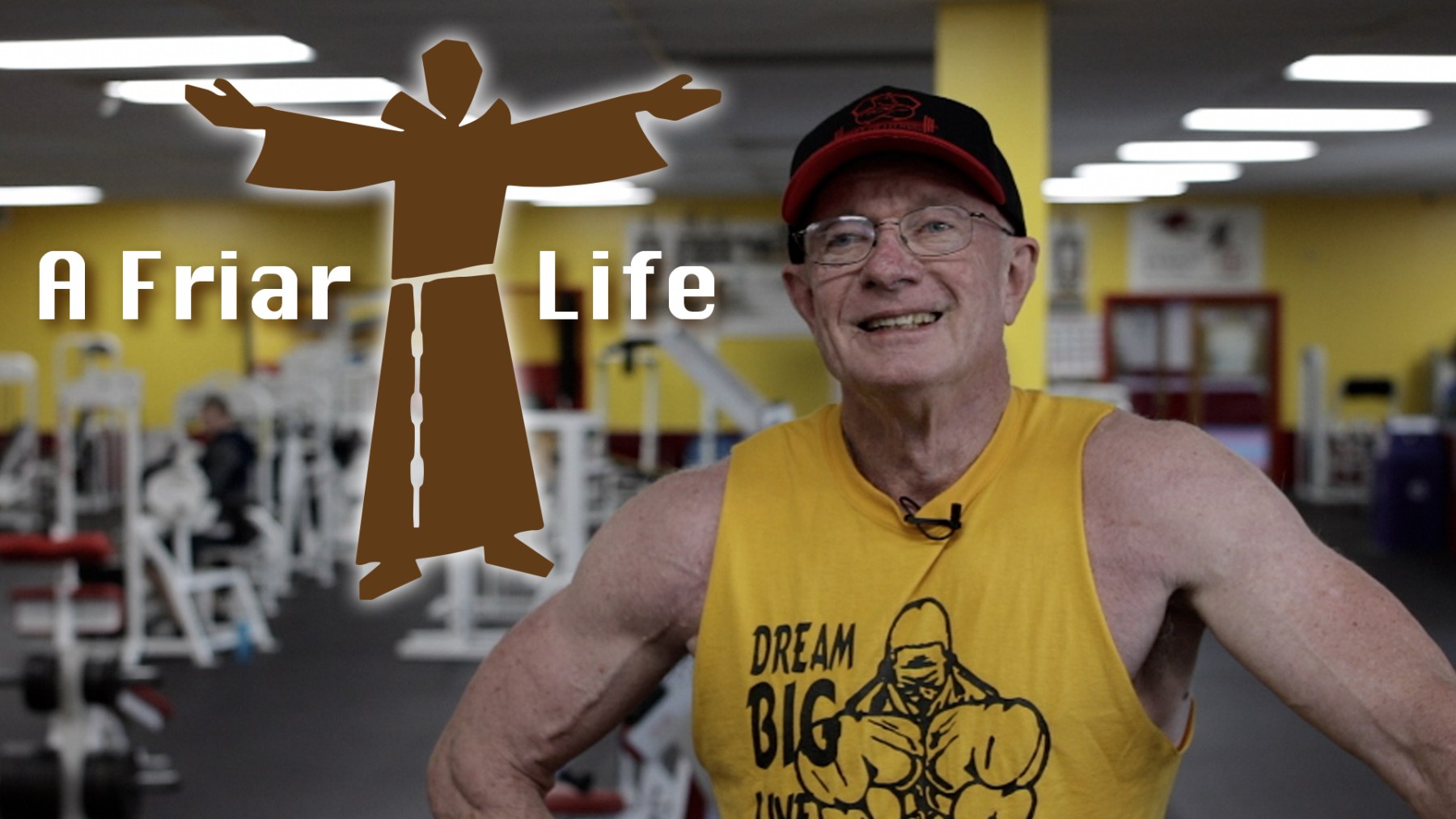
Fr. Bill McConville is a formidable man. Intellectually, he is a well-read scholar that can speak intelligently on everything from 17th century literature to medieval philosophy to modern world history. Professionally, his resumé is as solid as it gets, having lectured and taught at many distinguished schools before serving as a president of a university. Socially, he speaks with a powerful voice and tremendous confidence, attracting the company and respect of a wide array of people. And of course, physically, he is not exactly the average 70-year old, still training heavily and toning his body to peak condition.
In many ways, as even he would put it himself, he has lived a privileged life. From an early age, he was simply good at things and people wanted to be around him. Success by association.
And yet, no one knows more than him how flawed he truly is and how much he needs Jesus in his life. Despite all appearances of perfection—including what can be considered a fairly healthy ego—what has impressed me most in the last year living with Fr. Bill is not what he can do, it’s his willingness to openly share what he can’t. Of all the friars I’ve lived with over the past six years, I have not met a friar willing to be as vulnerable with the community and share who he truly is. At 70 years old—a lifetime behind him with more accomplishments to shake a stick at—he is a man continuing to battle himself in this life of conversion.
For me, that’s an essential piece of what it means to live A Friar Life. Called to humility before our Lord, there is no room to rest on our laurels and expect to be revered because of what we’ve done: our journey of living as Christ in the world is never complete.
This is the first episode of an ongoing series. For the next episode, click here.
Everyone has that one friend who always has an interesting story. No matter what you’re talking about or who you’re with, that friend always seems to have an experience that is so entertaining and over-the-top that you begin to doubt whether any of it is even real.
In my experience discerning with the friars back in 2010, Br. Fred Dilger, OFM was that friend for me. Living with him and the other friars for two months, I heard more stories about his life than I can possibly share.
There’s the story of him wanting to be an actor after high school. Rather than attending a school for the arts, something that his parents thought would be a waste of money, they decided to encourage his dream by dropping him off in New York City and telling him to see if he could make it. He didn’t, realized it wasn’t for him, and saved at least two years of his life.
Or his first interview at a powerful architecture and interior design firm. When asked where he saw himself in five years, his ambition and drive blurted out, “Your office, higher floor.”
That story only gets better when you find out where he actually was in five years. Having extraordinary talent and business savvy, Br. Fred found himself running his own interior design firm with none other than Elton John, a close personal friend, as his first client. Oh, and he also did design work for John Mellencamp, John Reid, John Bon Jovi… and I’m sure other people not named John.
There was the first time he tried to cook for himself in his Manhattan apartment. Unsuccessful, he thought, because the oven was broken, he found out later that it simply had never been plugged in. This was during his fourth year in that apartment.
But nothing beats his call to religious life. Feeling a little unsettled in his work and wanting some time away, he asked his assistant to book him “a nice room at the monastery” near him, “something overlooking water or something.” Even though his assistant told him that, “They don’t do that sort of thing,” he went anyway. Scandalized by the fact that he would have to share a bathroom with a stranger, he decided to leave quietly, stopping for evening prayer on his way out. Within minutes, he felt a tremendous and undeniable call from God and knew his life needed to change. He called one of his sisters that night to tell her that he was selling his business to join the monastery. And he did.
These are just a few of the stories that make Br. Fred, Fred. And they haven’t stopped since he’s entered the friars now a decade later. Of all places one might have expected him to choose as his first assignment, he chose the poorest one with the most manual labor: St. Francis Inn, a place for people to be served a hot meal restaurant-style 365 days a year. Even in the most ordinary of places, Br. Fred continues to find the extraordinary. While this video, the first of a seven-part series, doesn’t come close to capturing all that makes his life a friar life, it offers a piece of who Br. Fred is and what he brings to this life.
For email subscribers, click here to view this video.
When I was discerning a life with the Franciscans, one of the friars told me a joke: “Once you’ve met one Jesuit, you’ve met the Jesuits. Once you’ve met one Franciscan, you’ve met one Franciscan.” A quip both sides actually like to tell (James Martin, S.J., the Jesuit writer of for America Magazine mentions it in his book, The Jesuit Guide to (Almost) Everything), once could say that it’s more than just playful sibling rivalry: there’s actually some truth to it. As this friar (and James Martin) described it, Ignatian Spirituality and its subsequent formation program for new Jesuits is very organized, regimented, and clearly defined, producing men that all seem to have similar ideas about various topics. Even the slightest whiff of a reform is squashed immediately. The Franciscan charism, as many of you will remember from my video Why Are There So Many Different Franciscans? is slightly less defined… and is almost built on constant reform. As a result, I have heard Jesuits and Franciscans tell the same followup joke: “If you ask 100 Jesuits from around the world the same question, you will get the same one answer. If you ask 100 Franciscans around the world the same question, you might get 100—or more—different answers.”
It is within that context that I present the newest web series to Breaking In The Habit, “A Friar Life.” For years I have gotten requests to share what a normal day is like for a friar, and for years I’ve wanted to show it. But who could capture what it means to be a Franciscan for us all? What one single day could epitomize the rest? Surely, for us friars, one does not exist. Luckily, one doesn’t have to. For the next five (hopefully six… maybe seven) Fridays, I will present a glimpse into the life of a different friar. Sometimes shot in a single day, other times highlighting a variety of tasks over a series of days, no one video is meant to capture every aspect of each friar’s life as if each were complete, stand-alone records of each friar’s life. Rather, just as we come together to build a fraternity that is greater than any one individual, these videos are intended to be taken together, each as a piece of the wider, ongoing, and growing puzzle of what it means to live as a Franciscan.
Email subscribers click here to watch this trailer, and be sure to check back in each Friday. If you have not subscribed to the YouTube channel directly, you can do so by going to the page here.
The following is the seventh installment of a seven-part lenten blog/video series sponsored by Franciscan Media. For the previous reflections, click here. For those subscribing by email, click here to watch the video.
“Failure.” For many of us, it is a word we refuse to accept, the true “F-word” that should never be spoken in polite company. And why would we? We say that the keys to success are in our hands, that the strength we need is within us. We tell ourselves things like, “If you work hard enough you can achieve anything,” and that those who succeed are the ones “Who wanted it most.” We glorify those who “pulled themselves up by their bootstraps,” who don’t need help from anyone else, and who, no matter the difficulties, “Never, ever give up.”
Failure? No, we will not accept failure. Since we are always in control, there is no one to blame but ourselves if we don’t succeed. Accepting failure means accepting that we were not good enough to succeed.
And so, in our eyes, we never truly fail. Sure, things don’t always go right, but we can easily defer blame and minimize the effects. That competition was rigged… I actually wasn’t even trying that hard… It was her fault… It’s no big deal… I didn’t want to win anyway. Failure, that is, not being able to achieve what we wanted even though we thought we had the capability to do so, is so shameful, belittling, and dehumanizing that we can’t bear to even acknowledge a simple fact: sometimes we do fail.
And that’s okay. In fact, it’s more than okay: Jesus shows us that it’s necessary.
Rarely will you ever hear a vowed religious leader say these words, but Jesus’ mission on earth was by and large a failure. Yes, a failure. On the surface, Jesus set out to reveal the glory and divine will of the Father, namely, that if people were to follow him in humility and peace they would have eternal life in heaven. What happened? Well, Jesus was hated by the religious leaders, feared by the secular leaders, betrayed by his followers, and ultimately killed as a common criminal for blasphemy and inciting a revolt. He was weak, needed help, went through horrific physical agony and emotional shame, was abandoned by his defenders, and left alone to die.
Even the most lenient of curves is going to have trouble not giving him a big “F” on this test…
Here was someone who truly did hold the keys of success in his own hands, who, if he had worked hard enough, could have done just about anything he really wanted. More than any other human in history, he had the power to achieve worldly success. And yet, by our earthly standards, his life was a huge failure.
But of course, it wasn’t a failure. And that’s sort of the point.
On Good Friday every year, we do not celebrate the fact that Jesus came up short in his mission, we celebrate the power of God to transform even the worst of failures—unjust suffering and death—into the glorious success of our salvation. We celebrate the fact that it is not despite failure that God succeeds, but in fact through it. As is the case all throughout salvation history, God does not “help those who help themselves,” as we often say, choosing those with strength and charisma to achieve great things for God based on their own skills. No, God chooses the weak, the helpless, the lowly, the poor, and the incapable—the “failures” of society who have to rely on God— to show his true power and achieve his success.
When we enter into this mystery of our salvation, our conception of success/failure and our connection with Jesus’ mission completely changes. In following the path that Jesus has laid out for us—showing us that it is in dying that we are given life, in giving of ourselves in patient humility that we receive—we realize that being weak and asking for help is not “failure,” it is in fact a virtue we must live. We realize that our strength does not come from within, that we cannot actually achieve everything we want if we just work hard enough and want it. We realize that, sometimes, it is the very act of “giving up” and accepting our own defeat that we succeed beyond our understanding.
Most of all, we realize that failure is not the absence of God in our lives, moments of shame and humiliation that we should avoid, but in reality, the moments in which God is most present to us, lifting us up and transforming us in our most vulnerable state. It is why God, when asked by St. Paul to remove the thorn in his side, said no: “‘My grace is sufficient for you, for power is made perfect in weakness.’ I will rather boast most gladly of my weaknesses, in order that the power of Christ may dwell with me. Therefore, I am content with weaknesses, insults, hardships, persecutions, and constraints, for the sake of Christ; for when I am weak, then I am strong” (2 Corinthians 12:9b-10). St. Paul realized—only in a moment of failure, I might add—that true success does not come from our strength but Christ’s strength filling in our weakness.
And so I wonder. As we continue in this great liturgy of awaiting the Paschal Mystery and realize once again that our salvation does not come despite our failures but through it, how might our conception of failure, the dreaded “F-word,” change in our lives? It is my hope that we may strip ourselves of the inherently inspirational yet tragically flawed clichés of our time—these notions that we can achieve all that we want, that weakness is a flaw we can rid ourselves of, failure a concept we should repress, perfection the goal we seek, and that there is nothing more inexcusable than “giving up”—and put our strength and notions of success completely in God. It is my hope that, as a Christian people, a people that celebrate the power of God to transform failure into life, we may no longer run from or deny the failures we experience in our lives as moments of shame or worthlessness but see them for what they truly are: wide open moments to experience the power of God alive in our lives.
The following is the sixth installment of a seven-part lenten blog/video series sponsored by Franciscan Media. For the previous reflections, click here. For those subscribing by email, click here to watch the video.
“Sticks and stones may break my bones but words will never hurt me.” If you were ever a child on a playground, chances are you’ve heard this little jingle. Taught to kids as a way to fend off bullies and maintain their self esteem, it reminds children that words only have power over us if we let them. No one, no matter how powerful, can control how we feel or what we think of ourselves.
And yet even the weakest words from the weakest people often do just that, even to as adults.
Likely, it is not “sticks and stones” that cause us the most grief on any given day—things that will objectively hurt us—but rather those little, insignificant, and powerless words that come from our neighbor. How easily we are thrown into fits of anger, frustration, and misery when called something offensive. How quickly our sense of self comes crashing to the ground when told something hurtful. For many of us, what people say and think about us is often the greatest source of strife we face, defining us and bringing us down.
We know the opposite to be true as well. How surprisingly happy, uplifted, and hopeful we feel when given an unexpected compliment. How bolstered our sense of self becomes when we are affirmed by someone we respect. For many of us, what people say and think about us is often the greatest source of assurance we receive, defining us and lifting us up.
Quite contrary to what we tell our children, words in fact do have power over us. And I wonder: should they?
To find the answer, we once again look to Sacred Scripture and call ourselves to imitate the One we follow. In the story of Jesus’ entry into Jerusalem and Passion read each year on Palm Sunday, we find a man bombarded with “words.” Ranging from glorious hymns of praise and thanksgiving for His life and ministry to ruthless shouts of disgust and vitriol for His religious dissent, Jesus is surrounded by others’ opinions of Him. Any one of us, I can only assume, would have been moved to ecstatic joy to crushing despair in mere hours. And yet Jesus is unwavering: hearing His name called like a celebrity does not inflate His ego or fill Him with pride, and being falsely accused and treated like a common criminal doesn’t cause Him to lose hope.
How? He has confidence in who He is, and no one, good or bad, can take that way from Him.
But here’s the thing: Jesus’ confidence does not come from within. He is not simply some super guru or courageously-willed survivor who believes He’s able to accomplish anything He sets His mind to. It is not Himself that Jesus believes in. No, his confidence comes from God the Father. The reason that Jesus is completely unfazed by what people are saying around Him is because He knows who He is and where He comes from: He is the Son of the Father. Who could ever take that away? What could ever challenge that status? What “words” could cause Him to think more of less of Himself than He already does? Jesus lives with unbridled confidence in this fact.
And so should we.
In our being created in the image of God and recreated in our baptism, we find ourselves as adopted sons and daughters of the heavenly God. More than anything else, this status found in our relationship to the Father defines everything about us. I’ll say it again: we are adopted sons and daughters of the heavenly God. If this is the case and we truly believe it, what could ever matter more in life than pleasing God? What could ever define our sense of self more than what God thinks of us?
In this Lenten season, as we approach the joy of Easter, we are reminded time and time again how much God loves us and wants to be with us. That which we seek most is right before us. Emboldened by this ultimate truth, may we live with the same confidence that led Jesus to accept the world around him without wavering, saying with true conviction that “words will never hurt me.”



 Breaking In The Habit