Among the many ridiculous things that critics of the Catholic Church say about us, none is more bizarre than the attack that we are “cannibals.” Taking our doctrine of the real presence a bit too literally (and forgetting that they, mostly fundamentalist Christians, also have communion services in which they read Jesus’ words “this is my body”) they talk about us as if we were offering a live human sacrifice on the altar and sharing it among the congregation.

But unlike some of the other doctrines for which we are criticized in a ridiculous way (venerating Mary, baptizing babies, having a pope, etc.) I have the sense that most Catholics don’t know how to defend themselves on this issues. In fact, I suspect that many Catholics actually make the situation worse, misunderstanding our doctrine and perpetuating misunderstandings in their attackers.

We believe in the real presence of Christ in the Eucharist… but we do not believe that it is actual flesh and blood. In this case, “real” takes on a very different significance than we are used to.

That’s the topic of these week’s Catholicism in Focus, the first of the season. Theologically, what are we actually saying when we say that Christ is truly present, body, blood, soul, and divinity.

Now, as a caveat not in the video (a reason why you should read the blog as well and not just watch the video!) there have been what are called “Eucharistic miracles” on various occasions in which the host has appeared to bleed. I have intentionally left these instances out of the video, not because I do not believe in them or because they challenge the point I’m saying, but simply because they are the exception. Regardless of whether or not you believe in such miracles, they are miracles precisely because they act against the normal way of things—the normal Eucharist that we celebrate does not bleed real blood because that is not what we believe is happening. If God so chooses to make it bleed so that some may have faith, as it appears may have happened a handful of times in history, then God is capable of such miracles, but they serve as the exception to the rule, not the norm.

Anyway, that might make more sense after watching the video, so you should do that first. Also, you should come back every Monday this semester for new episodes!

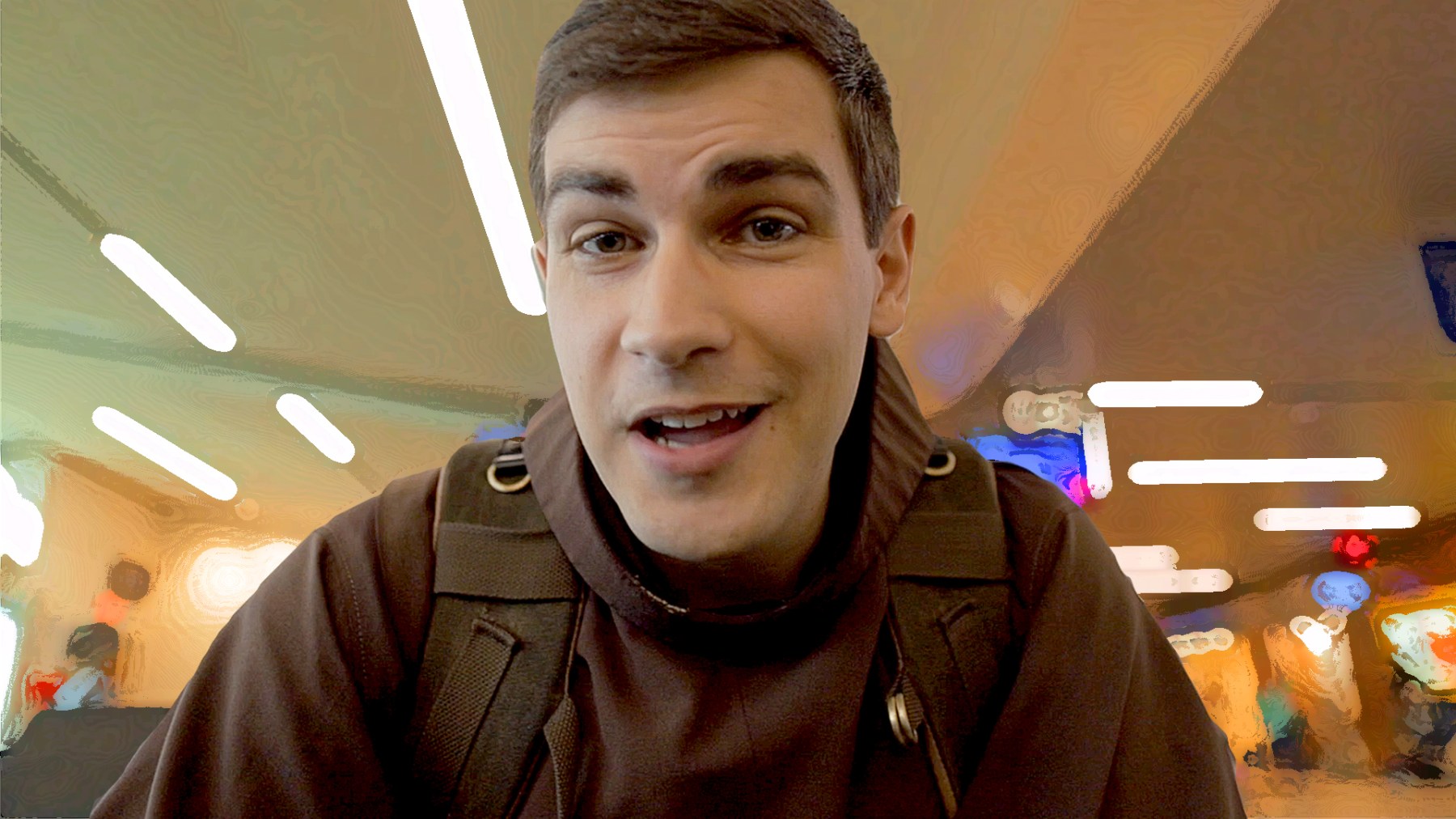
After a month off from social media (but not a month off… just so we’re clear), I’m happy to say that I’m back in the swing of things with YouTube, Instagram, Facebook, Twitter, and the podcast (whew… that’s a mouthful). While I’ve received many messages over the past few weeks wondering where I was, questioning whether I was stepping away from this ministry, the question was never in doubt; as with past Christmases, I take some time away, not just to rejuvenate, but to plan the next semester.

And yet, there was something a bit different about this break, I’ll admit. I didn’t have the same enthusiasm about the next semester’s lineup of videos. I wasn’t completely invested as I was in years past. A part of me was a bit frustrated with the work, a bit burnt out from the constant pressure to produce, and frankly, a bit disillusioned by the whole thing. Maybe I was discerning what the future would hold for Breaking In The Habit.

As I share in this week’s reflection, I found myself asking more and more last semester, “Am I even making a difference?” Sure, I was getting “likes” and nice comments. Sure, I have amazed at how many “followers” I have. But really, in the mission of Christ, was I really making progress in a way that reflected the work I was putting in and what I hoped to accomplish?

I share this, not because I’m still discerning this ministry or because I’m looking for compliments, but because I think that what I’m experiencing is very common in this life as a Christian. I think that we all hit walls, struggle to see the fruit of our labors, and have to fight the urge to give up. This is not the first time I have struggled in this way, and it will most certainly not be the last.

So, how do we respond. In this video, I want to suggest two things: 1) live with personal integrity, and 2) trust in God. At the end of the day, we cannot let our perception of success dictate how we act; besides the fact that our definition of success is different from God’s, we don’t always see the whole picture. It is important to remember, sometimes, that just because we don’t see progress, doesn’t mean that it isn’t there.

And so, I leave you with one of my favorite prayers, one related to this issue. Often attributed to St. Oscar Romero, it was written by then-Fr. Ken Untener (later, Bishop Untener) for the use in a homily delivered by Cardinal Dearden in 1979. I hope that it gives you the hope that it does for me, and that the wisdom of this prayer may guide us as we continue on.

Prophets of a Future Not Our Own

It helps, now and then, to step back and take a long view. The kingdom is not only beyond our efforts, it is even beyond our vision. We accomplish in our lifetime only a tiny fraction of the magnificent enterprise that is God’s work. Nothing we do is complete, which is a way of saying that the Kingdom always lies beyond us.

No statement says all that could be said.

No prayer fully expresses our faith.

No confession brings perfection.

No pastoral visit brings wholeness.

No program accomplishes the Church’s mission.

No set of goals and objectives includes everything.

This is what we are about. We plant the seeds that one day will grow. We water seeds already planted, knowing that they hold future promise. We lay foundations that will need further development. We provide yeast that produces far beyond our capabilities.

We cannot do everything, and there is a sense of liberation in realizing that. This enables us to do something, and to do it very well. It may be incomplete, but it is a beginning, a step along the way, an opportunity for the Lord’s grace to enter and do the rest.

We may never see the end results, but that is the difference between the master builder and the worker.

We are workers, not master builders; ministers, not messiahs.

We are prophets of a future not our own.

What do you when you’re a friar with a camera and you have a six hour layover?

Well, first you get on the metro, ride downtown to film a video, find out that it’s too bright and loud to film, give up on the video, and turn around to go back to the airport.

But after that… you still have three hours to kill, and so you do a question and answer video.

Not a bad way to pass the time, actually. Thanks to all who submitted a question, I hope you enjoy the answers. At this point, I’m home with my parents for a little over a week taking some time off. I hope everyone has a great final few days of Advent and a Merry Christmas!

On Monday, one of our brothers introduced prayer by saying, “Since it is now December 17, we will begin morning prayer with O Come O Come Emmanuel,” to which another brother said, “Which is the ONLY time that this song should be sung. None of this ‘first week of Advent’ stuff.” At least two people rolled their eyes and said, “yes, we know how you feel.”

We have interesting communal prayers in our house…

Who knew that even the classic Advent hymn “O Come O Come Emmanuel” could be controversial? For some, it is a very serious issue, one with strict rules and strong opinions. For others, it’s just a great Advent hymn that should be sung in the same way that people vote in Chicago: early and often.

So what’s the big deal? Why do some think that the song is meant for only one week of the year and others think it can be sung all throughout Advent? Well, it has everything to do with the origins of its source material, the O Antiphons. This week on Catholicism In Focus, I explain what they are and how they relate to the beloved hymn.

***

Unfortunately, this episode will be the final one of the year! I’m on vacation with my family for the next few weeks, but will be back in January with more episodes. Have a Merry Christmas!

Rejoice and be glad, the priest is wearing pink this weekend!

Okay, so technically we don’t rejoice because the priest wears pink, the priest wears pink because we’re rejoicing, but depending on your priest and how uncomfortable he feels looking like a bottle of Pepto Bismol… there can at least be some laughs.

This weekend is Gaudete Sunday, the time of the season when we take a momentary break from our penitential longing to remember that Jesus has already come, that there is already such great news all around us. Sure, he may not have arrived from his cloud to restore all that has been broken and we may not find ourselves yet in the perfect Kingdom, but that doesn’t mean we can’t take a second to be happy with what we have now. Our God has given us so much and loves us unconditionally. How could we do anything but rejoice‽

But that’s the easy part. Of course there is reason to rejoice, and for most of us, we can find many reasons to be thankful. God has blessed our lives with abundance. No, the question that I want to ponder, and what our Gospel suggests this week, is, how do we respond to God’s great love and mercy?

I want to contend that once we have found reason for rejoicing, once we have seen the amazing work that God has done in us and in the world, we can’t go back to who we were before we rejoiced; we can’t be the same person. Rather, we must live as people knowing the glory of God. This means sharing what we’ve found, changing our lives to better reflect the kingdom, and doing everything we can to make sure everyone rejoices with us.