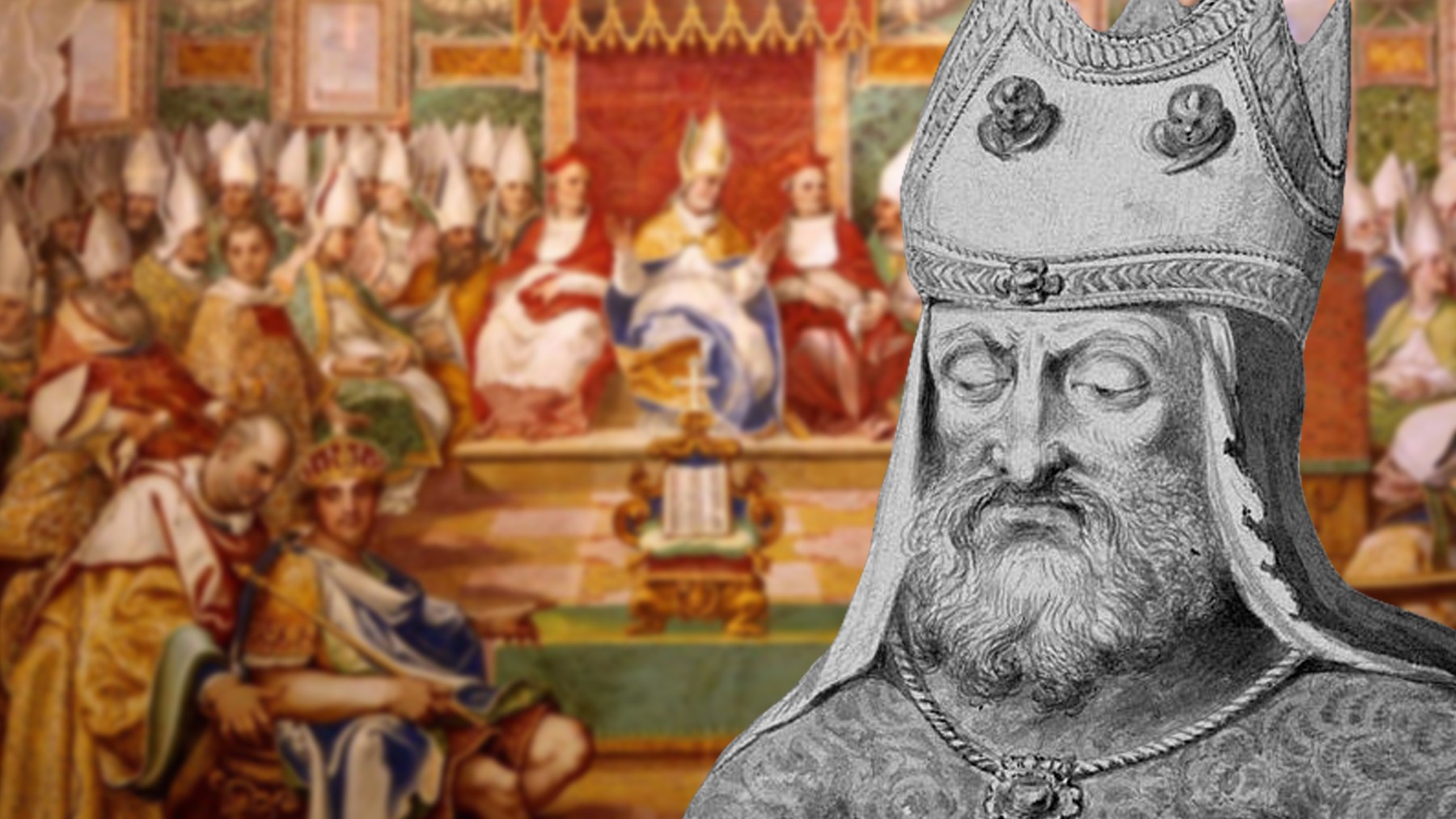
If you frequent Catholic blogs or YouTube channels, you are bound to see one word come up in heated arguments: heresy. When someone challenges Church teaching or another person just wants to belittle someone’s opinion, the word can get thrown around pretty easily.
Luckily, in most cases, heresy has not actually been committed. While heresy is certainly prevalent in our world (and I will make a video next semester outlining a few of them) simply disagreeing with the Church is not grounds for being called a heretic. The actual definition is a bit more precise than that.
So what is a heresy? This week’s Catholicism In Focus sets out to give a basic definition.
It is often jokingly said that in the “divorce” of the Reformation, the Catholics got the liturgy and the Protestants got the Bible. A reflection of the fact that Catholics emphasized the sacramental nature of God’s revelation while Protestants whitewashed their churches and made the Bible the only thing that mattered, historically, there was definitely a difference in emphasis, and one can understand why the stereotype was born.
This annoys the heck out me.
Like all stereotypes, the kernel of truth that existed 500 years ago has been so overgeneralized that it is, at this point, more of an untruth than anything else, and serves to create a false dichotomy. Just because some Protestants made the Bible their only authority and rid themselves of all other forms of divine revelation doesn’t mean that Catholics have any less reverence for it or that Sacred Scripture is any less important to forming our doctrine. The Reformers may have given up a sacramental worldview, deferring that identity to the Catholics, but the Catholics never gave up their emphasis on Scripture (and, maybe more accurately, weren’t subject to overemphasizing its importance as the Reformers did.)
What I am getting at with this? Often, out of this misunderstood part of history, Catholics face a criticism from fundamentalist Christians that many do not know how to answer. Thinking that Catholics do not care about the Bible and seeing that some of our beliefs are not explicitly stated in Scripture, some will say to us, “Your doctrines are made up” or “read the Bible and you’ll see how wrong Catholicism is.” I would say that I get a comment on a YouTube video to this effect on a weekly basis.
This week on Catholicism in Focus, I hope to address this issue by explaining the Catholic perspective on Scripture. We have the utmost respect for its words and maintain that it is the inerrant Word of God to guide our lives (not to mention that we proclaim as much or more of it at our liturgies than Protestants do). For Catholics, it is an essential form of divine revelation, but certainly not the onlyform. Looking at how the Bible was compiled, how God interacts with the world, and what Jesus did to form the Church on earth, we recognize that there is more to God’s authority than what is written in Scripture.
In moral theology, we make the distinction between moral evil (that which results from sinful action and imposes guilt on the actor) and metaphysical evil (the absence of good). In this case, murder would be moral evil while natural death would be metaphysical evil; the former is a heinous act against God while the second is simply the absence of good, the natural loss of life.
With this distinction in mind, how would we categorize war? There is no doubt, no matter the circumstances, that the act of inflicting violence and causing death is an evil; there is nothing “good” about it. But it does raise the question of guilt: is it morally wrong in all cases? Acts of war can be waged in self-defense. Violence can be used to save lives and protect the innocent. In many cases, doing nothing would result in more life lost and the greater spread of evil than a few calculated acts of violence against oppressors. Isn’t it more “evil” in these cases to do nothing than to fight against evil doers?
At yet, for Christians, the idea of a “just war” seems oxymoronic. How could there ever be a war that is just? How could one ever think that violence will ever bring about true peace? Sure, it might stop the violence from the opposing side, but does it bring the peace that Jesus spoke about? Probably not. One has to look no further than the “war to end all war,” World War I, and see how wrong this notion is. Despite enormous life loss, years of violence against the “bad guys,” and even an admission of guilt, the world was almost immediately thrown back into another war, far worse than the first, with almost three times the amount of casualties. War brought about “peace” for a generation, until the effects of that war caused a far worse conflict.
Which leaves us to wonder: is there such a thing as a “just war”? This is a question that Christians have been contemplating for centuries, leading to what it known as the Just War Doctrine in the Catholic Church, but also leaving many faithful Christians and theologians uneasy with its implications.
In this week’s Catholicism in Focus, we look at what exactly a just war is, when it can be employed, and what its limits are in use.

 Breaking In The Habit