As regulars to Breaking In The Habit will know, road trips are fairly common for me. Four times in the last two years I have found myself on trips of over 1000 miles, once driving from California to Washington, D.C. to pick up a friend, another time driving all throughout the Southeast to meet the friars and see our southern ministries. Two years in a row I’ve driven roughly 1200 miles on my vacation. It’s apparently what I do, both for work and for pleasure.

Apparently the friars wanted to continue to this tradition. Late last week one of the friars approached us and “asked” us if we were going to accompany him and the other friars on a trip to Cancún to move his stuff to his new assignment. I say “asked” in quotes because the question was less interested in our desire to go on this trip and more a question of us being ready to go in a few days. You can imagine our initial confusion. “Um, what now?”

For some, this might sound like an amazing opportunity, one that we should have felt excited about. And it was, for sure, and I’ll get to that in a second. But mind you, Cancún is not right around the corner. It’s a nine and a half hour drive—without stops—on a mix of highways, local streets, and yes, even a few gravel/dirt roads, sitting three across in the backseat of a pickup truck. Add that to the fact that we were never really asked, and that we would be missing a week’s worth of Spanish classes and contact with the migrants, and Christian and I were a bit, shall we say, less-than-excited about the trip.

Alas, at 5:00am Monday morning (a time that was negotiated away from the original 3:00am start we were first told), there we were crammed into the back of a truck on our way. Obedience at work, my friends! The drive was as expected, long and very uncomfortable, filled constantly with the thought, “What the heck am I doing here?”

Photo taken by Christian SenoAnd then we arrived to the beach. Suddenly my back pain disappeared, my frustration faded, and my wondering stopped. Just, wow. I have been to beautiful beaches in the US and I’ve seen clear blue water. But not like that. All I could think when I saw the water was that it had been photoshopped: “There’s no way that’s real. Mexico messed with the color settings of this beach.” Standing in the water we could see our feet clearly (and a handful of fairly large fish), the water was just below bathtub settings, and the sky had just the slightest touch of clouds brushed upon an incredible blue ceiling. After just one day on the beach, laying in the shade and drinking beers, the discomfort of the trip was suddenly all worth it.

And then we were gone. Just as quickly as we were “asked” if we wanted to go in the first place, we were “asked” after 24 hours to have our stuff ready to go in the morning when another friar would be arriving to take us some place else. Huh? Why? But I want to go to the pretty beach! Where are we going? The messenger did not know. And so we packed.

This ancient Mayan pyramid has 365 steps all the way around, just one of many astronomical features of their culture.

The following morning we awoke and packed back into the truck for a much shorter, two-hour drive into the heart of the Yucatán Peninsula, where we would be going to… somewhere. (Yeah, communication wasn’t really great on this trip.) Our first stop was the  historical site of Chichén Itzá, an ancient Mayan city. A major tourist stop for both Mexicans and foreigners, the complex was huge, complete with pyramids, temples, an arena for an ancient sport, domiciles, and even an observatory for star-gazing. As the friar that lead the trip was himself an anthropologist, we didn’t need to pay extra for interesting details or cultural feats, they came free!

IMG_3483

John Paul II visited this church in 1993

After a few hours we were on our way again, this time knowing where we were going. Or at least we thought we did. Told that we were going to Izamal, a town where the friars of this province have their provincialate at a large monastery, I pictured a larger city with a fairly new monastery tucked away in the corner somewhere. What we found was that the monastery was the city. Completed in 1561 (yeah, that building is more than 200 years older than the United States…), the monastery was built by the Spanish friars on top of the Mayan acropolis located in the middle of the city and has served as the focal point of the city ever since. The building itself was pretty extraordinary (probably the oldest building I’ve ever been in, come to think of it), especially from the view on top of the roof, but the city itself was quite a gem. Originally deciding to level only the acropolis for the use of the church, the Spanish left a number of other pyramids scattered around the city, maintained even until today. It was very cool to walk down an otherwise normal city street and see ancient pyramids between stores and houses.

The final surprise of the day (yes, we’re not done with surprises!) was when we packed up our things and got back in the car. This time I was legitimately confused. Wait, we’re not staying? Where are we going? Have I mentioned that communication wasn’t great? I was sad to leave the cool little city because I really wanted to walk around with my camera, but alas, we were gone before I knew it.

And I’m glad we did.
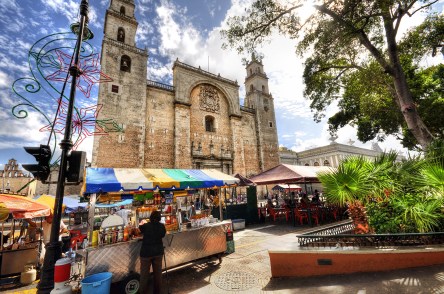
Unfortunately I didn’t have my camera with me, but here is a stock photo of the Cathedral in the city square.

The final stop on our whirlwind, unplanned, miscommunicated tour was hands down my favorite: Mérida. Located on the western shore of the Yucatán Peninsula, Mérida is the capital of the state and the largest city in the region, making it by far the most cosmopolitan. Within seconds I was taken away by it. While I’ve never actually visited Spain, all I could think about was Barcelona. The city streets, the culture, the old buildings, the night life, the art, the food. It was just so nice, an amazing blend of historic landmarks and modern living. We arrived just after sunset and the city was absolutely gorgeous. The city square had both the Cathedral and the governor’s building (the latter of which was absolutely stunning, filled with two-story tall paintings all the way around the top floor), live music and dance, restaurants galore (both local and international), and plenty of people taking in the warm summer night. We stopped at a bookstore to get some materials for our Spanish education (The Little Prince and The Curious Case of Benjamin Button, both in Spanish), and were off to dinner.

Little did we know (duh) that the “doña” of the restaurant was a close friend of the friars and we were in for a treat. Not only was the food and drink amazing (fresh, healthy, vegetarian menu), their was live music, a comfortable atmosphere, and a host that kept us laughing the whole time (at one point Christian and I got an unsolicited lesson in Spanish swear words, so there was that!) After a few free “tastes of the Yucatán,” courtesy of our gracious host, we began working on our friar-host to convince him to have us stay another night rather than leaving first thing the next day. Surely we can’t see it all tonight. This is a very important cultural experience. Why rush back, they’re not expecting us until Friday anyway. Very funny, but had it worked?

The next morning we met for breakfast and the friar began loading up the truck. Apparently not. Over in just a few days—the best part in mere hours—we were back in the truck for our seven-an-a-half hour trek back to La72. To say that the trip had its moments of discomfort would a complete understatement, but to say that it wasn’t worth it would be lying. I may have been surprised many times along the way, but I can tell you this: it would not surprise me one bit if I found myself in Mérida again one day, only for a lot longer.

There was much more of the trip to share, so make sure you check out my Facebook page for more pictures!

IMG_1748-0

No, it’s not the Ritz Carlton, it’s our dormitory at La72

As you might have noticed from my first post a month back, Christian and I are living in pretty tight quarters during our time here in Mexico. Not only are there six men in one room sharing a barley functional bathroom (you don’t want to know), our room is between the girl’s dormitory (six women sharing one room and one bathroom) and the common room, an all-purpose room for the volunteers to eat, talk, relax, play guitar, nap, and whatever else we like doing in our free time. Located on the second floor of the main building, it is open to all volunteers, not just the ones in residence, and so usually has at least 2-3 people present at all hours of the day.

This, honestly, has been one of the most difficult aspects of the trip.

Sure, the food is different and my body has struggled to adjust. Naturally, the weather is oppressive to someone acclimated to air-conditioning. And of course, trying to think and speak in another language provides more than enough headaches. But do you know what? I mentally prepared for these things. I expected them. And while they’re certainly don’t make what we’re doing a vacation, they are things that I have become relatively accustomed to over the past month.

I did not prepare for two months without privacy. When I go to bed, someone is in the bed next to mine; when I use the restroom, someone is just outside the door; when I sit down to read or study, someone is there making coffee, playing guitar, dealing with a problem. For almost five weeks now, everything I’ve done has been in the presence of others.

For an introvert, this is tiring to say the least.

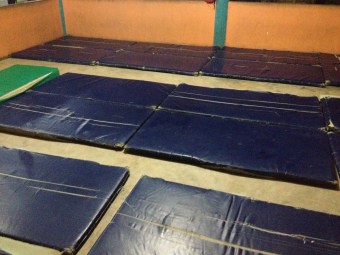
But this post is not a cry for sympathy, nor is it a complaint of any kind. You see, as difficult as the conditions have been for me to endure coming from my comfortable life in the United States, it takes but a single look outside of my window to see how comfortable I still have it. When I walk down the stairs of the volunteers’ quarters to the common area of La72, I see hundreds of people that would love to have what I have right now. A bathroom that only 6 people share? A bed to myself? A room with a door to close so I only have to be with three people, not 200As much as La72 is a Godsend to so many people, a place where people can breathe easily because they don’t have to worry about getting caught, facing violence, or finding their next meal without any money, it is not a comfortable living environment. The vulnerable groups (women, minors, and LGBT) each have a room to share with themselves while the men all sleep on mats under the pavilion or on the basketball court; they all share their meals in common; and there are just a handful of bathrooms and showers for everyone.

Seeing this makes me think of a number of things.

So that there is room for everyone, the men sleep four to two mats

The most obvious lesson, of course, is “be thankful for what you have.” So often we think about what we don’t have failing to see what we do and failing to see how rich our own circumstances are compared to others. This is a reminder I think we could all use.

But I think there’s something more to it than a cliché. What I am experiencing is a challenge to two strongly held values in our western world: privacy and autonomy. We like walls and fences over open layouts, suburban homes and rural fortresses over apartments.  I want my room, with my stuff, during my time. And who can blame us? Sharing is difficult. No matter if you’re five or sixty five, sharing requires that we give up something that we enjoy so that someone else can enjoy it instead of us. Sometimes it is difficult enough to share possessions that we are not even using. But what about our time? Our space? When we share these, relinquishing a little of our privacy and autonomy, we not only give up the right of use to something we enjoy, we allow ourselves to be bombarded with other people’s lives. Without walls or fences, without clear distinctions between yours and mine, we’re forced to interact with people outside of controlled environments, to meet them where they are rather than on our own terms.

And it makes me wonder: are privacy and autonomy due the amount of emphasis we give them? What if we were bombarded with people’s lives a little more, forced to interact with people not when we were prepared and ready but when the moment naturally developed?

What I—and to a much greater extent, the migrants—am experiencing is certainly the extreme case. Living two months without any privacy may not be the healthiest of lifestyles and I am surely not recommending it as the norm. But there is something here. There is something about being thrown to the extreme that has made the “normal” setup seem equally as distorted. Whereas in the US I am an autonomous individual that seeks out community when I see fit, here, my primary identity is as a part of a community and I have to actively seek privacy from the group.

Now of course, proximity does not necessitate community and togetherness does not necessitate intimacy, but there is something clearly different about this situation than my normal life at home: here, there is no denying that I am in this life with others. Like it or not, for better or for worse, I can’t think about myself or act in any way without being in relationship with another person. There is no escaping the larger group. Oppressive? A little. Claustrophobic? At times. But it’s an important question to ask ourselves as Christians: in all that we have and all that we do to maintain our privacy and autonomy, are we reflecting community and oneness, or we building structures of exclusivity and selfishness? Here, more than anything or anywhere else I have experienced, I have a sense that we are in this together.

Our neighborhoods, our Church, and our world would all be better places if we more tangibly knew what this felt like.


There is one Spanish phrase that I have used more than any in my three weeks here in Mexico. No, it’s not “See you later”; thankfully, it’s not “I need a bathroom, fast”; but unfortunately it’s not “Thank you for the beer.” No, of all the phrases that I have used on a regular basis, the one phrase that I use more times per a day than I care count is, “I’m sorry, I don’t understand.”

As you can imagine, this is a a frustrating thing to have to say on a number of different levels.

The first, quite simply, is that it sucks to be dumb. For someone who has always done well in school, has a fairly good grasp of the English language and is more than comfortable expressing personal and complex thoughts and feelings, to routinely have to say that “I don’t understand” and ask that they repeat themselves more slowly is humiliating. If, by chance, they are patient enough to speak to me like a small child—only adding to the feeling of inadequacy—I’m likely to understand the gist of the question or comment, but am left with another dilemma: What do I say in return? “Yes, I like cheese,” or “I am from the United States,” or “I need food.” Simple, direct, and extremely limited in expressing any sort of complexity or affect. So often I find myself wanting to say something just beyond the ordinary—a wish, a conditional statement, something with subtlety—but have to filter my ideas through my vastly inferior speaking ability.

And for casual conversations, this sort of embarrassment or frustration is to be expected, and most of the volunteers are helpful enough to make every conversation a teaching moment rather than get frustrated with me in return. But what about in conversations with the migrants, those who find themselves in great physical, emotional, and spiritual need? When a volunteer asks if I have seen such-and-such a person but I don’t understand the question, there’s really no problem; when a migrant asks me where they can get some food, tells me about their home country, or seeks help about some issue they have, to stare back at them blankly, request that they speak slower, and repeatedly have to say, “I’m sorry, I don’t understand,” it’s a different story. I feel stupid, yes, but often they do too. For some, my inability to understand them looks poorly on me as a student of the language (which is fine), but for others, the experience only furthers their feelings of doubt and alienation. “You don’t understand me?” It’s not about the language, per se, but feelings of inadequacy, feelings of being unintelligent, feelings of not being understood by others.

It’s a complex situation and I have mixed feelings about my experience thus far. On the one hand, there is tremendous benefit to being put in such a vulnerable situation, stripped of my confidence and forced to feel as so many do everyday. It is truly a “minor” position, and even if the conversation yields no tangible results for either party and I don’t necessarily grow in my Spanish-speaking ability, it is an experience worth having. On the other hand, though, there is definitely a sense that I would benefit more under controlled conditions, speaking to people who are not so vulnerable themselves, and who, frankly, are able to annunciate and articulate themselves in a simple enough way for me to grasp what is going on. (People from one country in particular are almost impossible to understand, even for the Mexican volunteers. For example, in one conversation this morning, one women said “De-SAY.” After a few seconds of confusion, I realized that what she was saying was dieciséis, the word for sixteen, pronounced, Dee-es-ee-SAYes, not “De-Say.”) To have “conversations” in which I am consistently lost from beginning to end doesn’t seem to be the best way to learn a language.

But who knows. Now just under three weeks in, Christian and I have another six weeks in Mexico to make the most of it. Our classes each day (for three hours) have been going well, I’m constantly studying vocabulary on an app on my phone, and I’m starting to notice results. I’m picking up more words in each sentence, I’m beginning to get more comfortable speaking, and just today, Christian said that he thought my vocabulary had noticeably improved already. Here’s hoping! For now, I’ll just have to get used to the fact that I’m not going to understand everything, and that that is okay.

After nearly two weeks of being here in Mexico, there are a lot of things that I want to share. Difficult things. Moving things. Heart-breaking things.

For right now, though, I don’t want to do any of that.

Lest all my posts give the impression that my experience is nothing but struggles or political statements about immigration, I present to you the adventure of a day off that was yesterday.

Being that neither Christian nor I speak Spanish very well, leaving the compound and venturing into the city is an adventure in itself. Ordering food, taking a taxi, or finding our way around the small town almost always has some hiccup in the form of a miscommunication.

You can imagine, then, how confident we felt as we left yesterday to find the “place where people swim” in the river. We knew the name of the place and roughly how to get there… and so we just went. (This, I would like to point out, is not something I would ever do on my own.) We took a small taxi into the town (about 5 minutes), found the place where the “bus” (a glorified van) took people out into the country, told them where we wanted to go and started our journey. Twenty minutes later, we found ourselves at a restaurant and park overlooking the river.

IMG_2714

Promising situation?

Great success? Not yet. As we looked into the river, there were a few boats, but no swimmers. There really wasn’t a shore or grassy area to get in the water, and frankly, the river looked disgusting. Do people actually swim hereSurely, if they did, there would be people swimming at 11:00am on a Saturday. Despite having ten or so people in the park area, we knew we had missed something. The existence of towels and coolers told us that we weren’t far off though.

Being that it was just before lunch and we had no idea what we were doing, we decided to stop in the restaurant to grab a bite to eat and ask for directions. “Do people swim here?” No. “Oh, where do they swim?” Santa Margherita. “Where’s that?” You need to take a boat north for 20 minutes.

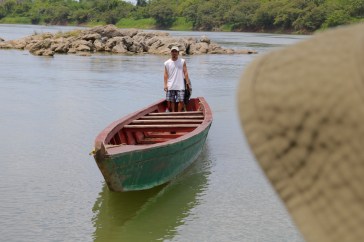
Shoot. A boat? In our broken Spanish, we talked to a guy who said he could take us and that it would cost 400 pesos (only about $22, but relatively expensive given that lunch for the two of us was around 150 pesos.) “Uh, no thanks,” we told him. When we had first arrived, and once while we were eating lunch, we saw a larger boat taking 10-15 people up north, so we figured we would wait for that instead of commissioning a private, small boat. All we had to do was wait for that boat to come back south, which seemed to be on a 30 minute schedule.

Yeah… it wasn’t. An hour-and-a-half later, still sitting at the dock with our feed in the water and sunburn developing on our arms, we had to ask the question both of us had been thinking but neither wanted to ask: “So… what should we do?” Feeling that we had made a big mistake, and dreading the embarrassment of having to go back to the compound and tell the volunteers that we had somehow misheard their directions and never actually found a place to swim, we prayed, threw a 50 cent piece into the river, and hoped for a miracle.

At the top of the hill, a car arrived. People. People with a cooler. And towels. And a little girl in a bathing suit and life jacket. We must be in the right place… right? Mustering our strength, we sheepishly walked up to these Spanish-speaking strangers, hoping that they could point two dumb Americans in the right place. As we approached, we both laughed. “Isn’t that the volunteer from Doctor’s Without Borders from La Setenta Dos?” To our great surprise, and relief, she recognized us before we even opened our mouths. What. A. Blessing. There with her family, the explained that you could either wait for the big boat or commission a smaller one and that it was 400 pesos, not each, but for the whole boat. With 8 of us, that was not only a lot cheaper, but also a lot more reassuring that we would get to the right place. (Knowing that the place we wanted was called Santa Margherita is great, but having people who actually know what it is and how to get there is a little better!)

IMG_2745

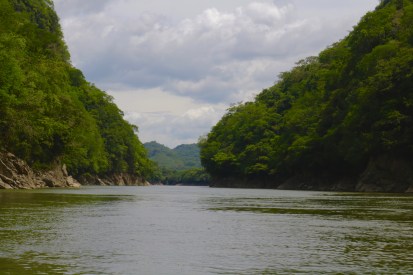
We were out in the middle of nowhere

I tell you, the boat ride would have been worth the full 400 pesos each had we known what we were doing. Traveling up an undeveloped part of the country, it was like we had entered the Amazon: trees lined either side of the bank as far as we could see, mountains and shear canyon faces surrounded the trees, and there was not a single sign of human life for the whole twenty minute ride. Half expecting to see piranhas jump into our boat, we were out there. And it was incredibly beautiful and so peaceful. With our new friends, we were motoring up a vast river into uncharted lands without only the slightest idea as to where we were going. We knew that we were going the right direction… but where would that ultimately lead us?

At first, it was pretty underwhelming and a bit confusing. We pulled up against a rocky, kind of dirty bank and were told that this was it. There were little lagoon cutouts into the land, and so we figured that’s why people came here: it was shallower, had no current, and might be cut off from wildlife. But it was still pretty dirty…

We walked, and we walked, and we walked. Maybe 200 yards along this thin strip of land past lagoons we walked, personally unimpressed. And then we saw it. Up ahead there was a freshwater spring shooting out of the rocks into an enclosed canyon. The water was clear. There were people jumping from the rocks into the surprisingly deep water, games being played, and people sitting on the edge drinking. When we jumped in, we realized that, not only was the water clean, it was cold. We’re talking ocean temperature before summer hits. It was an amazing. Hidden behind the murky river, surrounded by countless miles of untouched and inhospitable land, there was an incredible, mildly-civilized oasis to find refreshment. Christian and I spent about three hours there, the time away from the Casa an oasis in itself. For a few hours, our body temperatures lowered, our focus on those with such desperate situations all around us faded, and we were able to just relax on a beautiful day.

How we ever ended up in this beautiful place, having left with the faintest ideas of a plan, I have no idea. But it was wonderful.

[For more pictures, check out my Facebook page at: www.facebook.com/BrCaseyOFM.

One of the things that has surprised me thus far—though it shouldn’t have—was the amount of people I’ve met here at La Setenta Dos that have already been to the United States. It’s difficult to say how many, but based on my very limited, very anecdotal evidence, it seems like a good number.

The implications of this are quite terrible, for a number of reasons.

The first, and most apparent, is that no one should ever had to go through what they go through once, let alone multiple times. Risking their lives, living in fear, enduring physical and emotional pain, feeling unwelcome, begging for food—the list is not a good one. The journey for Central and South Americans to reach the United States is not a tale of adventure, complete with romance and triumph, narrowly escaping danger with comical flippancy; this is not Star Wars or Pirates of the Caribbean. Their journey is dangerous, tiresome, deflating, and unsettling, producing very few winners  and even fewer without scrapes and scars.

But that’s just part of the journey. As is evident by the amount of repeat travelers, arriving in the United States does not guarantee continued living in the United States. Those who do not have documentation live every day in fear of a traffic ticket or accidental brush with law enforcement because it could be the day that they’re sent back to the very place they fled. In a moment—any moment—they could be “found out” and deported, torn from their new life and forced to go back.

Go back to what, though?

I spoke with some men who had been in the United States for five, ten, even twenty years. One guy came as a teenager, graduated from high school in California, lived and worked for five years after high school before being deported. Where is this 23 year-old, having lived in the United States for eight years, going to go? How is he expected to make a livelihood in a country where he now knows very few people has nothing to his name to start with?

The fact of the matter, no matter the legal or ethical code one adheres to when it comes to immigration, is that many of those who have fled their country and arrived in the United States have no other home than the United States. They have no “home” to be deported to: their family, friends, possessions, job, and really, experience, all exist in the United States. In speaking with some of the migrants here, that was what gave me the greatest punch to the gut. Not only are they fleeing the violence and oppression that instigated their original departure, but many of them are also fleeing in a desperate attempt to return to the ones they love who had not be deported.

With that on their minds, the fact that they have to risk violence, go hungry, and face abuse along the way—terrible things for anyone to endure even once, let along two or three times—becomes an almost commonplace experience, a perpetual uphill journey. Been there, done that. Whatever it takes to get home.