One of the perennial questions for people of faith is that of evil and suffering. If God is all good and all powerful, why is there evil and suffering in the world? For many, it is the most challenging question to faith, the thing that most powerfully drives people away from God. When many see the massive destruction of a natural disaster, the horrors of an event like the Holocaust, or the tragic deaths of children, they’re left wondering what the point of it all is.

The fact of the matter is, despite the great wealth of wisdom we have in our Church, we have many more “okay” and “sufficient” answers than we do “excellent” ones. For centuries, we as a Church has grappled with the discomfort of incomplete responses. For much of my life, then, this has been a prominent point of reflection for me, a question that I have had to wrestle with constantly as I grow in faith. What’s the point of it all?

In 2011, shortly after joining the friars and starting my blog, I offered what I found to be the best approach to the question in a three-part blog post. It was a stab in the dark, an attempt to wrap my hand around a mystery that cannot be mastered, and obviously it was incomplete. Looking back, I see great wisdom in what I wrote, but also some problematic holes that need to be nuanced.

Today, I offer another reflection, this time in video form. Like the blog posts from more than four years ago, I am pleased with the words I have found and believe that there is wisdom worth sharing: God is not responsible for all of our suffering. While our first response is to always look to God as being responsible for everything that happens, it is much more appropriate that we look to ourselves as the culprits. In our narrow perspective, misdirected desires, and poor choices, there is enough fault in ourselves to free God of our finger pointing.

It is a reflection that has been very helpful in my own life.

And yet, just as in 2011, I fully admit that my reflection is not the end of the conversation: I present to you a video with problematic holes and incomplete thoughts. Just because we are responsible for much of our pain and suffering does not completely free God from all responsibility. Are there times when God does intentionally cause suffering, either to get our attention or for God’s own satisfaction? How do we reconcile the story of Job with a loving and all-powerful God? Why would God create a zero-sum game of a world, one in which its creatures were constantly in conflict with one another and suffering was inevitable?

It is a reflection that requires more thinking and more nuanced answers.

There’s so much more that I want to say, but I think that’s the beauty of mystery. We can never capture it all and there is always more to know. The question I seek to answer today is something that should challenge us as Christians for the rest of our lives. It is my hope that this video will not be seen as an a definitive answer to the question, but a stimulus for further reflection and discernment.


Good art has a way of changing our emotions, sparking our imaginations, touching our souls, and moving us to action. Think about how powerful your favorite movie was the first time you saw it, or how you feel when you get to watch it again. Think about how the right song can stop you in your tracks, lift you up, or completely change your day. Art, especially in the form of movies and music, is a powerful medium of expression and persuasion.

So, then, as Christians, what do we watch? What do we listen to?

Some choose to watch and listen to it all. “If it’s popular, I’ll see it!” This may not be our best option. Turn on the tv, go to the movies, or play a few songs on the radio and you are bound to find terrible language, un-Christian themes, gratuitous sex and violence, and really poor writing. The Christian is sometimes left wondering what to watch.

As a result, some have chosen to only watch and listen to things produced by the Christian industry, geared to created “positive and encouraging” entertainment for the whole family. Christian music and movies are uplifting, wholesome, appropriate for all ages, and even informative about our faith. Given what’s on regular tv and radio, some believe that this is all a Christian could ever need.

But, as I’ve written before (Franciscan Film Society) I’m not a huge supporter of the Christian industry. While I don’t find reason to discourage people from it, I often find the message simplistic, the situations far from reality, and the quality of production distracting. Sure, it may have a nice, wholesome message, but it does not challenge me or stimulate my imagination. For me, the Christian industry is not bad, it’s just safe. It does not take risks, does challenge or unsettle, and does not cause the viewer to come to his/her own conclusions. It comes up with a clear, comfortable message, and builds a story around it.

Not all art is so neat and tidy. Not all problems have an easy answer. Not all situations have a happy ending. Not all of life is G-rated.

For me, there is much more fruit for a critically minded Christian in secular movies: The best movies portraying the journey of a Christian to the heart of God are often found in the secular world. With better acting, larger budgets, more creative and skilled writing, and, frankly, more of a grasp on the way the world works, secular movies and music offer greater artistic value and stimulate our imaginations in a way that many (not all) Christian movies simply do not.

What I suggest in this month’s podcast with Rob is that a trip to the movies or a turn of the radio dial can be a prayerful experience, even if the content is not itself explicitly Christian. While there are certainly things that are probably not beneficial to anyone (there is bad art in every segment of the population), a Christian with an incarnational spirituality and a critical eye can experience God, redeem what they see, and be moved to be a better Christian, even in the secular world.

For those on email, click here for the video.

Christianity is a religion of mercy and forgiveness. The great truth that Christianity captures is the fact that, despite our rebelliousness against God, despite the fact that we are owed absolutely nothing, God gives us his grace anyway. We believe that there is no bound to God’s mercy, and at least in theory, there is no sin that God could not forgive. There is nothing that could keep us out of God’s love.

As I continue to grow in faith, working out my own salvation daily and training to help others in theirs, I have found otherwise, at least in practice. While God’s mercy may abound, the Church’s understanding and ability to express it does not, and we are left with one seemingly unforgivable sin.

Which one, you ask? Some point to Mark 3:29, and say that blasphemy against the Holy Spirit will not be forgiven. I’m not entirely sure what that would mean, but am sure that even the worst blasphemies are balanced with one’s faith at the time (“how could they even know what they’re saying?”) and can be forgiven. Others point to truly heinous crimes against humanity, e.g. genocide, or affronts to the most vulnerable, e.g. abortion, as sins that cannot be forgiven. Surely these are terrible sins, but with God’s boundless mercy in mind and the presentation of a truly contrite heart, the Church has a way for truly remorseful sinners who looking for a way back to God to repent and be readmitted into full communion. Sexual abuse must be what I’m getting at, then, right? Still no. Even in the case of priests and religious who have be defrocked and removed from active ministry–serious punishments for a serious sin–God’s mercy still allows that these men and women receive grace, and the Church has a way for them to be readmitted into full communion.

In each of these cases, blaspheming the Holy Spirit, abortion, genocide, and sexual abuse, there is a process by which one can be readmitted to the Eucharistic table and receive the sacraments of the Church. For some divorced and remarried Catholics, though, this process does not exist, and many people find themselves permanently unable to take part in the full life of the Church. For many, remarriage after divorce, at least in practice, is an unforgivable sin.

Maybe some theological background would be helpful hear. In the Catholic Church, marriage is not a simply civil contract between consenting parties, it is covenant before God. Like the covenants of the Bible, marriage is transformative, meaning that the relationship is different in nature than it was before, and indissoluble, meaning that its character is permanently established. Prior to being married, the bond between the couple is based on their will and love for one another; after being married, the bond, now sacramental and covenantal in nature, is based on God’s will and love for the couple. To turn away from this in divorce, or to break this covenant by trying to enter into it again with another person, is obviously problematic.

But the fact of the matter is, regardless of theology, people in the Catholic Church get divorced at the same rate as any other religious affiliation. And while divorce in itself is not sinful and does not remove one from the life of the Church, getting remarried without a declaration of nullity (showing that the sacramental bond never took place because of lack of consent or deceit on behalf of one of the parties) is a serious problem. How can one be in full communion if they break a covenant made before God and try to enter into another one? The Church “welcomes” these people, but does not allow them to fully participate in the life of the Church, i.e. they may not receive Eucharist at mass.

And on the one hand, it makes sense. Marriage is not taken seriously by many, and in many cases, is broken because of “irreconcilable differences” or because the couple doesn’t have the same love it used to. This is seriously upsetting, showing that the couple never quite understood what they were entering into when they made a solemn oath before God. To willfully and even casually jump from one marriage to another does remove one, to some extent, from the body of Christ.

On the other hand, to what extent is this selfish and even sinful act determinative of the rest of someone’s life? You will not find many people in the Church saying that divorce and remarriage is a good thing, but the situation many people face is one without a way out. What solution do we have for people who admit to this sin? Right now, the only solution is an annulment.

But let’s say there is a couple that gets married when they’re 24. They are both well-informed Catholics who know what they are getting involved with and enter into the covenant validly. Five years into marriage, though, they have a low point, let their tempers get the best of them, and say and do things that cannot be reconciled at the time. Without much prayer or consult, they rush into divorce, and choose not to speak again, moving on to other relationships. Looking back on that situation ten years later, one or both of them may see the error of their ways. They may see how selfish they were and how quickly they removed God from their lives. They are truly contrite, and wish that they had not acted thus. But now they are 39, far-removed from one another, and are both in, healthy civil marriages, raising children and teaching them the Catholic faith. What can they do? An annulment is not possible: the marriage was valid and they know it. Getting back together is not possible: they are too far removed, and now have children and lives with other people. They are stuck in a situation without a solution, removed from the body of Christ with no way back in.

This is not an unusual case. This is becoming commonplace in our churches.

When I think about the incredibly high number of people that are in this exact situation, and lament over the droves of people each year that leave the Catholic Church for another Christian denomination, I am reminded of the situation that Jesus faces in each of the Gospels. Weighed down by the heavy burdens of the Pharisaical law, entire groups of people find themselves outside of ritual worship with no way in. The shepherds who witness the Nativity in Luke would not have been allowed in the Temple; the woman suffering from hemorrhages for twelve years in Matthew would have been an outcast in society; the centurion who gives the final and most prophetic pronunciation of Jesus’ identity in Mark was unwelcome in the community; the woman at the well in John, a perfect example for this discussion, was rejected not only by the Jews but her own people. In each of these cases, and really, in almost every single case in the Gospels, Jesus forgives the sins of those unable to enter, reestablishes them within the worshipping community, and tells them to sin no more. He does not criticize the law, nor does he say what they had done wasn’t bad. He simply shows mercy and removes the impediment that keeps them from worshipping him fully with the rest of the faithful.

Isn’t that, ultimately, what we wish of all people? That no one wishing to enter, showing contrite heart and willing spirit, be denied entry into the life of the Church. For blasphemy, genocide, abortion, and sexual abuse, terribly heinous acts that are entirely against God’s will and pull our human family apart, there is no impediment for the Church to grant absolution if the right conditions are met. For divorced and remarried Catholics, the solution is not quite as clear.

So what is it that we do? How do we act as Jesus did, revealing the unbound mercy of God in our world? Some say that we should just stop putting so much emphasis on the whole issue, accept that divorce is natural, and allow it without consequence. Others hold firm to the theology, and, taking the stance of the penitentials of the first millennium of the Church, believe that people should simply understand the gravity of their error and live ascetically for the rest of their lives. For me, neither of these solutions are sufficient because neither capture the redemptive love and transformative grace that Jesus showed in his life.

The great truth of our religion, the “Good News” as it were, is that God humbled Godself, even died upon the cross, to give grace to even the least-deserving. The message of the Gospel is not one of excluding all but the perfect, but rather inclusion of the most imperfect. If we believe that salvation is from our Lord, and that the grace he gives is freely given to unmerited sinners, then we must believe that there is no sin that God cannot overcome. It is with great hope and anticipation, then, that I follow the current Synod on the Family, and pray that we may find a way to serve and welcome those who feel that they are unforgivable… Just like Jesus did.

It’s a Miracle!

Jesus is a great mystery of faith

Jesus is a great mystery of faith

This year at Catholic University, I am taking a class called “Christology,” the systematic theology course devoted entirely to the person of Jesus the Christ. Among the many questions that we are being asked to investigate (Who was Jesus of Nazareth? Was Jesus God? What is his relationship to the Father? Why did God become flesh? Did Jesus have to die? Did Jesus know he was God? What do we make of the Resurrection?) there is one that has taken hold of my attention this week because, well, it perplexes me: what is a miracle?

Given the amount this word is used and its centrality to the Gospel narratives, this may come at a surprise. What kind of vowed religious doesn’t know what a miracle is? Everyone knows what a miracle is! Fair enough. It is certainly a largely understood concept in common language. But is our common definition(s) based on a) what we believe about God or b) are they largely influenced by popular religion and “Hallmark” notions? This is why I find a need for more investigation, and why I will say at the onset, that I plan to share more questions than answers in this post.

So let’s start with a common definition. What is a miracle? “A surprising and welcome event that is not explicable by natural or scientific laws and is therefore considered the work of divine agency.” So says my dictionary. Basically, there are things that God does in our world that are extraordinary and absolutely unexplainable because God has entered into our world and made something amazing happen, e.g. the parting of the Red Sea.

But is this really the definition we want to settle on? Known as the “God of the gaps” explanation, this definition relegates God to those areas that scientific study have yet to understand. But these “gaps” as it were, the filling in of what we cannot otherwise figure out, are narrowing; scientific inquiry yields much more information today than it did 2000 years ago. Also, given the fact that we don’t know everything about nature but are continuing to learn, we have to recognize that there is a huge difference between “things we can’t explain right now” and “absolutely unexplainable.” Putting things in the latter and claiming them to be miracles is first of all arrogant, but worse, it inevitably undermines the claim of miracle when in fact science is capable of explaining its cause years later.

The other problem I see is with the whole notion of God interjecting the world with something not-of-the-world. Do we believe that God is outside of our world, looking in from a far, periodically jumping in to mess with the nature that he created? Surely, the God who created the world and its natural laws is a God that continues to create and govern the worldEven if we want to posit that God is capable of transcending his own laws (He is God after all), it would seem illogical to think that this is the only way that God interacts with the world. Just because we can scientifically explain the chain of events that caused something to happen, isn’t it possible that God is ultimately the primary cause causing everything else to happen? In other words, we may be able to scientifically explain why a person was cured of a deadly disease, but God could still have been working through the doctor to come to the correct diagnosis, the pharmaceutical company to accurately produce the drug, and the nurse to administer it properly.

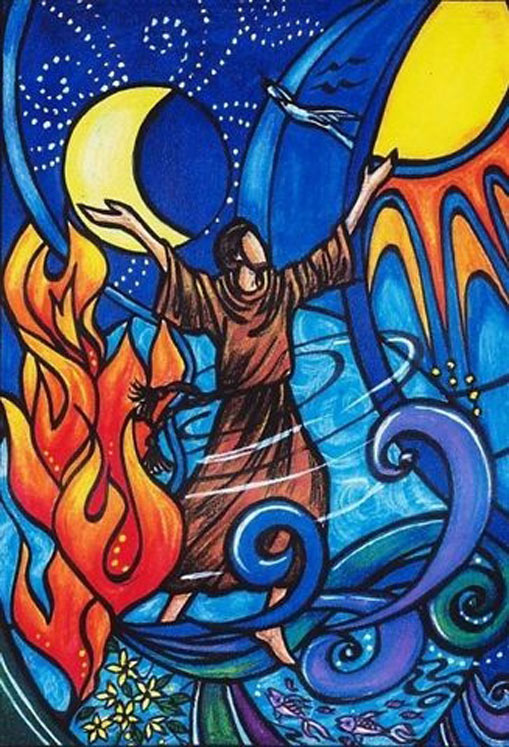
Understanding miracles in this way shifts the attention away from the undeniable, provable explanation of the “God of the gaps” onto the faith of the beholder. If God is ultimately the primary cause of all secondary causes, well then, it is up to the person of faith to have the eyes to see God’s work all around him/her. The beholder begins to see the world as Francis of Assisi did, not as innate objects following predictable laws, but as creation, the work of an ever-loving God that animates it into being. With these eyes, everything is a miraculous work that can overwhelm… if we have the faith to see it.

This end of the extreme also has some problems, unfortunately. With this “everything is a miracle” perspective, one has to wonder about the initiative of God. If everything fits within the laws of nature, either God is a) a micromanager that makes everything happen without any freedom allowed to creation, or b) the God of Deism, the watchmaker, who set the world in motion according to laws and then remained at a distance watching. In either case, “everything is a miracle” makes nothing a miracle: things only seem extraordinary because of our perspective, not because God has acted in a different way. God may still be its cause, but every act would be just as important as the one previous. This is not a “miracle” as we are investigating.

So what does that leave us with? A miracle could be something “unexplainable,” but we can never know that it is actually unexplainable. It could also be something entirely explainable and ordinary, but unless it catches our attention, one runs the risk of pure subjectivism not knowing which cases are “miracles” and which are ordinary natural laws (see Pat Robertson claiming that Hurricane Katrina was God’s wrath for a sinful lifestyle in New Orleans). God must clearly be the cause of all things, at least in the primary sense, but then what differentiates “miracles” from regular acts of God’s initiative?

At this point, I think it’s important to look to the experts for some guidance. Cardinal Kasper, a renowned theologian in the field of Christology proposes a theological theory of miracles in his book Jesus the Christ:

  1. Miracles can be extraordinary, unusual, and amazing, leaving them up to interpretation. Drawing on the Second Vatican Council, he says that it is up to the faith community to determine the unity between act and word so that an act of faith measures up with all that has already been received by faith in word (Tradition, Scripture, Teaching).
  2. “A miracle is the result of a personal initiative of God.” A miracle is God attempting to reveal Godself to creation, doing so in symbolic physical form.
  3. “A divine intervention in the sense of a directly visible action of God is theological nonsense.” Something that is so clear that it cannot be disputed removes the element of faith, compelling one to know not believe. God does not want to force us to know or love him. The more powerful the miracle, the more powerful our independence to reject it.
  4. All miracles have multiple interpretations. Like the previous point, miracles do not compel knowledge, but “can only be seen as the act of God by faith.” One’s faith and personhood largely influence how one will understand the initiative of God, and that is okay, for it is the purpose of miracles to “turn people’s eyes upwards, towards God.”

If after reading this post you find yourself more perplexed than you were to start, welcome to theological study! The fact is, much of our faith is a mystery, an aspect of faith that surpasses our ability to know perfectly. But that does not mean that we cannot know anything at all. With careful attention and prayer we can enter into it and be changed by it. If you can live your life in this mystery, seeking God with all your heart so to be given the eyes to see God’s work in you and in the world, there’s only one thing to say: That’s a miracle!

Francis: The Patron of More Than Just Birds

This evening, the friars in my house celebrated the 35th anniversary of St. Francis being named the Patron of Ecology. As head of the JPIC committee in the house, I had the privilege of preaching at mass based on Gen 2:4-25, Ps. 104:27-30, and Jn 1:1-5. For more information or other reflections, you can go the the Franciscan’s website, francis35.org.

Thirty five years (and six days) ago, John Paul II proclaimed Francis of Assisi the patron saint of Ecology with these words:

Among the holy and admirable men who have revered nature as a wonderful gift of God to the human race, St Francis of Assisi deserves special consideration.  For he, in a special way, deeply sensed the universal works of the Creator and, filled with a certain divine spirit, sang that very beautiful “Canticle of the Creatures”.

It is a great honor that we as Franciscans are able to celebrate today such an example, to be inspired by his life and to imitate his joy and reverence towards God’s creation.

It is also a time for clarity, for us and for the world, as to what Francis actually said and did. As we know, Francis is often found with a bird on his shoulder, sometimes even talking to many animals. But is this the Francis that we see as our inspiration, the one the world needs to see? I believe that there is confusion, even in John Paul’s proclamation, as to what Francis can offer the world. There’s something more to Francis than a lover of animals; something more than someone who saw nature as simply God’s gift to humanity.

Francis was a man who saw the world differently than those around him. Everything in creation pointed him to God.

Francis was a man who saw the world differently than those around him. Everything in creation pointed him to God.

As with everything for Francis, his worldview begins from a position of littleness and humility before his Creator. As humans, we are God’s creatures, beings that owe everything that we are to the “most high, glorious God.” Francis would always want us to remember where we came from: God formed us from the dust of the earth. When the Church talks about social teaching, it puts human dignity as the foremost principle, from which all others flow; creation in this sense is as John Paul put it, a gift for humanity. For Francis, it is the other way around: we were created out of the earth, as a part of creation, called to be stewards and caretakers of something much bigger than us. Creation is not subject to us, free to be used and exploited however it best fits us. No, the whole created order is our brothers and sisters, made by the same loving Father, oriented to pleasing him each in its own way. It is out of this great humility that Francis asked with his life, “What does my brother and sister need?” and remained subject to all so as to allow what God had created to act in the way God had intended.

How did God create the world? I think it’s easy to fall into a Deistic, Watchmaker understanding of the world: there was a time at which God made everything, it happened in the past, and now God is off somewhere looking down on everything he set in motion. This, I tell you, is not very Catholic, and it’s certainly not Franciscan. Instead, let us look at the Gospel: “In the beginning was the Word, and the Word was with God and the Word was God…All things came to be through him, and without him nothing came to be. What came to be through him was life.” God the Father created through the Son, in the Holy Spirit; the Father is the one who speaks, the Word is the one sent to the world, and the Holy Spirit is one hearing and responding. This is not something that happened, something that only took place at one point in time; it is the very nature of who God is: eternal self-disusing, creative love. God created, God creates now, and God will continue to renew the face of the earth.

And lastly, no discussion of Francis would be complete without mentioning the pinnacle of God’s creation and love, the Incarnation. As Franciscans and Christians, how can we not be amazed at what God has done: the Creator allowed himself to become the created. In the person of Jesus, we are able to experience God in our concrete, physical reality. It is a reminder to us that all that God has created, the entire material cosmos, is good and worthy of revealing himself. When Francis looked into the world, he saw the means for us to experience the living God. The Sun. The moon. Wind. Fire. Water. Earth. All of creation. These were not inanimate objects to use at his disposal, they were imprints of the one who created them, and vessels for us to experience him. How amazing it is that we can harvest the earth, bake it into bread, and encounter our God in a physical way? This is the perspective that Francis has to offer the world. This is the awe and reverence that inspires us, the humility and littleness that guides us, to see God working in and through all of existence.

For this reason, we are called to care for God’s creation, not for its usefulness to humanity or for the well-being of future generations, but for its own sake. What God has created is good, it is holy, and it requires our attention. Like Adam in our first reading called on to name the animals and take care of the garden, God has privileged us with being co-creators with him.

We can glory in the wonder of God’s creation or to manipulate it for our own gain;

We can choose to bring life or to destroy it.

We can work with God, who continues to renew the face of the earth each and every day, or we can work against him, polluting and over consuming what is not rightfully ours.

On this anniversary, I pray that Francis may be an inspiration to all of us, that we may be more humble servants in this world, caring for all that may lead us to the one who gives us life. May God grant you his peace.