For many, the liturgical reforms following the Second Vatican Council was a jarring experience. Even for those who favored them, the changes were so great in some places that it was difficult to reconcile what they were presently doing with what they had been doing. The new was a rupture from the past, and that was either a good thing or a bad thing, depending on one’s perspective.

Even today this perspective prevails. As we’ve become entrenched in our camps, very few have a satisfying perspective for me. Either the Tridentine Mass was the true Mass and the reforms were heretical or the Tridentine Mass was oppressive and the reforms brought us back to true worship. There is no harmony in the story. There is no sense that it was the same Church that promulgated the Tridentine Mass as it was that promulgated Sacrosanctum Concilium (Second Vatican Council liturgical document that offered principles of reform). No, for most people, one is right and the other is wrong.

I struggle with this perspective.

Too often with progress we want to forget the steps and people and decisions that came before us and dismiss people of the past as outdated or backward. They didn’t have the same sensibilities that we do. They weren’t as enlightened as us. Um… duh? Isn’t that the point of progress? We would not be where we are without the journey of those who came before us, and they with the people before them, and so on. What’s often lost in the discussion is that sometimes the people in the past, although outdated (by definition…) today, were progressive and pastoral and faithful in their time too. When we look at the Council of Trent in its context we understand that it’s perspective was both necessary and pastoral.

On the other hand, too often we romanticize the past, look to those who have gone before us as having some undeniable gift that we do not have. Sometimes we look at things that are old and give them tremendous respect and reverence simply because they are old and traditional. But guess what. Even the oldest and most traditional things all started out as new. At some point in every tradition’s life it started as a break from what was traditional before it. It is only over a long period of time when the initial memory is forgotten and new memories are made that something becomes traditional and romanticized and immune to change. As important as the vision for the Church of the Council of Trent was in the 16th century, it would have been seen as ridiculous in the 5th century and wasn’t what the Church needed in the 20th century.

In the history of the Church, a history that has spanned almost two thousands years, both of these perspectives are always at play. As the living and true faith, we as Christians are constantly growing and adapting. As we change, so does the Church and our approach to the world. And as an institution founded on a memory and an ancient identity, we are always trying to hold on to the past, maintaining and conserving what inspired us from the past.

It is with that that I present this week’s Catholicism in Focus, “The History of the Eucharist.” In six minutes, using Henri De Lubac, S.J. as a guide, I try to offer a general overview of the ways in which the Catholic Church’s liturgical life as been in a constant state of changing preservation. We are always growing. We are always trying to hold on to the traditions of the past. It is with this perspective, this overview of the way that certain things change while other things stay the same—that some things that are old are important while others were just mistakes—that the liturgical reforms of the Second Vatican Council may continue to feel jarring for some, but they appear inauthentic to none. What happened in the Church following the council was not a betrayal of tradition but the continuation of the complex, ever-growing, ever-changing life of the Church.

Have you ever done something that caused an unintended consequence? Unfortunately, that’s life. With everything we do, there are always intended and unintended consequences. As much as we would like to account for every possible outcome and act in a way to limit potential harm, such a goal can never been realized to perfection. No matter what we do, we will always cause something to go wrong.

Should this give us reason for despair? Hopefully not. When approaching this situation from the perspective of moral theology, we know that, even if an act is sinful, it cannot be a “mortal sin” unless we have full knowledge and intent in our action; accidents or results that come because of an alternative intention do not place blame upon us.

The reason for this is often the “principle of double effect,” a concept presented by St. Thomas Aquinas in the 13th century. In essence, it protects someone from the guilt of sin as a result of unintended acts, even if the person knew the effect was going to happen.

Take the classic case of self defense as an example. Someone is attacking you. What do you do? The natural reaction is to preserve one’s life: try to disarm your attacker with your own force or violence. In the process, it’s possible that you will hurt or even kill your attacker, something that can never be heralded as a good. But since your intention was to save your own life and not to take theirs, you are free from moral guilt.

Sort of.

As I explain in this video, there are four criteria that need to be present in order for this principle to apply. It’s very philosophical and may seem like mental gymnastics to justify an action, but we must always remember its intent: to encourage us to will what is good at all times. Bad things cannot be willed to justify good effects, only good ones. We cannot get so caught up in the effects, possible or realized, that we change what we work for or fail to act. In every action, there are intended and unintended consequences. All we can ever worry about is doing what is good.

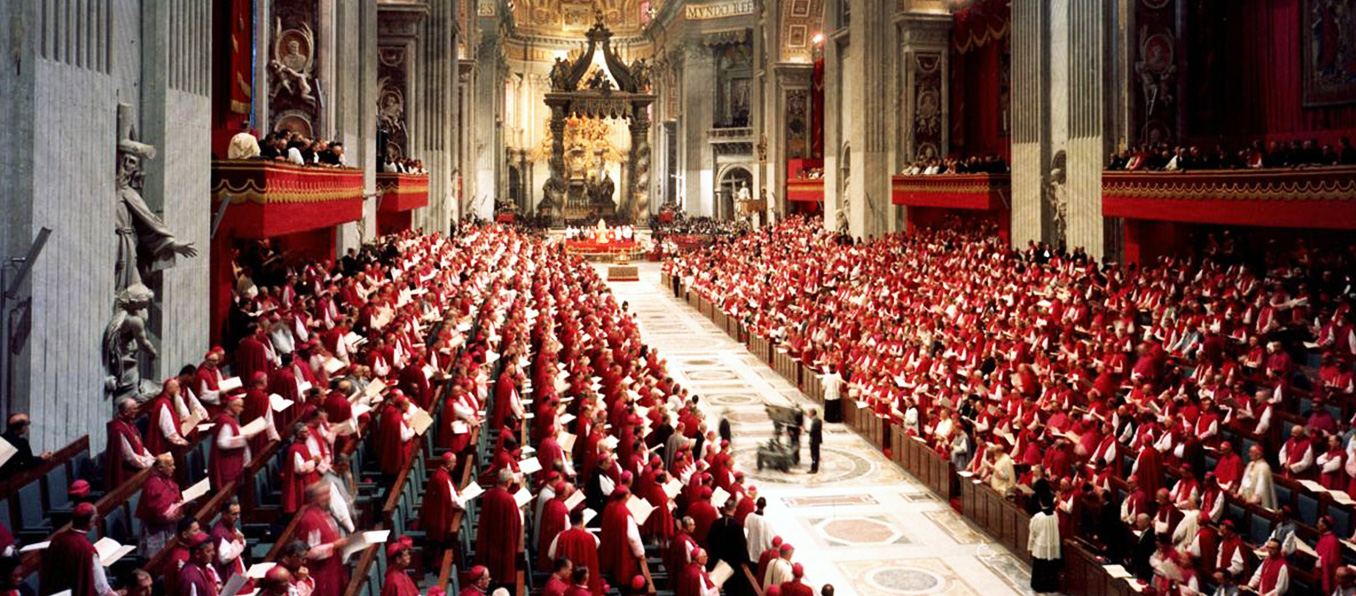
In January of 1959, Pope Saint John XXIII shocked the world when he announced the convening of the 21st ecumenical council of the Catholic Church. From 1962-1965, the bishops of the Church met to discuss the Church’s understanding of itself in the modern world, producing major documents of reform with changes to ecclesiology, liturgy, ecumenism, anthropology, and social responsibility.

In this episode of Catholicism in focus (here for email subscribers), I look at the inspiration behind these changes, putting the council in its context to understand why the reforms took place.

Here, I would like to take a minute to share a few of the things that changed with the council and why they were done.

The liturgyThe most obvious changes for the average Catholic was the Sunday Mass. From Latin to the vernacular, the priest facing the altar to facing the people, flexibility in music and allowing instruments outside of the organ, and increased involvement of the laity, the mass looked quite different in a matter of years. And while some of the things we do today are not actually the wishes of the council (if you’re interested, the document itself is not too long and quite good: Sacrosanctum Concilium) a number of the changes are the direct result of a critically different emphasis underlying the worship: full, active, and conscious participation on the part of the laity. Looking at the early Church, the bishops realized that the changes over time, solidified in the the 1600s, had lost an essential element of Christian worship. Focused solely on the transcendence and holiness of the mass, the Church had lost the foundational inspiration of the mass, namely, that it was a house meal of remembrance and fellowship. What Catholics were doing in 1962 looked nothing like the last supper or early expressions of the Eucharist, and some traditions, even though well-liked, actually detracted from the essential nature of the Eucharist.

The hierarchy of the Church: Ever since the very beginning of the Church, and all throughout our history, we have understood Jesus as the head of the body and the sole leader of our faith. How this body was organized on earth developed over time. In the very beginning, the roles of leadership were not clearly defined, and while scripture mentioned episkopos (bishop), presbyter (priest), and diakonos (deacon), these words take about 100-300 years to become clearly developed. Eventually, we see the Church being governed by the bishop—the fullness of the priesthood, prophetic voice, and kingly authority in a Church community—surrounded at the altar by his priests and helped in the community by his deacons. Deacons were not below priests, but a separate form of ordination with an alternatively important role. Over time, the permanent diaconate disappeared, the role of the bishop diminished (the Middle Ages considered bishops no different in ordination than priests), and the laity—out of which and for which leadership arose—fell by the wayside, placed at the very bottom of an upward ladder. The Second Vatican council did a number of restorative acts: 1) It restored the central authority and ordination of the bishop as the shepherd of his flock, 2) inverted the hierarchy by reminding us that we are one in our baptism, and that baptism, shared by all Christians, has primacy over ordination, and 3) restored the permanent diaconate and its integral role to the Church.

Relationship with the outside world: With the rupturing of the Western Church at the Reformation and the subsequent wars between Christians, and with the Enlightenment severing the secular world from the religious, the Catholic Church took up a defensive, antagonistic approach to non-Catholics. Filled with heresies and the source of violence, it was easier to adopt a “circle the wagons” policy, calling all non-Catholics heretics and maintaining that there was “no salvation outside of the Church” than it was to engage one’s enemy. One wonders, in the latter half of the second millennia, if anything else were possible anyway. By the 20th century, the world had changed and was ripe for a new perspective. Rather than hide from the world, the bishops, grounded in scripture, reminded the Church that we are all created in the image of God, all blessed with abundant grace, and all capable of knowing God intimately. Instead of hiding from potential problems, we, from our baptismal call to be priest, prophet, and king, were to go out into the world to evangelize through our lives. God did not speak simply through the magisterium of the Church, but through our consciences, other religions, cultural insights, and empirical study.

From these paradigm shifts, the result of a desire to brings things up to date with the sources as our foundation, the Church set forward a number of practical changes, suppressing some traditional practices that no longer carried forth the Church’s mission and elevating others that did so better. While it would take a series of books to identify them all and give proper explanation to each, my goal in making this video and writing this post is simple: as much as Vatican II angers or inspires people with its decisions on specific practices (Latin, veils, altar rails, reception on the hand, ecumenism, etc.) these things are inconsequential to the overall issue. We, as Catholics, are called to follow Jesus Christ. Trust me when I say that Jesus does not care about the color of our vestments or the shape of our churches. While those things can be important in providing an identity, facilitating worship, and organizing people, they are, at their best, passing expressions. We can never, ever, become a people attached to passing expressions. As difficult as change can be and as much as we might have liked one thing or another, when we assess the authority and faithfulness of a council and our desire to be in a Church based on its externals, we have lost the whole reason for being Church. Vatican II, while harsh for those who enjoyed the traditions of the Middle Ages, had at its very core the desire to makes its members better Christians. For me, the inspiration that guided the council and the overall paradigm shifts that came of it were exactly what our Church needed.

One of my favorite movies is Steven Soderbergh’s Contagion. Looking beyond the chilling plot of the movie—an elusive and deadly virus wipes out a large part of the world’s population—at its core is a kernel of truth that strikes much closer to home: sometimes, the virus of an idea can be more dangerous than a virus of the body.

While the government and world health organizations are working around the clock to find a cure and law enforcement and medical personnel are heroically doing their jobs when all seems lost—everyone who is “in the know” doing everything they can to save lives and keep the world together—there is one character spreading conspiracy theories and inciting a revolt. The government has a cure but they won’t share it with us. There is a cheap cure that the government is trying to coverup and refuses to test. I have been cured by this miraculous drug, so buy my product.

What ensues is mass chaos. Starting first with only those desperate and deranged enough to believe this man’s conspiracy theories (and unable to see how he is profiting greatly from it), some people take to the streets in fits of anger. If they’re not going to help me, I’m going to help myself. Stores are looted. Pharmacy workers are assaulted so they can get more of the “miracle drug.” Laws are disregarded. And while it started as only a few loud and violent people setting the example, their tearing at the fabric of society left the rest of the world with no choice: unless we also start looting, disregarding the law, fighting for our place, and standing up to the government, we won’t survive.

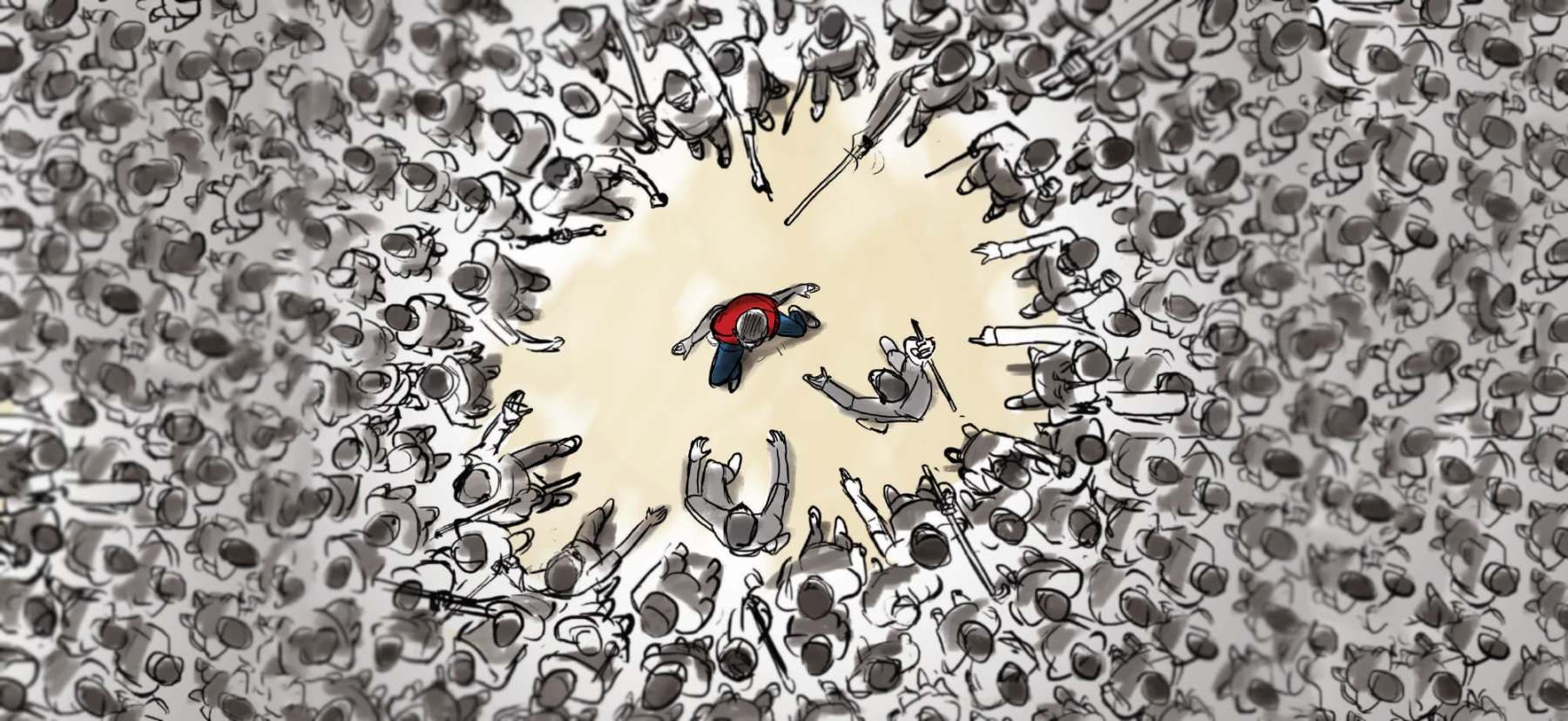
A mob mentality. Uninformed and seeing their peers acting a certain way, rational people find themselves guided by their anger and doing completely irrational things. Surrounded by so many others, they never question their motives, check their facts, search for alternatives, or know when to stop. Things just snowball out of control.

I present this rather dark picture as an extreme example of the tendency many of us have been prone to in recent years. While the increased political nature of our culture represents a people no longer willing to stand aside and be passive when their moral convictions are being challenged—undoubtedly a good thing—the critical thinking, respect for others, patience in due process, and willingness to respond constructively that needs to accompany political and social action has not increased as much. Conspiracy theories have become mainstream, vocal and violent minority groups scare the majority out of rational thinking, misinformation quickly circulates without question, and truth seems to have narrowed to but a singular expression, usually the one that I hold. Those people are wrong, we think. There is an emerging mob mentality in our world.

Oh, and yes, in our Church as well. This week showed us two prime examples.

The first is the case of Fr. James Martin, S.J., editor-at-large of America Magazine, acclaimed author, and consultor to the Vatican’s Secretariat for Communications. The recent author of a book about building bridges between the Church and the LGBT community, Martin says that he has faced unrelenting hate mail from some in the Church in recent months. Led by three minority but extremely vocal fringe groups in the Church, a campaign of voices directed this anger towards his venues in hopes of “getting him fired.” Despite his talks being about Jesus and not LGBT issues, despite being in good standing with the Church and being officially chosen by the Vatican for a special position, and despite his book in question having the imprimitur of the Jesuit provincial and approved by multiple cardinals of the Church… these venues cowered to the hate speech and cancelled his talks. Even publicly admitted that they did not disagree with what he was going to say, they simply feared the mob.

Another case, same situation. Enter Rebecca Bratten Weiss, college professor and founder of The New Pro Life Movement, an organization focused on integrating Cardinal Bernadine’s “seamless garment” and giving more attention to women’s rights within the “pro life” movement. The recent subject of an attack by one of the same fringe groups that attacked Martin, Weiss’ support of Cardinal Bernadine (yes, a cardinal of the Church), questioning of the mechanics of the current “pro life” movement to make it better, and even her personal life, were brutally chastised online, causing an outcry against the university. This week, Weiss was released from her position, and the president made an official statement to the website in question, assuring its followers that she had been released.

Two recent examples, but not the only ones. Lest what I’m trying to point out be misconstrued as a partisan statement (a criticism that might ironically serve to prove my point), this sort of mob mentality exists on the right and on the left, in the middle and in the apathetic: uninformed people going with the masses and using violence or the power of their voice rather than rational and respectful arguments, is not the exclusive domain of any one group. As we have seen in 2017 alone, mob mentality is everywhere.

And… while I know that this is going to be a longer post than normal, but short answers and loud voices won’t cut it in such a complex situation. I think that this is a critically important issue of our time that needs our attention, and I would like to offer a few suggestions that could help us, as Church, avoid this terrible trap.

There are more than two sides

In our American political system, there are really only two parties: Democrats and Republicans. While there are technically hundreds of parties, no one will ever get elected or do anything significant from outside of these two. Because of this, we are often faced with a false dichotomy: we are told that there are only two answers to a question and we have to choose one. “Which side are you on?” is a famous question to divide people.

The fact of the matter, though, is that every issue has multiple positions one could take, and often, we arbitrarily accept the opinion of a certain party even when it doesn’t fit our view 100%. In doing so, we not only cheapen our own perspective, but we make it easier to see the other as enemy: rather than realizing that there is a spectrum of perspectives and that most people don’t fit perfectly in the box but lean one way or another, we unfairly write people off as “those people” or from “that party” when their opinion might actually be fairly close to ours to begin with. When we realize that there are actually 10, 20, even 50 different ways of looking at things, we are much more likely to engage our neighbor and realize that we have something in common to build off of.

To combat a mob mentality, we need move away from broad categories of large groups and focus on individual people and ideas.

Some sides are in fact wrong: Fact checking

In our post-modern, post-fact world, we have placed the individual above all. While there is definitely a sense in which one’s experience and way they understand the world is valid, as it is their experience, and should be cherished as such, just because something has personal meaning does not mean that it is universally or objectively factual. A good example is something I saw on the news last year. A politician said that his constituents did not feel as safe as they did twenty years ago, therefore, the world was not as safe. It may be true that they do not feel as safe, but statistically speaking, his constituents were drastically less likely to be murdered today. Personally true, factually false and part of a mob mentality when continued to be spread.

I can’t tell you how many times I open my Facebook and see well-intentioned, nice, non-crazy people posting things that are not factually accurate. Usually it’s not a complete lie or slander. No, what I’m talking about is the thing that “sounds” right, comes from a quasi-reputale source, and is about something they like… but is a bit fuzzy on the details. A growing example of this is climate change. Scientifically speaking, there’s no doubt that the earth is warming and that humans are the main cause. And yet, that doesn’t mean that everything weather-related can be used to prove the effects of climate change. A huge hurricane season could be climate change, but it could also be within the statistical probability of a normal climate. One data point does not prove the whole.

To combat a mob mentality, we need to be informed and think critically.

But many sides can be right at the same time: Pluralism is not relativism

On the other hand, just because there might be wrong answers does not mean that there is always only one right answer. Is there only one way to climb a mountain? Surely not. And even though two people may not go along the same path, they can absolutely get to the same place.

As Catholics, those who hold that there are absolute truths about the world, this may sound a lot like relativism, the idea that everything is just as right as another. That’s not what I’m saying. Pluralism, rather than relativism, recognizes that there are absolute truths or ends about the world, but there are also multiple ways of expressing and understanding that truth. Look at our liturgy. Even within the West, the Vatican has allowed the modified Latin rite of the mass to be celebrated along with the normal, preferred rite of Vatican II, as well as having recognized a number of Eastern rites and communions to maintain their own separate traditions. Each are fundamentally different in gesture, purpose, and even outcome, but they all point to the same absolute truth.

In our religious world especially, controversy tends to boil over because we are unable to accept that there might be a different perspective that also holds truth. When we see the way people approach Church, God, family, ministry, and the outside world, there is a temptation in our world to write people off as a false Church, as heretics, as not the true believers. This, I firmly believe, is the result of a lack of faith. Unable to see that God is complex and not capable of being boxed into our small brains, anything that differs from our understanding challenges the validity of our faith… and it has to be stopped. It is easier to call someone a heretic, to protest their talks, to get someone fired, to belittle them as stupid, to laugh at them, or to ignore them than it is to engage what they are saying, where they are coming from, and the ways in which they might be right.

To combat a mob mentality, we need to broaden our worldview and live in the complexity of God’s mystery.

The Church has survived worse

Finally, there is no doubt that our world is witnessing dangers and fears that many of us have never seen before. We are, in some ways, at a turning point in world history, at a fever pitch of tension.

And yet, there’s also a sense that there is nothing new under the sun. The Cold War was much more dangerous than our times. The 1960s and 70s experienced much more social upheaval than today. The 1940s produced more war and death. The 1930s saw a much greater collapse of our world economy. The early 1800s resulted in a much greater cataclysmic tear in the fabric of the religious world. The 1600s witnessed a world in which Protestants and Catholics were murdering each other for different beliefs. Between 800 and 1100 the Church had a pope that sold the papacy, priests becoming overwhelmingly wealthy for doing little work, Church wealth used for war and opulence, and the intellectual decline of our theology. And so on. The Church and world has seen some stuff.

And it has prevailed.

So often in our arguments, our intensity and passion is the result of a narrow perspective: deep down, I think believe that this issue is the most important of history. This issue, whatever one we’re fighting about, proves how terrible the world is, how far we’ve fallen, and that there’s no hope… we have to fight above all else to win it. Too often, we make the stakes too high on the issues, gives ourselves too much credit in being responsible for causing/solving them, and we go nuclear when things don’t go well, failing to live for tomorrow because we believe that everything comes down to this one thing or to us.

There are important issues in our day. Absolutely. And we should definitely be passionate and serious about the world. But we also need to remember that the Church has survived worse. It is not up to us to be its savior, nor is it up to us to employ any means necessary to win an argument—personal attacks, creating false dichotomies, acts of violence, hatred, moral decay—undermining our cause to uphold the kingdom of God by acting against it. We are called to remember that this is God’s institution, not ours, and God will ultimately hold it together, not us.

To combat a mob mentality, we need to take a deep breath and remember that it’s going to be okay. At least in the long run.

I think our world and Church desperately needs these things. To stand for justice and truth, as mobs believe that they are doing, but to do so free of broad, inflexible categories of right and wrong; without personally attacking those with whom we disagree but working to bring the fold together; in integrity for real truth, not just the truth that supports our claims; and with the humility to know that we work for this Church but we are ultimately not responsible for it.

When we do this, standing together for what we believe and engaging the world, we are not a mob… we are a Church.

In the world of the internet, it seems like everything can be done online: Domino’s pizzas can be ordered, plane tickets and travel arrangements can be planned, and in some cases, doctor’s appointments can be scheduled. Just yesterday, I signed up for an online subscription, opted out of a service, and took part in countless social media endeavors, all without ever having to speak with or meet a real person. We have become so accustomed to the ease of access of such things, that three weeks ago, when I went to the gym for the first time, I was annoyed that I had to sit down with a representative and talk about the gym for 30 minutes before I could use it. Why can’t I just sign up online and walk right in?!

It’s with that as our backdrop that the initiation process of becoming a Catholic Christian appears so counter-cultural. With no “signup now” link on our website, it is only in the rarest of occasions that someone can decide to enter and be a full member in under a month. For most, the process can take six, nine, even 24 months from start to finish. And that is even an abbreviated process compared to what was practiced 1500 years ago!

Why so long? Contrary to popular belief (and even contrary to some popular practice) the purpose of the extended time is not simply because there is a lot to learn; intellectual formation is important, and the Church is rich in many things that are important to know, but being a Catholic Christian consists of more than just knowing. First and foremost, the process of entering the Church is about conversion. Unlike joining a gym or a political party, we as Church are concerned with the way people live—privately, in community, and in the world. Living the Gospel is not an easy task and it takes more than just knowledge to be a Christian, no matter how much knowledge one may have. At its core, formation in becoming a Catholic Christian requires a look at one’s prayer life, moral virtues, commitment to others, and readiness to answer God’s call.

This is hardly something that could be completed online.

What’s interesting about the process of initiation, then, is that it is not a one-size-fits-all experience. There is no aptitude test or bar exam that one has to pass. The question of entry is not about intelligence or ability to memorize facts, it is about one’s readiness to live the life. Depending on who one is, what they need, and what the Church can offer, depends on the process one follows. Flexible to the needs of aspiring members of the body of Christ, the Catholic Church groups people together into three main categories:

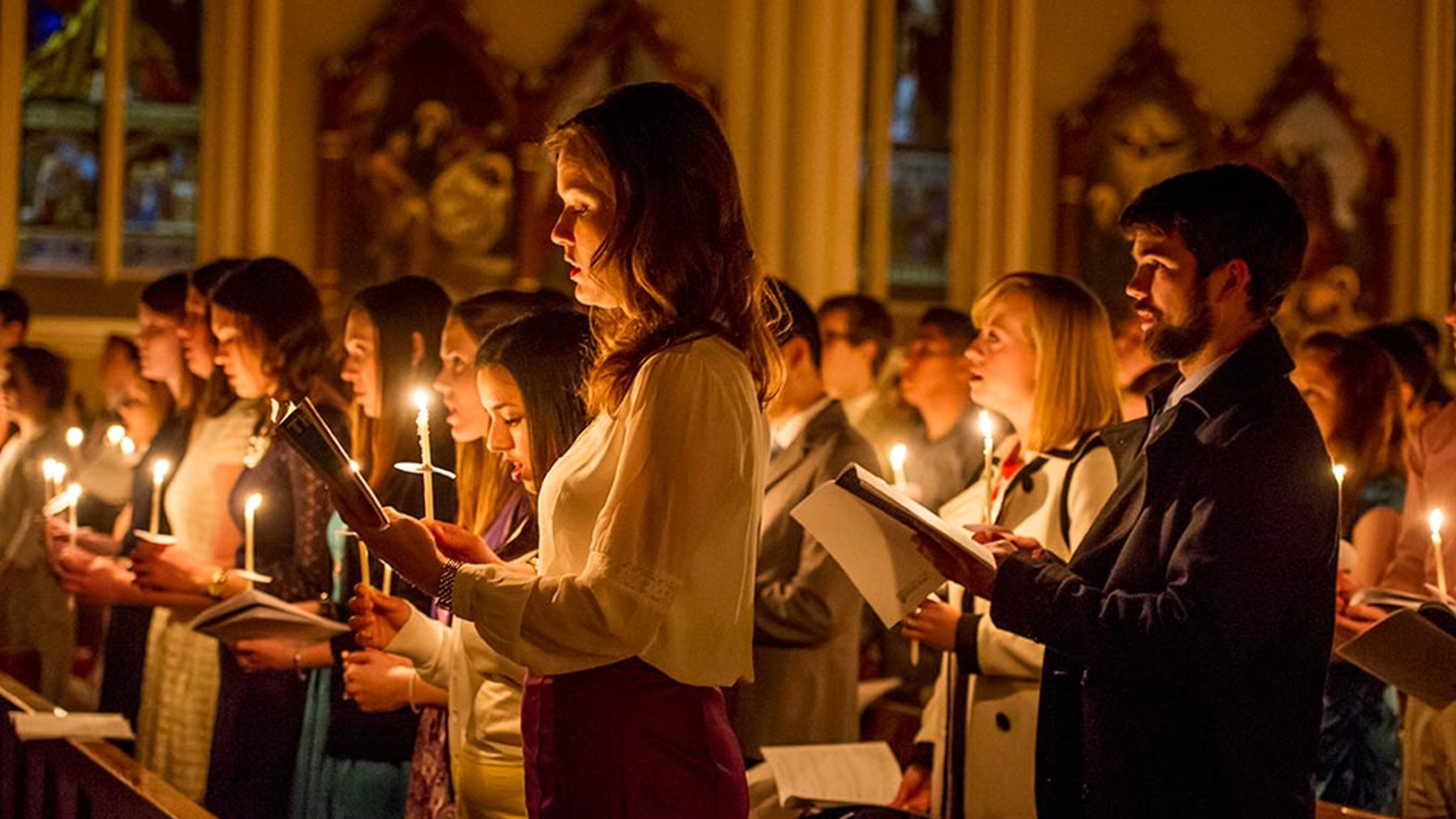
Non-Christian converts Never been baptized in any Church? Congratulations! You are a true convert to the faith of Christianity. As a result, we will start from the ground up, introducing you to the basics of the faith, helping you develop the skills needed for prayer, and encouraging you to become an engaged member of the community. Throughout the year-long (likely 9 months…) process, you will be gradually welcomed, strengthened, and initiated through a series of progressive steps so that you are ready to be a Christian when that day comes. Oh, and that day is already on the calendar: all baptisms of adults take place at the Easter Vigil.

Protestants seeking communion Were you baptized in another Christian tradition and want to become Catholic? Congratulations! You are already a Christian! As long as your Church baptized you in the Trinitarian formula (In the name of the Father, Son, and Holy Spirit), the Catholic Church recognizes the permanent and unfading character of your baptism and already considers you one with us in Christ. Unfortunately, because of the fracturing of the Christian Church over the years, there are still some areas in which we are not one in communion, however, and a period of preparation will be needed to teach about the specifics of the Catholic faith. There is no set time minimum or limit for these people; it all depends on how long it takes for someone to be ready.

Incomplete Catholics Were you baptized a Catholic but never confirmed or received Eucharist? Congratulations! You are already a Catholic! The most complicatedly simple category, there is no impediment for you to finish your initiation into the Church. While continued faith formation is important and usually required, the only thing that you will truly need is for your pastor to get permission from the bishop to complete your initiation and then pick a date to make it happen! Different Churches will have different processes, and some—especially if you know very little about the faith—may require that you attend some classes with the Protestants seeking full communion, but ultimately the focus is still the same: as soon as you are ready, you are ready.

Do you know someone who might be interested in becoming a Catholic Christian? Why not share this video with them so they can know what they have to do? For email subscribers, click here to watch the newest “Catholicism in Focus” video.