It is often said that, in our world today, more people than ever are “spiritual but not religious,” that they have a sense of God, want to live in communion with others, and do what is right, but have no interest in conforming to the norms of an institutionalized religion. You probably know quite a few people like this.

But what about those people who are “religious but not spiritual”? Now, admittedly, I’ve never actually met someone who identified as such, but I interact with them on a regular basis. People who are concerned with rules and tradition, who attend prayer services and identify with a particular congregation, but have no sense of the sacred, prayer life, or foundation in Jesus Christ for what they do. You probably know quite a few people like this as well.

In this week’s video, I want to subtly address this issue I encounter far too often in the Catholic Church: people can come to church their entire lives without knowing Jesus. As hard as it is to believe, it is very true. People come to mass each week for many reasons and it’s not always for spirituality or a relationship.

I think that this is a problem worth addressing.

Having posted this video a few days ago, I have had some time to hear some feedback and reflect on my own words, and I’d like to offer a few further thoughts. (Please pause this blog post and watch the video before continuing. I’ll wait.)

In one of my more provocative lines on Breaking In The Habit history, I say, “I would much rather people be in love with Jesus in a Protestant Church than wasting away in a Catholic Church. What matters is Jesus Christ, not your congregational affiliation.”

Yeah, I said those words. And after thinking about it more… I stand by it.

Despite what some have said in the comments, I do not want people to leave the Catholic Church; even less so do I think that all Christian Churches are created equal and that it doesn’t matter what you believe. I am very proud of my Church and believe that it holds the fullness of Truth, that it is the sacrament of salvation. I would love for every person in the world to be a practicing Catholic!

But the reason for this is not so that we can all bear the same name; it’s not because I think the way we worship, our stance on Mary or the saints, or the pope himself are constitutive for our salvation. Those things are great, but they are not why I want everyone to be Catholic. The reason that our Church is amazing—and truly the only reason necessary—is Jesus Christ. Our Church is endowed with the special mission of proclaiming his life, death, and resurrection, of caring on the work of the Kingdom. That is what makes our Church significant.

And so, back to my comment, if people are attending the Catholic Church and not living this mission, and if said people are able to live this mission within the bounds of another Church, growing closer to Jesus in holiness through love and sacrifice… you better believe that I would rather they have the option with Jesus in it. Jesus is what matters, not the congregational affiliation, and we do ourselves a great disservice to the kingdom of God when we think that we are automatically saved by being Catholic or that Jesus is unable to save those unlisted in our baptismal registry. St. John the Baptist admonished the people, “Do not presume to say to yourselves, ‘We have Abraham as our father'” (Mt 3:9). He is speaking to that mentality in us.

Let’s not make the same mistake, okay? Let’s not be like the hypocrites in Jesus’ time who confused what was important:

“Woe to you, blind guides, who say, ‘If one swears by the temple, it means nothing, but if one swears by the gold of the temple, one is obligated.’ Blind fools, which is greater, the gold, or the temple that made the gold sacred? And you say, ‘If one swears by the altar, it means nothing, but if one swears by the gift on the altar, one is obligated.’ You blind ones, which is greater, the gift, or the altar that makes the gift sacred?” (Mt 23: 16-19)

What is more important, the institutional church or Christ who makes the Church holy? Going to mass and receiving the Eucharist without any faith at all, leaving us unchanged, or attending a Protestant service on fire for the Lord in such a way that it causes us to be transformed into different people? Being a Catholic who doesn’t know Jesus or a Protestant who joins him to build up the kingdom?

I honestly hope that the latter choice is always the answer, but more than that, I hope that we Catholics will be unsatisfied with both choices. For those who got upset with my supporting the latter choice—saying that being a Jesus-following Protestant was better than a spiritually dead Catholic—I hope you see my real point in it all: I don’t want either of these things. As a Catholic minister, and without any disrespect to my Protestant and Orthodox brothers/sisters in Christ, I want for everyone to be a Jesus-following, spiritually nourished, on-fire disciples of Jesus Christ… within the Catholic Church. For me, that’s the endgame and nothing less.

I want Jesus, and I want his Church.

But short of that, in a world in which our Church fails to bring Jesus to people, I want people to be where they can find Jesus. Can we do that? Can we be that place? Can we make Jesus our highest priority, our identity as Christian first and foremost, our call to discipleship over our call to parish registration?

I hope so, and that’s my message this week.
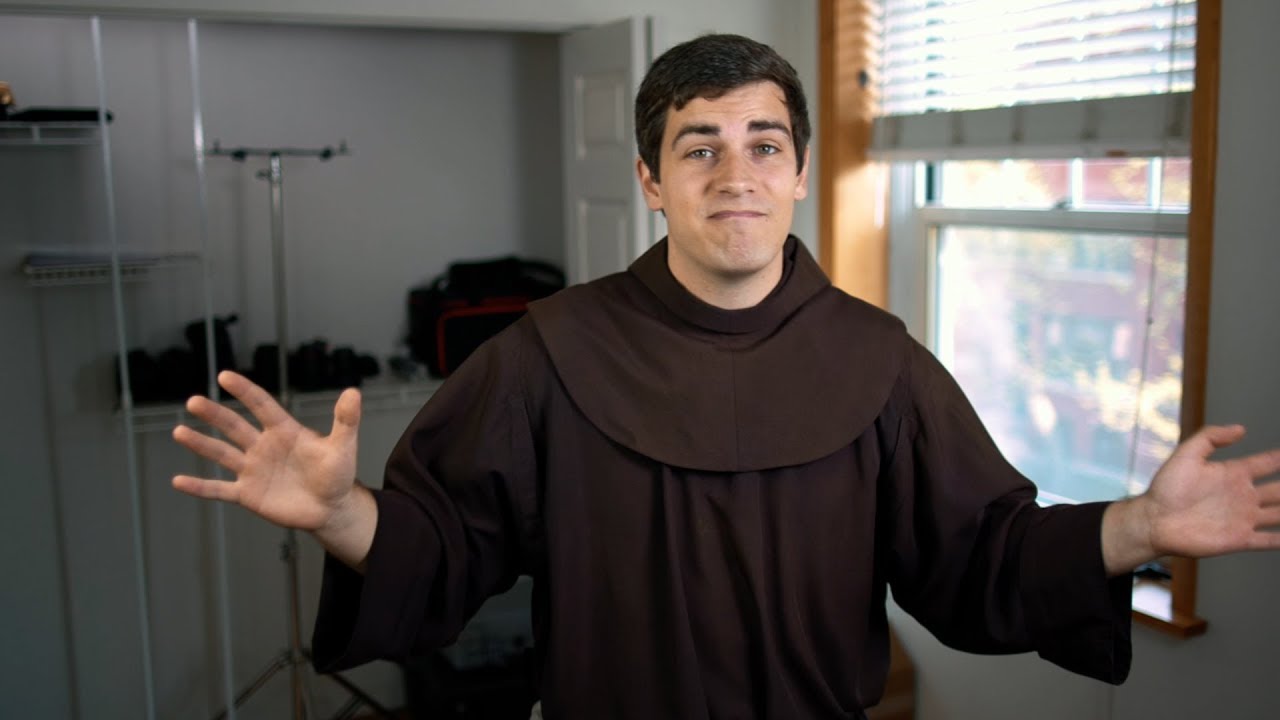
My apologies for the clickbait, but I think it’s a pretty accurate title… in a sense. I do think that we should stop referring to the center of our faith exclusively as “God.” I do not think that we should stop believing in a deity in general. Hopefully the video will explain itself.

But since I have gotten some confused responses, it might not hurt for me to offer a bit more explanation! Seems safer.

Put simply, the word “God” is very generic and means a lot of things to a lot of people. When some people say “God,” they mean a spirit in the sky that created the world but remains uninvolved in our lives; others mean a sacred tree that connects all life; still others have been influenced by a certain science fiction saga that takes place among the stars; and Christians… well we mean none of those things.

And yet, we still use the same word. And yet, we get our language mixed up and start to accept theologies about these “Gods” that has nothing to do with our own.

For me, we need to reclaim our own definition of God and our own theology, namely, that God is three in one, personal, and immanent. God is not just a philosophical concept, God is not just a transcendent being. God is Trinity, ever close and ever related to us.

Hopefully that helps to clarify!

When I talk to Catholics “of a certain age” who have either left the Church or wish to return to the Church of their childhood, the practice of abstaining from meat on Fridays—or more accurately the Church’s decision to abandon the practice—comes up with an interesting regularity as to one source of their dissatisfaction. (For those unfamiliar, Catholics used to abstain from meat every Friday of the year, not just during Lent, and it became a strong social marker of one’s identity as a Catholic as it brought us together for fish-frys and separated us from Protestants who did not follow the practice.) Longing for the days of old and disillusioned that the Church could just change what was considered a sin depending on how it felt, this devotional practice remains a point of contention for them.

Frankly, I find the issue to be very complicated and absolutely fascinating.

This week, I’d like to start with the video itself and expand on it. If you haven’t had a chance to watch this week’s Catholicism in Focus, placed above, take a minute to catch up on that before continuing. Don’t worry, I’ll wait.

Okay, great. What’d you think? Actually, no, nevermind. Moving on.

As I showed in the video, the Church did not abandon the practice, as some think, but actually sought to grow deeper in its penitential acts on Fridays by—get this—treating us like adults and letting us make decisions for ourselves! Instead of just “obeying the law of the Church,” Pope Paul VI wanted us to obey the law of our hearts, prayerfully listening to the Word of God and putting our faith into practice in a personal way. For a world that wants to personalize everything and only do things that we’re passionate about, he was ahead of his time.

There is also a sense that no matter what he did, all that was being changed was a discipline of the Church, the lowest level of Church teaching. To leave the Church because of or spend too much time complaining about a changed discipline suggests to me that many did not quite understand the teaching of the Church. This was not a radical move in which everything was now on the table and it was only a matter of days before Jesus was going to be declared “only human” or the Eucharist “just a symbol”; unlike Dogmas that cannot change and Doctrines that develop slowly over time, disciplines can and should change as our Church and world changes, ever reflecting the faith of the people in a current situation. In this case, the overall spirit of the Church remained the same, in continuity with the whole history of the Church. Only the specific practice changed.

Unfortunately, what resulted from this decision was not what he intended. For the most part, people just abandoned the practice altogether. As a result, there is definitely a sense that something has been lost in the process. While on paper it was both “fitting and right” to change the law, something the Pope had the authority to do and in the best interest of the faithful to help us grow deeper in Christ, one has to wonder if it was ultimately the right decision: although not free to choose the practice, at least people were doing something before, and in doing so, we formed a valuable corporate identity in the process. For better or for worse, there was an ethos to being Catholic prior to 1966, a common sense of identity through uniform practice. Sure, it may not have meant much to many people, just a law to be arbitrarily followed without much understanding of the reason, but it was something we did together. Through mutual submission to a common action, it formed something greater than oneself and brought people together.

Ultimately, this is what our Sunday worship is supposed to do, so it is not as if we no longer have a corporate identity at all. And doing something that is meaningless or even detrimental to one’s faith in the name of community is not spiritually beneficial. But it does raise an interesting question: might we have lost something in the process worth recapturing? In the search for more personal meaning, might we have sacrificed the equally important sense of togetherness? I’m not suggesting that we return to the practices of 1965 or that we arbitrarily impose new rules on the faithful just so we can do something together. I’ve been through novitiate… I know that that doesn’t always go well. But I am suggesting that we take this issue seriously. Let’s recognize that something truly was lost in 1966, and make sure that it was not lost in vain. Our practice may have changed, but the Tradition that guides it has not. Maybe this Friday will be the week that we take up our crosses again. Maybe we’ll even come together with a friend or in groups to do something together.

“Why do bad things happen to good people?”

No doubt one of the great mysteries of our human existence, it has puzzled the most brilliant of philosophers and caused grief to even the simplest of men and women. Especially for people who believe in an all-powerful, seemingly all-loving God, the lack of answer for such a question, and the prevalence of evil that good people endure, is a thorn in our side.

But I have a question in return: As Christians, those who follow an innocent man who was betrayed and suffered persecution before laying down his life for others, why would we expect only good things in our life? I’m not sure how you interpret “take up your cross and follow me,” but I can’t imagine that it is going to be an easy road. No, my guess is that a life in Jesus is much more difficult than a life without him.

The fact of the matter is bad things happen to good people because we live in a world that relies on things other than Jesus, and that will inevitably produce pain. Not only do we experience the pain of others’ sins corrupting our world, we experience it in our insistence on being our own strength, in refusing to ask for help when we need it, in failing to change our hearts and learn from our mistakes, and really… in the mere fact that we are mortal. Our own weakness—and our reliance on it—brings pain even to good people.

And for me, this is the great paradox of our faith. While the rest of the world tells us that we can alleviate our pain by seeking more control, growing stronger, and seeking perfection, Christians know that it is quite the opposite: it is only when we embrace our weakness, take on pain, and accept that we cannot solve our problems that we are actually the strongest. It is in those moments of desperation, those moments of pain and suffering, of utter failure, that we find that Christ is most alive in us offering us strength.

When we are weak, God offers strength.

When we sin, God offers forgiveness.

When we are hard of heart, God offers patience.

And when our mortal bodies have reached the end of the road and there is nothing left that we can do for ourselves, God offers us eternal life.

So, why do bad things happen to good people? Why do we suffer, experience pain, and fail even ourselves? I’m not sure. All I know is that even in those moment—especially in those moments—God is present to us more than ever. This lent we are called to embrace our failures and own our brokenness, allowing God to be more than we could ever be on our own.

Thanks for joining me on this journey through Lent. I hope that you enjoyed these reflections and will consider buying my book, Called: What Happens After Saying Yes to God, where you will find many other reflections just like these. 

“For where two or three are gathered together in my name, there am I in the midst of them.” Often spoken at the beginning of prayers, this passage from Matthew’s Gospel reminds us that our God is truly with us. Emmanuel he is called. More than a sentiment, more than wishful thinking, when we gather for prayer, God is truly with us.

But how? And why?

Often, I think we imagine this passage as a designation of the criteria necessary for Jesus to show up, as if he were saying, “I’ll be there if you get a few people together.” Once the requisite number is gathered, then Jesus will also come. But what if he meant something else by this? What if what he was trying to tell us was that, since Christ dwells in us and gives us life, when we gather together Christ is with us simply by virtue of us being together? In other words, since together we form the body of Christ, then when we gather, for any reason, Christ is with us in one another.

I think this is a critically important part of our faith. As much as we might see a transcendent experience with God in silent prayer or liturgical action, a direct encounter with God in Godself from on high, we must never forget that God is also present to us in the immanent. We experience God when we sit down for dinner, when we encounter a stranger, when we fight with our spouse, when we work with colleagues, and even when we shed a tear with a friend. When two or three are gathered, no matter the circumstance or purpose, Christ is with us.

What an amazing joy! When believing in a God that is neither visible nor physical, when we often find transcendent experiences of God far and few between, knowing that God is still among us is critical to maintaining our faith. In fact, some might even say it is essential to finding it in the first place. As much as we use words like relationship, sacrifice, love, devotion, patience, and forgiveness in reference to God, how could we ever use them in reference to God in any meaningful way had we not experienced and lived these words in our earthly relationships?

For me, it’s a reminder that God is present to us always—not just in our prayer, and maybe not even initially in our prayer—but rather through every encounter we have each and every day. It is our relationships with our friends and family, how we treat the people around us and show them love, that we find the very understanding of these concepts in the first place to know how to relate to God.

This Lent, we are called to share our lives with others. We are called to be in relationship, to give love, to offer sacrifice, to be patient, and to build community—not because we need new friends or something to do—but because it is in our being together that we make God present in the world and show the world what the love of God truly means.