Cardinal Differences

While these two men are unquestionably Catholic, they have very different visions for the life of the Church

While these two men have very different visions for the life of the Church, they are unquestionably Catholic

It was quite a remarkable week at the Catholic University of America. In what we were told was “completely coincidental,” two different (and I mean different) Cardinals found their way onto campus to give lectures about the Church. On Monday, Gerhard Cardinal Müller, the prefect of the Congregation of the Doctrine of the Faith (CDF), gave a lecture to the public, and on Tuesday prayed evening prayer and gave a lecture before a private audience of seminarians. On Thursday, Walter Cardinal Kasper received a medal for “Excellence in Scholarship and Leadership in Religious Studies” from the Catholic University of America and gave a lecture entitled, “Theological Background of the Ecclesiological Ecumenical Vision of Pope Francis.”

For those not up on the latest gossip–I mean news–within the Vatican regarding the Synod on the Family, this is quite a coupling of Cardinals to have speak in one week. Both men have been the center of attention of media personnel, and many have caricatured these men against one another as theological and political enemies, one being the progressive in favor of doctrinal change, the other the conservative defending the faith against heresy. While there is some truth to this, as they appear to have taken different stances on a couple of key issues, it seems to me to be a gross oversimplification of the issues and an attempt to create schism where no schism exists. These men hold different points of view regarding the life of the Church, sure, but they are also very Catholic in doing so.

Of the two, Müller’s was certainly the drier of the lectures. Being the prefect of the CDF, one did not expect him to present anything revolutionary or controversial. Added to that, language was definitely a barrier, meaning that his entire lecture and even much of the question-and-answer session, was read from prewritten statements. As far as presentation goes, I have to admit, I struggled to stay awake.

At the same time, though, it was a really worthwhile experience. Attended by and geared toward seminarians alone, the whole evening was a pretty inspiring event. While the Franciscans (OFM) and the Dominicans appeared to be the only religious in attendance (ahem… Carmelites, Capuchins, TORs, Conventuals, Paulists…), there were hundreds of seminarians in attendance, all students at CUA. That was pretty amazing to see. Vocations to religious life and the priesthood are by no means where they need to be, but it’s clear that there has been a small resurgence in numbers over the past five to ten years. Müller took notice of this, but seemed to indicate that quality is more important than quantity. Encouraging us to embrace the process of growth and conversion, he told us that seminary and formation were not simply, “I believe ze English term is ‘hoops to jump troo.'” We must always ground ourselves in faith, and recognize our journey in the life of the Eucharistic celebration. With the mass as our foundation, seminary and formation is not the step before we get to where we’re going, but rather the experience of Christ right now on our journey of faith.

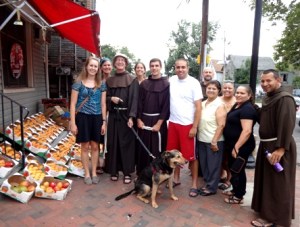
As an added “bonus” to the night, Cardinal Müller shook each of our hands, took a group picture, and invited us to tour the Saint John Paul II exhibit recently opened. (More about this experience at the end.)

But as worthwhile as our evening with Cardinal Müller was, it pales in comparison to Cardinal Kasper’s lecture. Let’s just say that the man was candid, casual, and full of joy with the current pope. Francis, he said, is Jesuit to the core (not a Franciscan in disguise.) Unlike his predecessor who exercised faith from the standpoint of his intellect and theory, Francis’ faith is rooted in experience and defined by practical measures. Distinctly South American, he exemplifies a method of theology found in the liberation theologians: see, judge, act. Unlike the liberation theologians, however, the Gospel is not primarily a message of liberation, but rather joy, and joy cannot be contained. It is God’s mercy that defines the Gospel, not law. As such, social justice is not some far off ideal we seek, but rather “the minimum amount of mercy” required by all. The Gospel requires more than just the minimum, more than just “what is due.” It requires mercy.

Through this lens, he described, Francis’ understanding of the Church is straight out of the Second Vatican Council, even if he never mentions it. “He doesn’t mention Vatican II a lot. The reason for this is not that he doesn’t agree with it, it’s that that he has embodied it so completely in himself.” For Francis, the Church should not be like a business in which the CEO dictates the mission and the heads of each department work towards pleasing the boss, guided by strict laws and protocols; the Church is not a top-down institution with the pope as the sole source and authority of truth, dictating doctrine for everyone to follow. The Church is the people of God, the messianic people, the sensus fidei, and he wants full participation from everyone, particularly the laity. Just as the outwardly written “doctrines” are secondary to the inward gifts of the Holy Spirit through the Gospel, the Magisterium is there, not to impose burdens on the people, but to listen to and serve the people of God. When the Church becomes self-centered, failing to move to the peripheries of society and Church out of fear, the joy of the Gospel does not get communicated. (I’ve intended to write a post about Francis, and maybe I’ll get there, but can I just go on record to say that I love this guy?)

It’s here, I guess, that the reflective piece of this post begins, and the true purpose of writing comes out. Having listened to two Cardinals with very different tones this week, and having spent a lot of time in conversation about the differences between the papacies of John Paul II and Francis, (not to mention the fact that there were two people protesting outside of one of the lectures!) I cannot help but recognize that each of these men is truly Catholic in his theology and understanding of Church, even if I prefer one over another. I think Cardinal Kasper’s very candid opening line of his lecture expresses what I want to say: “For some of you, the papacy of Francis is a spring of new life, a great warmth after a winter that has lasted for many years; for others of you, it is an unwelcome cold spell that has caused you to grab your coat and pray for a short winter.” This is not a new phenomenon, nor does it indicate that we are headed towards schism. To have a different perspective on Church, and thus, to be disappointed with the Church’s leadership at a given time, does not make someone a good or bad Catholic. As I walked around the John Paul II exhibit, I couldn’t help but be inspired by the many wonderful things he did and the great man of prayer that he always was; at the same time, I couldn’t help but remember that his understanding of Church and style of leadership were far from my own, and that he did a lot to undo the reforms put in place by the Second Vatican Council that really define my own theology. And that’s okay.

You see, we live in a pluralistic world, and like it or not, worship in a pluralistic Church. Having now taken classes in Church history, history of theology, history of the sacraments, foundations of moral theology, and social ethics, it’s clear to me that there has never been time in which everyone in the Church believed and acted the same way, even among the greatest of theologians. (Look at Saint Bonaventure and Saint Thomas Aquinas: contemporaries and doctors of the Church, they represent a Church moving in opposing directions. Look at East and West: truly faithful people that agree on every important dogmatic statement (minus one word that we added later…), both drawing their lineage all the way back to Jesus, and yet are very different in thought and practice.) While the experience of God’s revelation in Christ is unchanging, the way we understand that revelation and live it out develops over time. Just because we may have different opinions about theology and Church organization does not mean that one is right and one is wrong, it simply means, as Kasper said, “The totality of God cannot fit into one human perspective.” Instead of calling for Schism or name-calling among the people of faith, instead of a theology of arrogance that claims to know all that there is about the infinite, let us treat one another with humility of heart and joy for the Gospel, and do as St. Paul tells us: “Test everything; retain what is good.”
Back To School

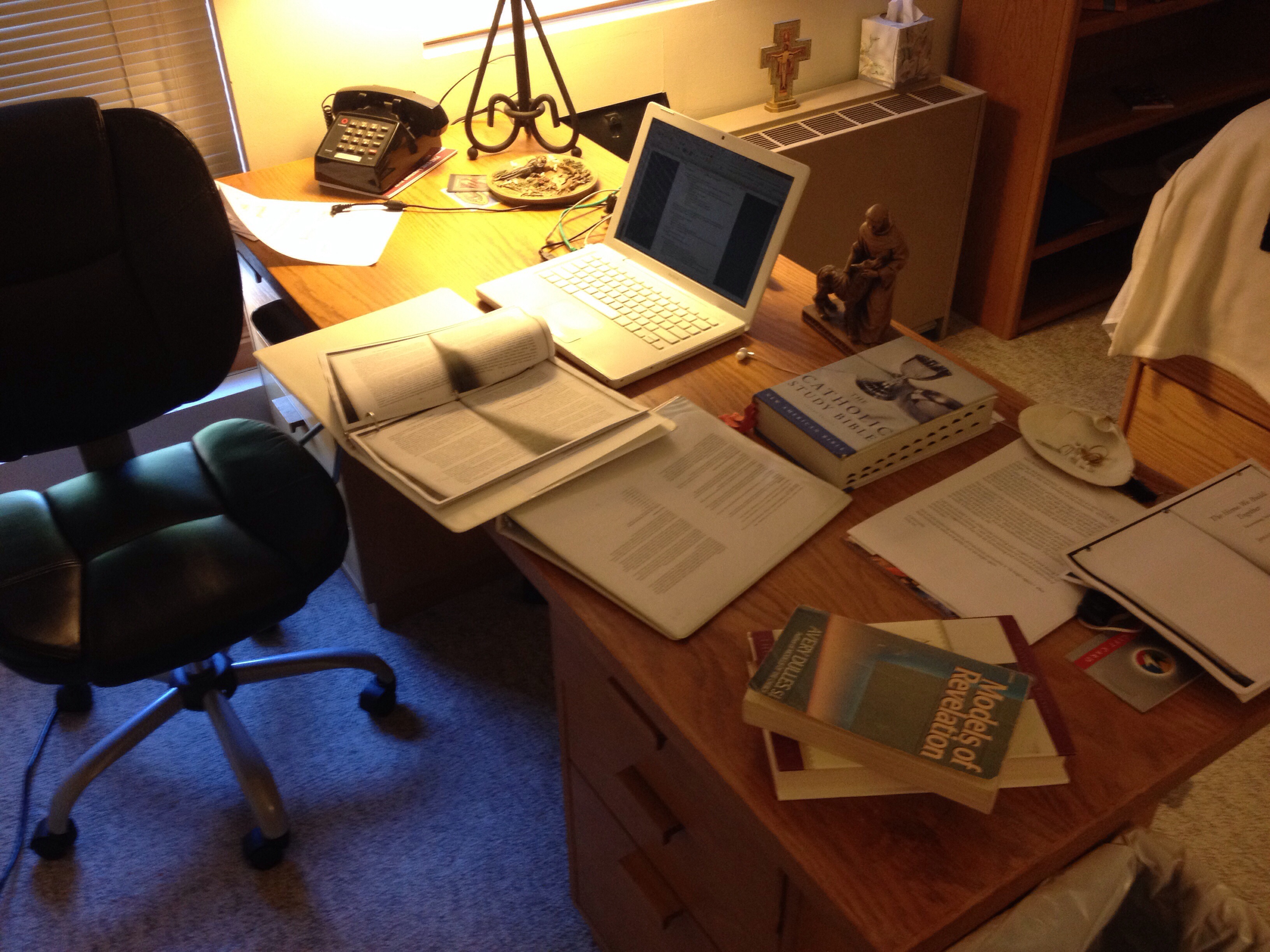
Three days ago, this desk was immaculate!

Three days ago, this desk was immaculate!

After more than three months of successfully (and futilely) avoiding all school-related activities, the fall session has finally caught up to me. Where has all the summer gone?! Like death and taxes, I guess you could say that it is just one of those inevitabilities for a seminarian.

With the new year comes an entirely new experience. Whereas last year I spent countless hours studying philosophy, this year I will spend countless hours studying theology (a major improvement). On Monday I officially started my degree for ordination, the Master of Divinity (M.Div.) In the next four and a half years, I plan to complete 103 credits of Master’s work in systematic theology, moral theology, biblical studies, pastoral care, history of the Church, liturgical history/theology/practice, and canon law, with a one year “break” for a pastoral internship somewhere in between. For those keeping score at home, that will be a grand total of 133 credits in nine semesters of work. Your prayers in this long endeavor will be greatly appreciated over the next half decade.

But that’s not all that’s new. Whereas last year I spent the entire first semester struggling to transition from novitiate, I start this year with a level of comfort unknown to me last year. I know how to get to school and where my classes are, have already established relationships that I can fall back on, a regular schedule within and without the house, a spiritual director I can call and meet with whenever necessary, and a set of leisure opportunities (golf, movies, gym, restaurants) that I can get right back to rather than search for. Without having to establish all of these things in a new city like I had to do last year, my stress level is next to nothing at the moment. This, I might add, is a tremendous gift at the beginning of a difficult academic year.

Lastly, whereas I taught two confirmation classes for 8th grade boys last year, ministering to a demographic that stretched me outside of my comfort zone, this year I will be working with campus ministry at Georgetown University, ministering to an age group that is a little bit more my speed. I’m not entirely sure what I’ll be doing yet, but I’m excited to be with young people in such a formative time in their lives in any way that I can. I have no delusions that the experience will be an easy one, but I look forward to the challenges ahead.

For now, it’s off to do what I will be doing for the rest of the term, reading, completed with a late episode of The Simpsons with a few guys in the house (a show, I might add, shows its characters in church or discussing religious topics more than any show on television. Really. The Vatican Newspaper even praised the show once. Really! Maybe I can team up with my classmate Ed Tverdek, an avid follower of the show, and write an post about it. I digress…) Blessings on all of you this year, and for those in the academic world, good luck with all your studies!

What I Will Take From Camden

Eleven weeks and a seven-and-a-half hour drive later, I find myself back in North Carolina for a much-appreciated week vacation before heading back to school. It’s been a great summer and a great first assignment in Camden, NJ, and there is a lot to take with me to my studies. Here are just a few things that I will take with me as I continue to be formed into a Franciscan Friar:

Adult Education

Of the many highlights of the summer, one of my favorite experiences was teaching a Bible class on Wednesday evenings. Let me be clear: this was not a “Bible study” as is common at churches. What I wanted with this class was to give the average parishioner an academic overview of the Bible so to empower him/her to be able to read, study, and pray with the text appropriately. Over eight weeks, I spanned a couple thousand years of biblical history in order to set the historical context out of which each text was written, highlighting the social and political events that greatly influenced the people of God. My bold guarantee when advertising the class was that, once completed, one would be able to open the Bible to any page and have at least the basic tools to know the context of the passage, and thus, an appropriate interpretation.

While the content of the material was something I personally understood, I had never taught it let alone organized the material into eight comprehensible sections. Could I even fill up an hour of material for eight weeks? Did I have enough knowledge of the Bible to synthesize it or field questions beyond the text? Turns out I could and I did, and I had a great experience doing it. The material will obviously need to be refined and updated as I take more courses in Scripture and theology, but it was very encouraging. My hope is to build on this experience with other adult education courses: church history, liturgy/sacraments, Catholic Social Teaching, and Franciscan history/studies.

Confidence to Preach

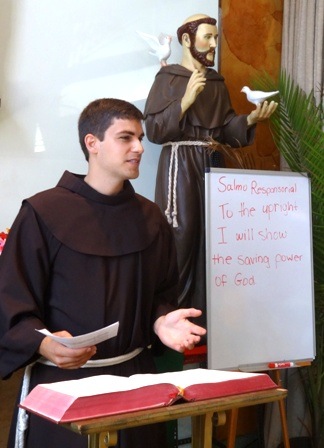
This photo is in no way staged.

This photo is in no way staged.

In a similar vein, I was given the opportunity to preach regularly this summer: twice a week at daily mass and two Sundays (the texts of which can be found here and here). While I had had a little experience preaching before this summer, this was actually my first time preaching at a daily mass, something surprisingly different, and more difficult, from a Sunday homily. For starters, it has to be very short and to the point. In a daily mass homily, there isn’t enough time to develop more than one point, and even with that point, not a lot of time to do it. What can I say in 3-5 minutes, that isn’t just fluff or sentiment, to really draw people into prayerful reflection today? 

Another difficult aspect of daily masses is that they happen, by definition, every day. Unlike Sunday homilies that take all week to develop, these reflections must be churned out each and every day. The plus side for seasoned priests is that the shortened length, casual nature of mass, and repetition of readings makes this very easy to be done quickly and mostly off-the-cuff. For me, having never had this experience, I found the experience to be a bit laborious at times, especially the Monday after preaching Sunday. Ugh… what am I going to say?

It is that tiny little bit of pressure, the regularity of preaching no matter the readings or context, that really helped my confidence in the long run. At first, I was very nervous and tried to memorize every word of the “perfect homily” I had written; by the end, I had a few notes jotted down and was able to speak a bit more extemporaneously. The other factor in all of this was that I preached bilingually each mass (and I don’t speak Spanish!) Although I was only reading a translation in Spanish, being able to stand in front of people and speak in a different language made preaching in my own that much easier.

Boundaries Between Work and Home

One of the potential drawbacks of living in Camden is that the friary is attached to the parish offices: 1st and 3rd floors are friars only, 2nd floor is parish offices. This creates a difficult boundary issue to navigate. Are people allowed into the friary portions, and if so, at what times? How do I “get away” from work if it’s only a few feet away? Do I have an obligation to be present ALWAYS? These are difficult questions for sure.

Here’s one example of an uncomfortable situation I faced this summer. I had been working really hard without a full “day off” in a week or so and was pretty tired. I decided I was going to take the day to just relax, prayer, and watch a movie. Nothing special, no vacation or excursion, just a recharge day. I didn’t want to go anywhere, just relax. Naturally, I get a call 20 minutes into the movie, “Hey Brother Casey, sorry to bother you, but one of our volunteers never showed and we have a student here and I’m the only adult. I can’t be here with him alone. Would you mind coming with me and we can drop him off at his house?” Was I really going to say no? Of course not. Well, there goes 45 minutes of desperately needed recharge time.

As someone devoting my life to the service of others, there is never an opportune time to take off. There will always be someone to help, and I will inevitably feel guilty for taking time for myself. I think the key is to set clear boundaries for doing so. Set a designated time or day off and publicize it to the ones being served: “If you want me to be my best to serve you at all other times, please respect this time for myself.” The other thing is to keep clear physical boundaries between work and home. At school this is tremendously difficult because my bedroom is my study room. In Camden, I can only imagine how difficult it is for the pastor to sleep in the same place where hundreds of people need him daily. As best we can, we need to set boundaries.

Take a Walk
While there are probably fifty more things I could reflect on, I’ll end with the one that I will most clearly take with me as I go back to Washington, D.C.: a walk. What I mean by this is not exercise, not a way to calm down, not breaks in study. What I take from Camden is their walks of subtle evangelization.

More than two years ago, the church was a part of a peace walk to end violence. At 6:20 that Wednesday, two parishioners left the church to catch up to the marchers and were mugged. That’s right, on the way to the peace march. In response, the friars have made it a point to walk the streets of their neighborhood every Wednesday at 6:20 for more than two years, missing only Christmas and Fourth of July.

They do not carry signs, nor do they pray the Rosary. Nothing about them is calling attention to violence or injustice. All they do is walk up and down the main street in their neighborhood, in habits, each and every Wednesday at 6:20. What I love about it is that they are a regular, vision presence in Camden. People recognize them and look for them, and for those that do not know them, they strike up conversations about who they are and what they’re doing. It is the story of Francis and a young brother: walking through the city one day, they went through the marketplace, side streets, and fields, not saying anything about Jesus. The young brother, disappointed, said, “I thought that we were going to preach today.” Francis replied, “My son, we have preached. We were preaching while we were walking. We were seen by many and our behavior was closely watched. It is of no use to walk anywhere to preach unless we preach everywhere as we walk!” It is my hope to do this always, of course, but to also make it a regular practice back in our neighborhood in D.C.

One Down. . .

Here is presumably the last moment of my life not under vows.

Here is presumably the last moment of my life not under vows.

. . . the rest of my life to go! Exactly one year ago, August 2, 2013, I was officially incorporated into the Order of Friars Minor by professing temporary vows of poverty, chastity, and obedience in the way of St. Francis of Assisi. The date marked the end of our novitiate year, the year of formation devoted to intense prayer and discernment, and the beginning of my vowed life as a friar.

Today, less officially, also marks the halfway point in my initial formation process in becoming a Franciscan Friar for life. With three years of formation behind me (Postulancy, Novitiate, and the first year of temporary profession) I now have three years of temporary profession to go before I am able to take my solemn vows, that is, my life-long intention to live as a friar in poverty, chastity and obedience.

I would be absolutely lying through my teeth if I said that it has been nothing but smooth sailing and steps forward, surrounded only by good examples. The fact of the matter is that the past three years have been the most frustrating and challenging of my life: I’ve had my values questioned, my vulnerabilities analyzed, my worldview challenged, my sense of self redefined, my expectations broken down, and my faults exposed. So much of what I have experienced in the last three years has been what most people go their entire lives trying to avoid.

And yet, what a gift it’s been. What a gift it’s been to be around people that care enough about me to want me to be better. What a gift it’s been to be opened up to a wider perspective of myself and the world, even if I didn’t want to see it. What a gift it’s been to go through all of this with great men doing the same.

When I look back three years–heck, when I look back one year–I can see the slow and steady work of God in my life, forming the stubborn clay that I am into his creation. When I look back, I can see what I didn’t see at the time, and I am grateful for the experiences that didn’t seem meaningful when they were happening. As the next three years of my formation unfold into the rest of my life, I thank God for the opportunities I’ve been given and pray for the patience and wisdom to appreciate the new ones ahead.

Summer Plans

This about sums it up...

This about sums it up…

All papers and exams are finished, grades are in, and I’m outa here! It’s been a long and tiresome year (with a lot of fruit to show for it, I will add) and it’s on to the next thing. What is the next thing? It doesn’t matter as long as it isn’t school for three months!

Actually, the first all of the friars did immediately after finals were over was to go on a retreat. From Monday to Friday of last week, the seven temporary professed, two directors, and one visiting friar, enjoyed a relaxing and rejuvenating time at PriestField Pastoral Center in West Virginia. Among the least structured retreats I have been on since joining the friars, the purpose of the retreat was less about deep spiritual encounter or conversion, and more about fraternal time and simply processing all that went on in the year. While there was a lot of time for communal and personal prayer, guided reflections and personal quiet time, there was also a lot of time for talking, joking around, having fun, and just enjoying each other’s company. Prayer and quiet are great things, but there’s something to be said about setting up intentional time away from home to be with one’s community in a mostly-prayerful environment. Definitely a great way to end the year.

From there, we’re off to our summer assignments. While we’re not in school, friars are sent to one of our many ministries on the east coast to gain pastoral experience in real-life situations. The process of picking an assignment is very open, and follows a dialogical process: the director meets with the student friar to discuss the desires of the student with the possible openings, the two think and prayer about the best fit for the student, and once a decision has been made, the provincial council is asked to approve or deny an assignment. In almost every case this year each student was given his first choice. You can read about each of the assignments here.

My assignment is at St. Anthony of Padua Church and School in Camden, NJ. It is in a rough part of town (as if there is a nice part!) that is largely Spanish speaking. Those who know me well will note that no hablo Español, and those who know anything about a normally functioning human being will note that I’d prefer not to be shot. Just saying. In any event, despite the obvious drawbacks for the normally functioning human being (oh, and did I mention that the church doesn’t have air conditioning?) I have to admit that this was actually my first choice. Ever since I visited St. Anthony’s back in the postulant year I have been attracted to this community in the way that the friars work with the poorest and the most outcast people you can find (both immigrants and people from New Jersey), live as simply as anyone in our whole province, do incredible work in bringing a broken community together, wear their habits as much as I have seen (not that this is a high criteria, just something I prefer) and they have a dog (and no, this is not secretly the only reason I chose Camden… although I list it for a reason.)

I’m not entirely sure what I’ll be doing throughout the summer, but I know that I’ll be busy. The church has a community garden, a house for AIDS patients to come for food and the dignity of touch/friendship, an active youth leadership group that empowers students to take action in community government, and services to the poor, not to mention the regular activities such as bible study, faith sharing, and liturgies.

With all that said, the real reason I picked Camden was its ministry of presence. As odd as it sounds, I am looking forward to being in place where I have to struggle to communicate, where I will be with the less-than-popular people in a less-than-glamourous town living a simple, even dirty lifestyle. I am sure that there will be a lot for me to do, and I look forward to all of that, but what I am really looking forward to is simply being present to a people and place that has so much to teach me.

But before all of that, there is something much more important to be done: vacation! I’ve chosen to split my two weeks of vacation in two, taking one week starting tomorrow and one week in August before school, both of which will be in Raleigh, NC with my family. I’m not sure if I’ll find the time or inspiration to write while there, but check back throughout the summer for what I hope will be rich (and more frequent) reflections! Please keep me in your prayers!