Radical Obedience

There are few people that live obedience more radically than these two!

There are few people that live obedience more radically than these two!

When we think of things that are “radical” about religious life, things like helping the poor, shared life in community, and celibacy all come to mind as being counter-cultural witnesses to Christian life. How often, however, do we associate obedience with being radical? By their very definitions, one would think, “radical” and “obedience” are closer to opposites than synonyms: one requires submission, the other fundamental change. Obedience is something for children and the oppressed, not for radicals that want to change the world. And yet, I stand by the title of this post. Even more boldly, I stand by the statement that obedience is the most radical thing we as Franciscans can share with the Church and the world.

Before you click to a new link, hear me out! I’m not trying to start a cult or militia, and I’m not asking anyone to stop being a free thinker. Quite the opposite actually.

The way I see it, we live in a society focused entirely on the individual. We have become such an inwardly looking people that we have given up on absolute, universal Truth. Truth in today’s world is determined by the individual based on what is considered meaningful, and it varies from person to person. “That may be true for you, but it’s not for me,” one may say. Inevitably, it devolves into a system of belief that can only say, “Who are you to tell me what to do? I believe whatever I want.” In this world of thinking, the world in which the only obedience is obedience to self, we have made ourselves into gods. This is not truth at all. This is delusion.

Christianity professes a very different idea of Truth: Jesus Christ, God incarnate, is the Way, the Truth, and the Life, and he is obedient to the Father. St. Paul writes in the letter to the Philippians that Jesus humbled himself by renouncing his place in heaven to take on flesh, that he was “obedient to death, even death on a cross.” As fully divine and fully human, this act of obedience was a full and conscious choice and the part of Jesus, a choice that could have gone otherwise: just as He was free in the desert to be tempted by the devil, Jesus was free to let fear of pain and death deter him from doing what He was asked to do. Had it been up to his own will, things might have been different:

Then he said to them, “My soul is sorrowful even to death. Remain here and keep watch with me.” He advanced a little and fell prostrate in prayer, saying, “My Father, if it is possible, let this cup pass from me; yet, not as I will, but as you will.” (Mt 26:38-39)

Jesus provides us with a perfect example of obedience: even though He did not want to do it, and wasn’t completely sure if what He was being asked to do was entirely necessary, He did it anyway. Was it because He was brainwashed and couldn’t think for himself? Hardly. His example of obedience is rooted in humility, trust, and faithfulness to what he knew was the will of God. Jesus’ kenosis included giving up the need to know, the need to be in control, and the need to be consulted before God made the decision. All Jesus needed was to pray and to live in the tension of the situation.

When I look at obedience through this lens, I see it as an openness to be moved, to be taken outside of one’s comfort zone, and to be brought outside the realm of control. It is radical trust in people we love, in people who have gone before us and claim to know the way, and in God, knowing that our feeble attempts at controlling our world pale in comparison to the active work of God in salvation history.

As I study more philosophy and theology, and as I begin to take on a more active ministerial role in the Church, I am increasingly faced with teachings and actions of the Church that leave me unsettled. In some cases, I find myself truly struggling to accept them. And so I return to the title of this post: what does it mean to live with radical obedience when faced with situations that seemingly challenge my conscience? It means living in the tension between humbly challenging and faithfully trusting. The church does not need brainwashed robots that will blindly follow its every command, especially when they may be contrary to the Gospel. At the same time, the Church needs people to recognize that it is founded on nearly two thousands years of tradition and tremendous amounts of prayer, study, and action. After 24 years of life, am I really willing to say that I know more than the collection of theological thinkers over two millennia? I hope not.

When I look to history for other examples of faithful Christians faced with the same issues, a Saint and Pope bearing the same name come to mind: Francis. The profound counter-cultural nature of their lives reveals a disconnect between the Church they imagine and the Church they see; there is no doubt that these men saw a Church in need of reform. And yet, I daresay you will not find a single line of either of their’s calling for revolution, denouncing a Church teaching, or encouraging dissent from the outside. The humility and reverence for the Church is simply too great in each of them. Rather, the profound reform of these two men emanates from inside, within the limits of a less-than-perfect church, through their living of the Gospel as authentically as possible and by challenging the Church to do the same.

This is the type of radical obedience I hope to live. The type of obedience that says, “I may not agree, but I’m willing to try.” The type of obedience that trusts before it dissents, investigates before it acts. The type of obedience that holds the revelation and dogma of the Church in one hand, my own will and the will of the people I serve in the other, and refuses to ever let go of either. I assure you that I will never find the answer to all of our questions and I severely doubt that I will ever be able to profess without reservation everything the Church teaches, but my charism as a Franciscan will always guide me live life in the tension of these realities. For Franciscans, we do not seek easy answers to difficult questions. The world is not so black and white. For us, God is in the grey area, the murkiness, the tension. It is in faithfully trusting what we do not know, imitating our Lord that did the same, that we are able find God.
A Life Ordained By God

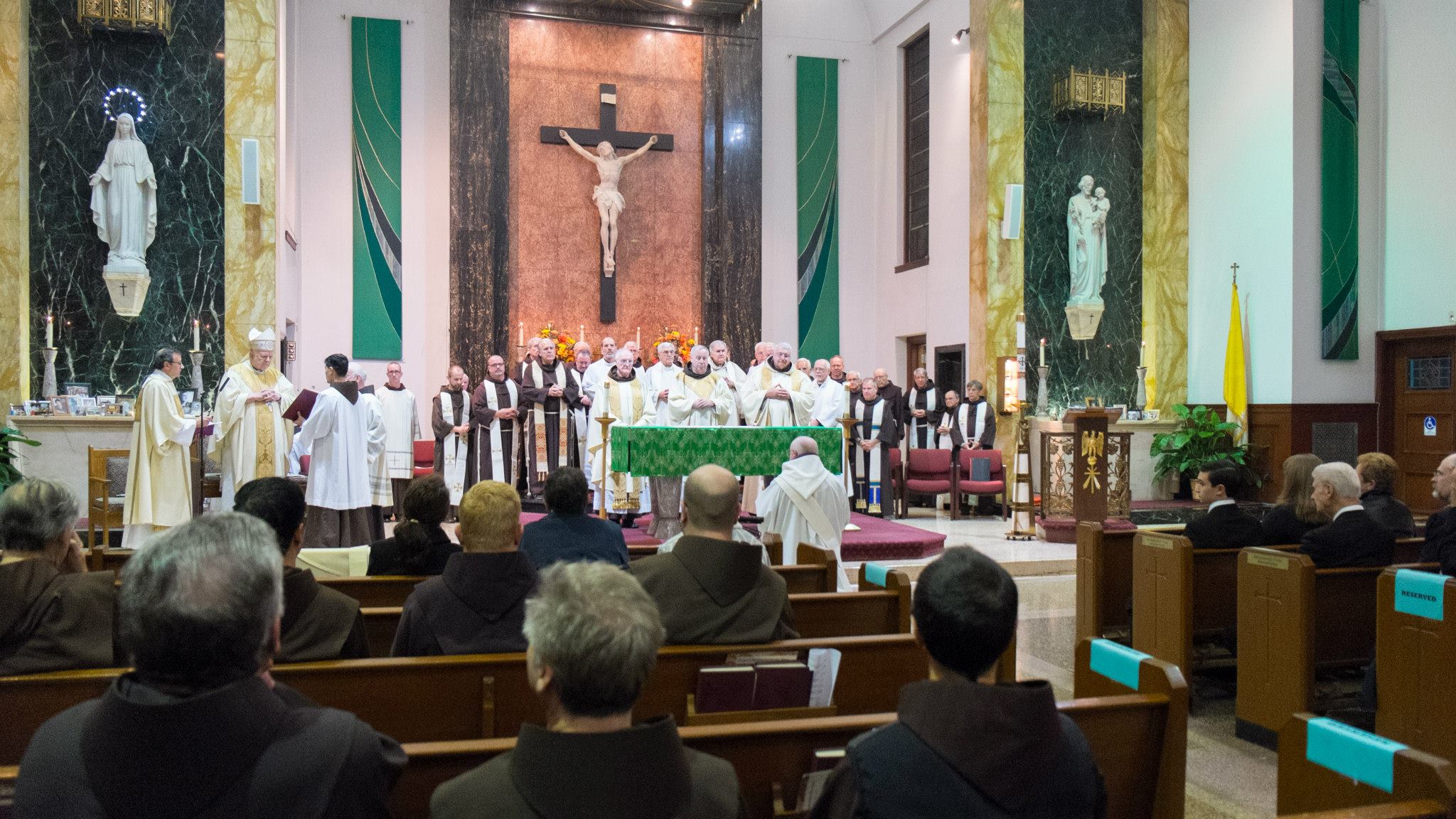
Ordinations are elaborate services that include a lot of people

Ordinations are elaborate services that include a lot of people

At the beginning of Postulancy I had the privilege of attending a solemn profession of two of our brothers within the first week. In my post at the time, I mentioned that it was a great experience to have before starting because it offered a clear picture of what would be to come if I continued in the Order. Yesterday, I was afforded a similar privilege.

Joined by roughly forty friars, a packed church of lay people, and a bishop, the simply professed friars in this house took part in the ordination mass of Paul Keenan, ofm, yesterday at Assumption of Our Blessed Lady Church. As is usually the custom, the simply professed friars served at the mass as acolytes, responsible for carrying the cross, miter, and crosier, setting up the altar with the gifts, preparing the incense, and assisting the master of ceremonies in anything else that needed to be done (which is a lot whenever a bishop is involved!)

Like the experience I had at the solemn profession two years ago, I couldn’t have been happier and more confirmed in my vocation after this experience. Seeing Paul standing in the place where I hope to be standing in four or five years was really inspiring; thinking about Paul standing where I was a few years ago was pretty surreal; hearing the bishop speak about the role of the priest in the church, that of servant of the people, was humbling.

Beyond all of that, though, I was touched most profoundly by the presence of the friars who came from all around, on a Saturday evening, to support our brother Paul in his acceptance of this vocation. There surely cannot be a greater image than seeing four rows of friars coming up one-by-one to lay hands on the kneeling candidate, offering their blessing on him before he is officially ordained. The feeling of brotherhood was overwhelming and the emphasis on being a “Franciscan” priest was unmistakable.

As I begin my studies to one day stand where Paul stood and to walk where he now walks, I have in my mind a clear bit of inspiration for the future. The road ahead is going to be long and difficult, and it will certainly be easy to lose focus on what’s important amidst a sea of books. At the heart of it all, I must remind myself of this experience and what this call means to me.

I am called to live in fraternity in the way of St. Francis. I am called to serve my brothers and sisters. If I can remember these two things, everything else will fade away.

Really, Would You Do It With Me?

In my last post, I mentioned that I was in Greenville, SC and that I was going to be speaking at four masses and appearing on a student radio show. I cannot begin to explain how well it went. Besides getting to see a lot of people that had influenced my vocational journey, I gained some invaluable pastoral experience. After a number of requests, I’ve decided to post the text of my reflection Sunday. I hope that God is able to speak through this to you, or to someone else you might know that could use this. If you would like any information about a vocation in the church, I would be more than happy to help.

[After a brief introduction specific to each community], and so I’m here to share a little bit about how God has worked in my life over the past four years, how I felt a call to follow God, and how I believe that he is calling each of you.

And what better way to begin than with our first reading and psalm: “The Lord hears the cries of the poor.” We are reminded once again that God knows our concerns, cares about us, and is willing to intercede for us. Just as he heard the cries of his people when they were slaves in Egypt, the Lord has heard our own cries and has come to free us from our burdens.

How often have we been a poor and oppressed people? How often have we looked around and asked, “How am I ever going to get through this?”  Whether it’s been a demanding job, a difficult relationship, bills that keep piling up, or just lack of direction, we’ve all felt the weight of oppression, have been tempted to lose hope.  DON’T LOSE HOPE! God is here to answer our prayers! All we have to do is cry out to him. In my own life, money has always been a worry, and school is very expensive.  Each year in college I would pray that I would have enough to get by, that they wouldn’t kick me out or that I’d run out of money half way through the year. God answered my prayers, and each year I made it through.

But it’s been my experience that God is not one for theatrics, that he does not answer our prayers through shock and awe miracles, but through our brothers and sisters we see each day. When I was struggling to find a way to pay for college, I didn’t happen to find the money miraculously sitting in my back account one day, nor did twenty-dollar bills fall from heaven like manna.  No, it was the sacrifice of my dad who changed jobs, drove over an hour to work each day at a job he hated because they offered tuition exchange.  It was the dedication and perseverance of my mom who has worked at the same job for more than 25 years that has kept my family above water and made it possible for me to get an education at all. It was a teacher who saw potential in me and invited me to apply for a program with a scholarship.  God heard the cry of the poor, but he answered my cry through the works of others who were willing to be God’s hands and feet.

Which got me thinking. If I truly believed that God heard my prayers and answered them through others, if I truly believed that I was nourished by God in the Eucharist and in the word, that God truly dwelled in me, then it meant that it was time for me to start hearing the cries of the poor as well, and to be God’s hands and feet. I realized that God was calling me to his service. I realized that God was calling me to a life devoted to others in prayer, poverty, and fraternity.

But there is a great danger in stepping up and being God’s representative. I’ve seen it in myself and I’ve seen it others: the moment that God starts working through us and letting us bring his grace to others, we are tempted to turn into Pharisees.  You see, the sin of the Pharisee was not that he fasted. Fasting is a good thing. It is not that he paid tithes. How else would we have this church and new school? It’s not even that he prayed in public, seeking validation from others. We’re doing that right now.  No, the sin of the Pharisee is that he began equating the grace God had worked in him with his own ability. Since he was a Pharisee, God had no doubt blessed him with a good education, a stable upbringing, and enough money to remain comfortable.  He did not deserve these things, he did not earn them. The reason that he had everything was because of the grace of God, God’s freely given, unmerited favor.  And how did he thank God? By praising himself and judging his neighbor. “I pay tithes. I fast. I did all of these things without anyone else’s help, so why can’t you?” How ugly! The Lord says, “Whoever exalts himself will be humbled, and whoever humbles himself will be exalted.”

There’s a story of a group of scientists that got together and figured out a way to create life, not by putting together things that were already living, but by simply mixing together chemicals and water and dirt and a few other things. They created life out of nothing.  So proud of their own skill, they called up to God and said, “Hey God! We don’t need you anymore. We can make life ourselves.” “God responds, “Oh. Is that so? All by yourself? Where’d you get the chemicals and water and dirt? Your ability to think, your passion for science, and the life you have? Did you make those things too?”

These scientists, like the Pharisee, forgot how blessed they were, how you can’t even walk out the door without running into God’s grace. This is an absolute tragedy because it is the acceptance of a lie. We are fooled into thinking that we are in control, that we determine our own fate, that all we have to do is work hard and we can accomplish anything all on our own.  It is a lie in believing that we do not need God. As St. Paul tells us, this could not be further from the truth. He says,

At my first defense no one appeared on my behalf,
but everyone deserted me.
May it not be held against them!
But the Lord stood by me and gave me strength,
so that through me the proclamation might be completed
and all the Gentiles might hear it.

I’ve experienced it and so have you: people will let you down. It’s a fact of life.  Your kids will disappoint you. Your parents will embarrass you. Your church, your government, and your best friends will do things that infuriate you. I will let you down, and at times, you will even let yourself down.  When we try to be our own lords and do things without God’s help, we will let each other down.

But God will never let you down. God will never abandon you. God will always be there at your defense, hearing your cries.

All you have to do is act as the tax collector did, and return to God will humble heart and be open to God’s grace working through you. We don’t know what the tax collector did to make him a sinner.  But does it matter?  His example to us is that he knew that he couldn’t make things right without God. He knew that God would listen, and he showed to tell him.  He could have let his sin get in the way of his relationship with God, too afraid to ask forgiveness; he could have chosen to deny the fact that he had sinned at all; he could have acted prideful, believing that he was big enough to handle it on his own.  But he didn’t.  He recognized that all that he had been given up until then was grace, and if he was ever go to make it to another day, it was going to be because of more grace.  He recognized that his life meant nothing without God. “Whoever exalts himself will be humbled, and whoever humbles himself will be exalted.”

My life as a Franciscan friar has just begun, and I couldn’t be happier.  I could speak for hours about how free I feel, how much fun I have with my brothers, how my mind has been stretched so far with philosophies and theologies about God, how I have been challenged to do work that I would have never done otherwise, work that, frankly, no one else is doing. But we don’t have that sort of time.

Instead, I’ll end with a question for you. If you believe that God has worked wonders in your life, that God is capable of great things in you, that our world is in need of God’s faith, hope and love, and that our church is something worth preserving; if you believe all this,

Would you be God’s ears to hear the cry of the poor and his hands and feet to answer their prayers? 

Would you live a life for the life of the Church?

Would you let God poor you out like a libation wherever he needs you?

I pray that you may be given the openness to hear God’s call, whatever it may be, and the courage to answer it. I’m here to tell you, you won’t regret it. It’s the best decision I’ve ever made and I couldn’t be happier. But I don’t want to do it alone. And so I ask you,


Would you do it with me?

Would You Do It With Me?

dare-to-be-a-discipleI’m on a mission this weekend: a mission to inspire a new generation of disciples to step forward in the church. Jesus tells us, “The harvest is abundant, but the laborers are few,” and nothing could be more true for our culture in today’s age.  All around us we find people in need of God’s grace, but we struggle to find people willing to bring it to them. I’m on a mission to change that.

That’s why I’m here in Greenville, SC, where my own vocation was born. Tomorrow, I will be speaking at all three masses at St. Anthony of Padua Church, and at the one mass at Furman University, as well as appearing as a guest of Fr. Patrick Tuttle, ofm on his radio show at Furman University (you can listen to the broadcast online here and call in at (864) 294 2757.

My message to them will be a simple one: if you believe that God has answered you in your time of distress, and you believe that God is capable of working through you to aid others in their’s, our world needs you. I’ve answered God’s call to be his steward on earth, to love his people for him, and I couldn’t be happier with my life.

Would you be God’s ears and hear the cries of the poor around you?

Would you recognize how much you need God and devote your life to him?

Would you let yourself be poured out like a libation for all the world? 

Would you do it with me?

My Advice For Those Discerning

With the transfer of the Postulancy program from Wilmington, DE to Silver Spring, MD, the postulants and simply professed will be under the same roof once again. Holy Name Province is blessed to have eight incoming postulants this year. Their arrival sparked this reflection.

Two years ago I started my journey as a Franciscan. Tomorrow, eight more men will do the same.

Two years ago I started my journey as a Franciscan. Tomorrow, eight more men will do the same.

Having now completed two years of the six-year formation process to become a Franciscan friar, I feel that I have learned a thing or two worth sharing with those discerning religious life. Obviously, my experience is quite particular to my Order, province, gender, and age, but I think that there’s something universal that can be shared with all who are discerning religious life: Give it two years.

What I mean by that is be patient. The entire formation process to become a Franciscan Friar is long (one year of postulancy, one year of novitiate, and four years of temporary profession.) It doesn’t happen overnight, and for good reason. Discernment takes time. Spiritual growth takes time. Building relationships in fraternity takes time. It takes so much time, in fact, that there is a two-year period between entering postulancy and making one’s first official commitment, simple profession. Be patient.

Being patient means giving yourself completely to the program. The first two years are not like the rest of friar life, nor does it claim to be. It is a period of deep spiritual discernment, exposure to a new way of life to try new things, the transformation of self, and the laying of a foundation that will last the rest of your life. These are all critically important. These are all critically tedious and frustrating at times as well. There will be workshops, sharing sessions, confrontations, suggestions and critiques, activities, and people in general that will seem so useless and trivial at the time that you’re going to ask yourself, “What the heck am I doing here?” Sometimes, it’s simply humility and patience that will get you through it. And you will. But I cannot stress it enough: stay open, especially in these times! There have been countless grace-filled moments over the past few years that I didn’t recognize at the time, and had I not been open to try new things, even in the frustrating times, I would have never seen them. Give yourself to the program.

Lastly, most important of all, giving yourself completely to the program means giving up thinking about “all the things I could be doing.” I could be getting a degree; I could be helping the poor; I could be dating; I could be making money; I could be furthering my career; I could be out with friends doing the things we used to do. You’re right: you could be. But you’re not. You’re a part of a once in a lifetime opportunity in which people will take care of everything for you so that you can better know God, yourself, and how that relationship fits with others. Trust me when I say that this is an invaluable opportunity for anyone, even for those who discern away from the friars.

And so I say again, give it two years. What’s two years of your life in the grand scheme of things? Sure, you could discern out, and you would “lose” two years, but think about how much more of an attentive husband, faithful and knowledgeable layperson, effective boss, and empathetic neighbor two years of such an in-depth spiritual program could make you. And if the worst-case scenario were only that, you discern out of religious life after two years a better person, it would seem that you’re risking almost nothing in order to gain everything. What if, on the other hand, that tiny spark of a calling you feel now becomes so enflamed after two years that you can’t think of anything else to do but devote your entire life to God and neighbor? What a wonderful two years that would be.

I now leave you with a prayer that has been very helpful over the past two years in my own discernment, a prayer that has kept me patient in my vocation in good times and bad. May it give you the same peace that it gave me to know that God is working in my life, even if it’s not always obvious.

Above all, trust in the slow work of God. We are quite naturally impatient in everything to reach the end without delay. We should like to skip the intermediate stages. We are impatient of being on the way to something unknown, something new. And yet it is the law of progress that it is made by passing through some stages of instability—and that it may take a very long time. And so I think it is with you. Your ideas mature gradually—let them grow, let them shape themselves, without undue haste. Don’t try to force them on, as though you could be today what time will make of you tomorrow. Only God could say what this new spirit gradually forming within you will be. Give our Lord the benefit of believing that his hand is leading you, and accept the anxiety of feeling yourself in suspense and incomplete.

Pierre Teilhard de Chardin, S.J.