Perception and Reality

Picture-2

Sometimes, perception and reality are not the same

Perception and reality are two things that do not always match up. Sometimes, what we see is not exactly what is actually there but rather the projection of our own experience: when we encounter something that is unfamiliar to us, we tap our memory for information that could fill in the blanks to make sense of what we’re seeing. And who can blame us? Given our limited worldview, we simply cannot know everything, and our mind makes great inferences, projections, and connections between what we see and what we know to help us navigate the unknown world.

Because of this, even though what we are perceiving is not the exact objective reality outside of our minds, it is in a very real sense reality. What we perceive, although potentially factually or perceptually incorrect, is a very real experience to us and our worldview. What we experience is what we will think of the world, what we will bring to new situations, and how we will engage new situations. In a very real sense, then, no matter what the actual, objective, outside-the-mind experience really is, our perception is our reality.

I say all of this as a background to the real questions of discernment we face every day as Franciscan Friars: as a radically countercultural and commonly misunderstood people, should we care about the way we are perceived, and, if those perceptions are negative, should we change how we act so as to not create scandal among the misinformed? In other words, if people aren’t going to naturally understand what we’re trying to say, should we give up and change our message, or should we struggle through ignorance to teach them?

The most obvious example of this is our attire. While wearing my habit I have been confused as a monk, a Jedi, a Moses impersonator, and an actor in a medieval play, while others have been confused as being Muslim, working for UPS, or someone early for Halloween. While there are some that immediately recognize me as a friar, many more are confused (and one can only imagine the conclusions that have not been expressed to us.) Do I avoid wearing my habit because perception is reality and I am promoting an incorrect reality for some, or do I use it as a chance to educate people that their perception is not in fact reality?

Another situation that comes up for me a lot, and admittedly is the inspiration for this post, is golfing as a friar. On more than one occasion I have been looked on with judgmental eyes and given some comment about my lack of poverty when I say that I golf. For me, there is no disconnect between being a friar and a golfer: I have discount clubs, I play on cheap public courses during off hours usually running me about 15-25 dollars to play, and I play only once or twice a month. For me, it is exercise in a beautiful environment, and when I’m not swearing at my ball, it is generally a relaxing, social, prayerful experience. Knowing this, and also knowing how others with a “vow of poverty” spend their money, I pushed one of my brothers on it one day. Turns out, his perception of golf was a country club atmosphere in which women and minorities weren’t really welcomed, where caddies carried the golfers’ clubs, and it cost $50 or more to play. His perception was not the actual reality in which I lived, and yet, until properly explained, his perception would have been a very difficult reality for him to reconcile with being a friar. Given his perception, I completely understand his judgment. So, because situations like this that go unexplained, do I give up golf because of the scandal it could bring to the misinformed believing perception to be reality, or do I go on defending myself on a person-to-person basis because perception is not in fact reality?

To muddy the discussion even further, I have one last case of misconception. Let’s say that there is a child all alone walking down a street at night in, let’s say, a neighborhood that you would expect to find friars. Upon seeing this, the “right” thing to do would be to approach the child, ask where his/her parents are, and offer to give the child a ride home for the sake of safety. Clearly a child should not be walking the streets at night and as a religious person, it is good to protect our children. No foul play is even thought of in the situation. What happens, then, when an outsider witnesses the child getting into Brother X’s car, alone, late at night? “What is that child doing all alone with that priest? Where is he taking him/her?” Because perception is a form of reality, assumptions and accusations will inevitably ensue despite an actual reality contrary to the observer’s perception. This is a very, very bad situation that, despite it’s complete disconnect from reality, is something that needs to be avoided at all costs.

And so I ask again: as a radically countercultural and commonly misunderstood people, should we care about the way we are perceived, and, if those perceptions are negative, should we change how we act so as to not create scandal among the misinformed?

Given my examples, I think that it’s clear that there is no easy way to answer this question. In one sense, we are public people in charge of caring for many; to not care about how we are being perceived would make us very ineffective at what we do. On the other hand, what we do is very countercultural and largely misunderstood by those we serve; to serve them in a way that they expect or feel comfortable with would be to do them a great disservice because it is the very things that they do not understand that we have to offer them.

At this point in my friar life, my answer is that there is always room for more transparency and evangelization, but that not every situation is it likely to yield positive changes in perceptions. People may not understand us now, and there’s a good chance that there will always be a large portion of the population that remains in ignorance, but think about all the people that could be enlightened if we wear our habit almost everywhere, if we talk about our fraternities in our homilies, if we invite people over to our house for prayer and dinner, if we open ourselves up to be transparent, public people, willing to share our lives with the world. Maybe we don’t go as Br. Casey to the liquor store or golf course; maybe there are times when it is much more pastoral to blend in than it is to stand apart; maybe there are times we act more like the expectation of our congregation than the way we do in our friaries because people are not ready to see 25 year old, real-human-being Casey, they want pious, well-behaved Br. Casey. Point taken: even though there is nothing wrong with any of these things, there is a time and a place for effective evangelization.That being said, without talking early and often about our lives, people will misunderstand the habit, will misunderstand our fraternities, will misunderstand our hobbies, and will misunderstand why we do what we do.

But it’s worse than that. If our concern for how we are perceived or really, our fear of being misperceived, becomes so great that it discourages us from public action, there is a great possibility that we will not be perceived at all. This, I say, is an actual reality we cannot ignore.


What Are You Looking For?

This weekend, I’ve been given the opportunity to preach at St. Anthony of Padua Church in Camden, NJ. For the readings of the day, you can go to the USCCB website found here. May God bless you on this 17th Sunday of Ordinary time.

For many, we're searching for something we don't yet know. What is it that you are looking for?

For many, we’re searching for something we don’t yet know. What is it that you are looking for?

Imagine for a second that you were in Solomon’s place. God appears to you in a dream and says “Ask for anything. I’ll give it to you.” Anything. Blank check. Anything you can possibly imagine. What would you ask for? In some ways, it’s kind of a silly hypothetical question, a cheesy get-to-know-you game question like, “If you could be any animal, what would you be?” On the other hand, it may actually be the most important question you ever ask yourself. Why? Because it reveals what is at the deepest depth of your heart. Instead of thinking about it as some wish from a genie, ask yourself: “At the absolute core of who I am, what is it that is most dear and true to my heart, the thing that I desire with all of my being?” It may be something that you already have that you want to keep or something you don’t have that you want to get. It can be physical or mental, social or spiritual; it can be real or imaginary, plausible or impossible. What is it that you desire most, and what does that say about you?

In Solomon’s case, his greatest desire revealed his humility, compassion, and above all, his great love for God. Of all the things that his imagination could possibly conjure up, all that he requested from God was an “understanding heart.” I mean, come on! He could have asked for anything: power, money, fame, immortality. Like so many kings of his time, he could have tried to rule the whole world, put his face on money, or at the very least had a theme park named after him. But he didn’t. He didn’t ask anything for himself at all. What he asked for was the skills to love God’s people better, in essence, to be able to give more of himself. How much more revealing of a virtuous character do you get? At the core of Solomon’s heart was love for God and his people, and nothing more.

So what about you? Does your desire stack up to Solomon’s? What does that say about you? I admit, it’s a really difficult question. It forces us to look deep inside ourselves, to potentially see what we’re not always proud of. It requires us to see our potential faults and shortcomings, our insecurities and vulnerabilities. Our natural impulse will be to deny what we see, to blame it on others, or to just not care. Instead, we prefer to stay on the surface, to talk about the weather or what was on TV last night, to go through life hiding from ourselves, remaining unchallenged. I think, if you’re willing to open to yourself, to see the person that God sees, you’re right, you may not like what you see. But how can we ever be called to conversion if we never know what needs to be converted?

When I’m honest with myself, I see that there are some desires deep inside me that I wish weren’t there. I care very much about what people think about me, and desire to be liked by everyone. Even though I know God loves me and that should be good enough, I still want everyone else’s approval. Can anyone relate to that? If not, I’m sure that there are plenty here that have a deep desire to always have more. So many people waste their entire day worried about making money and their entire night worried about keeping it. What other things do we desire but don’t want to admit? I imagine we could go down each row and find desire after desire that doesn’t match Solomon’s: power, fame, intelligence, leisure, control, security, affection.

But that’s okay. It’s who you are right now, and whether good or bad, I think that knowing what we truly desire, the thing we love above all else, is the most important thing we could ever know about ourselves. Really. Like Solomon, our desires reveal who we are and who we want to be before God. They reveal what motivates us, and ultimately, how we’re going to act. There’s a prayer by the late Jesuit priest Pedro Arrupe, S.J. that captures this perfectly. It goes:

Nothing is more practical than finding God, that is, than falling in Love in a quite absolute, final way. What you are in love with, what seizes your imagination, will affect everything. It will decide what will get you out of bed in the morning, what you do with your evenings, how you spend your weekends, what you read, whom you know, what breaks your heart, and what amazes you with joy and gratitude. Fall in love, stay in love, and it will decide everything.

Such words of wisdom, and from a Jesuit no less! Whatever it is that we desire above all will have a hand in everything we do. It guides us and informs our decisions. Sometimes, it even makes us do radical things. When we find that buried treasure in the field or the pearl of great price, that thing that we most desire, we are able to give up absolutely everything we have, our time, our skills, and our money, just to get it.

Look at your own life. Look at what gets you up in the morning; what keeps you up at night; what makes you laugh; what makes you cry. What is the buried treasure that you spend your whole life seeking? Is it money, or is it Jesus? Is it personal glory, or is it the glory of the kingdom? Is it power over others, or is it the desire to be faithful to our God?

In many ways, we know that there will always be competing desires in us. We seek God, but sometimes, we seek other things as well. While I’d like to say that Jesus is my only desire, I know that my actions don’t always say so. When I honestly look inside myself, when I honestly look at how I spend my time, I know that I am in need of further conversion. We all are. The real question is, when push comes to shove, which desire is going to win out: Jesus or the world?

Our Church is witness to so many inspirational people that have made Jesus their ultimate desire. Of particular importance today, we remember all of those who have gone on mission through the Franciscan Missionary Union. Through this organization, men and women have been led to serve the lowest and most forgotten people of society, people who would otherwise never be loved or cared for; they have built schools and universities all around the world, spreading not only knowledge, but wisdom to people who need it most. They have loved without boarders, given of themselves without restraint. Why? Because Jesus is their greatest desire. Our second collection today will be an opportunity to support those who have supported so many in this world.

For me, it is actually my need for conversion, not any perceived holiness or perfection, that has led me to this life as a friar. I know that I am a sinner and that I fall short. Being a friar isn’t about being perfect or having no worldly desires: it’s about recognizing how much we need Jesus in our lives, even if we forget it sometimes. Jesus is my pearl of great price, and even though I get distracted by other things at times, I know that I want to give up everything I have in this world to buy it. Because we take vows of poverty, chastity, and obedience, some point out that there are a lot of things we cannot do. True, we cannot get married, become rich, or chase prestigious careers. But look at all the things we can do: we are free to move where we’re needed, to love without restraint. We live a life centered in prayer, poverty, and humility, and the best part about it is that we don’t have to do it alone: we always have our brothers. If you ask me, there is no greater treasure in the world than what I’ve found.

And so I ask again, what is your deepest desire, your pearl of great price? Have you found it yet, or are you still searching? My prayer for you today is that you may know with all of your heart what is truly important in this world, that Jesus is the only treasure worth seeking. I pray that when you find him, you may have the courage to give up everything you have to be with him.

Updating Our Image

The other day I was watching television and I saw an incredible commercial promoting vocations. With triumphant music in the background and images of courage and selflessness, the narrator spoke:

There are a few who move toward the sounds of chaos, ready to respond at a moment’s notice. And when the time comes they are the first towards the sounds of tyranny, injustice, and despair. They are forged in the crucible of training.

Which way would you run?

I was amazed at how powerful the commercial’s message was and how it moved me to want to do something important, something radical, something to make the world a better place.

When I thought about it, another commercial came to my mind. Similar to the one before, triumphant music played as a video montage showed people making great sacrifices for others, going where they would never had thought they would go, and doing so in the context of a living fraternity. The narrator spoke:

The call to serve, it has no sound, yet I have heard it. In the whispered retelling of honorable sacrifices made by those who have served before me. The call to serve has no form, yet I have clearly seen it. In the eyes of men and women infinitely more courageous and more driven than most. The call to serve has no weight, yet I have held it in my hands.

I will commit to carry it closely in my heart until my country is safe and the anguish of those less fortunate has been soothed. The call to serve is at once invisible and always present, and for those who choose to answer the call for their fellow man, for themselves, it is the most powerful force on earth.

Given the powerful message of these two commercials, as well as their high production costs, it’s no wonder that the two Orders that produced them have been wildly successful in recent years at recruiting new members; young men sign up in such great number that many are turned way. Clearly, the opportunity to serve others by doing something self-sacrificing and noble, the thrill of doing something radical and counter-cultural, and the sense of belonging in being a part of a life-long fraternity, are things that young men are looking for.

Unfortunately, the two “Orders” that are promoting such a “vocation” are the United States Marine Corps and the United States Navy. In almost all of their commercials, the focus is less on the brutality and violence one would expect and more on the bond of brotherhood, the sense of honor in building something greater than self, the selfless act of protecting those in need, and the ways in which one is challenged to be a better person. These two major branches of the military know how to recruit men to do something dangerous and life-changing, and they’re doing it with OUR message. 

Like all companies, we need to be able to adapt our public image if we are to remain relevant.

Like all companies, we need to be able to adapt our public image if we are to remain relevant.

I have to say that this bothers me a bit. It bothers me, not that the Marines or Navy have creatively tapped into a man’s (or woman’s) inherent desire to be a part of something greater than self, but that we as a church have failed to do so ourselves. Why haven’t we been able to brand ourselves in this way, to market the Church and a vocation within it as an empowering and noble thing to do? Why do does almost every vocation brochure or church pamphlet exclusively show pictures of friars and sisters piously praying the rosary in their habit inside of a quiet church? It’s not a bad image, don’t misinterpret what I’m saying, but it’s only small part of who we (religious and Catholics in general) are, and it leaves so much of what it could mean to be a practicing Catholic, not the least of which is fun.

I guess what I’m trying to say is, “Wouldn’t it be cool if we hired a professional ad agency to rebrand and re-market the Church for the 21st century?” What would it take to attract the best and brightest, the young professionals and entrepreneurs, the ones with the greatest work ethic and the power to move the Church? This is not naivety I assure you: I know that a simple ad campaign is not the only reason that the armed forces are recruiting men and know that there are serious issues of commitment and secularism in our culture that a new brand image are not going to magically fix. But at the same time, there are good men and women out there with a great sense of belonging, looking for something noble to do, that have been turned off by the Church based on popular depictions alone. When this happens to companies like Walmart, Apple, and McDonald’s, they don’t change their product, they change their image. We have an INCREDIBLE product. Let’s do something about our image.

How cool would it be if we, the Catholic Church, could dedicate the sort of resources that the evangelical churches have into movies and music, but in our case, do it with deeper messages than the “me and Jesus,” overly dramatic and corny conversion story with no artistic value? How about a movie in which the Church, realizing that its charity has enabled dictators to abuse the masses for centuries, goes on strike, shutting down all of its hospitals, soup kitchens, church pantries, and social services? Think of the social/political themes, the moral dilemmas, the conflicts. If we’re feeling a little less ambitious at first, how about just getting some priests, brothers, and sisters in quality secular movies that are more than just caricatures or jokes? A popular character can go a long way to changing public opinion for the better. In terms of music, and I know this sounds crazy, what about a Christian song that uses “we” instead of “me” and focuses on the Jesus suffering in the street not just the Jesus that makes me feel warm inside? Still too ambitious? Heck, I would love to see someone with a Mac and a camera rip off the audio to the Marine commercial and replace the video with pictures or videos from their church. How sweet would that be? (But really, does someone want to help me on a project like that?)

The possibilities are endless and surely better than the ideas I can come up, but the need is real: we as a Church, we as Franciscans, have incredible message to share, and the resources and sense of quality art to package it well. Let’s use them and let’s modernize our message. A pious friar praying the rosary in his habit is a beautiful image, but it cannot be the only image we use if we are to attract people of the 21st century.

The road ahead may be tough, even chaotic:

There are a few who move toward the sounds of chaos, ready to respond at a moment’s notice. And when the time comes they are the first towards the sounds of tyranny, injustice, and despair. They are forged in the crucible of training.

Which way would you run?

Renewal of Vows

I profess to live in poverty, chastity and obedience for the period of one year.

I profess to live in poverty, chastity and obedience for the period of one year.

Like the process of dating, engagement and marriage, the process of becoming a fully-professed member of a religious order takes on many stages. Last August, I professed for the first time my vow to live in poverty, chastity, and obedience in the way of St. Francis of Assisi. In a way, these vows were a test: I was testing the life to see if it was truly where I was called.

And wouldn’t you know it? Time’s up on that first year. In the Church’s great wisdom, however, the time has not come for me to make my lifetime commitment: for the next three years, all I have to do is profess vows for a period of one year as I continue to discern my place in the Order of Friars Minor.

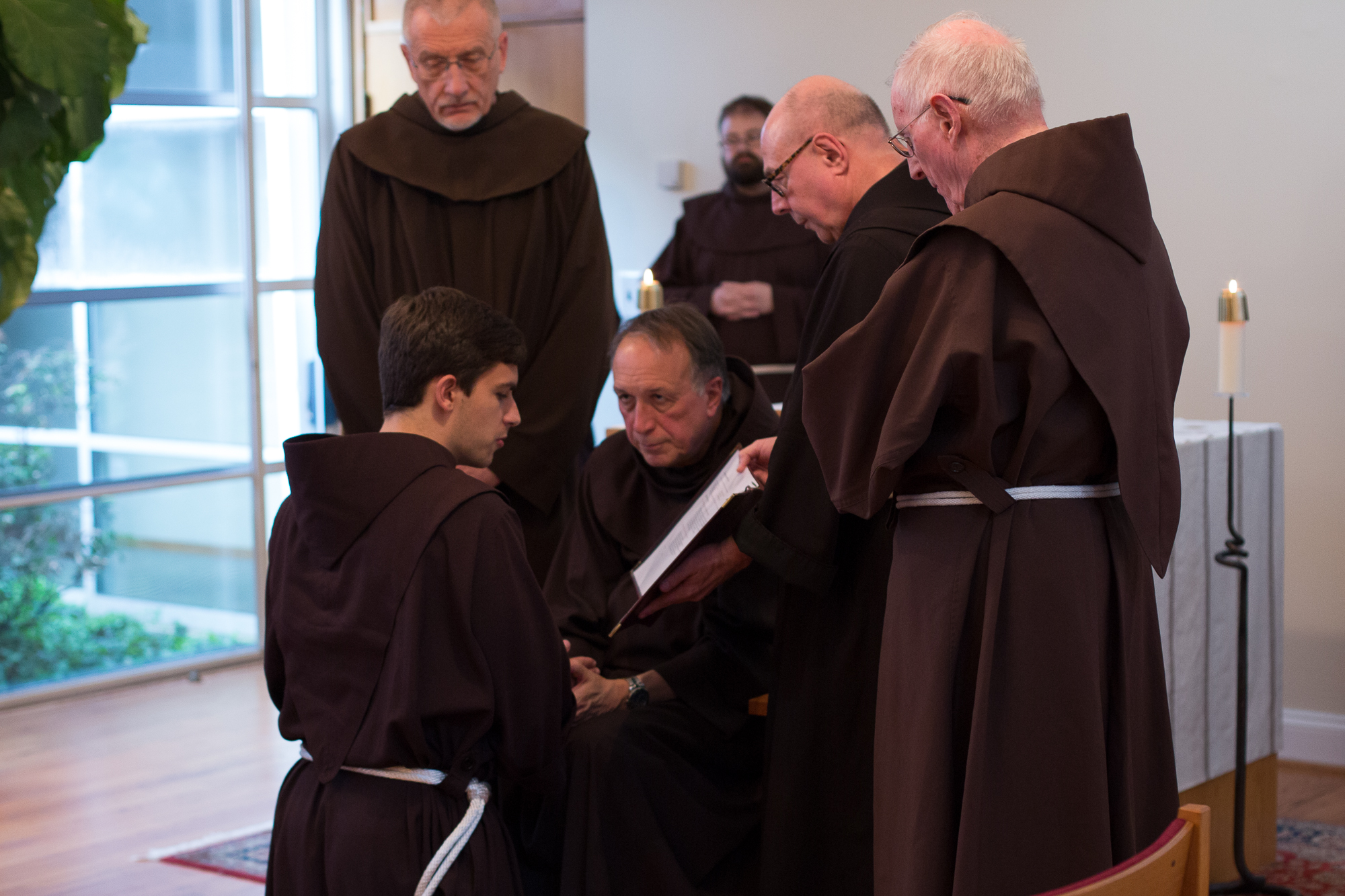
In other words, it’s like a lease to an apartment: I either have to resign the contract or move out. For now, as is fairly obvious from the picture, I have discerned that this life if for me and will continue for another year. Last evening, kneeling before our Vicar Provincial (essentially the Vice President), I spoke these words once more:

To the Praise and Glory of the Most Holy Trinity, I, Brother Casey Cole, since the Lord inspired me to follow more closely the Gospel and the footprints of Our Lord Jesus Christ, before the Brothers here present and in your hands, Brother Dominic, with firm faith and will, vow to God, the Holy and Almighty Father, to live for the period of one year in obedience, without anything of my own and in chastity, and, at the same time, I profess the life and Rule of the Friars Minor, confirmed by Pope Honorius III, and promise to observe it faithfully in accordance with the Constitutions of the Order of Friars Minor. Therefore, I give myself to this fraternity with all my heart so that, through the efficacious action of the Holy Spirit, guided by the example of Mary Immaculate, through the intercession of our Father St. Francis and of all the Saints and supported by your fraternal help, I can constantly strive for perfect charity in the service of God, of the Church and of mankind.

This I promise.

603A4757It was a quick and simply ceremony within the context of Evening Prayer, but was the result of careful discernment and conscious action. Each year we must step back, look at our lives, and ask ourselves with great conviction: “Where has God called me to be?” For the next year, I believe that God is calling me to continue in the way of St. Francis in the Order of Friars Minor, taking one step closer to formally committing myself to God and his Church.

Sunday Reflection: Drink From Living Waters

This weekend I will be traveling to the University of Georgia to visit with the students at the Catholic Center and to give a reflection at each of the masses. My reflection is based on the readings for the day, found here.

While there are few things more exhilarating than a ride like this, we need something more in our life to remain fulfilled.

While there are few things more exhilarating than a ride like this, we need something more in our life to remain fulfilled.

They say that money can’t buy happiness. But then again, money can buy wave runners, and I dare you to find a sad person riding a wave runner. Am I right? Probably not the opening line you expected from a Franciscan, but I stand by it. The reason I say this is that there are a lot of good, physical/temporal things in this life that make us happy and keep us going. While riding a wave runner might be a bit of an exaggerated example, our lives are often focused on fulfilling these physical/temporal needs, and this is not necessarily a bad thing. For those of us in school, getting good grades is among our highest priority, and it’s good to do so. For those of us in the working world, earning a good paycheck helps us to eat, pay the bills, and provide the general necessities of life, which are all good things. Eating is good. Having fun with friends is good. Looking nice is good. Going to college football games is good. In a lot of ways, these physical/temporal needs, eating/drinking, work/play, accomplishments and status, are not only good to have, but also necessary to our survival.

In my life before becoming a friar, I was filled with more blessings that I can count. Like the Israelites wandering in the desert, I was often unable to see all that God had done for me and was often ungrateful. Although I never had an abundance, God continued to bless me and stand by me, to keep me safe and well-nourished. I was blessed with great parents that supported me. I played baseball for our club team in college and even had a chance to go to the Club Baseball World Series; I had a beautiful girlfriend that made me happy; I got good grades in most of my classes; and I had friends that made me laugh and joined me in never missing a party. For all intents and purposes, I was living it up, and very happy with the life I had. 

That is, until the summer after my sophomore year when I was invited to live and work at the church run by the friars in Greenville with three other students. What started out as simply an opportunity for free room and board turned into the most life-changing experience of my life. The four of us prayed together twice a day, ate meals together, and really, grew together. We spent each day serving the church and community, and then each night sharing our lives, talking about faith, and becoming amazing friends. It was an intimacy of friendship that I had never experienced, and an intimacy that was life-giving. It was because of that powerful experience in community that I found myself able to be poured out day after day for others and yet never tired of what I was doing.

The following year, I realized something had changed in me. For spring break, sixteen friends and I found a house in Key Largo on a private beach; the weather was perfect sunshine and 85 all week; we had no cares in the world except to grab a drink and sit in the sun. For most of us, that’s paradise: we could do that all day, every day. What could be a better life than to sit on the beach all day? To this day I’ll never be able to explain it, but by the third or fourth day of the week, I found myself a little restless. There was something unfulfilling about it, and I started looking forward to going back to school. I know, it sounds absolutely crazy. It was a tremendously fun time, and don’t get me wrong, I’d kill to be back there, but there was something about it, and something about the majority of my life, that was completely unsustainable. I longed to be back at church, living in community, serving people who needed help.  There was a thirst in me that couldn’t be quenched by a day on the beach, no matter how fun. I longed to be doing what truly fulfilled me: serving others.

As I continued on my journey, I spent a summer with the friars in Philadelphia where we have a soup kitchen. There, I met a friar with a similar story. Owning his own business with an office in New York and Atlanta, making incredible amounts of money, and working with celebrities like as Elton John and Bon Jovi, he says that his life was like the most expensive, rich and creamy dessert you can imagine: decadent, extravagant, and eventually unfulfilling. Eating a twelve layer chocolate cake is delicious for dessert, and there are times when it is exactly what we’re looking for; but what if we ate 12 layer chocolate cake every day? I imagine that even the most delicious cake in the world would get old after a while. That was how his life was: he had all the money and prestige he could ever want, but it wasn’t until he gave those things up and devoted his life to the poor that he felt truly fulfilled. There are few people I know that are happier in what they do than him.

In this time of Lent, God is calling all of us to this sort of life-changing experience. Rather than continuing to drink from wells that cannot quench, seeking happiness in things that do not last, we are called to drink of the water of eternal life. We are called to the Word, to the Eucharist, to a life in Christ. We are called to replace a life of fear, emptiness, and futile pursuits for a life of love, fulfillment, and building up of God’s kingdom.

A life like this truly is a calling, and it is a calling Christ has for each of us, each of you. Like the woman at the well, Jesus is calling you, because he knows you intimately. Just as he knew that she had had five husbands, he knows who you are and where you’ve been. He knows what you’ve done well, and where you’ve fallen. He knows this because he was walked this road with you, standing by you as you drank the water of earthly life, while always offering the water of eternal life.

What would happen if you answered this call, took in living water, and let it spring up in you throughout the whole world? Where do you think it would take you?

In the life of the Church, it has taken people to serve the lowest and most forgotten people of society, people who would otherwise never be loved or cared for; it has built schools and universities all around the world, spreading not only knowledge, but wisdom to people who need it most; it has inspired doctors, lawyers, politicians, and business leaders to put their tremendous skills toward the common good, even working for free in order to bring life to those without hope.

For some, it has moved people like me to do even wilder things: to vow ourselves to the Church in poverty, chastity and obedience. Let me tell you, it was the most freeing thing I ever did. Don’t believe me? All I have to worry about in life from now on is how I’m going to best love God’s people for him. Because I have given up the ambition to be rich, or even comfortable, the desire to have a family, and the need to be in control or have a successful career, I am free to move where I’m needed, to love without restraint. I live a life centered in prayer, poverty, and humility, and the best part about it is that we don’t have to do it alone: we do it together, living in community. Through these things, God has given us friars so much life-giving water that we can’t help but share it with the world. We work in parishes, universities, schools, retreat centers, and soup kitchens; we act as priests, teachers, artists, musicians, writers, and social workers; we have brought the gifts God has given us to serve the people of God, and we do it together, as Church and fraternity. 

In all of these ways, the seeds of living water have been planted. Jesus has used men like Father David and Father Tom, along with thousands of other men and woman, to bring living water to the world for two thousand years. Jesus tells us that the fields are “ripe for the harvest.” In this time we live, there is an incredible harvest to be had and so few laborers. The churches they’ve built, the schools they’ve founded, the soup kitchens they’ve established, and the movements they’ve sparked, all need strong men and women to keep them going. People often ask, “Why are there so few priests, brothers, and nuns today?”  I wonder: “Do you think that Jesus has called fewer people to serve or are fewer people willing to answer that call?” He says in today’s Gospel: “I sent you to reap what you have not worked for; others have done the work, and you are sharing the fruits of their work.” Jesus is calling you to this harvest. With Jesus as the life-giving water, and others having done so much of the work before us, what is ours to do but to say, “Yes” and continue what they’ve started? It doesn’t matter how old you are or what skills God has given you, the world needs what you can offer.

There is nothing wrong with things of this earth. Much of the physical/temporal things we seek are good. But are they ends in themselves? Can they satisfy us forever? The wave runner eventually runs out of gas, beauty fades, money runs out, jobs end, power weakens, and no one cares about your grades after your first job. In this Lenten season, I ask you to look at your life and ask yourself this question: am I drinking from waters that leave me thirsty, seeking happiness in things that do not last? If this is the case, now is the time to turn your hearts, to say yes to the Lord, and drink of living waters. Just one sip and you can’t help but spring up for the world; you’ll realize that it’s in pouring yourself out that God continues to fill you up. And so, Jesus is calling, “The hour is coming and is now here.” Will you answer? “If today you hear his voice, harden not your hearts.”