An Old Path Made New
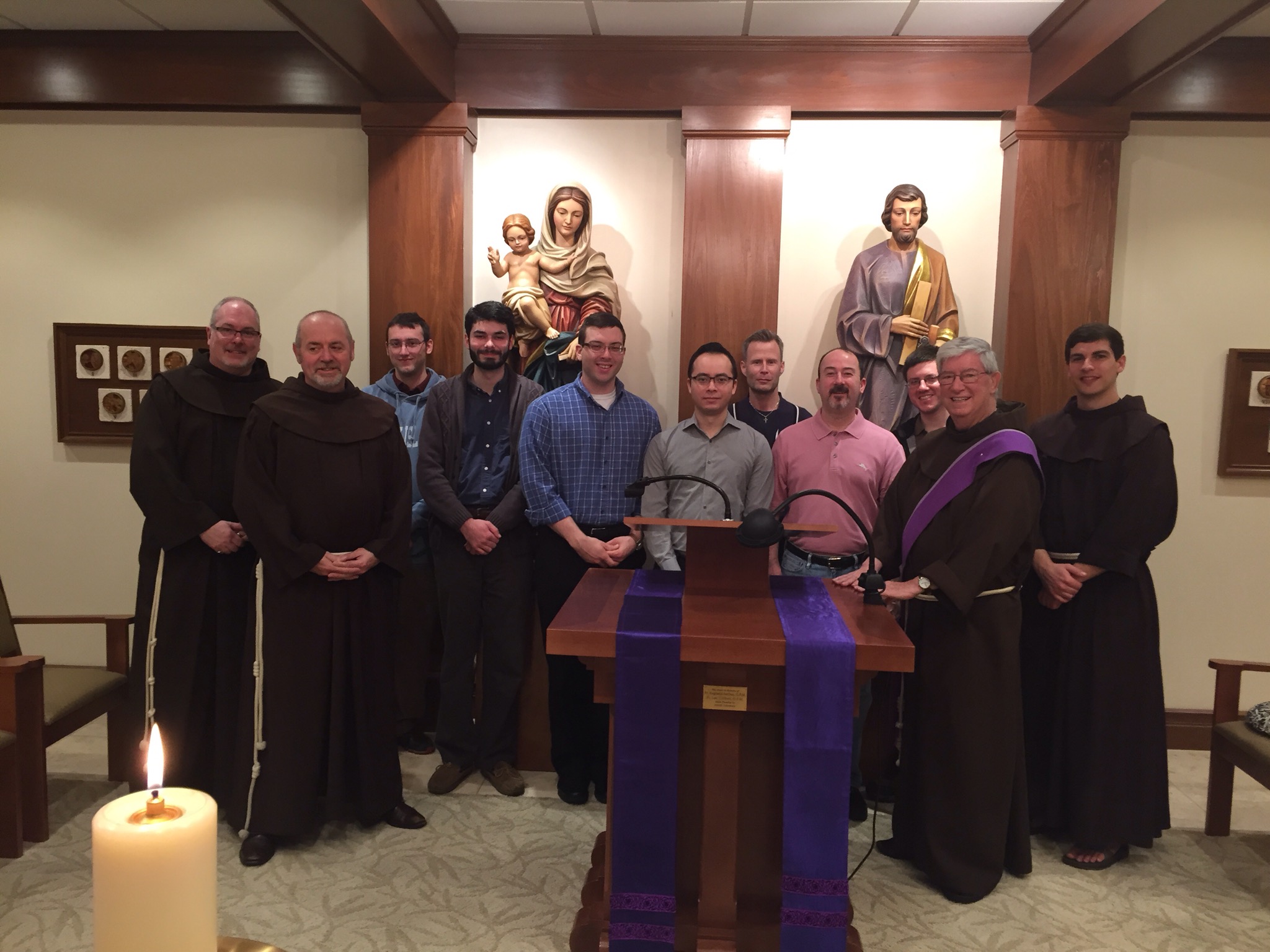
I was so impressed by these men, from left to right: Br. Basil, Fr. Frank, Ben, Todd, Crawford, Gilbert, Ken, Jim, Nick, and Deacon

I was so impressed by these men, from left to right: Br. Basil, Fr. Frank, Ben, Todd, Crawford, Gilbert, Ken, Jim, Nick, and Dn Alan

This weekend I was offered a tremendous opportunity. While Washington, D.C. was recording its coldest temperature in over 100 years and amassing over 6.5 inches of snow, I was asked to travel to sunny Florida to bask in he spring-like weather. For what? Who cares! I was going to say yes to anything! Luckily for me it was for a great event: a vocation discernment retreat for new candidates.

Taking place at our retirement home in St. Petersburg, some, including myself, had some reservations with the concept. Is this really the image we want to use to introduce men to the order? Are a bunch of old guys really the best sell for a group of excited candidates?

Turns out it was the perfect place to be. These men, both young and old, could not have been more impressive, and the rapport they shared could not have been better. The weekend was an unforgettable experience of bridging the future and “past” of the Order, mutually inspiring each other with new life. The accomplishments of the retirees grounded the candidates’ idealism and the energy of the new men brought life and joy to an otherwise quiet house.

The weekend started Friday night with us doing what we do best: eating and socializing. To my great enjoyment, the candidates and retired friars had no problem hitting it off. The new men were eager to hear about the friars and the friars were overjoyed at the opportunity to entertain visitors. Following dinner, the group was formally introduced as we prayed Evening Prayer together.

The first session was led by Paul Santoro, OFM, and myself, and was entitled, “What does it mean to be a friar today?” All we could say is that there is simply no blueprint for who and what a friar should be. Even though there are specific aspects of our charism that guide us (prayer, fraternity, minority, and mission) and we spent some time sharing our experience of each, the fact of the matter is that there is no “correct” way to live them out. “it’s what you bring to this life that makes it what it is.” As the other friars began to chime in with their own diverse experiences, hopes, and visions, we found ourselves building a beautiful mosaic right before our eyes; though varied and seemingly fragmented as individuals, together we made something coherent and full of tremendous meaning.

The following morning built upon this diversity with a discussion about the mission of the friars led by two very different men: Jerome Massimino, OFM, and Kevin Mackin, OFM. While Jerome had spent most of his life in pastoral settings, staffing parishes and campus ministries, Kevin spent most of his life in academia, teaching and administrating at a high level. In almost no way did their ministries overlap; the people they served, the tasks they carried out, and the problems they faced were completely different. And yet, both men are Franciscan through and through. The juxtaposition of their lives was a wonderful witness to see.

A few of the guys with Fr. Kevin Mackin

A few of the guys with Fr. Kevin Mackin, OFM

The final talk of the weekend came after lunch Saturday and could probably have been named (and I kid you not) “Dying with Dignity as a Friar.” Given by Francis Souci, OFM, the man instrumental in building and running a skilled nursing facility for aged and infirm friars for more than 20 years, it was a powerful talk about how we are fraternity until the end. Refusing to call it “the infirmary,” he insisted that it be called and treated like any other friar, a place where men could pray and socialize with one another, affording them the dignity at the end of their lives that they had given so many others throughout their life of ministry. One might not expect a talk such as this on a discernment retreat, but I can’t tell you how important a similar experience was for me when I was discerning, to know that I would be loved and cared for even in my old age.

And really, I think that was the surprise “sell” of the weekend. Obviously, I think it was great for someone like myself to be there, to be able to field their questions from the perspective of someone currently going through the process; and it was obviously great to have the head vocation director and regional guys in full-time ministry to share from their more seasoned life with the friars. But those sorts of things are to be expected and are commonplace at our retreats. What was different about this one was being around our highly decorated brothers. These men are the ones who blazed the trail before us, made the path open for the rest of us to follow. And this did not go unnoticed by our candidates, men who are trying to find their own path to walk in this life. I know that I was touched and inspired by their life and witness.

All in all, I leave Florida elated and surprised by the happenings of the weekend. What I witnessed was life-giving. There are men before me that made my life in this Order possible, and there are men, truly fantastic men, that appear to be coming after me. Again, I find myself so affirmed in this life, and overjoyed that others feel the same way. The path of a friar is laid out before us, old and true, but there are always new ways to walk it.
My Vocation Journey

It occurred to me this week that, while I have shared much of my journey through formation as a Franciscan, I have shared almost nothing about my vocational story prior to the friars.  Back in August of 2011, weeks before entering, I gave a little explanation as to what a friar was and what it was I would be doing over the next few years, but oddly enough, no explanation as to why. My only guess is that the earliest readers were close friends and family and so I saw no need to share what they already knew.

So, who was I way back when and what happened in my life to cause me to make such a ridiculous decision? Let’s start with a little background. I was born into a Catholic family, baptized as an infant, and made to go to church and religious education until I was confirmed in 8th grade. I was always a good kid (no comments from family members please…), said prayers before bed each night, and genuinely believed in God my whole life. By the time I was confirmed, I found church tremendously boring. “Why do I need to go to church? Can’t I just read the Bible, say my prayers, and be a good person?” According to my parents, this was not enough. To church I went. Every week.

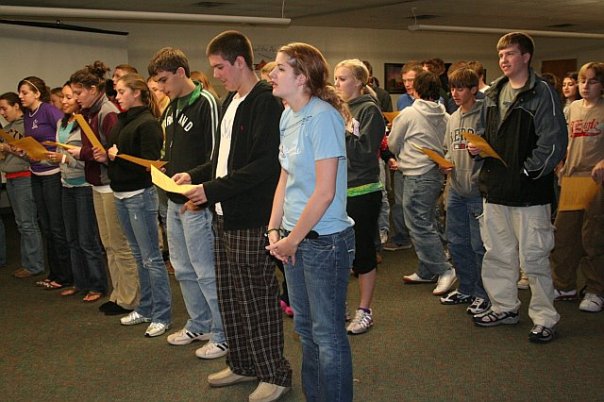
This was a retreat designed specifically for the older leaders. There were still about 40 students.

This was a retreat designed specifically for the older leaders. There were still about 40 students.

The first major step came when we moved to Cary, NC and started going to a new church. What an experience! There was a mass specifically celebrated for teenagers, complete with a rock band playing contemporary Christians songs and three rows in the front (and floor space) filled with students; each Sunday there was a youth group event with about 100 students, 20 or 30 of which came not because it was a confirmation requirement but because it was the most fun thing people did all week; and twice a year there were retreats with 125 people to the mountains/beach that packed together hilarity, intimate bonding, and powerful conversions. What started out as a cool hangout place with the cool kids turned into a true calling: I wanted to be active in the church. When I was 16, I dove in headfirst. I became a peer minister, went on seven retreats in two years, gave talks in front of large groups, found myself at church sometimes 3-4 nights a week, and during my senior year, worked out a program with my school to leave during fourth period to do an internship with my youth minister. Happily dating throughout high school, I knew that I wanted to devote my life to ministry, but had ABSOLUTELY no interest in becoming a priest (and had never heard of religious life.)

Few memories are happier than with these people!

Few memories are happier than with these people!

At that point, I really liked the prospect of becoming a youth minister and so went to college in pursuit of a religious education. While excited about faith, until this point I had very little knowledge of what that faith actually was, and needed a stronger foundation. I got involved with the Catholic ministry group on campus right away, and while it was not what I was initially looking for (it was very small and seemed to be mostly talking, whereas I was used to 100+ people singing, acting, praising, and working), I was encouraged to stick with it and grow in my faith. I was elected retreat coordinator my sophomore year, and Program Director (retreat coordinator combined with Wednesday meeting planner) the final two years. It was here that my faith evolved from the charismatic, evangelical faith I adopted in high school, to a faith grounded in theology and social teaching. I’ll never forget when it just clicked. Catholic Campus ministry did a series on social issues my sophomore year: what does the Church have to say about Walmart, poverty in foreign countries, and injustice in the business/political world? To my surprise at the time, a lot. I realized that faith was not simply praise and worship, it didn’t only take place within the church walls; faith was something that was intrinsically linked to justice, charity, and social action. I was sucked in. The faculty advisor of the Catholic group made a presentation about a new minor being offered in the spring, Poverty Studies, and I knew that’s where I was being led. After classes like “Faith and Ethics,” “Social Class in America,” and “Ethics of Globalization,” two of which taught by this Catholic professor, I knew that my vocational journey had taken a turn: I was called to serve the poor and work for just social systems from a position of faith. While inspired by the Franciscan chaplain at school, I found myself in yet another serious relationship, and the thought of ordination or joining religious life was nowhere on my radar.

Minus Melissa, the group wearing our custom t-shirts for the summer: "OFM What can brown do for you?"

Minus Melissa, the group wearing our custom t-shirts for the summer: “OFM: What can brown do for you?”

That was, until the summer I spent in the old friary. Driven by the most altruistic, mature reasons possible (I wanted to be independent from my parents and was hoping to spend a summer near my girlfriend), I accepted a research grant through the Religious Studies department and agreed to take part in a new program at the Franciscan church (which offered free room and board if I worked at the church and lived in community. Cha-ching!) I had no idea what was about to hit me. Consisting of two men and two women from my college, our community lived in a house next to the church, ate meals together, prayed the Office together, and met weekly for reflections with Fr. Pat (aka “FP” or aka another nickname which included his middle name… but I won’t mention that here…) Even today, I’m not sure if I could have handpicked a greater group of people to live with. From prayer we would go out to our ministry sites, returning to share, vent, and recharge each other for another day, ending as we started, in prayer. Not only did I grow more in faith that summer than any other time of my life, I grew in my understanding of intimacy. With these people, without my girlfriend (who ended up going home for the summer rather than staying in the area), I realized that I had everything I needed socially and emotionally. I realized that marriage was not the only way to be fulfilled, and without it, I would not end up lonely. As I learned about St. Francis that summer, the seeds were planted. At first, the idea of becoming a married deacon, taking more of an official role in the Church seemed plausible; the more I let it sit, though, the more I realized that becoming a Franciscan was a legitimate possibility. My girlfriend and I took a short break at the start of the year for me to get some perspective. We eventually got back together, but the nature of the relationship was completely different from then on out: I was now actively discerning becoming a Franciscan and our relationship had to take it one day at a time.

Serving as many as 400 people a day is not possible without a community like this.

Serving as many as 400 people a day is not possible without a community like this.

The final step came the summer after my junior year of college. As a part of the Poverty Studies program, I was required to complete a ten-week internship in which I spent at least 50% of my time in direct contact with the poor. Wanting to also continue my discernment, something that was now always on my mind creating a lot of anxiety, I decided to live at St. Francis Inn in Philadelphia, our friars’ soup kitchen. It was there that I worked as the friars worked, lived as the friars lived, and prayed as the friars prayed. I experienced the vows of poverty and chastity, two vows to be expected in such a situation, but to my surprise, also the vow of obedience: sharing the house with other lay volunteers, I found myself connecting with one guy, ambivalent towards one girl, and completely agitated by another guy. Unlike my experience in community the previous summer, I had to grow in love, even will it at times, to realize the great gifts they had to offer the world, even if the way they ate really annoyed me. Talk about a preparation for friar life! When I wasn’t working, I read as much as a could about Francis and took the opportunity to get to know the actual brothers around me: besides the seven friars there at the time, I was fortunate enough to visit Wilmington, DE for a first profession ceremony, Camden, NJ, New York, and Boston, tallying seven friaries visited and more than 50 friars met in a year’s time. I came, I saw. There was nothing more I could expect to learn or see to have a more informed decision. One day in July of 2010, I found myself in the air-conditioned chapel, asleep in front of the tabernacle. I woke with this very clear thought: if I were to get married, that would mean I couldn’t become a friar. For years, it had always been the opposite. “Look what I would give up if I were celibate.” Something had changed. I realized that I had all-but decided to become a friar many months earlier, that when I said “both are great options” I was really leaning towards religious life. I was simply afraid of how my life would change once I was honest with myself. I knew I needed to say it out loud and live with the consequences of the decision already made in my heart: “I want to be a friar.” Boom. Relief. Direction. Affirmation.

Since that day, I have never doubted my vocation as a friar. Is it always fun? Absolutely not! Am I ever frustrated with the friars and our Order? On a regular basis! But what marriage, job, friendship, or organization doesn’t include these things? As with anything worthwhile, this life requires a tremendous amount of work to make it happen. People often ask me how I continue to know that I’m in the right place. For me, it’s not that everything goes well or simply that there are a lot of good moments. Anyone can enjoy the good times, especially when they come easy, but that’s not a sign of vocation. It’s that I love putting in work to make it happen, that I’m still passionate about this life even through the frustrations. When you can find joy in what you do or who you’re with, even on the worst days, that’s a sign that you’re in the right place. I have my bad days for sure, but they’re bad days with people I’m called to be with. How could I even imagine being anywhere else?

One of the best movies I have seen in a while. Not for the faint of heart.

One of the best movies I have seen in a while. Not for the faint of heart.

The following contains spoilers to the movie Calvary (2014).

Last night, I went to the movies with two of my classmates to see Calvary. Last night, I was hit by a train in the theatre.

Calvary is about the turmoil of the Irish people in the wake of the sex abuse crisis in the Catholic Church. The movie opens in the confessional with a man revealing to the priest that he had been sexually abused by a priest for multiple years and, just as he had been innocent and undeserving of such acts, he planned on killing this priest precisely because he was a good priest and had nothing to do with the abuse. He told the priest that he planned on killing him on the following Sunday.

For one week, the viewer follows the priest on his road to Calvary, an “innocent” man on his way to slaughter, through the brokenness all around him. Torn apart by the acts committed by clergymen and completely disillusioned by the hierarchy’s attempt to cover them up, each character has one of two dispositions: 1) Pure anger and disrespect, unwilling to hide their disgust and fully willing to take it all out on him, or 2) in a much more chilling way, mockery at what people find to be completely irrelevant, even a laughing matter, the Church.

And yet, oddly enough, each character in the movie is found at Mass in the opening scene, and throughout the movie, each character is preoccupied with the sins they have committed, freely sharing their faults and failings in hopes that they will be forgiven. It is a strange disconnect between thought and action, an acceptance of faith but denial of virtue, a denial of church but a fear of not attending. Because of this, each and every character is able to recognize their sins, but not a single one shows contrition for what they’ve done. Despite the terrible sins of nearly every single character, there is not one truly repentant heart in the whole movie.

Against the backdrop of the sex abuse crisis, Calvary presents a stunning parallel between the people of God and the hierarchy of the Church. In the scene just after the church has been violently burned down by a disillusioned parishioner, the other priest says to him, “Hasn’t the Church paid enough for these sins? For God’s sake we’re nearly bankrupt because of all we’ve given out. If you ask me, I think it’s time that we forgive and forget” (paraphrase mine). In this one character, Calvary epitomizes what many feel about “the Church”: like the people of God, it is able to acknowledge its sins, and to some extent has even paid greatly for them, but shows no act of true repentance or conversion. Is it sorry for being punished, or does it truly seek reconciliation?

In one of the most gut-wrenching scenes in the movie, the main character reveals to the man wishing to kill him that someone had killed his dog. “Did you cry when you found him?” the man with the gun asks the priest. “Yes… yes, I loved that dog.” “Did you cry when you read in the newspaper what your brother priests were doing to innocent people like me?” (long pause) “No… I was too detached.” It was in this line that I felt the director speaking directly to the audience. “Why didn’t you cry when news broke? Why didn’t you well up with anger at this injustice and put a stop to this?” Like the priest, we may not have abused anyone ourselves, but as the body of Christ, it was the failings of the whole that allowed this to happen, continue, and go un-repented.

Such, I believe, is the nature of all sin and the beauty of this terribly graphic movie. Throughout this movie, the virtuous priest worked night and day to seek out his lost sheep that had been led astray. Confession after confession he remained patient when confronted with the most repugnant of acts: adultery, cannibalism, attempted suicide, domestic violence, corporate theft, abandonment, and sex abuse. With no judgment, he attempted to forgive everyone he met, calling each to focus on positive virtue over past sins. Even though almost every character had been so disillusioned that they felt salvation was no longer an option, he continued to serve God’s people. But he could not save any of them. He could not grant even one person absolution. Were their sins too grave? No, there is no sin that cannot be forgiven, he repeated many times. What was lacking was true repentance. Although they could name their sins, they lacked the virtue to want to live differently. All too often I find myself with the same heart.

All in all, I would say that this was one of the best and most challenging movies I have seen in a long time. As a seminarian, I felt myself pulled violently in opposite directions: on the one hand, “What the heck have I gotten myself into? The Church is broken and irrelevant! Jump ship!” and on the other, “This is exactly why I feel called to this ministry. People need to vent and they need someone willing to walk with them. The world needs more positive images of faith.” Although I would not recommend it to everyone, I think that every single seminarian should see this movie. Rated R for graphic content and language, Calvary is not for the faint of heart, but it is Christian at its core. The fact that the main character is a priest only makes obvious what the entire movie seeks to portray, that God is a merciful God ever wishing reconciliation with us, and, despite our brokenness and pain, we are capable of loving and forgiving those who have hurt us. But we have to choose to do so. God may forgive us, but it is up to us to accept it.

Commitment is Radical

From left to right, Jeffrey, Michael, and Ross, made a powerful commitment on Saturday. (Photo by Octavio Duran)

From left to right, Jeffrey, Michael, and Ross, made a powerful commitment on Saturday. (Photo by Octavio Duran)

Yesterday morning, I was a part of a beautiful, powerfully inspirational ceremony in New York in which three men committed themselves to a life of poverty, chastity, and obedience in the way of St. Francis of Assisi. To the outsider, what they did was radical, countercultural, and strange. What would possess someone to choose a life “without anything of one’s own,” in celibate-chastity, obedient to both superior and equals? What would possess someone to devote their entire life to the welfare of others, often sacrificing one’s own livelihood in the process? What would possess someone to wear a brown dress and a rope in public?

As I thought about it all over the past week, I realized that what was truly countercultural about their lives was much deeper and yet so simple: at the heart of their life is commitment to something other than themselves.

What was once a problem seemingly exclusive to young men in relationships, I believe that a “fear of commitment” has become a cultural problem in our day. Everyone knows that divorce rates in this country are astronomically high (roughly 50% of first marriages ending in divorce), but what about the declining marriage rate, down 60% since 1974. (Those people sure aren’t all running to religious orders, I can tell you that!) And yet, the problem has nothing to do with the institution of marriage or people becoming less dependent on each other. No, the decline in marriage is one symptom among many of the growing fear of commitment we experience as a culture.

Last week at our sexuality workshop, one of the presenters asked the question, “What is the most difficult part of being celibate?” My response was, “Having to talk about celibacy so much.” And while in jest, there was great truth in it. People are enamored by what we do, not that we don’t have sex, but that we don’t have sex for the rest of our lives. One student pointed out, “For God’s sake, people are up in arms these days that they have to sign a year or two long contract to get a cell phone. How are they ever going to understand what we do?” How true. How very indicative of our culture. When I watch television, I notice more and more that it is not a product that I am being sold, it is a feeling of freedom, a no-strings-attached purchase that can be discarded or traded in for the next best thing whenever I want to. No matter what it is, we are told to follow our impulses, drop anything that gets in the way of our dreams, and to not let anything get in the way of what we want to do. With this way of thinking, there are no wrong choices because you never actually have to make one; without commitment to anything other than your own wants, you are free to drop the previous one on a whim for the next one.

When I look at my brothers having just taken their solemn vows, their final, life-long commitments, the voices of our generation echo in my head. “Think about all of the things they can’t do now.” “What if they want to leave?” “Don’t they want to live a little before settling down?” “Oh, I could never do that. I need my freedom.”

Commitment can be fun. Look at those faces!

Commitment can be fun. Look at those faces!

In each of these responses, there is a false sense of freedom, a false sense of superiority that being free from commitments allows one to do everything, a false sense of having it all. To commit oneself to is deny oneself possibilities. But how many possibilities does one actually have if one never makes a commitment? To stay single leaves open the possibility of marriage and religious life, but it never actualizes either; to switch jobs every two years leaves open the possibility of doing everything, but it never actualizes anything. To commit to something takes away some possibilities, for sure, but it also makes other ones real.

When I look at my newly professed brothers, I see men doing something completely radical, countercultural, and strange: they have committed their lives to finite actuality rather than remaining open to infinite possibility, men that have given up on everything for the sake of something. What they have done is not easy to do. “How do I know what to commit to?” That is the ultimate question, now, isn’t it? How we answer that will determine who we are and where we go, as well as who we aren’t and where we won’t go. The catch to this question is that it cannot go unanswered: to commit to nothing is still a commitment and it will still define you, but it will give back very little in the end.

And so I say, be radical. Be countercultural. Be strange. Make a commitment to something other than yourself. My Franciscan brothers just have, and I hope to do the same in three years time.

The Irony of Being Celibate

Today I attended a three-hour sexuality workshop to fulfill requirements set by the Church and my province. It was the first of two sessions that we will attend this year, the second level of a four-year program. Prior to this, my classmates and I attended three workshops during Postulancy and Novitiate, each consisting of two or three sessions per day for more than three days each. If that’s not ironic, that is, celibate religious men devoting a tremendous amount of time talking about and developing their sexualities, I don’t know what is. But wait, there’s more!

We talk about sexuality much more [intelligently] than before. 

The ironic thing about being a celibate in a religious order is not just that we talk about sexuality much more than we ever did before entering, it’s that we do it much more intelligently than in the outside world. Sure, guys would get together and talk about sex, but when did I ever have a conversation about sexuality? The thing is, sex and sexuality are related but not the same thing. Our schools were required to talk about the practical aspects of sex, but who ever talked to us about attraction, orientation, loneliness, friendships, non-genital expression, boundaries, or addictive behaviors? These topics are vastly underdeveloped in secular education and common knowledge, and were never the topic of my conversations prior to entering the friars. In religious life, these are common place.

Because of this I find myself to be more self-aware and self-accepting of who I am than I ever was when I had the possibility to date. Talking about these topics ad nauseum (and I do mean nauseum) and studying them in an intelligent context has given me the language and skills to identify not only important aspects of my own sexuality, but also to understand those around me much better and to enter into relationships in a much more meaningful way. Why everyone doesn’t take a full two years to understand oneself, how one relates to others, and social dynamics is beyond me. Going through the process of becoming a celibate religious prepared me for dating more than anything else in my life.

Clearer boundaries actually makes for freer relationships.

Because I am very comfortable with who I am and the vocational path I am following, I never enter a relationship confused or plagued by sexual tension. I am certainly still attracted to people and find myself wanting to be around certain people more than others (welcome to being human), but there is a clear boundary in every relationship that was never there before: I do not want to date you. Really. I don’t care who you are. (I still may be speechless or swept off my feet, but I don’t want to date you!) This, I have to say, is one of the greatest freedoms I have ever experienced in being with people.

When I stopped looking at everyone as a potential date, relationships opened up for me.

When I stopped looking at everyone as a potential date, relationships opened up for me.

Before becoming a friar, there was always the internal tension in every new relationship: “Do I find her attractive? Does she find me attractive? Could I date her? Should I try? Am I trying already? What could I do to make her like me? Dang, look at that body! I wonder what she thinks of me?” With clear boundaries, I know that the answer to any one of these questions now means absolutely nothing to me anymore and am free to completely disregard them for a less superficial relationship that before. Do I succeed at this? Not always. Vanity is a tough one to kill and we all want to feel important around attractive people. I will say this though: giving up the desire to date has helped me tremendously in looking beyond one’s attractiveness and has helped me treat attractive women with much more dignity and respect than I did before.

The ironic and somewhat tragic part of this is twofold: 1) Obviously, that it took stepping away from women for me to objectify them less, and 2) more tragically, that I would be so much better of a boyfriend/husband now having spent three years learning how to be in intimate relationships while having absolutely no intention of possession or objectification. Come on! I’m nowhere close to perfect now nor will I ever be, but I often wonder what a relationship would be like with this more mature and respectful approach.

As “men in uniform” and in positions of authority, we are more attractive than we were before.

The last part is a little bit of a joke but true nonetheless: people in leadership positions, especially for organizations of service or selflessness, are very attractive to people. Add a great looking uniform and be under fifty years old and people will come in droves. As friars, we know that we are “attractive” people. We’re friendly; we’re jovial; we’re virtuous (sometimes); we’re in charge of important things. Whether deserved or not, people tend to think highly of “the brothers” and naturally want to be around us. This is a natural attraction that none of us has ever experienced in our lives.

The difficult part of this for some friars is understanding the difference between being attracted to “Br. Casey” and “Casey”. We were told a story as postulants of a well-liked friar that was very attractive to the people he served, particularly the single women. Seeing other options, he left the friars to pursue a relationship in which the girl later realized that it was “Br. X” that she had been attracted to all along, not X, and they never ended up getting married. (If that’s not the most twisted irony you’ve heard today I don’t know what is!) Sometimes, it’s both “Br. X” and “X” that people are attracted to, but the point remains: being a public person in authority wearing a respectable uniform is going to attract more people than we’re used to and we need to be prepared for that.

*

To summarize, I know myself much better, I would make a much more mature and respectful partner, and I find myself with more opportunities than I had before. And this is preparing me for a life alone? Yes and no. While ironic in the sense that it has potentially prepared me for its opposite, celibacy is a gift that has truly prepared me to be a man for everyone, not just a man for someone. In this life, I know myself better, I am a more mature and respectful partner (to all) and I am given more opportunities to love than I would ever have been offered in an exclusive romantic relationship. I guess you could say the real irony of it all is that celibacy deters people from religious life because they are afraid that they will not find the love that they need. In reality, celibacy is a life learning how to love as many people as possible as well as one can possibly love. Wouldn’t you give up something too if you could do that?