On Tuesday of last week, the Catholic Church found itself back in the spotlight. Unfortunately, this was not the sort of spotlight that Jesus meant when he said that a lamp should be placed on a stand so that all may see its light. No, once again, the Catholic Church was the center of the world’s attention for the sins it has committed in the abuse of minors by priests and its subsequent coverup. According to a Grand Jury report from the Office of Attorney General in the Commonwealth of Pennsylvania, as many as 1000 minors had been abused by priests over a 70 year period.

One thousand.

For many, the gist of the story is old news. In fact, the Church had reported similar numbers itself back in 2004 when it had done a full survey of the entire country. The fact that there were so many is horrifying, but not all that new. What is new, though, is the list of perpetrators and the details of their cases. As opposed to 2004, what the world is seeing now is more than just a statistical breakdown, more than just overall generalities, but an actual list of names, details of their abuse, and the ways that the Church systematically covered it up. By no means for the weak of stomach, the report reveals unconscionable tactics that these priests used to lure in minors, abuse them, and even create a network of abusers within dioceses, able to continue their actions from place to place under the shelter of the Church.

Simply horrifying.

And so, once again, the Church finds itself in the spotlight with attackers from every angle. We experience the same hatred and distrust as a decade ago, the same wound being reopened and made worse. And we are left shocked because we put our Band-Aid on and thought that it would have healed by now. There are some in the Church that wonder why there is so much animosity towards the Church again, becoming very defensive, claiming that there is nothing new in this report and that this is all old news. But this wound is too deep to think that it could have healed in short time, to think that it could have healed on its own without tending to the depths of the damage inflicted. No, to its credit, the Church changed some of its protocols and made Churches the safest place for minors in our world today, but it never addressed the structures that led to such a problem, and it never really healed the wounds all around.

And so they fester.

And so we find ourselves bombarded with the same horrible arguments as a decade ago. Some want to use this an opportunity to remove the requirement of celibacy for priests, arguing that this is the cause. But do we really want to say that remaining single and not acting out sexually causes one to be a rapist? Should we be worried about the millions out there not currently in relationships? This is ludicrous. Others want to use this as an opportunity to denounce homosexuality and to purge our seminaries of anyone with a same-sex attraction. But do we really want to say that having an attraction to someone of the same sex causes one to rape minors? That there is a natural propensity in gay men to want to be sexually active with children? This is absurd.

Pedophilia and ephebophilia are not normal expressions of sexual desire. In fact, they are not primarily sexual in nature: rape is more an act of violence than anything else. These things comes from a place of brokenness and distortion, the result of a real disorder. To use this situation as a means to promote an agenda, claiming that celibacy or homosexuality causes one to develop such a disorder and act out in heinous ways, is cheap, scientifically inaccurate, and against what the Church has said about itself.

But most of all, it is a deflection. It is a way of scapegoating an issue so that the blame is placed onto someone else, that we who are not of that category are left feeling innocent, and all the while, the victims themselves are left as an afterthought.

That cannot be our path forward. That cannot be the way we ultimately heal this wound and move on as the light of Christ in the world. More than anything else, the Church needs to recognize and accept the sins that it has committed, willing to accept the consequences for the sake of bringing justice for the victims, rather than focusing on self-preservation. Rather than focusing all our attention on who is to blame so that we can be sure that we’re not to blame, our focus needs to be on having a real sense of remorse, an honest reflection on what went wrong, and a steadfast commitment, above all else, to those who need the most healing. As much as this situation hurts us and we can say that the Church needs to be healed, we are not the victims here. I’ll say it again:

We are not the victims here.

It is only when we are able to fully accept this that the healing can begin. A Band-Aid will not heal this wound. Nor will treating the wrong patient.


The following is my homily for the 20th Sunday in Ordinary Time, Year B.

I’ll never forget the first time I held a sparkler. While they don’t interest me much now, they were so amazing when I was little. To see the bright light, the sparks going everywhere, the crackling sound; you could write your name or just stare at the light show right in front of you. I’ll never forget the first time I held a sparkler… because it did not go very well. You see, I was little, five or six, I don’t know, and when I saw all the older kids playing with one I begged my parents to hold it myself. Knowing it was dangerous, my mom made me promise that I would not touch the end. “You need to be very careful. Hold it like this,” she said. She must have told me three times. “Sure, sure, uh huh, I’ll be careful I promise. Can I have one, please please please??”

I’m sure you can see where this is going…

To be fair, I was very careful…. while it was lit. I didn’t touch the sparks, I didn’t put it in my pocket, didn’t attack anyone with it. In fact, I waited until it was completely out… to get distracted and grab the hot end with my other hand.

Yeah… not the greatest childhood memory.

But really, how many times did we do things like that when we were kids? We were told over and over to be careful—not to run in the house, not to drink juice in the living room, to be gentle with our younger siblings—only to have it end in an unfortunate way. How many times did we hear our parents say, “how many times have I told you?” As children, sometimes, we can be a bit foolish.

And now, I find that to be an interesting world, “foolish.” We hear it proclaimed today in both the first and second readings, a call not to be foolish but to be wise. I find it interesting because it says nothing about how smart we are, doesn’t imply malicious intent; it’s the sort of word that we use when someone knows the right thing to do, is able to do it, but gets so distracted by something unimportant that they end up doing something careless. Being foolish is being told over and over not to touch the end of a sparkler, not to run in the house, to be gentle… knowing that bad things can happen, and yet still getting get burned, knocking something over, or hurting someone.

Of course… being foolish is not limited to being a child, is it? Adults, sadly, can be just as foolish, and this is the danger that the people of the Gospel face today. You can almost hear Jesus’ frustration growing. Here he has been preaching all day about how he is the bread of life come down from heaven. Over and over he has said this—he even performed a miracle and fed five thousand people—and the people still do not believe. “How many times do I have to tell you? I am the bread of life. Unless you come to me, you will have no life within you.” I do not suspect that these were bad people; I don’t think that they were intentionally denying the divinity of Christ, the power of the Eucharist, the life-giving nature of the resurrection. No… they were just being foolish. The answer was right in front of them, but they were too focused on the wrong things—just too distracted—to accept what Jesus was saying and to do something about it.

And it makes me wonder. Here we are, having heard some variation of this Gospel for four straight weeks now, some variation of Jesus proclaiming that he is the bread of life, the life-giving food, the grace of God given to us in bodily form—how many times we have heard this message! And yet, I’m left wondering whether it’s truly sunk in. Having heard these words for four weeks now, I wonder if they have changed our lives… or if they haven’t just become like the words of our parents telling us to be careful, words that go in one ear and out the other without catching our attention or changing our actions, words that we hear but don’t actually lead us to act wisely. “Yeah, sure sure, bread of life, of course, Jesus from heaven.”

Some many find these readings a bit repetitious, maybe even a bit boring, but not me. I have to say… I actually love hearing it over and over again. I’m not sure about you, but I can be a bit hardheaded in my faith. Sometimes, I need to hear something over and over until it clicks, until I actually start to believe what I’m saying, until I actually start to live what I’m believing. Sometimes it takes two, three, even four times or more for me to do what’s right.

I think of how many times I went to mass over the years, heard the word proclaimed, ate the bread of life… but left the same way I came in. It was right in front of me, but I foolishly didn’t even notice it.

I think of how many times I’ve said yes to God, yes to following God’s will, being a good Christian, yes to turning my life around… only to forget the path I was on and fall short. The path was clear and easy to follow, but I foolishly took another path.

I think of how many times we as a Church have asked the world to trust us, proclaimed ourselves to be a people of truth and love… only to have more scandals, more coverups, more revelations of devastating systems of sin be brought to light. We were entrusted with such an amazing responsibility for the sake of the world, but now the world simple sees us as fools.

How frustrating this can be for us, feeling so foolish.

And yet, despite all of this, how many times has God continued to call our name?
How many times has God continued to give us everything we could ever need?
How many times has God continued to wait patiently while we were acting foolishly?

I tell you, I love these readings. I love being reminded over and over and over again of the power of Christ to give new life where there is nothing but death because it shows me how patient God is with us even when we’re foolish. It shows me that when something is important, God isn’t just going to give up on us and let us get away just because we weren’t listening. It gives me hope that even if I have fallen short before, even if I have let my friends, my Church, and even myself down, even if our Church has let the world down over and over again, there is still time to say yes today. There is still time to start again today and make things right. There is still time to accept Jesus as the bread of life come down from heaven and to let him live in and through us in everything that we do.

Because truly, with God, it doesn’t matter how many times we’ve been told not to touch the sparkler but did anyway.
It doesn’t matter how many times we’ve heard what was true and didn’t listen.
And in a way, it doesn’t even matter how many times we’ve let people down. We can’t change the past.

All that matters is that we have today, this very moment, to finally choose wisdom over foolishness, to begin to right what is wrong, and to say yes to God with all our heart.

The Church’s Moral Standards Are Too High

“They say there’s a heaven for those who will wait
Some say it’s better, but I say it ain’t
I’d rather laugh with the sinners than cry with the saints
The sinners are much more fun
You know that only the good die young.”

Read any line of Billy Joel’s “Only the Good Die Young” and you’ll find the song’s simple message ringing through: The Church’s rules are stuffy and useless, so give in to carnal desires and have fun. By his own admission, “The point of the song wasn’t so much anti-Catholic as pro-lust,” but it’s also hard to see the difference in this case. Joel painted Catholicism (or maybe the Church in general) as an institution disconnected from the world, out of touch with people’s reality, and burdensome to normal living.

But this sentiment is not limited culturally Jewish New Yorkers with a lot of experience living around Catholics. No, this is an argument that even some Christians have made: The Church’s moral standards are too high. Setting up rules and regulations completely disconnected from the lived reality of people today, the Church, some say, expect what is impossible when what it should do is “lower the bar” a bit and set more attainable goals. Why set the ideal as the bar when everyone is going to fall short?

As you can imagine, I am not one of these people. For me, the Church’s moral standards are exactly where they need to be because they point us to exactly where we need to be going: the kingdom of heaven.

The following is a homily for the 19th Sunday of Ordinary time, year B. The readings for this Sunday can be found here

Does anyone here every get “hangry”? For those who don’t know, hangry is a combination of the words “hungry” and “angry,” and it’s the feeling some people get when they are so hungry they become irritable and impatient and just difficult to be around.

I am one of those people. 

With a full stomach, I’m a normal, polite, functioning human being. But as soon as my stomach begins to rumble… I become completely useless and impossible to be around. All I can focus on is food. I have no motivation, no focus, no patience. Yeah… it’s kind of embarrassing. Maybe you know someone else like that…

What I find really amazing about being “hangry,” though, is not so much how I act or feel when I’m without food, it’s how quickly I can change with it. One minute the world is ending—I’m dying of starvation, my brain doesn’t work, I want to yell at people for nothing and steal food right out of their hands—but get me a turkey sandwich, maybe just a bag of chips or some popcorn, and immediately I go from being the Hulk back to Bruce Banner like nothing happened. All is good now. The phenomenon is so commonly understood, in fact, that Snickers built an entire ad campaign around it: “You’re not you when you’re hungry.”

I think it’s because we understand this feeling so well on a visceral level that the experience of Elijah is so easy to relate to. Here you have a man who has been a fugitive on the run, nothing to eat, no snacks with him, and he is just famished. He is weak. So hungry that he’s decided to give up. He just can’t go on any more. The world seems impossible. Even taking another step seems too unbearable. 

But Elijah isn’t on this journey alone, is he? No, at his weakest moment, an angel of God comes to him and gives him bread—offers him a snack—provides him with the little bit of nourishment that he needs. And then, all of the sudden, he’s back to his old self and can continue on his journey. Just like us after getting an afternoon cookie.

God knows that without food, our bodies grow weak and eventually break down and so, in Elijah’s time of serious physical need, God provided what he needed to go on.

Of course, we know that we are not simply physical beings with physical needs. Holding us together, animating who we are and what we do are our souls and spirits, and it is because of this that Jesus reminds his people that they cannot live on just bread alone, that bread—or food of any kind—will not fill them. If all they have is physical food, they will be satisfied for a moment, but they will become hungry again. They will eat of it, but still die. No, what they need is spiritual food. What they need is the bread of life, the living bread from heaven. What they need, what we need, more than anything else, is Jesus Christ.

Hopefully this should not come as a new revelation to anyone. Hopefully we all know—hopefully the reason that we are all here—is because we seek the bread of life, the grace of salvation found in the Word spoken and the sacrifice offered on the altar. My guess is that we know that God pours God’s grace out on us in this sacrament and that is why we are here, to be spiritually nourished.

But here’s the million dollar question: Are we? Do we come to church weak and broken but get our turkey sandwich (so to speak) and find ourselves back to normal, ready to take on the world… or do we come to church weak and broken and leave just the same? Are we nourished by what we receive here, or might our lives reveal that in fact, we are quite spiritually “hangry” after all?

Even though this is truly the bread of life, the real presence of Jesus Christ offered to us, simply coming to communion doesn’t mean that we will be spiritually nourished. The reason for this, as far as I see it, comes down to a simple distinction: do we approach the grace we receive a “what” or a “who”?

You see, sometimes we talk about grace as if it were a “what,” a thing, a sort of supernatural substance from God with powerful properties. Maybe it’s the elixir of life, an energy force, a power that works on us, but what we know is that when we take the Eucharist or receive one of the other sacraments, we are given this special power that acts on us—making us stronger and better and holier.

And that’s a good thing, right? We want to be stronger and holier. But there’s also something a bit strange about this way of talking about grace, isn’t there? If grace is simply a “what,” a thing to be collected, we begin to treat it like something that acts upon us without our knowing and without any faith; it is something that “works,” like a magical weight-loss drug or allergy medicine that doesn’t require you to change your diet, you can eat anything you want and still lose weight!

And while this might sound appealing for diets and weight loss, it doesn’t sound too fulfilling for our spiritual lives, does it? In this view, there is no need for conversion, no need for free will, no need for us to do anything. It just “works.”

Instead of a “what,” something to be collected and administered, I want to suggest that we need to begin to see the grace that God gives us as a “who”: Grace is the gift, not of some created substance of God, but of God’s very self. In the Eucharist, in the Word, in the sacraments, in every moment of our lives, God does not give us some supernatural energy separate from God… No, God gives us God’s very self; we receive the real presence of Jesus Christ through the Holy Spirit.

And what a difference this makes on our part! Rather than passively sitting back as a force acts upon us without our knowing, what we receive is an invitation to a relationship, a relationship that calls us to be more like the one we receive, a relationship that gives us a measuring stick for what holiness looks like. When we receive Christ’s very self, living and breathing and radiating in us, we cannot just do nothing and hope things get better in us—we are not just ourselves with supernatural powers— we find ourselves as beacons of the real presence of Christ, called to go out into the world to live and share what we have become. That is spiritual fulfillment.

Unlike with our physical selves—unlike just eating a sandwich—nourishing ourselves spiritually takes more than just showing up and eating a meal, simply coming to mass and taking the Eucharist without any change, any commitment, any desire to be different. This is not going to ultimately satisfy us. We can eat all the Eucharist we want, come to every mass on Sunday, but we’re going to be left as spiritually hangry as when we walked in the door. Coming to the table is only the first part. To really fill ourselves up, to find the comfort and nourishment that we desire, it takes saying yes to God here at this table, but also saying yes every minute of our lives outside of these walls.

Because, ultimately, just like our physical selves, unless we feed our souls, we will have no life within us. Without nourishment, we will find ourselves hangry, like Elijah, ready to give up. And that is just a shame, because God is offering us all we ever need to stay full for the rest of eternity.

Say yes to God. Say yes to letting God grow in you and be known in you, and never be hangry again.

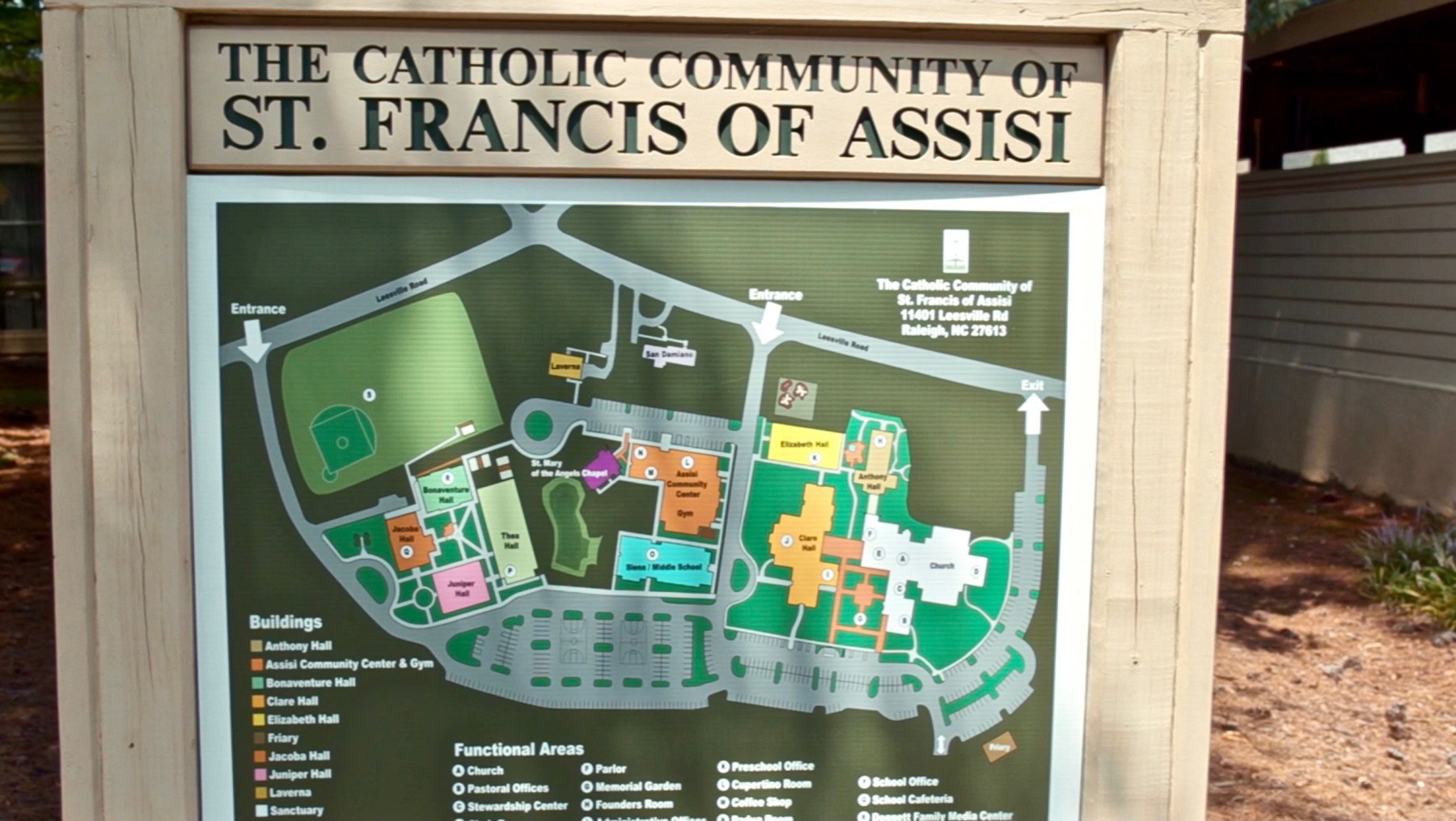
Last week I was in Raleigh, NC at The Catholic Community of St. Francis of Assisi. And really, to call it the “Catholic Community” is much more appropriate than to call it a church. This place not only has a giant worship space that serves thousands of people each weekend, it’s nearly 5000 families have access to an elementary and middle school, office space, recreational buildings (including a gymnasium, parish hall, library, and meeting spaces), a separate building for a daily mass and prayer chapel, and even two residential houses for special use. This is not your grandmother’s Catholic Church… (unless of course your grandmother lives in north Raleigh, then it might be.)

But beyond the opportunity to see one of the largest parish communities in the country, what made this stop interesting was the proximity to where I went to high school. Just a few minutes from the parish is my old house, high school, church, and a host of other places that offer a trip down memory lane. How did I feel going back? Well, my reaction was not exactly the same as what I felt in Greenville and Durham, we’ll say that.

All of that and more in this week’s vlog! I just arrived to Trinagle, VA where I’ll be preaching at St. Francis of Assisi Church. I hope everyone has a great weekend!