If you’ve ever been to confession, you know that it is a “safe space.” When you bear your soul, confessing sins committed, the priest is forbidden to tell anyone what you’ve said. This is the “inviolable” seal of confession.
What most people don’t know, however, is that this seal extends far beyond words and is completely free of exceptions. A priest may not act upon anything he hears in the confession, neither telling anyone else or changing the way he would normally act, no matter what is confessed. While a mandatory reporting for things like suicide in abuse in every other case, if such things are revealed within the confessional, he risks excommunication if shared with authorities.
Recently, this is come under great scrutiny by civil authorities, and some states have even made it illegal, forcing priests to break the seal under certain circumstances or risk being imprisoned. At the moment, California is considering this exact legislation.
And in one way, it makes sense, right? Why would we want to protect a potential murderer, child molester, or someone at risk of suicide? We should want to do everything we can to turn this person in, either to get them help or to punish them for their actions.
And yet, I have to argue that something quite essential would be lost within the sacrament if the inviolable seal were removed: with anonymity comes the freedom to return to God with one’s whole heart and take the first step towards retribution for one’s sins. Without the fear of civil punishment, the Church is able to engage with people who would have otherwise carried their sins alone until their death, never taking a step forward and never finding the peace necessary to make things right. As counter-intuitive as it may sound, a firmly believe that the seal of the confession actually makes it more likely that people who have committed horrible sins will seek the help they need and reconciliation will be achieved by all involved.
As the Church continues to move forward with scandal, showing that it has been irresponsible to keep the safety of the public in mind, this case is going to be more and more difficult to make, but it is one that I think we must continue to hold. There is truly nothing like the opportunity that the sacrament allows, to step outside of our time and space, and to speak directly to God.
After being “sent out” with the homily, creed, and universal prayer, bringing the Liturgy of the Word to a close, the Mass begins again (in a sense) with the Liturgy of the Word. And just as the congregation was gathered in and prepared, given a gift, and sent out to share that gift in the Liturgy of the Word, so, too, will it be with the Liturgy of the Eucharist.
In many ways the most practical part of the Mass—the altar needs to be set in order for the sacrifice to take place—many forget that every action in the mass is filled with symbolic meaning that help the congregation enter more deeply into the mystery. Sure, the practical reality is that we need to get the gifts from point A to point B, but do we ever stop to wonder why? Do we stop to ask how it should be done? Too often, I see parishes diminish the preparation of the gifts to a merely practical act and the richness of the gesture is lost. Here are a few “pet peeves” that I notice.
The collection is not brought to the altar, or if it is, it is brought up afterwards and not acknowledged by the priest. While, yes, the overall point of the collection is to raise money for the church and its needs, there is also a sense that it is a symbolic act of participation on behalf of the whole congregation. We are quite literally giving from ourselves what is necessary for the sacrifice before us and life of the church. It is not simply a practical necessity that we throw into the liturgy at this time because the people have nothing to do; it is integrally connected to the preparation of the altar and offering sacrifice. In this act, the congregation offers its own sacrifices in the form of donations, symbolic of our spiritual sacrifices. For this reason, it is very important that the collection be brought to the altar and received by the priest along with the bread and wine.
The gifts are all stacked on the altar by the altar servers so that they can go do other things. Just as it is the priest who receives the gifts from the congregation, it is the role of the priest to pray over them and place them on the altar. Placing them on the holy altar is a serious act of bringing the preparation to a conclusion, a concrete act of beginning the sacrifice. To simply stack the bread off to the side or place the wine down indiscriminately without any prayer or intention diminishes this act. There should be intentionality to this act, which means that only that which is being offered as sacrifice should be placed on the altar, and only when it is ready to be offered should it be placed down (and not moved or fiddled with until the actual institution narrative.)
The gifts are “offered” to God during the preparation. Often you will see at this time the priest holding the bread and wine above his head while raising his eyes. While no words are spoken, the gesture seems to indicate that he is raising the gifts to heaven, “offering” them to God. While seemingly intuitive, this is actually not the point of this part of the mass; the priest does not “offer” the gifts to God at this moment (this will come later with the anamnesis.) His purpose is to begin the fourfold act of Jesus: Take, Bless, Break, and Give. At this point, he is merely completing the act of taking, and blessing what has been received, offering a brief word of thanksgiving to God. For this reason, the Roman Missal is clear that when saying a prayer over the gifts, he “holds it slightly raised above the altar with both hands.”
Washing one’s fingertips alone. This final one may not make a lot of sense to the congregation as it is almost never seen, but it is still a weird pet peeve. After the gifts have been placed on the altar, the priest turns to the side and washes his hands. Starting in ancient times as a literal act of washing hands (because he has just received assorted gifts from the people that are no doubt dirty), today, we recognize this as a symbolic act of purification before offering the sacrifice: the priest asks to be worthy of what he is about to do. Some priests, however, taking the washing too literally, pour water simply on their fingertips, as, I guess, they believe that this is the only part of them that will actually touch the bread and chalice. This greatly diminishes the power of the sign and runs the risk of perpetuating a very narrow theology of cleanliness as we approach the body and blood of Christ. Is the host such that we should be afraid to touch it outside of our fingertips? Are we only to cleanse that which will touch it and not our whole selves? Wash your whole hands. And use lots of water.
—
In any event, I’m sure this post of pet peeves could go on for a long time and I could make an entire series out of it, but in the interest of time and charity, I will stop here. My point, I hope you understand, is not to go on a rant or to criticize churches that do any of these things, but to show that even the most practical acts can have tremendous symbolic importance, and if we are not careful to understand why we are doing what we do, the entire Mass may sink into one giant practical act. When people claim that they are bored at Mass or that their liturgy is unengaging, this is generally why: shortcuts are made for practical reasons, keeping only what it necessary and losing what is beautiful. Brevity is wonderful, but when something is meaningless, no matter how short, it will always be more of a chore than something that is lengthy but full of beauty and significance.
I received my letter of obedience from my provincial this week and I am extremely excited for what’s about to come. Besides the fact that I will be finishing school and devoting myself full-time to ministry (which is a gift unto itself no matter where I live), I have been assigned to live and work at the Catholic Center on the campus of the University of Georgia. Far from the tiny liberal arts college I attended for undergrad, a place that had around 25 people at a weekly Catholic meeting and 50 or so students at mass on Sunday (in a chapel we shared with the other organizations and could only use at a reserved time), this behemoth, 38,000-student state school has its own building just for Catholics, own church with multiple masses, and enough of a budget to have two full-time friars and a staff!
Yeah, this will be a slightly more involved experienced than I had as an undergrad.
Besides that, the province has supported my desire to evangelize and catechize online as well as to further my work in the ministry of the word, meaning that I have been given permission to include that in my ordinary work each week (rather than a “hobby” I do in my free time and on vacation). The friary and Catholic center have some extra rooms available, and I’ve been told already that I can have one for a dedicated studio (which will be soooo nice to have a bedroom that’s actually a bedroom again and not filled with lighting equipment everywhere!)
Fraternally, the guy I’ll be living with is a great friar, one who has always made me laugh and been a joy to be around. He also just so happens to be an accomplished chef… so that doesn’t hurt either. While some friars would be hesitant to be a part of a community with only two people, I’m actually looking forward to it. I’ve mentioned before that I prefer smaller, more intimate houses, and with just the two of us, it has the feeling like I’m a part of something new. Rather than joining a house of 8 in which I’m the only new person and so would simply adopt the preexisting culture of the house, we have the opportunity (and responsibility) to build a fraternal life plan from scratch. That is an intriguing concept.
So, yeah. Obedience. What a horrible thing, right? In this process, I did not request UGA. I didn’t really request anything. The province asked if I had any top choices, which I didn’t, but I was able to share some values I had for ministerial and fraternal life. They thought about it, weighed the needs of the Church and Order, and handed me an assignment. This was not a democratic process. It was not one in which I could have the final say. It was a conversation in which my provincial listened, thought, and then directed.
Which, for many people, sounds absolutely terrifying and horrible. While poverty and chastity are strange concepts to most, oddly enough, I get the most confused and interesting questions around the vow of obedience. The idea of giving up one’s will and doing what someone else wants is just unacceptable to most. There is this sense that we are blind followers of an autocrat, lemmings running off a cliff with no reflection. Who would ever give up their will and accept the commands of another outright? So ridiculous! So un-American! You must fight to be in control and only do what you want!
And yet, I have to say, it was actually a pretty encouraging experience. There is something genuinely great about a vow of obedience, even a sense of tremendous freedom in it. Forced to come up with my own path, to choose what was best for me at this time, I don’t know what I would have chosen. I don’t know if I would have made a good decision, to be honest. In letting go of my need to be in charge and to make every decision, I was forced into a position of trust, to recognize that someone else cares about my well being and might actually have a better sense of what’s good for me and the world than I do. My duty in this was not to waste time making big decisions or worrying about the overall picture; all I was asked to do was to go out and faithfully do my job, loving those I encounter and building up the kingdom of God.
I think we place too much emphasis on the big questions of our life (what am I going to do, where am I going to live) and we let it get in the way of the experience itself. Too focused on worrying if we’re making the right decision, we never fully invest in what we’re actually doing. That… is never a problem for someone with a vow of obedience, and, as ironically as it may sound, I find this to be such a liberating experience.
I have a friend that only reads non-fiction. He likes biographies, news articles, and reports published in academic journals. Why waste time, he wonders, with things that are not real, with stories that are made up? For him, one should just stick to the facts.
Naturally, I don’t agree with him. Quite obviously, given our previous episodes of this podcast, I find that fiction can actually capture truth in ways that non-fiction cannot, helping us to enter into a reality far from our own to learn something new about ourselves and others. But I think it’s more than that. Not only can fiction capture the truth, but there is a misconception about non-fiction that just because it is “factual” that it is without bias or subjectivity. This is patently false.
Unfortunately, many viewers/readers of non-fiction tend to approach these works of art without a critical eye; they tend to accept what is shown as the truth without reflection because, well, it’s “non-fiction.” In documentaries, for example, one is able to see with their own eyes the primary sources. They can watch the actual events, hear the actual historical figure speak. It must be true, we tell ourselves.
The fact of the matter is that works of non-fiction and fiction—while using opposite approaches—essentially seek to do the same thing: they tell stories to transmit truth. They choose what to be included and what to leave out. They build story arcs, build drama, make arguments, and seek to evoke a response from the viewer/reader. Works of non-fiction may use nothing but factual pieces of information, but in choosing what to present, and more importantly, what to leave out, they inevitably share a truth that is incomplete. No one is able to share everything about every situation that influenced the topic at hand.
That’s where things get interesting, and what Br. Tito and I discussed in this week’s podcast. How do documentaries reveal much-needed truth, but how do they also leave us with more questions than answers?
And I’m not saying anything against Catholic theology.
You see, whenever we get into important theological definitions, the language we use is incredibly important. Precision matters, and while it may sound like two explanations are saying the same thing, they might be actually quite different.
Take, for instance, the Catholic stance on justification. For many, the difference between us and Lutherans is that they believe in “faith alone” while Catholics believe in “faith plus works.” You’ve probably heard this before. And it’s… sort of true. More precisely, Catholics believe that justification is through faith, something that issues forth in works. We could simplify it to say that Catholics believe in “faith plus works,” but it might imply that what we are saying is that we can do good works to achieve our own salvation, something that is actually heretical. Rather, salvation is through faith, and if it is a true faith, it will manifest itself in the form of good works. Similar to “faith plus works”? Yes. A bit wordier? Absolutely. Theologically different? You betcha.
Whew. That was a long example to make a point. I hope I didn’t lose you.
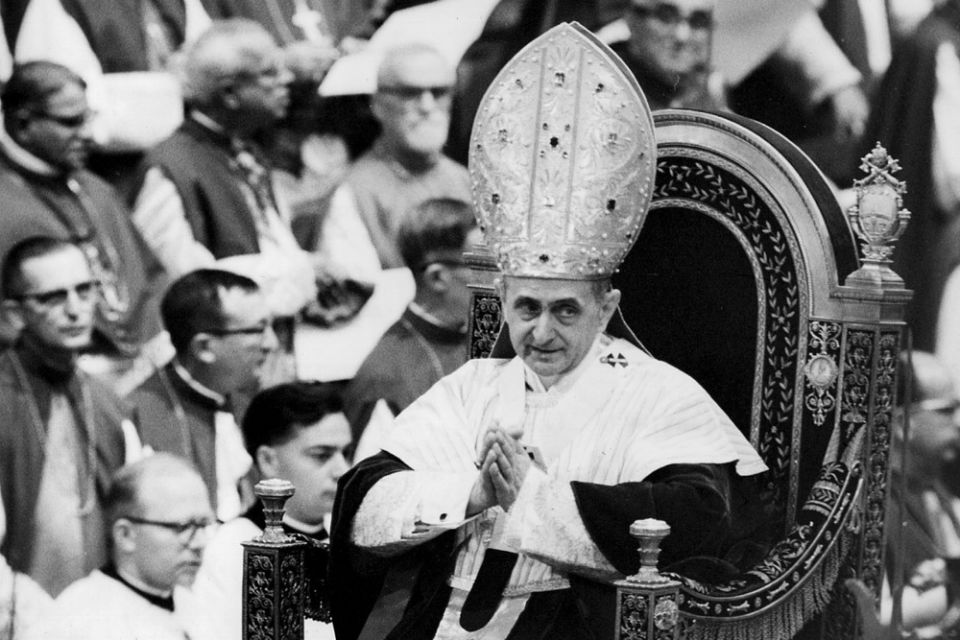
The reason I say this is because Catholics do not believe that the pope is infallible. Rather, Catholics believe that the teaching authority of the papacy enjoys infallibility. It may sound like the exact same thing and that we are needlessly splitting hairs, but it’s actually quite significant. In the latter, what we are saying is that the office of the papacy, regardless of who holds it, may speak without error under specific circumstances; in the former, what we are saying is that the human person who is the pope cannot be wrong. This is a major difference, and why I believe that so many people scoff at the idea of papal infallibility. Frankly, they just don’t understand it.
But this is not the case for you! At least, it won’t be the case after you watch this week’s Catholicism in Focus. More than anything, I hope that it will serve as another example of how important it is that we get our language right and are attentive to the words we are saying. Too often we get trapped standing by things that are false, rightfully attacked by non-Catholics for our beliefs, simply because we have used sloppy language. These things are important, and we must take them seriously!




 Breaking In The Habit