
Finding Solitude

I may have experienced solitude here, but a spirit of solitude comes from within.

Back we are in Wilmington, and away we go! Today I found myself enjoying the bright sunny day with a little reading, cleaning, and laundry, taking in the time to relax  before heading out again. No complaints here, though: t’s was a great week at the Graymoor Spiritual Life Center, and I’m looking forward to our retreat coming up!

The week started on Tuesday with a 4 day workshop on Franciscan prayer led by the renowned André Cirino, OFM. Centering the material around Francis’ radical approach to constant prayer, we spent a good portion of our time focused on his The Office of the Passion (translated and published by Fr. André as The Geste of the Great King), and A Rule for Hermitages (also known as The Prayer of Solitudea less common but arguably more accurate name).

Of all the little bits of wisdom I received from Francis and Fr. André alike, one thing really struck me: solitude is less of a place than it is a state of mind.

This is a great challenge for me. When I’m in between activities with only fifteen minutes to pray or am outside of traditionally “sacred” places where it can be busy or loud, I find it difficult to get into a prayerful mindset, and believe that less-than-ideal environment makes my prayer less meaningful, and to some extent, less effective than a more formalized, “ideal” prayer. The problem that I’ve realized is that I am looking for solitude outside of myself, as if it can be found in a particular place or situation. In reality, one finds solitude from within, not from without.

My attempt to process this new concept could not have had more appropriate, yet ironic, timing: starting tomorrow, we’ll be starting a six-day hermitage retreat. Talk about external solitude! Not only will we be on retreat from the busyness of the world, prohibited from using cellphones and the like, we will also be living in our own private cabin. Whereas we were discouraged from talking outside of communal prayers on our trip to Mt. Savior Monastery back in December (“Living In The Moment“), we will even be discouraged this week from seeing one another but once a day for mass, dinner, and vespers.

Though I do find it a little ironic as well that I’ll be entering into physical solitude while arguing that inner solitude is independent from location, I think that this will be an excellent first step, and a challenge for sure. Just because one can remove all external distractions doesn’t meant that there will not be distractions to prayer! On the contrary, the lack of external distractions simply leaves an individual unable to hide from their internal distractions. These are definitely the hardest to overcome and the true impediments to prayerful solitude.

And with that, I’m off to find some solitude, hidden deep within myself! I thank you once again for your prayers and support, and will be praying for each of you this week!
Quiet Weekend, Busy Weeks Ahead

After spending so much time in preparation and implementation of the Parish Mission last week, the other postulants and I enjoyed what turned out to be a very quiet weekend: with the exception of class Friday and Today, and an integration seminar on Saturday, we were actually free to do as we pleased all weekend. This was much appreciated (and much deserved, if you ask me!)

Besides the usual reading, YMCA, and group movies, it was also a weekend of “firsts” for me: on Saturday, Dennis, Ramon, and I went exploring the nearby park looking for good walking trails by the river, and on Sunday, I cooked dinner for the first time. No one died as a result of either experiment, so I would consider it a pretty successful weekend!

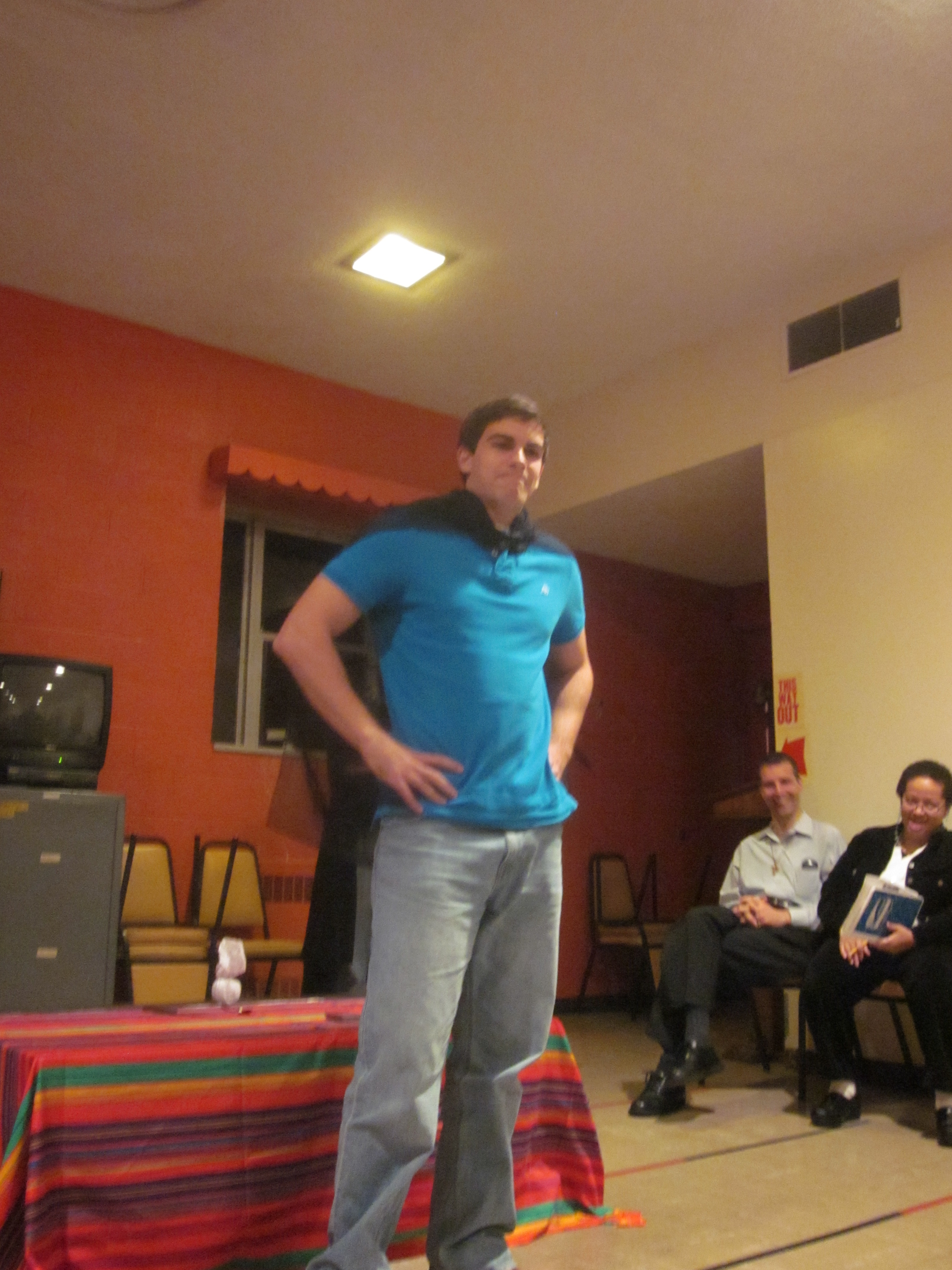
There won't be any "magic" in our sketch per se, but we've got a few tricks up our sleeves...

A relaxing weekend couldn’t have come at a better time, because by 6:50 tomorrow morning, it’s back to the Postulant grind. We’re starting with mass at 7:00 at the Poor Clare Monastery here in Wilmington, followed by lunch and fellowship at the Poor Clare Monastery in Wappingers Falls, NY, before we arrive once again in Garrison, New York for a Franciscan four-day workshop at the Graymoor Spiritual Life Center. If you’ll remember, we spent four days at Graymoor back in November and had an excellent time (you can refresh your memory with my post, Finally, a Franciscan!). We’re all really looking forward to another fully Franciscan run, Franciscan themed, and Franciscan attended workshop.

That’s it for now, but make sure you check back next weekend when we get back. I don’t want to give too much away, but the other postulants and I have been working on another routine for this year’s talent show that you’re going to want to hear about! Wish us luck!

“Mission” Accomplished

St. Anthony of Padua is regarded as one of the greatest preachers in the order.

Arguably the oldest and most “authentic” Franciscan ministry, the Ministry of the Word is an effective way that friars have reached the people where they are for 800 years. Today, it takes the form of a Parish Mission, in which friars travel from church to church preaching at mass, offering time for penance, and organizing a series of evening lectures on a given topic. When done well, inspiring preachers can be the spark that revives a congregation in faith and action, while being the replacement necessary for overworked pastors to take an overdue spiritual retreat.

From Saturday until Wednesday, the other postulants and I got some first hand experience of the workings of such a ministry. Instead of simply supporting our director (Fr. Ron) with our presence and prayers, we were actually given the responsibility of coordinating a significant portion of the events: each of us took part in speaking at the Sunday masses to advertise while Dennis and Ramon spoke three different times to the various youth groups, Edgardo gave the homily at the Spanish mass and coordinated a Spanish mission night, and Sergio and I took turns emceeing for Fr. Ron and each gave ten minute talks of our own.

How did we do, you ask? In terms of our programming, preaching, and message, I think we did a good job. People left with a little more joy, were a little more forgiven, and were hopefully a little more inspired for the life of the Church than when they started. By those standards, I’d say we did fairly well.

But because we’re Franciscan friars, there’s always more to it than the message itself: our witness to fraternal life. Though our programming, preaching, and message may be exactly the same as secular priests, Ph.D.’s, and most other forms of speakers, it is our ability to flow from and witness to fraternal life that sets us apart, and therefore should be the standard by which we judge ourselves. By those standards, I’d say we passed with flying colors.

Because we took the time to work together (even though it might have been more efficient to work alone), and were present and visible to our brothers when they were speaking (even though we probably could have just as easily stayed home and gotten something done), our actions were much more effective forms of evangelization than our words ever could have been. Even though Ron did the majority of the speaking, his visible relationship to us forced the congregation to recognize a collective presence, not just Ron’s. Thus, when they heard the message, whatever it was, and whoever was speaking it, I got the feeling that they heard it as our message, not just one’s own. Because we had made it so apparent to them that fraternity is the core from which we minister, I believe that they saw us as one unified entity rather than a collection of individuals. If that is truly the case, then it is “mission” accomplished.

After having experienced a parish mission first hand, I think it’s certainly possible to be more efficient in programming, preaching, and orchestrating a coherent message when working alone (not too mention much easier); but in terms of effectiveness, friars working together will always triumph because of their inherent ability to witness to the fruits of fraternal life. It is this witness that gives me the life and inspiration to continue in my journey as a friar in training, and gives me great hope for a future with my brothers.

Mine!

Mine! Mine! Mine! Mine! Mine! Mine! Mine! Mine! Mine! Mine! Mine! Mine! Mine! Mine! Mine! Mine!

This past Sunday, the postulants took a 24-hour hiatus from the phone, computer, television, newspaper, and general conversation so as to devote an entire day to prayer and meditation. We were free to spend it however we pleased as long as there was an emphasis on renewal and contemplation (for some of this, this even meant intense exercise, as that can be a great time to think!)

Though I found the many things to be fruitful and the day to be rejuvenating in general, rereading parts of C.S. Lewis’ The Screwtape Letters ended up being the most revelatory, “blindsiding” me with a truth I needed to hear: “my” time is not my own.

Now you will have noticed that nothing throws him into a passion so easily as to find a tract of time which he reckoned on having at this own disposal unexpectedly taken from him. It is the unexpected visitor (when he looked forward to a quiet evening), or the friend’s talkative wife (turning up when he looked forward to a tête-a-tête with the friend), that throw him out of gear. Now he is not yet so uncharitable or slothful that these small demands on his courtesy are in themselves too much for it. They anger him because he regards his time as his own and feels that it is being stolen. You must therefore zealously guard in his mind the curious assumption “My time is my own” (Letter 21, page 111-112)

The timing couldn’t have been any more perfect. No more than twenty minutes prior to reading this passage, I was informed that our Spanish class would replace the scheduled afternoon meeting for the next day, that the original meeting would be changed to the evening (my time), and that another meeting would be scheduled another night (also my time). No sooner do I get home do I read this passage, which continues, “The man can neither make, nor retain, one moment of time; it all comes to him by pure gift.”

BOOM! Wakeup call! In as many words, this passage not only captures the most frustrating aspect of postulant life, it forced me to see its true source: me. When I stepped back and asked myself why I got frustrated with these common occurences, I realized that it wasn’t because the unplanned tasks were difficult, painful, or even useless; the source of my frustration was an unfounded assumption that I had exclusive possession of certain time periods. Rather on focusing on the great gift that I have each and every day to work, pray, eat, sacrifice, and so on, I was stuck into believing that I was entitled to a time each day to do whatever I pleased, and that the aforementioned “gifts” were actually inhibitors to that time.

As a Christian, let alone a friar in training, this possessive idea of “mine” can be a dangerous one. Left unexamined, it can permeate beyond time into all aspects of our lives until we become disillusioned into thinking we are the Lord of our own lives:

And all the time the joke is that the word “Mine” in its fully possessive sense cannot be uttered by a human being about anything. In the long run either Our Father or the Enemy will say “Mine” of each thing that exists, and specially of each man. They will find out in the end, never fear, to whom their time, their souls, and their bodies really belong–certainly not to them, whatever happens (Letter 21, page 114-115).

As I move forward in formation, I must always remind myself of the wisdom in this letter: everything that I have, whether it be time, material possessions, a functioning mind, or good health, are “mine” not because I created them or am their sole controllers, but because they have been gifted to me by God. Thus, a worldview firmly rooted in this wisdom, one that I must challenge myself to accept each day, no longer wishes to differentiate between “mine” and “not mine.” Rather, it wishes to use and share all that we have for the sake of loving God, self, neighbor, and the created order, acting with humility and gratitude for all that we have been given. The first step in forming myself in this way is accepting that God is my all, and that of me, he says, “Mine.”

No Pain, No Gain

Sure, it sounds ridiculous, but isn't this what our actions say?

Back in October, I wrote in the post Ecological Justice that the care for the environment is just as important as economics and peace when it comes to upholding justice for all humanity. The effects of pollution, climate change, scarcity of natural resources, deficiency of naturally clean drinking water, and so on, hurt the poor much more significantly than does the rich (as well as being a primary source of conflict in economics and peace). Last week we attended a different workshop in Brentwood, NY, in which the speaker reiterated these same points.

The discouraging part about both of these lectures was that both speakers focused almost entirely on outside forces rather than looking at the effects caused by normal individuals. There’s no doubt that multinational corporations are to blame for a lot of the environmental degradation in the world, but who are the ones actually buying, using, and demanding more? The truth is, if we ever want to see to it that the documents of the Church actually get put into action, it’s going to require the individual consumer like you and me to put our money where our mouths are.

Unfortunately, I’m finding in religious communities and the secular world alike that we’re not yet willing to do that: either we don’t quite understand how drastic the changes need to be, or we’ve become too attached to the present comforts of overindulgence that we’re unwilling to enact them. On one side, sentiments like “little changes make a big difference” merely offer justification for unsustainable lifestyles, while on the other, sentiments like “what I do, good or bad, isn’t going to have much effect” place all responsibility on the world community while failing to recognize oneself as a member of that community. If we’re going to actually enact doctrines of ecological justice, it needs to start with the individual, and the actions need to be serious.

So what am doing, you ask? In conjunction with Lent, I’ve decided to add to my list of environmentally sustainable habits a two major inconveniences as a way to remind myself of the injustices of which I am partly responsible, and to call to mind two things that I take for granted in the “First World.”

The biggest of these is the reduction of meat in my diet. Believe it or not, our dependency on cows and other animals for every meal has resulted in the production of dangerous levels of methane in our air, as well as higher rates of polluted water and increased deforestation. My goal is to reduce the amount of meals containing meat each week to only one or two, so as to bring attention to the issue while still remaining healthy.

The second inconvenience is going to be a drastic reduction in the amount of water I consume in the shower. As environmentally conscience I am, I have to admit that I’m a huge culprit when it comes to extended hot showers. I definitely take for granted the amount of (clean) water I use and the amount of energy needed to make it warm, and consume more than I need for the sake of comfort while others do not have enough for the sake of necessity. In a similar way to the meat reduction, it’s not in my best interest to remove showers completely, but a reduction will help to bring to my attention something I have taken for granted for many years.

In a lot of ways, Lent and ecological action go hand in hand: both begin with an examination of self, particularly how one relates God and others; both encourage sacrifice and penance as a means for reconciliation; both prepare oneself in thought and deed to live rightly in a future soon to come. By means of these two inconveniences, I hope to find myself more rightly oriented to God, others, self, and the created order by the time of Easter, reminding myself all along the way, “No pain, no gain.”