Would You Do It With Me?

dare-to-be-a-discipleI’m on a mission this weekend: a mission to inspire a new generation of disciples to step forward in the church. Jesus tells us, “The harvest is abundant, but the laborers are few,” and nothing could be more true for our culture in today’s age.  All around us we find people in need of God’s grace, but we struggle to find people willing to bring it to them. I’m on a mission to change that.

That’s why I’m here in Greenville, SC, where my own vocation was born. Tomorrow, I will be speaking at all three masses at St. Anthony of Padua Church, and at the one mass at Furman University, as well as appearing as a guest of Fr. Patrick Tuttle, ofm on his radio show at Furman University (you can listen to the broadcast online here and call in at (864) 294 2757.

My message to them will be a simple one: if you believe that God has answered you in your time of distress, and you believe that God is capable of working through you to aid others in their’s, our world needs you. I’ve answered God’s call to be his steward on earth, to love his people for him, and I couldn’t be happier with my life.

Would you be God’s ears and hear the cries of the poor around you?

Would you recognize how much you need God and devote your life to him?

Would you let yourself be poured out like a libation for all the world? 

Would you do it with me?

An Attitude of Gratitude

Francis

As a Franciscan friar, I believe that gratitude and joy are as much of our charism as poverty and fraternity.

There are a lot of good reasons to be angry today. When we look around and continue to see injustice in our government, our church, our cities, and in our homes, it is more than acceptable to get angry and to turn that anger into constructive change. To go through the world with a critical eye, a strong sense of purpose, and the perseverance to make a change is much needed.

As I get more involved with the church and the issues relevant to it, I find myself fueled by anger more and more. How can I not when I see the things I see, done to people for which I feel so passionately about? How can I stand content with so much wrong with the world around me? I can’t, I tell myself.

But this way of thinking in exhaustive and unsustainable.  Even for those most concerned with the injustices of the world, anger is a short-lived motivator that cannot sustain.  Motivated by anger alone, we end up bitter and unfulfilled because there will always be something new to get angry about. It is a road that might accomplish many good things, but alone it can only lead to bitterness and despair. (And yes, I really mean despair. When you look at the outlook of things like climate change, growing poverty statistics, government efficiency, and energy consumption, it is difficult not to throw up your hands, say, “We can’t possibly make any difference!” and give up.)

When I find myself going down this road, what always brings me back is a reminder to have an attitude of gratitude. Sure, it sounds a little cliche, but it’s much more than just a self-help/mind-over-matter gimmick: it’s a theology.

To go through the world with an attitude of gratitude, even in it’s most frustrating times, is to recognize the goodness of the God-incarnate in the world. How often do we call to mind the endless gifts we’ve been freely given without merit or entitlement? When I do, it reminds me that I’m not in control, that there is something outside of myself capable of so much more than I am. It reminds me why there are things worth getting angry over in the first place, but grounds me to know that I can’t solve the world on my own. At its best, it reminds me of how wonderful all of creation is, gives me a greater perspective on eternity, and abates my anger completely because I know that everything will work out in God’s eternity.

This absolutely does not mean I wish to slip into a state of apathy because “God will take care of it,” nor does it mean that we should work any less for the sake of justice.  Such attitudes are at best a self-therapeutic conception of God, focused entirely on the self.  No, what I mean to say is that Love is more powerful than Hate; optimism more inviting than pessimism; praise more constructive than criticism; and gratitude more life-giving than complaint.  Even when faced with life’s most challenging issues, in times when we have nothing but anger and frustration, we still have a loving and merciful God that has blessed us with abundance at every turn. Why should we believe that the future will hold anything less than the same outpouring of gifts we have already encountered, or that tomorrow’s problems will somehow be beyond the reach of God’s intercession?

As a guide, who could be better than Francis of Assisi? Surely there is no one in history that praised God more often or more completely than the little poor man from Italy, even in the harshest conditions. I believe that joy and gratitude are as central to our charism as poverty and fraternity, and it’s the model I’m trying to adopt today.

Humble Ambitions

tumblr_m54ipjGvoB1rokkrlo1_500I’m a pretty ambitious guy. Understatement of the blog, right? Ever since I can remember, I have had a clear sense of what it was that I wanted to accomplish, the vision to set both long-term and short-term goals, and the discipline to stick to them.

Ambition is a great American value. For some, it is the only one necessary: if you have the determination you can accomplish anything you want! Behind every great accomplishment, innovation, record or praiseworthy individual, there lies the unbridled passion to make something of oneself, and the skill to make it happen.

I bought into this with everything I had very early in life: I could have been anything I wanted, all I needed to do was work hard. Even after I began to understand that physical, economic, psychological, and social barriers make the “American Dream” little more than a fallacy, i.e. that often times the hardest workers are not the most successful, I could not shake the imbedded ambition to succeed. It’s simply a part of who I had been socialized to be, and who God had called to this life. (There have been enough situations in which my ambition for something selfish ended up leading right to this vocation to know that God knows the best way to use who we are to move us one way or another.)

But how can someone be a follower of Christ in the way of Francis of Assisi, seeking a life of humility, simplicity, and obedience, and at the same time remain an ambitious, success-oriented American? Surely, one would say, God has used this vice of mine to call me to conversion, to shed the old me in order to be born anew. One might also say that ambition is a gift, something that God could and would clearly want to use for good.

And so I searched for answers. The first one I came to was through both Richard Rohr’s writings on the Enneagram and my former campus minister: transform the ambition for self into ambition for God. Rohr says, “[We] are overly concerned with building our own kingdom and seeking our own fame… Keeping the Sabbath reminds [us] that the meaning of life does not consist in action alone” (Discovering the Enneagram, 228). Rather than attempt to change who we are, we need to orient who we are toward God so that our many gifts may point back to the one who fashioned us. It’s a reminder that “success” does not have to be personal or selfish, (e.g. wealth, fame, gratification, and power), but rather communal and altruistic (e.g. full churches, upheld dignity of neighbors, peace, and educated people). In this way, my former campus minister has argued that, not only is it possible to be 100% humble and 100% ambitious at the same time, it’s necessary. The way he put it, being a humble servant means giving all that we have and working for all that we can for the sake of building God’s kingdom.

Unfortunately, the problem I’ve found with this mantra, “Build God’s kingdom, not my own,” is that it more often serves as a justification than it does a conversion. At least, that’s what I my spiritual director and I realized was the case for me. You see, whenever my spiritual director and I spoke about the future, I found myself beginning every sentence with “I would really like to. . .” or “I don’t feel called to. . .” or “I would be good at. . .” I believed that I was seeking to build God’s kingdom because everything was about his church, his people, his ministries; subtly, though, it became apparent that all of these things were being filtered through the self, and that my success, my image, and my reputation were informing me as to what God’s kingdom needed me to do. “I wonder if there’s a way to take the ego out of it,” he would say. Ouch. He had a point though: it was the “I” and the “I” alone that made these questions difficult:

  • Would I feel that I was “building God’s kingdom” if I were assigned to a nursing home or Hospice care, my only responsibility being the comfort of near death individuals?
  • How important is recognition to my ministry?
  • Why do I subconsciously believe that a bigger ministry is better than a smaller one?

So how could I take the “I” out of it, to stop looking at how ministry could make me the most comfortable or fulfilled (in essence, stop seeking my own ambitions) and focus entirely on what God had in store?

I think the key for anyone with high ambitions is to keep a balance between relationships and tasks. Otherwise, even the most well-intentioned goals will end up trampling people and ruining relationships. For me, that meant two new mantras:

  1. All I’m called to be is a brother.
  2. Love God’s people for him.

In both of these, I’m called to focus less on the task, the goal, the potential accomplishments (either God’s or my own), and more on the opportunity for relationships before me. There becomes no need to struggle for power or authority, no reason to worry about the big picture, and no recognition to be had. The goal is a person. The ambition is charity. To fully accept either of these mantras is to realize that spending time to share a meal with even one hungry and lonely person is as important to building God’s kingdom as is leading a crowd of people in prayer; that taking the time to listen to a person in their brokenness is as life giving as a well-attended Bible study; that Hospice care is as important as peace and justice missions. There is a need to remember that building God’s kingdom is not separate from loving those in it. It is not a task to be accomplished, but rather a people to be loved.

Ultimately, what I’ve come to understand and have struggled to implement is this: you don’t need me, you need God. I need to fully accept that my role in ministry is to provide God to everyone I meet, not myself, and whether it be through innovative, big-picture goals, or through loving, careful relationships, building God’s kingdom takes many forms. And so I offer this conclusion for those with a similar ambitious nature: be a vessel that works as hard as it can, with unrestrained creativity, with no limits in sight, not taking no for an answer, and completing things that have never been done before, and do not for even one second forget that God could equally have used a pile of rocks to accomplish the same thing. Humbly recognize that you are simply a rock, an open vessel willing to do God’s work. That’s the humblest ambition I know.

Bad Worship or No Worship?

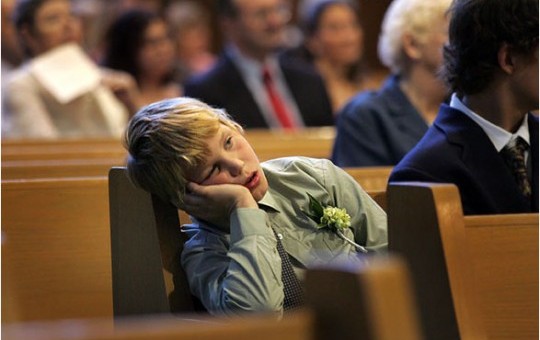
Being bored in church is an all-too-common phenomenon.

Being bored in church is an all-too-common phenomenon. I think that it’s much more than an inconvenience: it produces bad faith.

Bad worship is an all-to-common phenomenon in our churches. As I’ve traveled around quite a bit in the past 7-10 years, I’ve experienced choirs reminiscent to the movie Sister Act to no choir at all; preachers that have absolutely no life to preachers with a little too much life and no tact (I’m looking at you priests that preach about abortion on Christmas or tell your congregation that voting for a particular candidate is a mortal sin); lectors that are impossible to understand to lectors that would be better suited for a kindergarten class; congregations that range from disinterested to indignant.

As I began to notice the lack of consistency from church to church, and left many “celebrations” of the Eucharist with a feeling ranging from emptiness to anger, I asked myself this question: “Is bad worship better than no worship at all?” It’s an interesting question that I’ve asked myself and many priests over the past three years with a wide range of responses.

The biggest difficulty in answering this question, I think, is coming to an appropriate definition of what “bad worship” really is. In one sense, this means determining what is essential in making the mass a valid sacrament; in another, it means determining what best allows for the sacrament to be received and reciprocated. Put another way, there are both objective and subjective elements to the mass.

Objective

The objective elements of the mass are easy to understand and evaluate because, well, they’re objective. Were the words of consecration said? Did the presider use bread and wine? Was the presider an ordained member of the priesthood, and did he have the appropriate faculties? All of these questions, among others, help to determine whether or not the mass was in fact valid, or in other words, that the sacrament really happened.

Rarely is this ever an issue, and even if it is question, there are a few safeguards for the people. For instance, Ecclesia Supplet, canon 144.1 in the Code of Canon Law, says that the “Church provides” governance when it may otherwise be in question, as in the case of a priest not having faculties. In the case that a priest may not say the exact words of consecration, Pope Pius V declared in the papal bull De defectibus that the sacrament remains valid, even if the words have been changed, as long as the new words do not change the original meaning.

Even in the case of a priest in the state of mortal sin, or with malicious or indifferent intentions, the Church has argued since the Donatists of the 4th century that mass is in fact valid. Since it is actually Christ that is conferring the grace through the sacrament, the Church says that it is “by the very fact of the action’s being performed,” not the state of it’s celebrant, that matters (Catechism of the Catholic Church 1128).

In this way, we may take solace in the fact that no matter how bad the music may be, how boring or offensive the priest’s homily may be, how terribly ugly the religious vestments or sacred art may be, or even how terrible of a person the priest may in fact be, we are receiving God’s grace by partaking in the action.

Subjective

For this reason, unfortunately, some presiders and church leaders end their concerns here: if the elements are present to make the sacrament valid, what else could possibly matter?

There are plenty of things that matter! Preaching and music have a critical importance to the worship experience. Art is a gateway into the transcendent. One would think that interaction with a community of believers would be paramount to the experience.

It’s because of this that I find it a bit silly when I hear people accuse others, “You’re only going to that church because of that priest and/or the music. Church is more than a preaching and music you know!” I just want to say, “Yup, that’s exactly why I’m going there. And of course it’s more than that. But if both churches are going to offer me an equally ‘valid’ sacrament, but one church is lively, engaging, and filled with people who want to participate, why should I be forced to go to one that puts little to no effort into worship?”

I believe that the subjective elements are much more than simply peripheral perks of a grace-filled experience, though. I believe that they are essential to good faith, and are equally important to having a graced experience as the objective ones. As I’ve mentioned before, “Faith grows when it is well expressed in celebration. Good celebrations foster and nourish faith. Poor celebrations may weaken and destroy faith” (Music in Catholic Worship: 6; 1983). To say that preaching and music are simply aesthetic, non-essential additions to the what really matters, the words of consecration, is nonsense. Sure, the objective elements may remain the same, and God is equally present no matter how it is performed, but isn’t the one receiving the grace much more willing to accept it if they are in a welcoming, engaging, inspiring, beautiful environment? There is a reason that the church builds transcendent buildings, installs captivating art, requires a homily, and encourages that many parts of the mass be sung: each of these make a tremendous difference in worship.

And so we come to our original question, but now phrase it in a new way: “Are the subjective elements of Mass essential enough to the worshipping experience that, in the event of their absence or privation, the validity of the mass is called into question?”

The fact of the matter is that Christ’s words, no matter how poorly spoken, are still the words of Christ. Can I really say that the power of Christ is dependent on the charisma of a single man or choir? I cannot. To hear them in any context, in any form, is a blessing. The quality of the sign does not affect the fullness of grace.

But on the other hand, I do not want to promote a theology that borders on magic: the words are said, things happen. There’s something more going on at mass than those words; more than the transcendent; more than God acting upon us. Eucharist is an act of thanksgiving: it is a meal that must be done in common, with active participation, in love. The liturgy is by its very nature a drama, and should cause and assist a memory of Christ. To remember the words of a lover, “I love you,” holds it’s meaning no matter the context; to remember these words with another, done in an emotionally and aesthetically provocative way, effects an experience that has more meaning than it’s original words because they begin to participate in history as it is today. This is entirely impossible without inspiring, well-executed subjective elements.

So, is bad worship better than no worship? Barely. But it should not be tolerated in our churches. There is an experience of God that is possible that heightens our faith and builds our communities. Why should we ever settle for less? Good preaching, good music, good art, and good community are essential to good worship.

Out of the Birdbath, Into the World

St. Francis is much more than decoration for a garden. His spirituality demands conversion in our hearts and in our world.

St. Francis is much more than decoration for a garden. His spirituality demands conversion in our hearts and in our world.

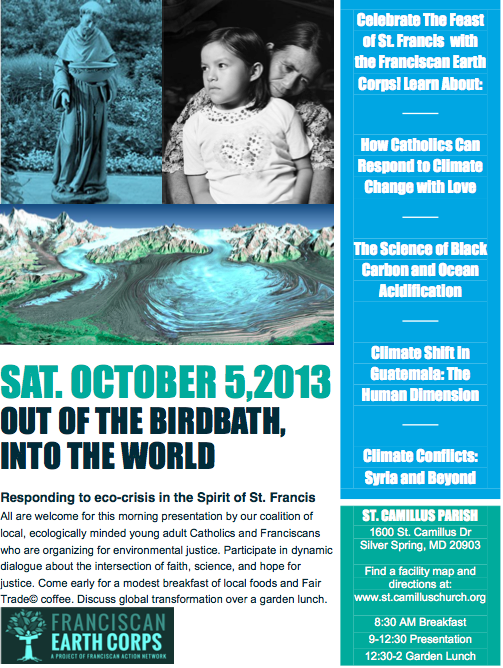
In honor the the Feast of St. Francis, Franciscan Earth Corps, in collaboration with St. Camillus Church Young Adults and the Franciscan Friars, is hosting an event tomorrow about applying Franciscan spirituality to the ecological crisis. Along with being the event’s emcee, I will be giving a 2-3 minute personal talk about how I have changed something in my life for a greater care of creation. The following is an extended version of that talk.

I’ve mentioned before that the environment is a big issue for me. I feel that it is the most neglected aspect of peace and justice work despite being one of the most pressing issues of our generation. When we sit down and look at the numbers, there’s reason to panic. For instance, many scientists believe that there will be nothing left to fish from the ocean within fifty years. Can you imagine a fishless ocean? What’s even more daunting is that the United States E.P.A. estimated that more resources have been used in the last fifty years than in the rest of human history. These are just two of the many earth-shattering (literally) facts that reveal the grave condition of our earth and the imminent danger our consumption is causing others, especially the poor. Something obviously needs to be done.

Well, the first thing that needs to be done is to determine who’s to blame. The effect is pretty clear, but what, or rather who, is the cause? Many want to point the finger at multinational corporations because of their size, affluence, and history of circumventing environmental laws for the sake of higher profits. While true, multinational corporations are certainly not innocent when it comes to ecological justice, who keeps them in business? We do. Multinational corporations have enormous leverage and financial capabilities because we shop at their stores and buy their products. Not only that, we as consumers and we as American consumers, also use energy in our cars, our homes, our waste, and in our stomachs. If the information from above about the direction we’re heading concerns us, then it’s about time we looked at the problem not as something outside of ourselves, “those evil multinational corporations,” and instead something for which each and every one of us is partially responsible.

When I did some research about my own consumption, I found that the way that I ate as an American is positively unsustainable and that changes needed to be made. When you stop to think about how much grain is needed to produce a cow (6-7 pounds for every one pound of meat), how much carbon dioxide, methane, and ammonia cows produce in their lives (more greenhouse gases per day than a car, including 2/3 of all ammonia in the atmosphere), and how much deforestation occurs to make more room for cow pastures, you realize that consuming beef is one of the worst possible things one can do to the environment. Pork, chicken, and wild fish (as opposed to farm-raised) are better in terms of greenhouse gases, but each bring with them a host of other problems.

So what did I do? I tried being a vegetarian. The Franciscans observe an additional Lenten fast prior to Christmas, so I decided to give up meat entirely from the feast of All Saints until Christmas Eve, and then again for the Lenten season before Easter. What I found in that time was that vegetarianism is awful. Seriously. I was hungry all the time, I lost weight, and I struggled to get anyone to take me seriously. Worst of all, I found that I was doing more than I should have been doing. Feeling so overwhelmed with the lack of worldwide progress, I felt that it was my duty to make up for everyone around me. What I actually did was to take on more than I could handle.

Did I give up then, you ask? No. I reevaluated. I identified all of the values that were at stake, i.e. environmental impact, physical health, financial concerns, and the possibility of converting others, and let them sit in tension with each other. What would happen if I just let go of my need to come up with the perfect solution that would change the world and instead just allowed my desire to be authentic to each value play itself out differently each day?

In order for that to happen, I had to accept that I could only control myself. As was a common theme during novitiate, there’s no use worrying about or judging others for what they do because there is nothing I can do to change others. The key for me was to do what I felt I needed to do in order to feel personal integrity.

In the end, I decided on two things: 1) I may eat meat once per day, of an appropriate size (3-4 ounces) and 2) for every meal that I don’t eat meat, I must find a way to replace the protein lost. There have been times since then that I have gone a week without any meat, and there have been other times when I found it best, either for my health or for the sake of those providing the food, that I have broken both of these rules. At this point, the flexibility has actually helped me keep with it because it makes the changes easier to manage.

Ultimately, the point of sharing my diet with you is to say that the ecological justice is important to me, and that I’m willing to change major aspects of my life to affect change (even on a small scale.) The way we eat is not the only way to affect change, nor is it necessarily the most effective. I hope that, if you care about the rate at which we are destroying God’s creation around us, you will take to heart my attempts to reform my daily life and make a change in your own life. Check out this checklist for possible suggestions and see how well you’re already doing. This feast of St. Francis, is there something that you could pledge to do to make a positive impact on our world?