The Medium is the Message
Are we always the people we say that we are?

Are we always the people we say that we are?

As Christians, I’d say that our “message” is pretty good: the eternal and all loving God, wanting to be one with all that God created, became human, experienced all that we experience, died and rose again forgiving all of our sins. It is a message of love, forgiveness, peace, mercy, and justice; it is one of eternity.

But as I’m sure you know, it’s not what you say, it’s how you say it that matters. In an amazing way, we humans are able to communicate so much more than the words we speak: our body language and tone shape our words, convey meaning, and often overshadow what we are actually saying. Even more importantly, who our listeners believe us to be (sometimes in terms like “good” or “bad”) can determine the message that is received, no matter the words. Even before we speak we have communicated something.

As Christians, sometimes we can communicate mixed messages. Our words say love, but our actions say hate; our words say forgiveness but our actions say retaliation; our words say peace but our actions say violence. Trust me when I say that the medium is the message. When the outside world looks at us Christians, they do not evaluate the clarity of our words, the thoughtfulness of our theology, or the logic of our philosophy; what is “heard” most clearly is the way that we live and how we treat others.

As friars, “official” members of the Church, we must be as conscious of this fact as anyone. We are given the opportunity to engage thousands of people each week as representatives of the Church, capable of being the inspiration to return to God or the final nail in one’s coffin that is religion and “all those hypocrites. Because of this, the friars of my province are meeting this week for what is called a Provincial Chapter, a meeting (instituted by Francis himself) of all the friars every three years for fraternal fellowship, prayerful retreat, and practical planning, such as elections. This year, our question is simply stated but difficultly answered: “Are we who we say that we are?”

The idea came from one of our lay leaders. She told us that the charism of the friars is a wonderful charism that the Church needs in this time: men who live simply in a fraternity of prayer and work, treading the world humbly in order to promote peace. We do not need a new statement of character, a vision of ministry, or structure of fraternity. What we needed, she suggested, was to simply be who we say we are, who people believe us to be. It was a call to integrity, a call to recapture what may have been lost and to recommit ourselves to it.

I think that it is a fantastic theme for the chapter because, frankly, we are different from many of the religious in the world and we need to own that. Many times in our history we have chosen to sacrifice aspects of our charism for the sake of more ministry. We took on more parishes because we could reach more people, but sacrificed our poverty and humility in the meantime, taking on great authority and even wealth; we decided to split up, preaching separately so to preach more, but sacrificed the opportunity to preach together from our fraternal life; we focused very intently on going out to preach the message to all corners of the earth, but sometimes we forgot to go back in to receive it in prayer.

For me, as a humble student friar finishing up my third year of formation, I think that there is so much more to the message than the words we speak and how often we get to speak them. The way we live is a more powerful message than any homily we could ever preach. It is my hope at this chapter, along with the thoughtful election of new leaders and adoption of new referenda, that we refocus our message on the medium. Let us recommit ourselves to a simple lifestyle and not be afraid to say no to the generosity of our parishioners that want to give us more than we need; let us recommit ourselves to fraternal life, one that does not simply sit around together doing nothing, but that is attentive to our brothers’ needs, works through the mess of living together, and shares that experience with the world; let us recommit ourselves to a life of prayer, making prayer as important of a priority in our fraternity as anything we do, unwilling to miss it or “do it later” because some ministerial need arises.

In my short time as a friar, I have learned that there is always something more to do: someone is in crisis, the Church needs money, the buildings need repair, and thousands of people are poorly catechized. We could work 24 hours a day and there would still be more to do. What’s different about us as Franciscans, I believe, is that we approach these problems from a life of simplicity in a fraternity of prayer and work, treading the world humbly in order to promote peace. It is our lifestyle that must be our primary focus. If it is not, and we choose to sacrifice any part of it for the sake of more ministry, I wonder what type of ministry we will be doing. Sure, we will be doing more, but where will we be drawing our inspiration and strength?

For me, it is not what we preach, but how we preach it. Our source of strength and identity is our fraternal life, and whether we recognize it or not, people notice. This as true for friars as it is for all Christians as it is for all people. People notice who we are, and that affects what they hear. If we are going to truly be good preachers of a message of love, forgiveness, peace, mercy, and justice, we must first focus on the medium: are we the people we say we are, people that practice what we preach?
My First 24 Hours

One of the bright spots of Camden.

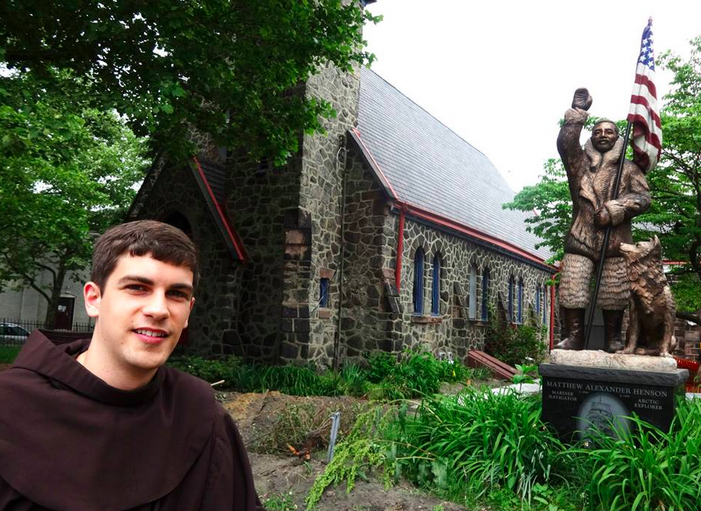
One of the bright spots of Camden: statue of the first man to the reach the North Pole.

Vacation is over and it’s on to the next thing: summer assignment in Camden, NJ. If the first 24 hours here are any indication of how the summer is going to go, it’s going to be a full summer.

I hit the ground running the moment I got here last night: after evening prayer, the four resident friars and I went out to dinner and an italian ice where, despite being in the next town over, we ran into two of the Franciscan Volunteer Ministers living near the church as well as a handful of parishioners. I spent the rest of the night unpacking my things and rearranging my room, and it was on to the next day.

Morning prayer started our day at 8:10 (a welcome change from 6:50 during the school year) followed by a scheduling meeting with Fr. Jud Weiksnar and a walk around the neighborhood. Besides coordinating a community garden across the street, St. Anthony’s is highly involved in the development and safety of the adjacent park. With the student leaders, the community has orchestrated the cleanup of the park, the painting of the benches and trashcans, and most recently, the addition of lights and the removal of a rundown tennis court for more green space, a process that we were thrilled to find had started today.

From there, it was off to Francis House, a ministry on campus for HIV-positive men and women in the area looking for a good meal and, more importantly, love and respect. People come to listen to music, play games, do puzzles, and to just talk many days of the week. Today, Fr. Jud and I went for a quick prayer and lunch, but I imagine that I will be spending a lot of time there this summer.

At that point, the day was just heating up (literally… hot day in the habit and no air-conditioning). Camden may not be the ideal destination for many people, nor is it the most beautiful city to look at, but trust me when I say that it is an interesting city with a lot of history. With Fr. Jud as my guide, we explored East, North, and South Camden, highlighting the good, the bad, and the ugly (and there was a lot of that). Camden is a highly depressed city with as much abandoned property as it has drugs and violence, and yet, amidst all of the stereotypical things one would expect to see in such a place, there are more than 100 community gardens, historic sites, and areas of recent revitalization, not to mention two universities and a growing hospital. One park in North Camden recently received a multi-million dollar grant to put up new fences, basketball courts, bathrooms, and great sitting areas, and honestly looks wonderful.

My fourth "sacred space" as a friar.

My fourth “sacred space” as a friar.

With so much to see, we had to cut the tour short to rush back to the church for a weekly Student Leaders planning meeting. Joining the FVMs, the friars and a few adults hold weekly meetings with 8th grade students to empower them in government and community planning. Today, the focus was on the July trip to D.C. to meet their representatives in Congress.

A little break in the day allowed Br. Juan and I to run out to Good Will for a quick shopping spree (4 t-shirts for less than $5!) and it was back to the friary for prayer and dinner with the FVMs. While friars are all very busy people, I respect these friars for putting a high priority on community prayer, praying six days a week at 8:10 and 5:15 without exception. Inviting the FVMs weekly is a great way to welcome lay volunteers into our lives and to evangelize in a comfortable setting: prayer and food.

But wait! There’s more! After dinner and clean up, Fr. Jud, Br. Juan, one of the FVMs and I went to a parishioner’s house for a bilingual rosary and fellowship. For me, even as someone without as great of a devotion to Mary and the rosary as other friars, it was a great experience: unlike most things at church, this gives us friars an opportunity to be invited into our parishioners lives and to served by them, a reversal of roles and a step out of our comfort zone into theirs.

All in all, I did very little but had a full day of exploring and experiencing. I’m sure tomorrow will be much of the same, and it will probably be a few weeks before I work myself into a comfortable routine. Until then, I’m remaining open to new experiences and new people, enjoying my time here in Camden.

Summer Plans

This about sums it up...

This about sums it up…

All papers and exams are finished, grades are in, and I’m outa here! It’s been a long and tiresome year (with a lot of fruit to show for it, I will add) and it’s on to the next thing. What is the next thing? It doesn’t matter as long as it isn’t school for three months!

Actually, the first all of the friars did immediately after finals were over was to go on a retreat. From Monday to Friday of last week, the seven temporary professed, two directors, and one visiting friar, enjoyed a relaxing and rejuvenating time at PriestField Pastoral Center in West Virginia. Among the least structured retreats I have been on since joining the friars, the purpose of the retreat was less about deep spiritual encounter or conversion, and more about fraternal time and simply processing all that went on in the year. While there was a lot of time for communal and personal prayer, guided reflections and personal quiet time, there was also a lot of time for talking, joking around, having fun, and just enjoying each other’s company. Prayer and quiet are great things, but there’s something to be said about setting up intentional time away from home to be with one’s community in a mostly-prayerful environment. Definitely a great way to end the year.

From there, we’re off to our summer assignments. While we’re not in school, friars are sent to one of our many ministries on the east coast to gain pastoral experience in real-life situations. The process of picking an assignment is very open, and follows a dialogical process: the director meets with the student friar to discuss the desires of the student with the possible openings, the two think and prayer about the best fit for the student, and once a decision has been made, the provincial council is asked to approve or deny an assignment. In almost every case this year each student was given his first choice. You can read about each of the assignments here.

My assignment is at St. Anthony of Padua Church and School in Camden, NJ. It is in a rough part of town (as if there is a nice part!) that is largely Spanish speaking. Those who know me well will note that no hablo Español, and those who know anything about a normally functioning human being will note that I’d prefer not to be shot. Just saying. In any event, despite the obvious drawbacks for the normally functioning human being (oh, and did I mention that the church doesn’t have air conditioning?) I have to admit that this was actually my first choice. Ever since I visited St. Anthony’s back in the postulant year I have been attracted to this community in the way that the friars work with the poorest and the most outcast people you can find (both immigrants and people from New Jersey), live as simply as anyone in our whole province, do incredible work in bringing a broken community together, wear their habits as much as I have seen (not that this is a high criteria, just something I prefer) and they have a dog (and no, this is not secretly the only reason I chose Camden… although I list it for a reason.)

I’m not entirely sure what I’ll be doing throughout the summer, but I know that I’ll be busy. The church has a community garden, a house for AIDS patients to come for food and the dignity of touch/friendship, an active youth leadership group that empowers students to take action in community government, and services to the poor, not to mention the regular activities such as bible study, faith sharing, and liturgies.

With all that said, the real reason I picked Camden was its ministry of presence. As odd as it sounds, I am looking forward to being in place where I have to struggle to communicate, where I will be with the less-than-popular people in a less-than-glamourous town living a simple, even dirty lifestyle. I am sure that there will be a lot for me to do, and I look forward to all of that, but what I am really looking forward to is simply being present to a people and place that has so much to teach me.

But before all of that, there is something much more important to be done: vacation! I’ve chosen to split my two weeks of vacation in two, taking one week starting tomorrow and one week in August before school, both of which will be in Raleigh, NC with my family. I’m not sure if I’ll find the time or inspiration to write while there, but check back throughout the summer for what I hope will be rich (and more frequent) reflections! Please keep me in your prayers!

We Are in Need of a Good Shepherd

This weekend I was in Raleigh, NC giving a reflection for Vocation’s Sunday and Franciscan Formation weekend as an attempt to raise interest in and support for the friars, the shepherds of so many. I ask that you take these petitions seriously, that you may follow Jesus more closely and in return, share with others what Jesus has given you.

Without a shepherd, the sheep are lost.

Without a shepherd, the sheep are lost.

Sheep are interesting creatures. Born without horns, claws, strength, speed, or really any way of defending themselves, the only thing sheep have is each other: when frightened, they clump together as a giant flock protecting each other through a strength-in-numbers technique. Their instinct to look to one another for safety is the very thing that keeps them safe; unfortunately, and quite ironically, it’s also their greatest danger. Sheep are natural followers, having no instinct whatsoever to lead. When clumped together, any movement from the heard is interpreted as a sign of leadership and the rest blindly follow along. It’s no wonder, then, how sheep have been known as entire flocks to walk right off a cliff.  In turkey a few years back, 1500 sheep ran right off a cliff, one after another. How could an animal be so stupid, we wonder. They act without thinking, are often lost or confused, and go with the crowd because they’re afraid to be different.

You wouldn’t happen to know of any other animals like this, would you? I wonder… Have you ever intended to do one thing and ended up doing another; got distracted with what you were doing, went with the crowd, and ended up somewhere you never wanted to be; have you ever been tempted to do things that were not good for yourself or others, led astray by something or someone that didn’t care about you? We can be just like the sheep sometimes, can’t we, wandering through life looking for help in all the wrong places.

We are a people in need of a Good Shepherd, someone to guide us and protect us.

Luckily, we have one: his name is Jesus, and he has risen from the dead, alleluia! He is the Good Shepherd because he knows his sheep and cares for them. He loves his sheep so much that he gave up his place in heaven to come down and be a sheep himself. He has walked the life we walk, suffered the pain that we suffer. He took on everything about us but our sin. Jesus Did this because he loves us; because he loves you. He cares about you. He wants to know you. Jesus is the perfect Good shepherd because he is at the same time shepherd and sheep, God and human, because he was willing to lay down his life for the flock. His life, death, and resurrection remind us of the great love he has for us as his flock.

We are in need of a Good Shepherd, and we have a Good Shepherd.

If we follow Jesus, we will never be weak for he is our strength; we will never be lost for he is our guide; we will never be alone for he is our great love! With Jesus as our Shepherd, there is nothing we shall want. He guides us where we need to go and gives us everything we would ever want. We have no need to fear because we know he is with us by our side. If you think about it, our cups our truly overflowing with his many blessings. How can we even begin to count the many ways he has loved us?

We are in need of a Good Shepherd and nothing more.

Where do we find Jesus? In our brothers and sisters. In this community of faith. Jesus may be the Good Shepherd, but we are his hands and feet. From him, through us, and to the whole world Jesus loves his sheep. It is through you and me, the humble and lowly, the lost and confused, that Jesus brings strength, guidance, and love to the whole world. Because of this,

We are in need of good shepherds, people to do Christ’s work.

Some people, like myself, have been called to religious life, and one day to become a priest. God has called me to lay down my life for his sheep, to give up my own life for the sake of others. What does this mean? I think pope Francis has it exactly right: at the end of the day, a good shepherd smells like the sheep. This is what I want. This is what Franciscans do. We are called to live a radical life with the poor, for the poor, as the poor. When we enter, sure, we give up our money and possessions. But it’s much more than that: when we accept Jesus as all that we need, vowing to live a life for him and for others, we are truly without worry. What could there possibly be to worry about? Seriously. Advancement in our careers? People won’t like us? Wouldn’t have enough money to buy the latest clothes or get the coolest technology? In this life, all that I ever have to worry about is how I’m going to love God’s people for him. That’s it. It’s a remarkable life being a shepherd in this way.

We are in need of a good shepherds to devote themselves entirely to the Church as priests, brothers and sisters.

Others, no less important, are needed as shepherds in other ways. Where would we be without teachers that take care of our leaders of tomorrow; police officers that keep us safe and together; public servants that lead us to where we need to go as a society. As the laity, each of you is called to a special vocation, to be a shepherd in a way that we friars simply cannot be: you are called to evangelize people outside of the Church with your lives. Since you live and work in the world, you interact with people of all faiths and backgrounds, people that do not know or believe in Jesus, people that would otherwise never enter these walls to hear us preach, to be guided in faith or by the Church. Everything you do is a form of evangelization. This is a vocation truly your own.

We are in need of good shepherds to live by example, evangelizing everyone they meet with love.

And lastly, how can we forget the greatest group of shepherds we know: mothers. Mothers are the shepherds of the family, the ones that guide us from the time that we are very little and keep us safe. Without mothers, I’m fairly sure that by the age of five we would have all been like the sheep wandering straight off a mountain. If you want to talk about a person that lays down their life and smells like the ones they serve, there’s no better example than mothers. [I actually have the interesting, and frankly terrifying, opportunity today in that my mother is actually here. So, whether she wants the attention or not, I have to say that] My mother has meant the world to me. She has worked hard to give me everything I have and supported me in everything I have done, including becoming a friar. Before I had even considered it, one of our friars said to me: You’d make a great friar. I laughed at him. I thought it was a great joke and so I told my mom that night. Can you believe what father said to me today? Her response: you would make a good friar. If that’s what God is calling you to do, I would definitely support you in that. Trust me when I say that that was not the answer I wanted to hear… but it was the answer I needed to hear. My mother’s support helped me in my vocation.

We are in need of good shepherds that will raise good families and encourage their children like my mother has.

So I leave with you a threefold petition:

The first is easiest but most significant. Please pray for more good shepherds in our world. Make it a daily practice to pray for vocations to the friars, to communities of sisters, and to the diocese. Pray for good men and woman to take leadership in the church, society, and in their homes, to live lives worthy of following. And pray for the people who have already chosen to be shepherds that they may have strength and be guided by the Holy Spirit. If we are a people that believes in the power of prayer, I beg of you that you take this petition seriously.

The second petition is that you support our way of life with a monetary donation. The friars have many men who dedicated their entire lives to the Church, giving up everything they had for the sake of others, and are now growing old and infirm, no longer able work. On the other side, we have 17 men like myself training to be the shepherds of tomorrow. So that we can be the shepherds that the world needs and deserves, we need your help paying for the six years of school and character formation each of us goes through.

Lastly, I ask that you consider being a shepherd yourself. Maybe God is calling you to lay down your life for others, either in society or in building a family. These are incredible vocations we desperately need. On the other hand, we can’t ignore the face that there is a tremendous shortage of able men and women running the Church today. Which makes me wonder: is God calling fewer people today than he did before, or are fewer people willing to answer that call. Maybe, just maybe, God is calling you to live a radical life with the poor, for the poor, as the poor. Why not you?? Mothers, the shepherds of our families, why not your son or daughter? Have you ever encouraged your son or daughter to a life in the Church, to become a friar, sister, priest? Why not? I know that I would have never even considered it had it not been for the support of my mother, and trust me when I say, I couldn’t be happier.

We are truly a people in need of a Good Shepherd and we have one. Jesus is there to be our strength, our guidance, and our love. All we need to do is follow him, and to share what he gives us with others. And so I ask you: how has Jesus called you to be a shepherd today?

If you would like to learn more about partnering with us in mission in any of the ways mentioned above, please visit the province’s development website here.

Renewal of Vows

I profess to live in poverty, chastity and obedience for the period of one year.

I profess to live in poverty, chastity and obedience for the period of one year.

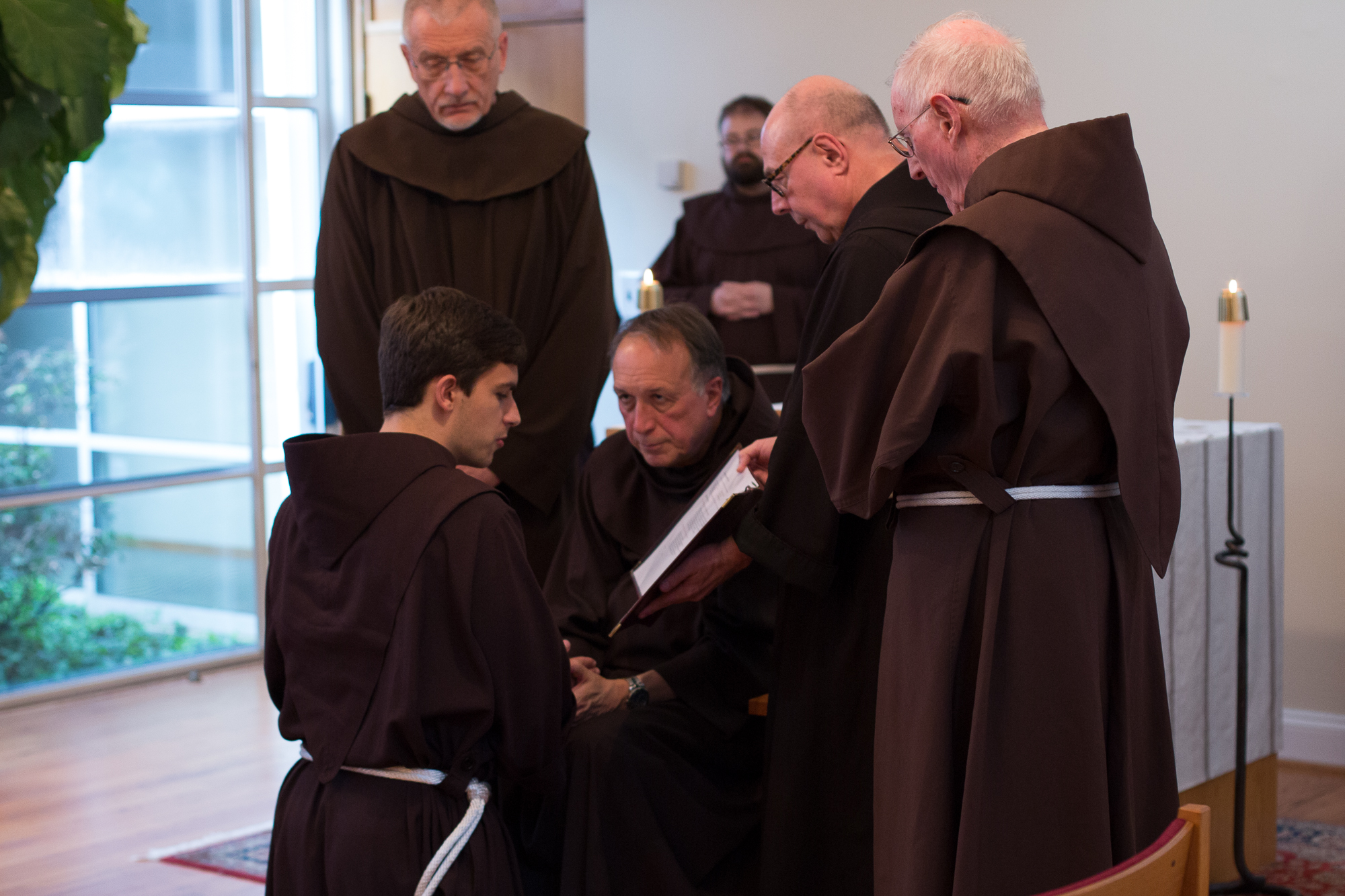
Like the process of dating, engagement and marriage, the process of becoming a fully-professed member of a religious order takes on many stages. Last August, I professed for the first time my vow to live in poverty, chastity, and obedience in the way of St. Francis of Assisi. In a way, these vows were a test: I was testing the life to see if it was truly where I was called.

And wouldn’t you know it? Time’s up on that first year. In the Church’s great wisdom, however, the time has not come for me to make my lifetime commitment: for the next three years, all I have to do is profess vows for a period of one year as I continue to discern my place in the Order of Friars Minor.

In other words, it’s like a lease to an apartment: I either have to resign the contract or move out. For now, as is fairly obvious from the picture, I have discerned that this life if for me and will continue for another year. Last evening, kneeling before our Vicar Provincial (essentially the Vice President), I spoke these words once more:

To the Praise and Glory of the Most Holy Trinity, I, Brother Casey Cole, since the Lord inspired me to follow more closely the Gospel and the footprints of Our Lord Jesus Christ, before the Brothers here present and in your hands, Brother Dominic, with firm faith and will, vow to God, the Holy and Almighty Father, to live for the period of one year in obedience, without anything of my own and in chastity, and, at the same time, I profess the life and Rule of the Friars Minor, confirmed by Pope Honorius III, and promise to observe it faithfully in accordance with the Constitutions of the Order of Friars Minor. Therefore, I give myself to this fraternity with all my heart so that, through the efficacious action of the Holy Spirit, guided by the example of Mary Immaculate, through the intercession of our Father St. Francis and of all the Saints and supported by your fraternal help, I can constantly strive for perfect charity in the service of God, of the Church and of mankind.

This I promise.

603A4757It was a quick and simply ceremony within the context of Evening Prayer, but was the result of careful discernment and conscious action. Each year we must step back, look at our lives, and ask ourselves with great conviction: “Where has God called me to be?” For the next year, I believe that God is calling me to continue in the way of St. Francis in the Order of Friars Minor, taking one step closer to formally committing myself to God and his Church.